
The FT reports the Irish bailout package will total €80bn-€90bn, which is about 60 percent of the country’s $200 BN annual GDP. Massive! The FT writes,
The bail-out is expected to total €80bn-€90bn and will include contributions from the UK and Sweden, according to people briefed on the discussions. But the deal may not be concluded until the end of November because the parties are still negotiating the conditions attached to the aid.
To illustrate the Irish bailout, imagine this scenario: A shaky U.S. banking system with total assets well in excess of 200% of GDP, coupled with deteriorating sovereign credit fundamentals as the government was forced to backstop the entire banking system during the financial panic. Depositors, concerned about the credibility of the sovereign to honor deposit insurance and other explicit or implicit financial guarantees — not mention Treasury securities held by banks — begin to flee. As the run on deposits picks up, banks are forced to turn to the Fed for liquidity or face collapse. The government is unable to stabilize the banking system with a TARP II, for example, because the capital injections are also perceived to be impaired. The U.S. is forced to turn to an outside entity, such as the IMF, to secure funds to recapitalize the banking sector in an attempt to stabilize the deposit base. Imagine the political outrage, especially if the IMF doesn’t allow an extension of the Bush tax cuts!
This is exactly the case with Ireland. Some of the rescue package will be used to recapitalize the banks with the hope of stabilizing deposits and some for fiscal adjustment. The reported amounts vary, but Irish banks have been drawing large sums of liquidity from the ECB, which has stated that it can no longer continue. The result is the Eurozone equivalent of TARP via the Irish government. Relative to Ireland’s GDP, this is a big package – the U.S. equivalent would be $8.8 trillion.
It will be interesting to see if just the announcement of the deal is enough to stabilize deposits and how much of the bailout will actually be drawn.
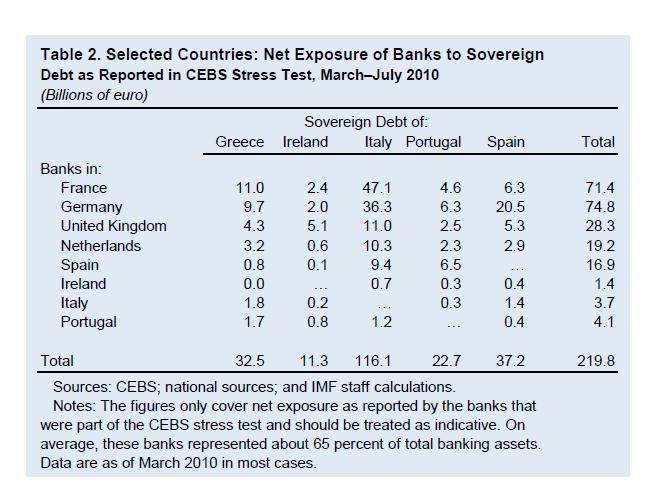
The IMF chart below shows that Ireland’s underlying economic fundamentals are superior to many European countries. This is not about fiscal imbalances, lack of competitiveness, or fat pensions for 52-year old retirees. Ireland’s problem, like much of Europe, is over banked, and experienced a massive housing bubble. The assets of just the Bank of Ireland and Allied Irish Banks, for example, are around 200 percent of GDP. If the country can somehow find a way to restructure and fix the banks, it will be on a much quicker road to recovery than the rest of the European periphery. Godspeed Ireland!



 Global Macro Monitor