
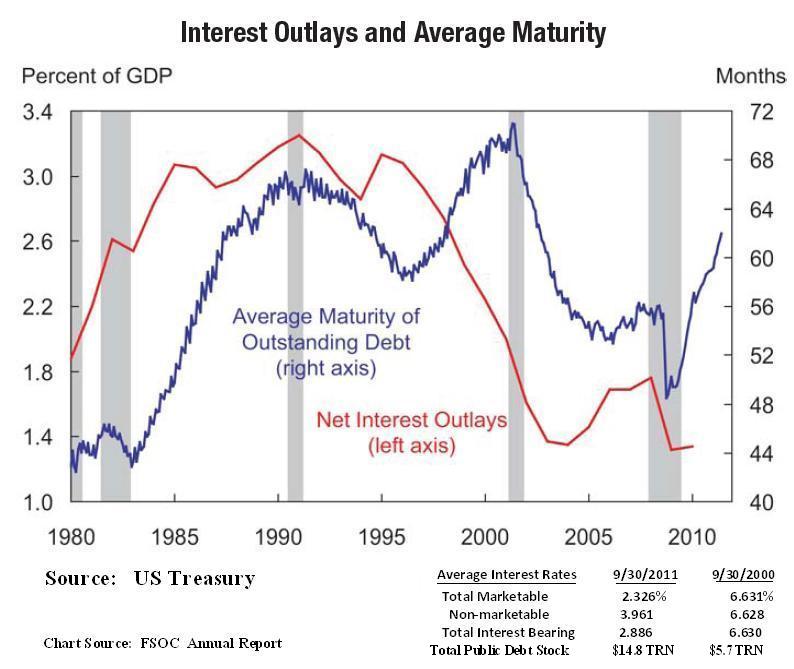
Here is one chart that may be used in our grandchildren’s economic and political history classes. The current debt service burden on the national debt (as % of GDP) is as low as it has been in last thirty years. As one Latin American finance minister used to say, “debt and deficits without tears.”
The chart may surprise many given the huge run up in the U.S. federal debt over the past 10 years. The data show that the total public debt stock has increased from $5.7 trillion on September 30, 2000 to $14.8 trillion on September 30, 2011.
The net interest cost to service the debt, however, has fallen as a percent of GDP due to the sharp drop in the average interest rate paid on the debt, which fell from 6.63% in 2000 to 2.886% on September 30, 2011. Growth also contributed to the drop and as a rule of thumb if the average interest rate is below the nominal growth rate, the ratio falls.
The danger of massive borrowing at record low interest rates is that it makes the borrower extremely vulnerable to an increase in rates. This was the case of the housing bubble. This is the case of Greece. Furthermore, debt and leverage is rewarded in a declining interest rate environment and punished as rates increase. A repeat of the 30-year secular decline in interest rates is not likely.
Rising interest rates can also reduce market confidence in a heavily indebted borrower’s ability to service its debt, which in turn reduces market access and increases the rollover risk of maturing debt. Pay it down, default, bailout, or, in the case of a country with an autonomous central bank, hyperinflationary monetization of maturing debt becomes the only options.
What puts the “acute” in an acute sovereign debt crisis is the inability to roll over maturing debt. No doubt Secretary Geithner understands this and, as the chart illustrates, is trying to extend the average maturity of the public debt.
Borrowing at low interest rates also raises several questions. What will happen to the U.S. budget deficit if the economy picks up and interest rates return to normal? Will the increase in cyclical tax revenues be offset and by increased interest payments on the national debt? What are the political implications as debt service crowds out expenditures in the rest of the budget? Did the Fed enable the borrowing binge by its zero interest rate policy?
Borrowing at low interest rates is the like the analogy of the two frogs in a pot of boiling water. One is dropped into a pot of boiling of water, feels the pain, and immediately jumps out. The other is put into pot of cold water and as the heat is turned up enjoys itself in the Jacuzzi while boiling to death. High interest rates are penal, low rates are not, until they begin to increase.
Greece borrowed most of its bond denominated public debt at an average interest rate of around 5.0 percent. That was some Jacuzzi.
P.S. If you think the U.S. is vulnerable to an interest rate shock, take a look at Japan. Yikes!
 (click here if chart is not observable)

 Global Macro Monitor
Reforming our tax code just might help with the federal deficit but according to Geithner, we just “don’t have the time” http://bit.ly/nD76EU
Pingback: NY Times: Greek government’s $38000 bills for office curtains | The Peter Principle
Pingback: Wednesday links: sentiment and confidence | Abnormal Returns
The chart is no surprise given the fact that interest rates are determined in large part by the Fed. The author’s inability to distinguish between Greece which is a currency user and the US which is a currency issuer is unfortunate.
Seth2077, We think it’s unfortunate you don’t know your history. Your arguments sound a little like Countrywide before the collapse of housing. Why didn’t the Fed just move rates down in the 1990’s to get the interest bill down? Fortunately, Greece can’t print money to monetize its debt and in up in a hyperinflationary spiral. Touché
Pingback: U.S. Public Debt: Going Greek | The Big Picture