
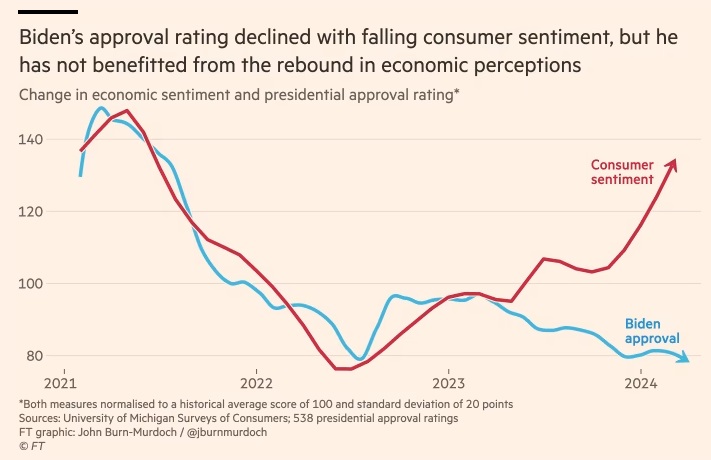
The diverging relationship between economic performance and political success in the U.S. highlights a shift from the past, where a strong economy positively impacted incumbent approval ratings. President Biden’s approval ratings remain unaffected despite recent economic improvements, suggesting a decoupling of economic sentiment and political fortunes. This phenomenon, which contrasts with stable economic-political linkages in Europe, is attributed to the U.S.’s heightened partisan divide, where political allegiance increasingly dictates economic perception, challenging the traditional belief that “It’s the economy, stupid” in American politics.
Key Points:
- President Clinton’s political advisor, James Carville, highlighted the economy’s role in political success during 1992 presidential campaign with assertion, “It’s the economy, stupid.”
- Voter sentiment has traditionally linked to economic performance, affecting incumbent party success.
- Recent trends show a disconnect between the U.S. economy’s health and President Biden’s approval ratings.
- The COVID-19 pandemic and inflation crisis may have influenced this anomaly, yet the shift predates these events.
- Research indicates a decoupling of economic sentiment and presidential approval in the U.S. since Obama’s tenure.
- This phenomenon seems unique to the U.S., with European governments’ popularity still tied to economic conditions.
- U.S. political polarization may explain the decoupling, with partisan views influencing economic perceptions.
- Studies suggest that political biases skew individual economic assessments (confirmation bias) impacting presidential approval.
- The current U.S. political climate suggests economic policy impact on electoral decisions is diminishing.
- Contrasts with Europe, where economic sentiment is more uniform across political lines, suggesting a more rational political-economic relationship.
Source: Financial Times

 Global Macro Monitor