
Great piece in the Washington Post today about trendy baby names.
Wattenberg has a theory…she calls her “grand theory” of baby names… In the olden days, Americans shared a monoculture dominated by three broadcast TV networks, no internet and no annual SSA name rankings. Hence the frequent reliance on family tradition when a bouncing baby arrived.
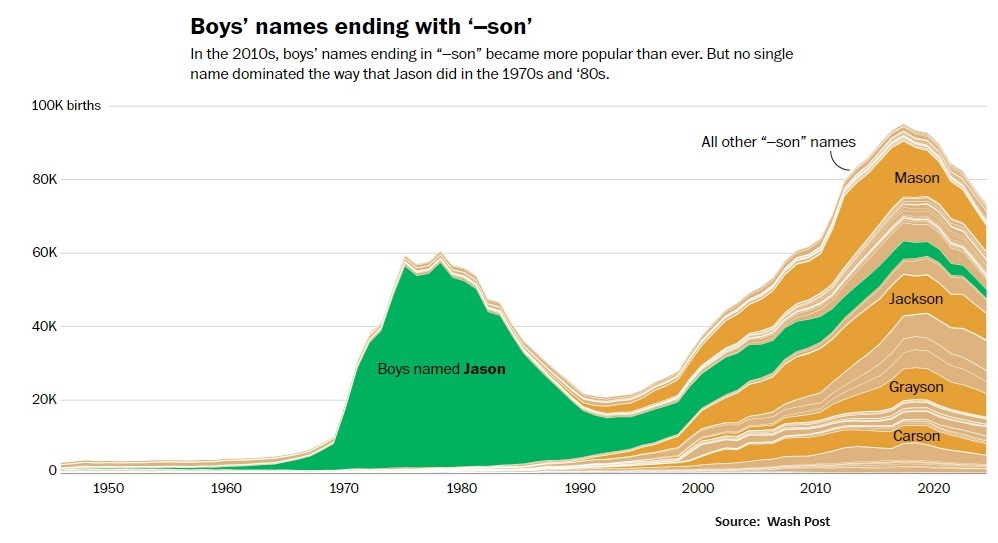
Nowadays, she said, people not only have access to unlimited cable channels and the internet, but those innovations have helped usher in a “username creation” mentality — meaning that if someone else has the same name, it’s viewed as taken. So parents tend to tweak their baby’s name just a bit — keeping the “-son,” for example, while swapping the “Ja-” for “Car-.”
Wattenberg finds “an incredible irony” in this. People think they’re choosing something totally unique, but they do it in a way that winds up moving with the zeitgeist. As a result, names have a , with nearly half of all baby names now following identifiable suffix trends — a phenomenon Wattenberg calls “lockstep individualism.” – Washington Post
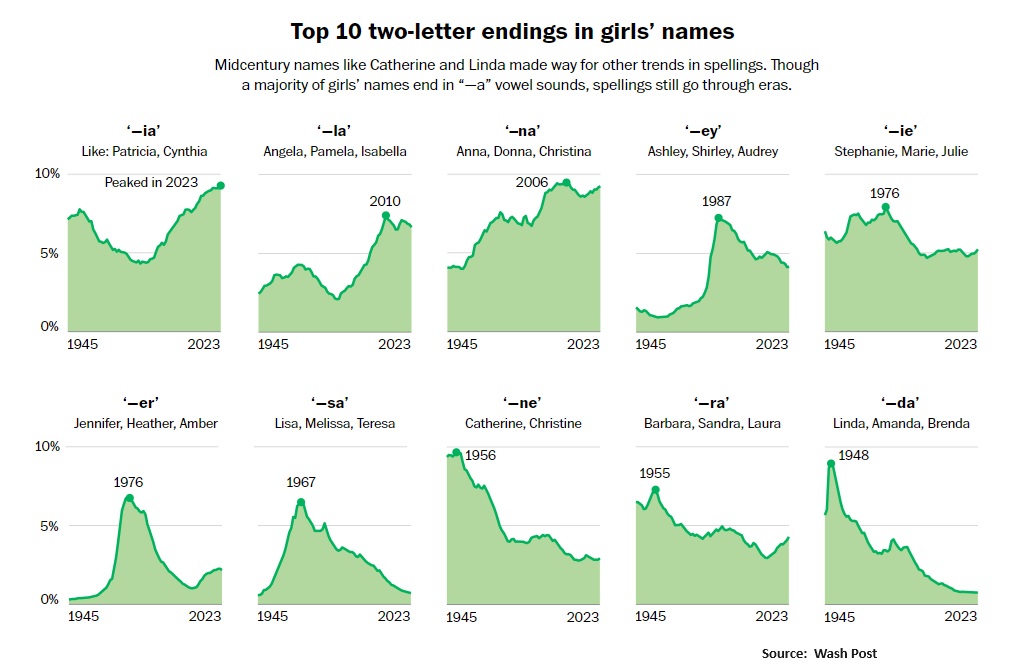
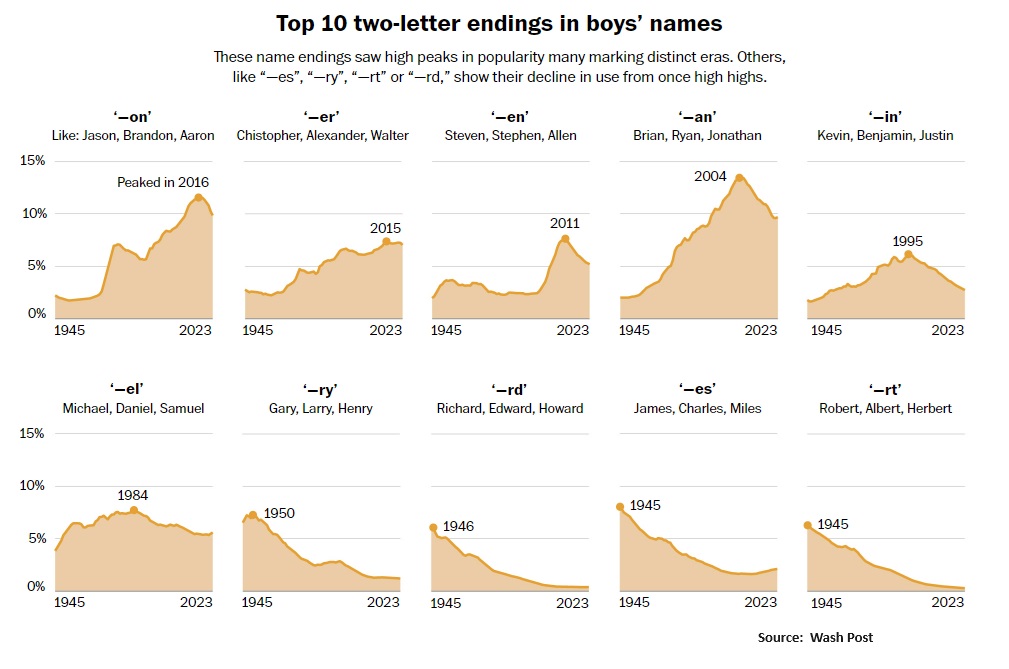
Baby names often encapsulate the trends and cultural shifts of their times, with different spellings and endings marking distinct generational identities. A detailed analysis of American baby names from 1945 to 2023 highlights these shifts, showcasing how names evolve from traditional to unique and trendy variations.
Key Points:
- Generational Markers: Names ending in ‘-ly’, ‘-ley’, and ‘-leigh’ indicate generational trends, with ‘ly’ popular among Gen X and ‘leigh’ rising in the 2010s.
- Peak Popularity: ‘Ly’ endings peaked in 1970, ‘ley’ in 1987, and ‘leigh’ in 2019.
- Cultural Shifts: Traditional family names have been largely replaced by more unique names that still conform to unspoken social norms.
- The Role of Sounds: As naming traditions faded, the sounds and aesthetics of names took precedence, influencing name choices.
- Data Analysis: The Social Security Administration’s data reveals broad trends in name endings, despite challenges in categorization.
- Changing Trends: The popularity of names like ‘Jason’ in the 1970s has given way to a variety of names sharing similar suffixes like ‘son’ (Mason, Jackson, Carson).
- Lockstep Individualism: Despite striving for uniqueness, many modern names conform to popular endings, demonstrating a blend of individuality and conformity.
- Influence of Media: The rise of internet and media has shifted naming conventions, moving away from family traditions to more unique and personalized choices.
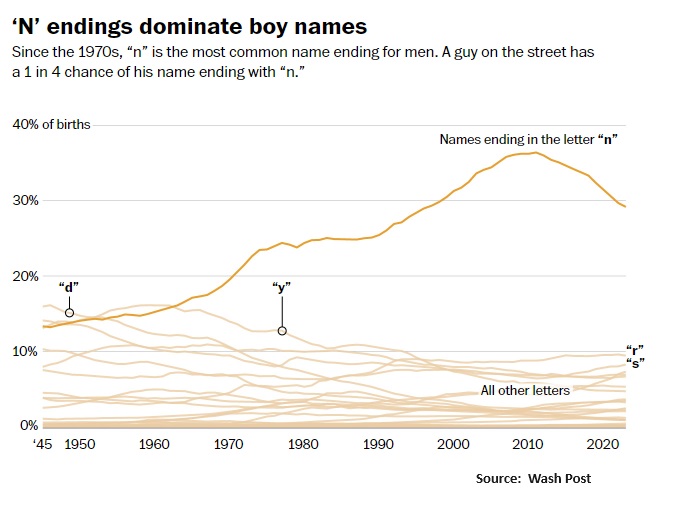
- Impact of Trends: The data reveals that modern names increasingly share common endings, reflecting broader societal trends.
- Personal Story: The article also narrates a personal journey of choosing a name for a newborn, reflecting the delicate balance between uniqueness and fitting in.
This analysis not only shows how names can reflect broader cultural trends but also illustrates the personal and societal factors that influence these choices over decades.



 Global Macro Monitor