
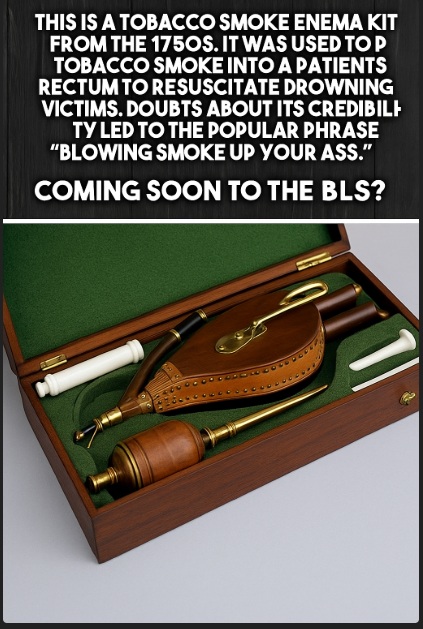
Historical Origin of the Idiom (Literal Roots)
- Tobacco smoke enemas (literal usage): In the 18th century, medical practitioners in Europe, particularly England, used tobacco smoke enemas as a resuscitation method. They believed administering tobacco smoke via the rectum could stimulate the heart and warm the body, particularly for drowning victims.
- Richard Mead (around 1745) was among the earliest Western physicians to recommend this method for reviving drowning victims.
- By 1774, London’s doctors William Hawes and Thomas Cogan established an institution (later the Royal Humane Society) to resuscitate drowning victims — equipping riverbanks with apparatus for tobacco smoke enemas, functioning much like early defibrillators.
- The practice eventually fell out of favor after around 1811 when researchers discovered nicotine’s toxicity, which exposed the dangers of such procedures.
- Transition to figurative usage: The literal practice may have sown the seed for the idiom, but its leap into slang (meaning insincere flattery) didn’t emerge until much later, around the mid-20th century.
Cultural & Linguistic Context
- Evolutions of slang:
- The simpler phrase “blow smoke” had already been used since at least the 1940s to mean exaggerate, boast, or deceive.
- The fuller phrase “blow smoke up someone’s ass” or “butt” emerged as an intensified, more visceral version—likely for rhetorical punch rather than direct reference to medical history.
- Cultural flavor:
- The coarse addition “up someone’s ass” sharpens the phrase’s impact; it turns ordinary deception into a vivid image of absurd, over-the-top flattery.
- Though the literal medical practice was largely forgotten, its grotesque, memorably bizarre nature probably lingered in cultural memory making the idiom feel especially abrasive or brutally humorous.

 Global Macro Monitor
And the GOP yawns, as they will be in position to profit from a manipulated market.