Next week’s solar eclipse has sparked speculation among some in the extremes of the evangelical community, suggesting it may herald the second coming of Christ. The eclipse, set for April 8, 2024, will be visible across much of North America.
One image driving these predictions shows southern Illinois as the point where the paths of the upcoming eclipse and the 2017 North American solar eclipse intersect. Theological prognosticators maintain that these eclipses, seven years apart – a number that symbolizes biblical completeness and perfection – and their intersecting paths form a cross; ergo, the second coming is nigh. This notion sounds a bit like financial market technical analysis, doesn’t it?

The human quest to predict the future by observing the stars is an age-old practice. This includes stock market astrologers who use celestial patterns to forecast market trends.

Hail Caesar, Hale-Bop
In ancient Rome, for example, following Julius Caesar’s assassination in 44 B.C.E., a comet that appeared and remained visible even in daylight for about a week was considered a significant omen. Roman historians Pliny the Elder (also notable for lending his name to an esteemed beer, though some in the craft beer cult prefer Pliny the Younger) and Suetonius documented this event.
The Heaven’s Gate cult serves as a distressing example of how conflating religious beliefs with looking for signs in the heavens can lead to tragedy. Followers were convinced that a spacecraft concealed in the comet Hale-Bopp, visible in 1997, would elevate them to an advanced state of consciousness. Driven by this belief, 39 followers of Heaven’s Gate ended their lives in a collective suicide.
Useful Delusions
Humans struggle with the concept of uncertainty, often seeking solace in dogma and predictions by market gurus, religious figures, or those who assertively speak of the future. The reality, however, is that the future remains unknown, and we all harbor our own “useful delusions” to cope with the unpredictability of life and markets.

We based most of the above on this article.
President Biden has fully recovered from the downturn in his election prospects, as observed in the prediction markets after the Special Counsel described him as a “sympathetic, well-meaning, elderly man with a poor memory.”
The rebound coincides with the recent poll in Pennsylvania giving him a 10-point lead over the former president,
The good news for President Joe Biden comes in the form of a two-horse race against former President Donald Trump. After landing within the margin of error against the 45th president in February, the 46th president has more than doubled the 4.0% margin of error (MOE) in this survey with a 48-38% percent advantage. An additional 13% favored “someone else,” while just 1% indicated that they did not know. – PoliticsPA
However, when third-party candidates are considered, Biden’s lead narrows to within the margin of error.
We have no doubt the former president will try to conflate today’s market volatility, which we expect to continue, with Biden’s rising poll numbers – “the market is tanking because it’s anticipating a Biden victory in November” – for example.
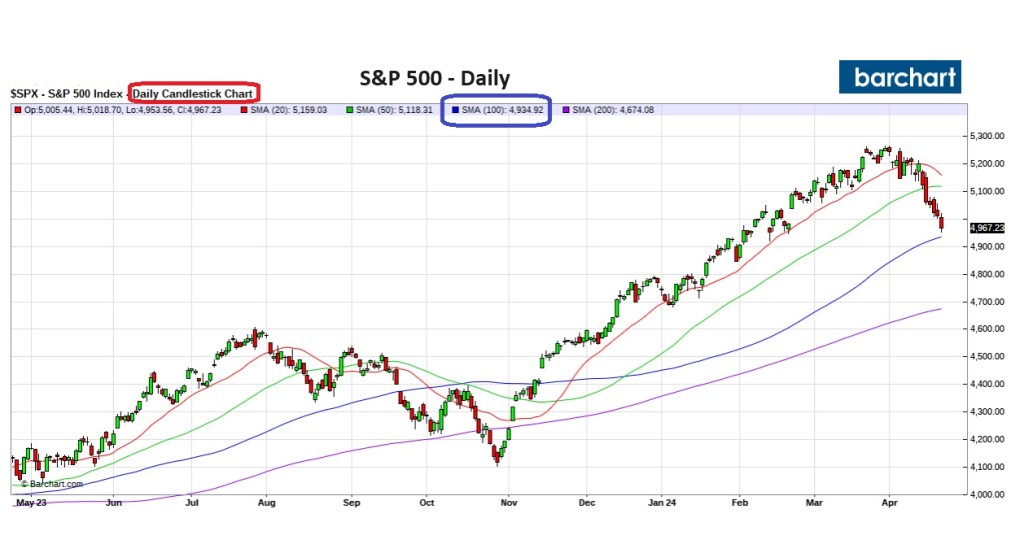
We also expect geopolitical events to continue to heat up, as the markets began to price in today.
Rising gas prices are political death, so look for the shenanigans by the bad actors in foreign lands who would like to see Trump win to continue.
Gold Price
In our March 9th post, What’s Up With the Gold Price?, we dismissed the notion the rise in the gold price could be solely attributed to expected Fed rate cuts and offered up the following,
Nobody knows for sure, but our best guess is it’s a safe haven play with expected domestic and geopolitical instability to increase as the year progresses. Stay frosty, folks.
Today, the market woke up.


In my early teens, I befriended a Cy Young Award-winning pitcher from the Dodgers who eschewed the celebrity culture of autograph signing. He would often advise young fans to seek autographs from their teachers instead, arguing that educators play a more pivotal role in their lives than sports figures. He wasn’t very popular because of that stance, but his perspective was profoundly insightful.
The question arises: who holds greater significance in our society, a teacher who instructs first-graders in reading or a social media influencer? Educators, especially those teaching fundamental skills like reading, contribute extensively to society beyond the immediate impact on each student. They provide numerous positive externalities that enhance our communal life. The value of a well-educated population is a public good, an essential element for the foundation of a functional society.
The Economic Policy Institute, a left-leaning think tank, calls this difference the “teacher pay penalty.” EPI calculated that, in 2022, teachers earned only 74 cents on the dollar compared with comparably educated professionals. The right-leaning Hoover Institution reached a similar conclusion in its 2020 report on educator compensation, showing that, even adjusting for factors such as talent and experience, “teachers are paid 22 percent less than they would be if they were in jobs in the U.S. economy outside of teaching.” – Washington Post

This is a must-view, folks.
One of the most important Collective Illusions we’ve ever discovered has to do with the way that people define a successful life. It turns out the vast majority of the American public believes that most people in the country care about wealth, status, and power when, in fact, the opposite is true. The vast majority of the American public is focused on a more personal fulfillment orientation but our kids are paying an incredible price because they do not understand that this is an illusion. They try to chase fame because they believe that’s what other people will recognize as success.
Here’s a blast from the past!
It seems nobody knows for sure the true origins of why we do the things we do on April Fools’ Day. We’re commoners so we’ll go with the commonly held view that the April 1st informal holiday has its origin in the change from the Julian to the Gregorian calendar in 1582.
Here is some great history from HubPages and a BBC report (see video) voted as the greatest April Fools prank/joke of all-time! Spaghetti grown on trees? Yummy!
April Fools’ Day, aka All Fools’ Day, is observed in many countries throughout the world on April 1 as a day of practical jokes, harmless pranks, hoaxes and just all around tomfoolery. However its origin remains a mystery.
Traditionally the most common theory is it originated in the 1500s when parts of Europe, particularly France, began using the Gregorian calendar in 1582 by edit of Pope Gregory XIII to replace the long-established Julian calendar. The Julian calendar observed New Year’s Day on or around April 1 which coincided with the vernal equinox which signifies the beginning of spring. The Gregorian calendar which is still in use today designated January 1 to be New Year’s Day. As the new calendar began to be adopted throughout Europe many of the populace, particularly rural peasants, refused to accept the new date, or did not learn about it, and continued to celebrate New Year’s Day on April 1. These traditionalist holdouts began to be mocked as fools and were taunted by pranks such as sending them on “fool’s errands” or trying to trick them into believing something false.
The problem with this theory is there are records of April Fools’ being practiced prior to that period of time though the records are quite ambiguous to truly pinpoint an origin. Many of the ancient cultures had springtime festivals to celebrate the end of winter and the return of spring. These festivals were called “renewal festivals” by anthropologists. Though these festivals had different references with many of them based on mythology and not all of them were in the springtime they all were celebrations of merriment and frivolities. There is no true connection between these festivals and April Fools’ though April Fools’ Day may have been derived from these festivals.
Ancient festivals with possible correlations to April Fools’ Day
The Romans had two festivals similar to April Fools’ in custom. The festival of Hilaria held in late March near the time of April Fools Day was to celebrate the resurrection of Attis, son of the Great Mother Cybele. This festival was renowned by its donning of disguises and high-spirited merrymaking. The Roman winter festival of Saturnalia observed at the end of December later transformed into a January 1 New Year’s Day celebration had similar playful indulgences.Later in medieval times other similar festivals evolved. The northern Europeans observed an ancient springtime festival to honor Lud, a Celtic god of humor. This festival obviously was dedicated to humor and whimsical antics. Another renowned medieval festival known as Festus Fatuorum (Feast of Fools) was the successor to the Roman Saturnalia. It was regularly celebrated by the clergy and laity from the fifth century until the sixteenth century. On this day celebrants elected a Lord of Misrule and parodied church rituals, often in extremely blasphemous ways. The Church condemned the custom, but had little luck eradicating it despite frequent decrees forbidding it.
All these various festivals have similar traits with April Fools’ Day and could very well have contributed to its origin. A few of the countries participating in the April Fools’ Day celebration claim the rights of origin and have their own unique rituals.
In France, they claim origin based upon the calendar change made in 1582 as discussed earlier. They believe the custom originated when King Charles IX proclaimed the Gregorian calendar to be the official calendar of France which brought about the contagion surrounding April 1 which was no longer New Year’s Day. It soon became April Fools Day according to their theory, despite the flaws in the concept. As the custom evolved the day became known as Poisson d’‘Avril (literally translated “April’s fish”). This allegedly came about as a result of the abundance of fish found in the French streams and rivers during early April when the young fish had just hatched. Legend has it these young fish were easy to fool with a hook and lure. It soon became customary to fool people on April 1, as a way of celebrating the abundance of foolish fish. Part of the tradition is the practice of trying to attach a paper fish to the victim’s back without being noticed.
In Great Britain, the folklore links April Fool’s Day to Gotham, the legendary town of fools located in Nottinghamshire. The inhabitants of this town staged a ruse of having the appearance that everyone in the town was a lunatic to fool the king. April Fool’s Day was then established to commemorate their trickery. Great Britain along with their former colonies, unlike the rest of the world, celebrates April Fool’s Day only till noon. Any tricks or jokes perpetrated after that time, the perpetrator will be taunted the “April Fool”.
A scholar from Boston proposes a theory
Finally in 1983 Joseph Boskin, a professor of history at Boston University, derived a story explaining the origin of April Fool’s Day. The story contends the practice began during the reign of Constantine when a group of court jesters and fools told the Roman emperor that they could do a better job of running the empire. Amused by the notion, Constantine allowed a jester named Kugel to be king for one day. During his 24 hour reign Kugel passed an edict calling for absurdity on that day and the custom became an annual event. This story was generally accepted and published in many newspapers released by the Associated Press. There was only one flaw in the story. Boskin had made the story up. It took a couple of weeks for the Associated Press to realize they had been duped by an April Fools’ joke themselves.The Best April Fools media hoax of all time
One of the greatest media-generated hoaxes of all time was perpetrated on April 1, 1957 from a news report by Richard Dimbleby which aired on BBC British Television’s news program Panorama. The report gave an account that Switzerland was experiencing a bumper spaghetti harvest that year thanks to favorable weather conditions and the elimination of the dreaded “spaghetti weevil“. The report was so convincing with the staged video footage of happy peasants plucking strands of pasta from the trees that more than 250 viewers jammed the BBC switchboard wanting more information on the spaghetti harvest. These were serious inquiries ranging from wanting to know where to buy spaghetti plants and where to go to watch the harvest.
(click here if video is not observable)
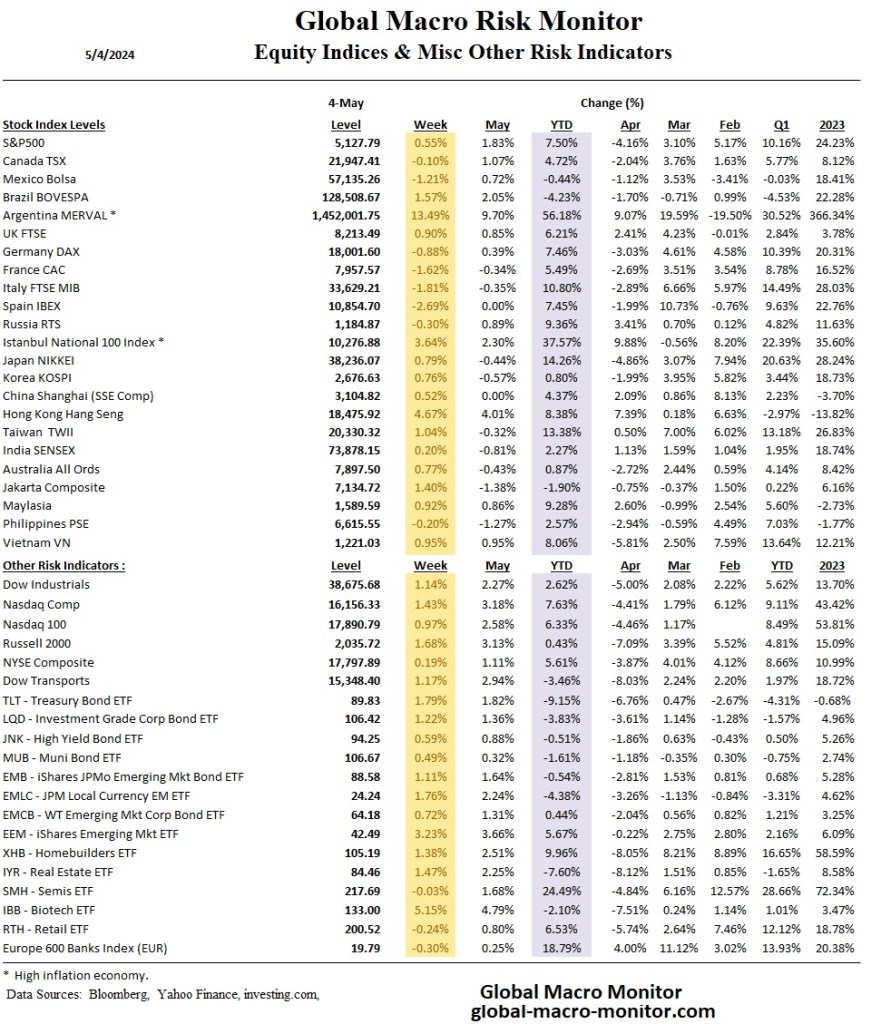
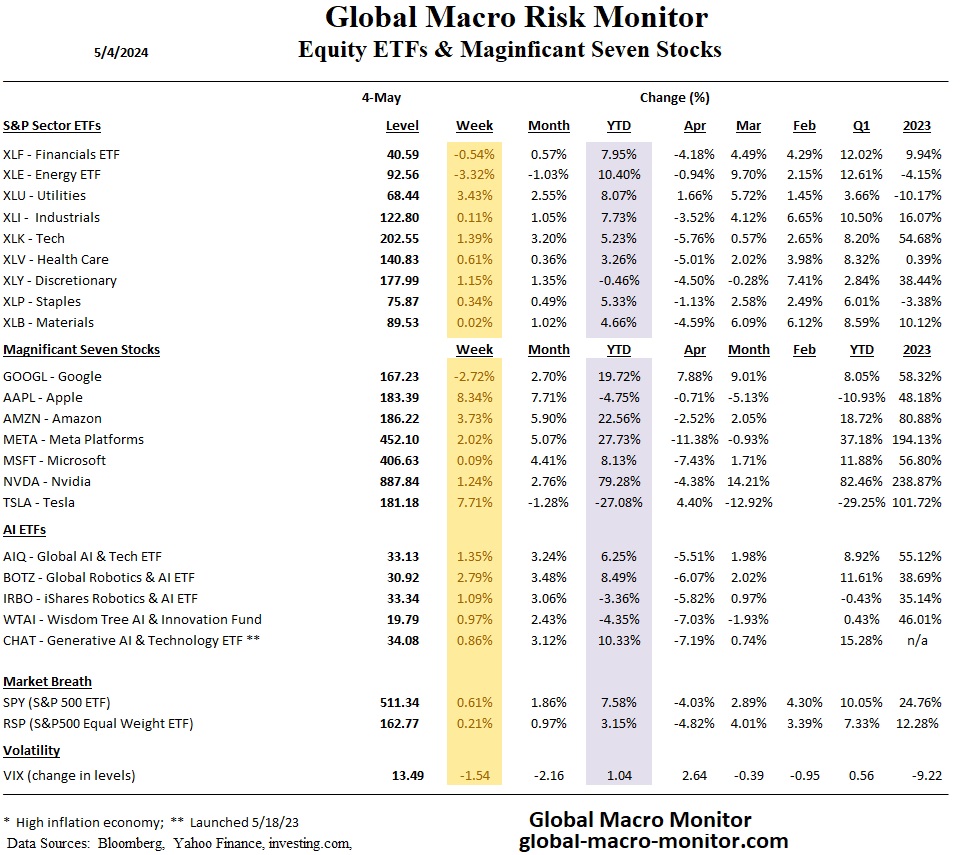
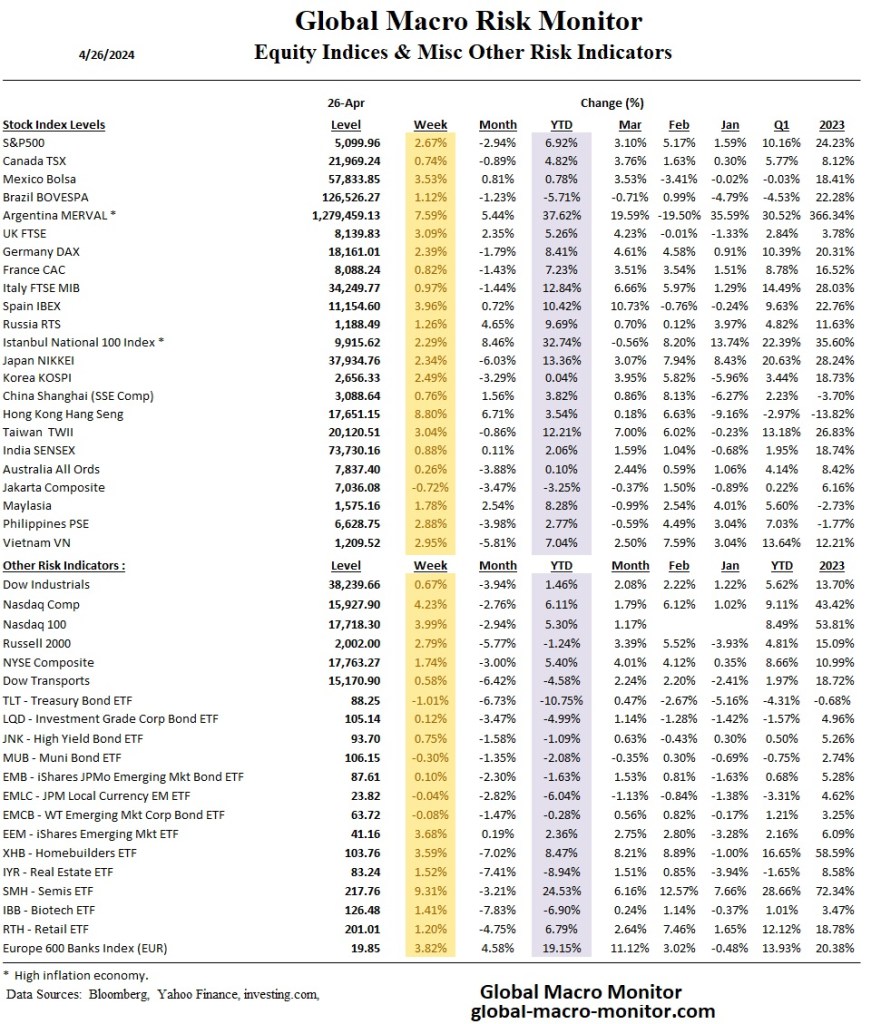
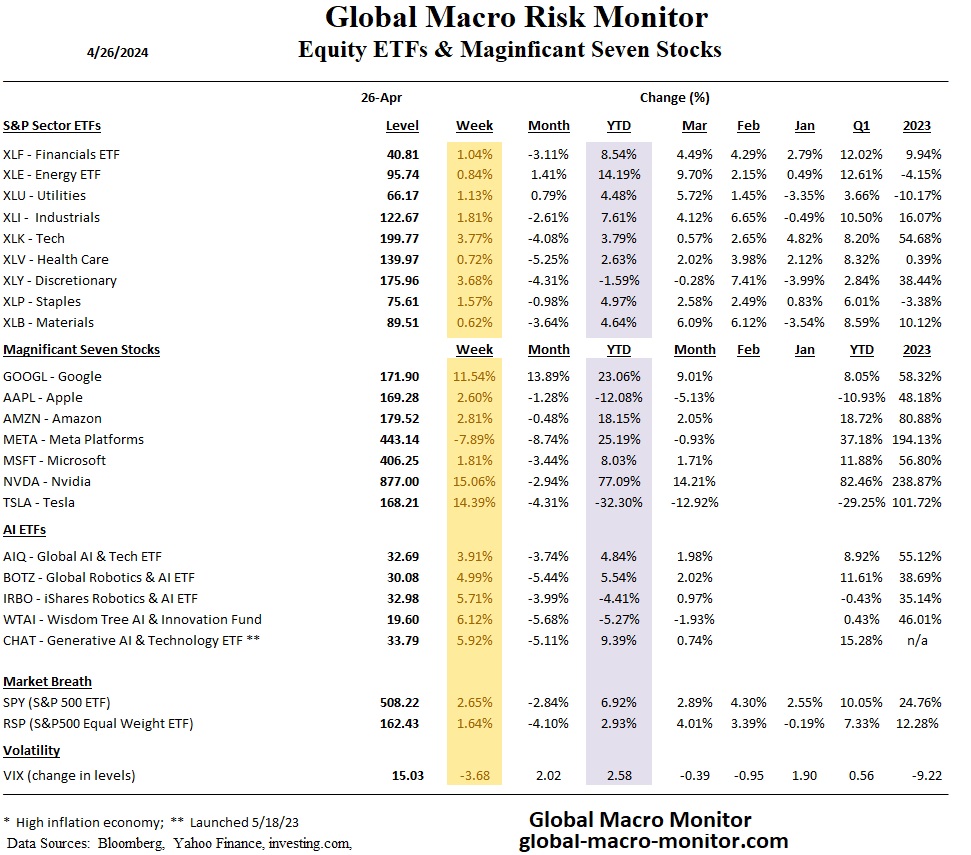
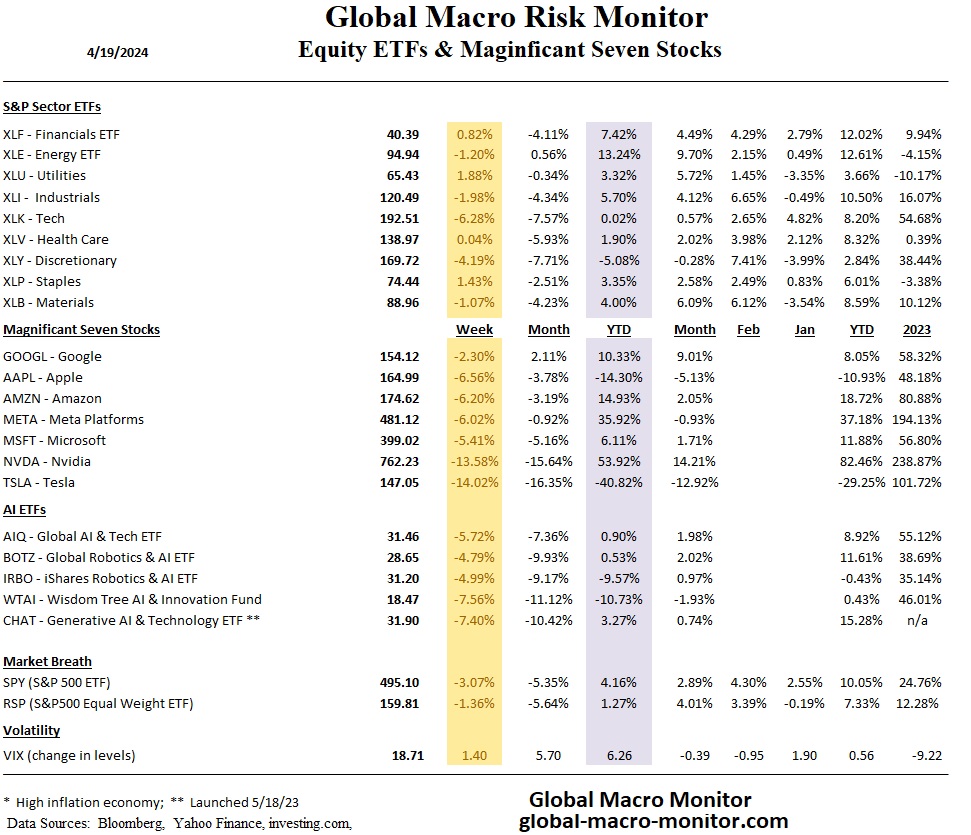
We have incorporated several AI-focused ETFs into our equity table.
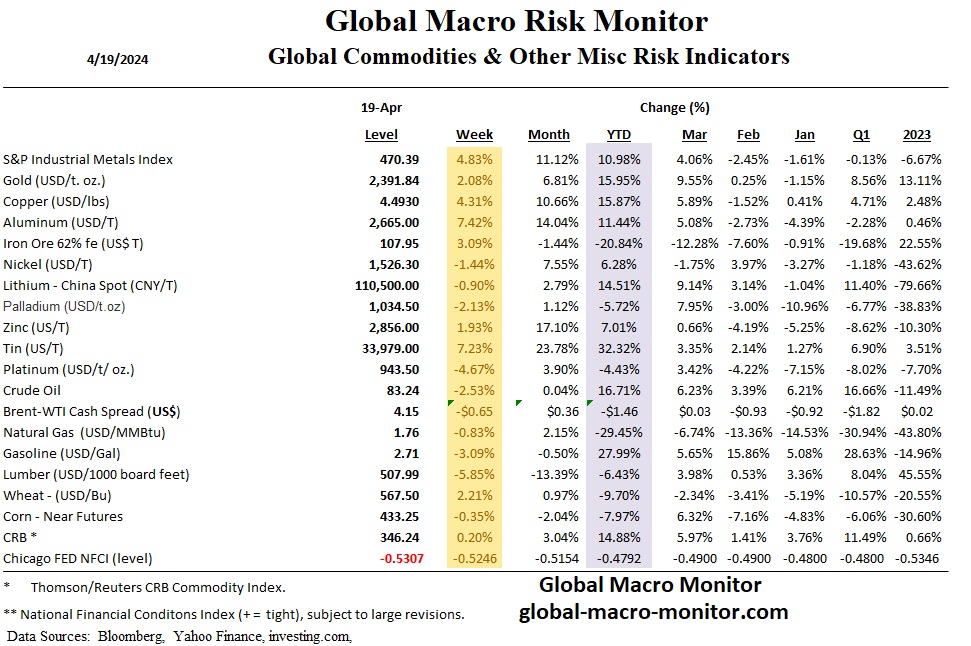
Additionally, observe the trend in financial conditions as indicated by the Chicago Fed’s National Financial Conditions Index, detailed in the commodities table. The index’s current reading of -0.53 – measured on March 15 and should be a few points easier for March 22, given this week’s market performance – signifies the easiest financial conditions since January 2022, a few months prior to the Fed’s interest rate hikes were initiated in March 2022. These lenient monetary conditions are facilitating economic performance that is consistently surprising to the upside, and allowing financial assets to rip.
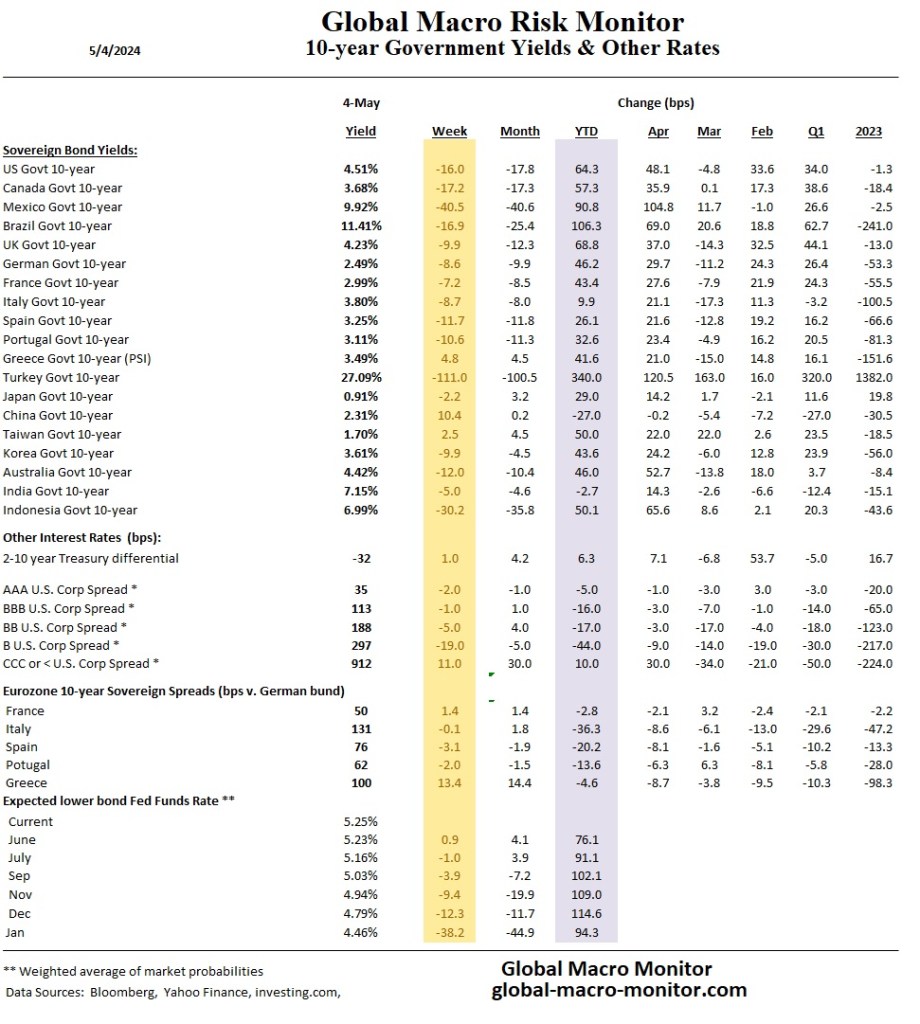
This dynamism complicates the Fed’s job. Market anticipation continues to revolve around the first rate cut, but given the prevailing financial conditions, the wait is likely to continue.
Waiting on Jay Po? Prepare to keep waiting.


The diverging relationship between economic performance and political success in the U.S. highlights a shift from the past, where a strong economy positively impacted incumbent approval ratings. President Biden’s approval ratings remain unaffected despite recent economic improvements, suggesting a decoupling of economic sentiment and political fortunes. This phenomenon, which contrasts with stable economic-political linkages in Europe, is attributed to the U.S.’s heightened partisan divide, where political allegiance increasingly dictates economic perception, challenging the traditional belief that “It’s the economy, stupid” in American politics.
Key Points:
Source: Financial Times

A Bloomberg article from this morning offered an excellent array of charts detailing the shifts in interest payment flows amid rising rates. The historical anomaly was both surprising and contradicted our priors.
10 Key Points: