In Honor Of Veteran’s Day: The Butterfly Effect

Originally Posted: November 11, 2018

To honor Veterans’s Day,  we are reposting our June 2017 butterfly piece, which illustrates how sleepwalking can lead the world into a war that nobody wants.

French President, Emmanuel Macron, warned today about sleepwalking into another great conflict.

“I know there are old demons which are coming back to the surface. They are ready to wreak chaos and death. History sometimes threatens to take its sinister course once again.  – President Macron
Vets

History’s Biggest “Butterfly Effect” Occurred On This Day

The butterfly effect is the concept that small causes can have large effects. Initially, it was used with weather prediction but later the term became a metaphor used in and out of science.

In chaos theory, the butterfly effect is the sensitive dependence on initial conditions in which a small change in one state of a deterministic nonlinear system can result in large differences in a later state. The name, coined by Edward Lorenz for the effect which had been known long before, is derived from the metaphorical example of the details of a tornado (exact time of formation, exact path taken) being influenced by minor perturbations such as the flapping of the wings of a distant butterfly several weeks earlier. Lorenz discovered the effect when he observed that runs of his weather model with initial condition data that was rounded in a seemingly inconsequential manner would fail to reproduce the results of runs with the unrounded initial condition data. A very small change in initial conditions had created a significantly different outcome.  — Wikipedia

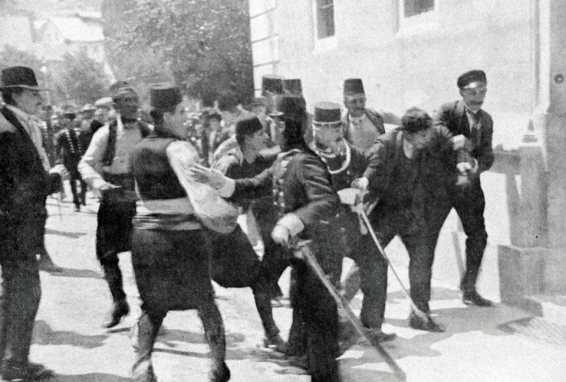
On this day in history, June 28, 1914, the driver for Archduke Franz Ferdinand,  nephew of Emperor Franz Josef and heir to the Austro-Hungarian Empire,  made a wrong turn onto Franzjosefstrasse in Sarajevo.

Just hours earlier, Franz Ferdinand narrowly escaped assassination as a bomb bounced off  his car as he and his wife,  Sophie,  traveled from the local train station to the city’s civic city.   Rather than making the wrong turn onto Franz Josef  Street, the car was supposed to travel on the river expressway allowing for a higher speed ensuring the Archduke’s safety.

Yet, somehow, the driver made a fatal mistake and tuned onto Franz Josef Street.

The 19-year-old anarchist and Serbian nationalist, Gavrilo Princip, who was part of a small group who had traveled to Sarajevo to kill the Archduke,  and a cohort of the earlier bomb thrower, was on his way home thinking the plot had failed.   He stopped for a sandwich on Franz Josef Street.

Seeing the driver of the Archduke’s car trying to back up onto the river expressway, Princi seized the opportunity and fired into the car, shooting Franz Ferdinand and Sophie at point-blank range,  killing both.

That small wrong turn,  a minor perturbation to the initial conditions, or deviation from the original plan,  set off the chain events that led to World War I.
Archduke_Jan27

Stumbling Into The Great War
Fearing Russian support of Serbia, Franz Josef would not retaliate by invading Serbia unless he was assured he had the backing of Germany.   It is uncertain as to whether the Kaiser gave Franz Josef Germany’s unequivocal support.   Russia, fearing Germany would intervene, mobilized its troops forcing Germany’s hand.

The great European powers thus stumbled into a war they didn’t want through complicated entanglements and alliances, and miscalculation.  Russia backing Serbia;  France aligned with Russia,  Germany backing the Austro-Hungarian Empire;  and Britian, who really didn’t have a dog in the fight except her economic interests, aligned with France and Russia.

Later the U.S. would enter the war due to Germany’s unrestricted submarine warfare threatening American merchant ships and the Kaiser floating the idea of an alliance with Mexico in the famous Zimmerman Telegram, which was intercepted by the British.

Of course, some will argue that Great War in Europe was inevitable

The great Prussian statesman Otto von Bismarck, the man most responsible for the unification of Germany in 1871, was quoted as saying at the end of his life that “One day the great European War will come out of some damned foolish thing in the Balkans.” It went as he predicted.  – History.com

Nevertheless,  maybe the course of history would have been different if not for that wrong turn on June 28, 1914, which created the humongous butterfly effect, which we still experience the consequences this very day.

The botched Treaty of Versailles  sowed the seeds the for World II.  The War contributed to the Russian revolution and Cold War.  The redrawing of borders in the Middle East after the War created the conditions for the instability and breakdown to tribalism the region experiences today.

A map marked with crude chinagraph-pencil in the second decade of the 20th Century shows the ambition – and folly – of the 100-year old British-French plan that helped create the modern-day Middle East.

Straight lines make uncomplicated borders. Most probably that was the reason why most of the lines that Mark Sykes, representing the British government, and Francois Georges-Picot, from the French government, agreed upon in 1916 were straight ones.  — BBC News

If Franz Ferdinand had not been murdered on this day in history,  that conflict between the Serbs and the Austro-Hungarian Empire may have been contained to just the Balkans.   Maybe.

The butterfly effect.  Think how many small events, decisions, mistakes, one small turn, or “minor perturbations” in plans have had enormous consequences in your own personal life.
Posted in Geopolitical, Uncategorized | Tagged , , | Leave a comment

The Other Son

An apropos must-view movie, folks.

Posted in Uncategorized | Leave a comment

Seasonal Greetings From The S&P500

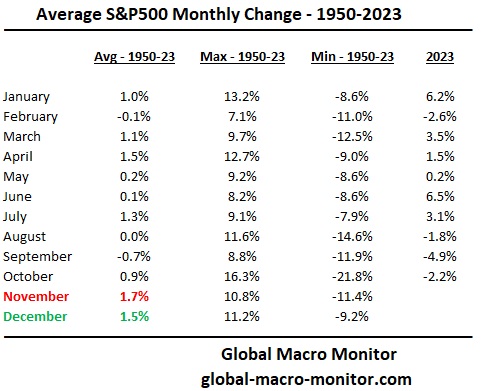
Stocks began “the most wonderful time of the year” by putting in a nice performance on the first day of the best-performing month of the year.  The S&P500 was up 1.05 percent to start the month of November, which on average has generated a 1.7 percent price return since 1950, followed by December with an average performance of  1.5 percent.    

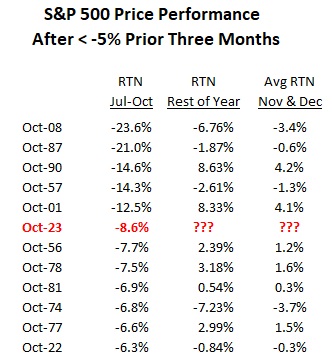
The index entered November after generating three consecutive months of negative returns, falling 8.61 percent since the end of July. Only five times in the last seventy-three years has the S&P500 entered November after such a poor performance in the prior three months.  The following table shows that in three of those times, the performance for the rest of the year was negative, while in the other two instances, the S&P was up north of 8 percent. 

It’s going to be an interesting rest of the year.  Place your bets, folks.  

Posted in Uncategorized | 3 Comments

The Dynastic Duo: PTJ and Druck

Must view, folks.  It should sound familiar if you’ve been reading GMM over the past year.

Posted in Uncategorized | 1 Comment

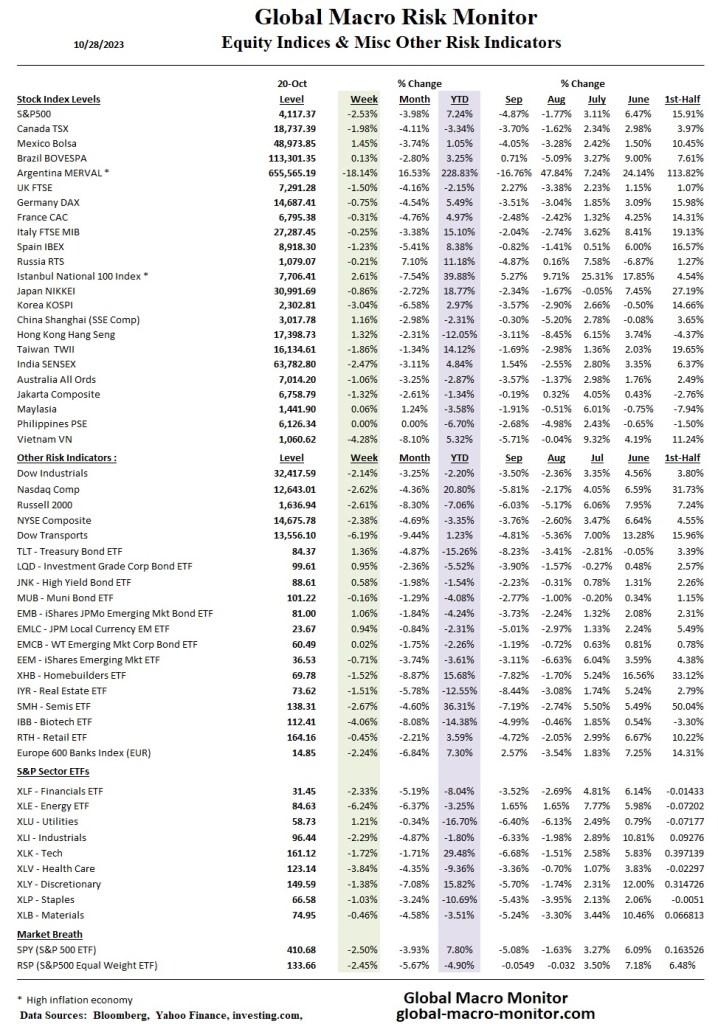
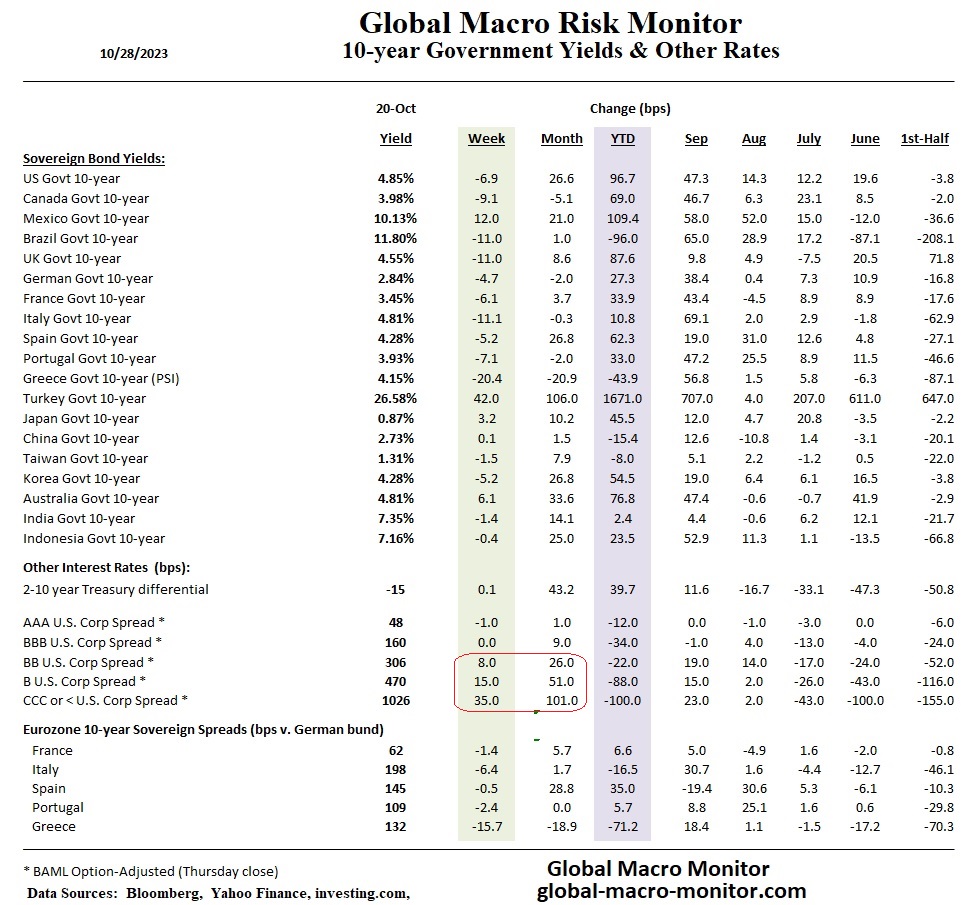
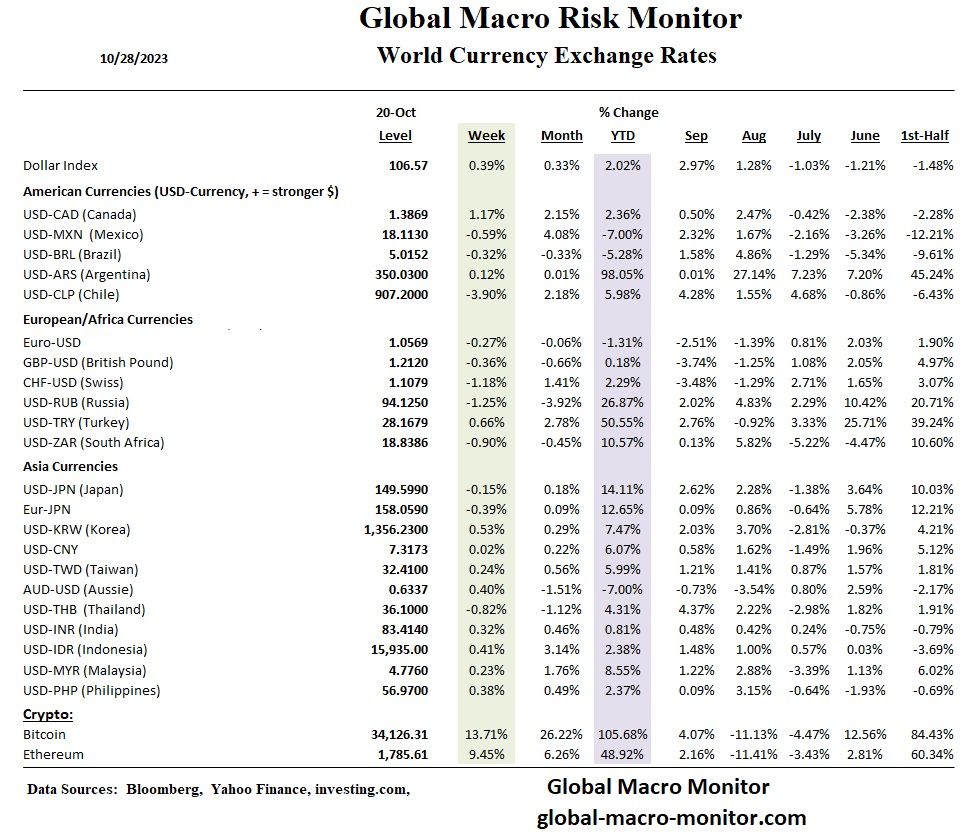
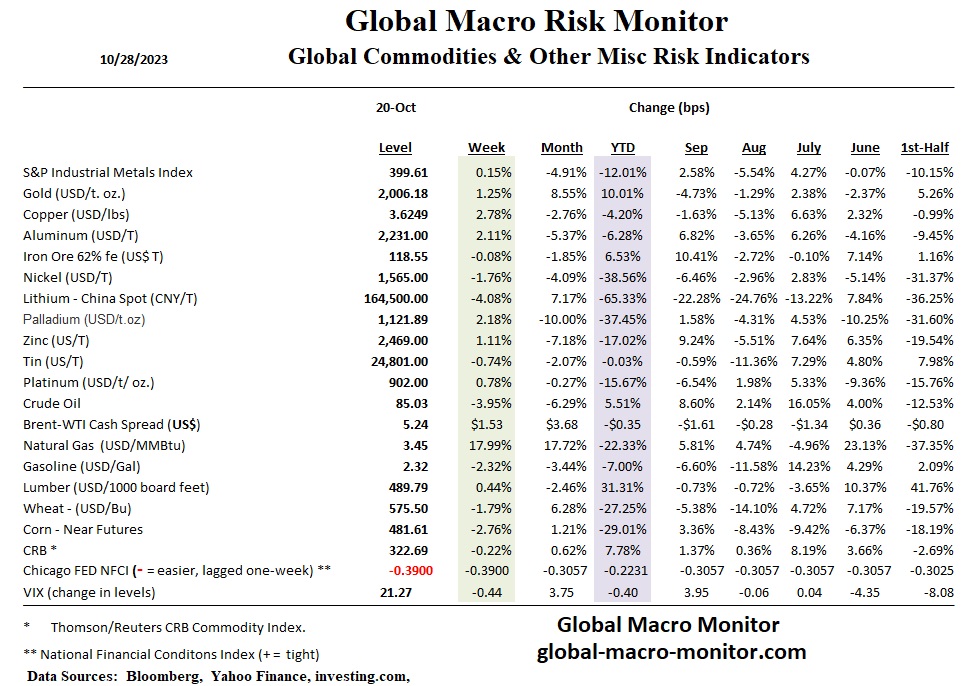
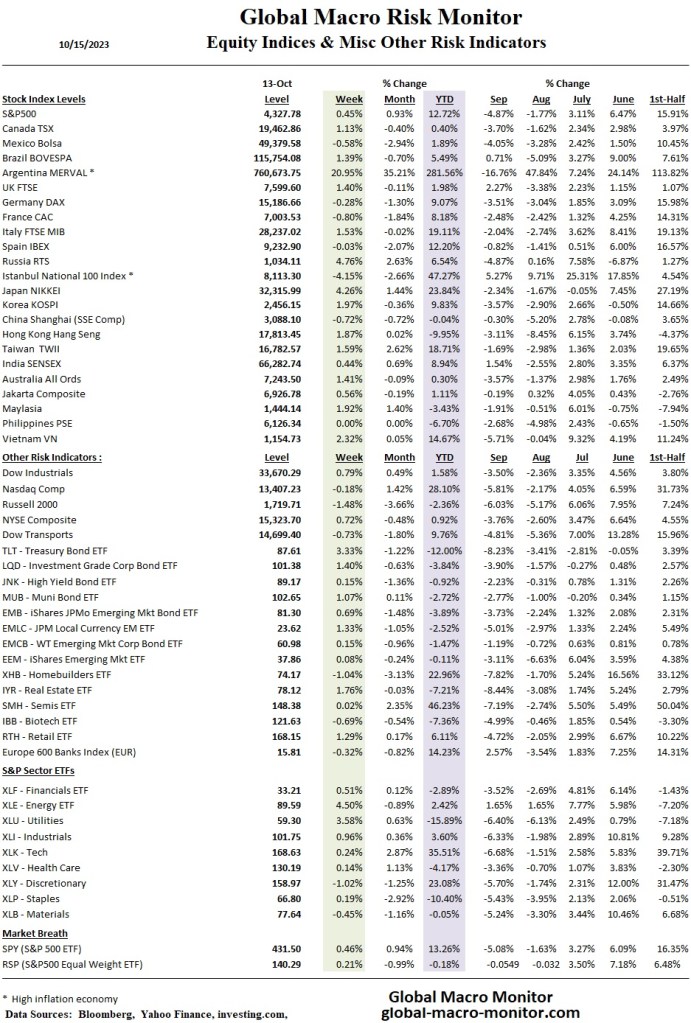
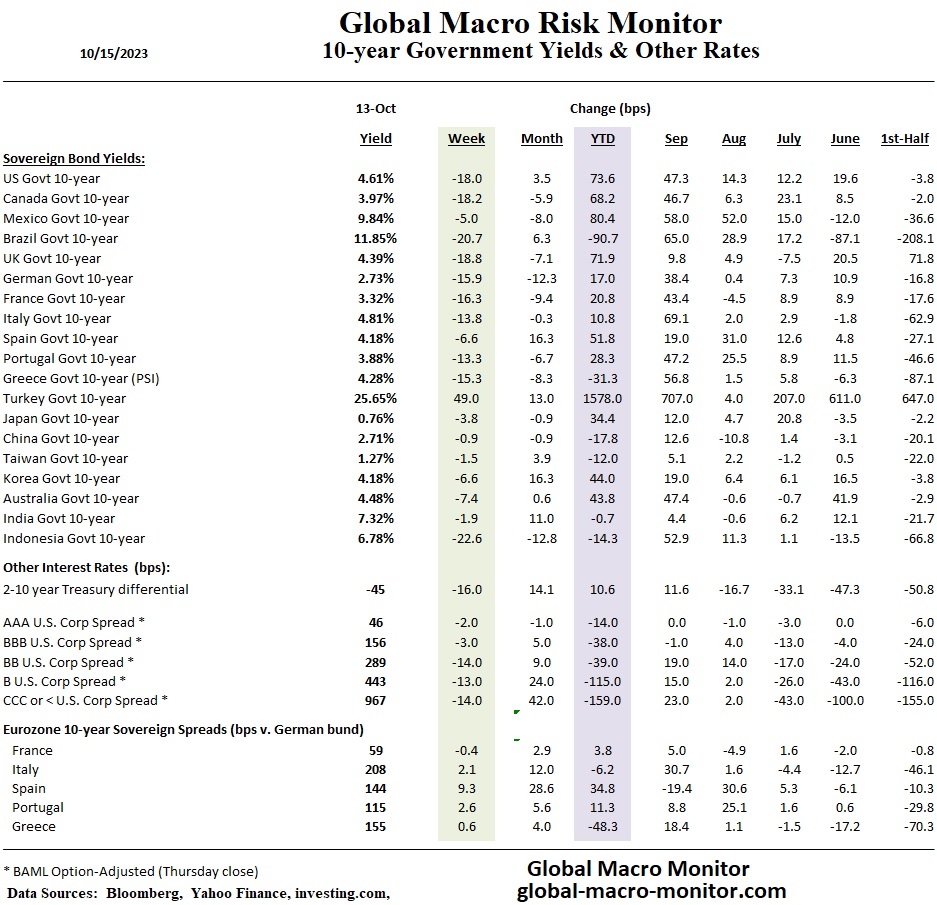
Global Risk Monitor: Week In Review – October 27

Lower-quality credit spreads starting to blow out.  


Posted in Uncategorized | Leave a comment

Taylor Made Her Billion Swift

Why Taylor Matters To Economists

In addition to being a generational talent, Taylor Swift is a great economist,” said Carolyn Sloane, a labor economist at the University of Chicago. “Taylor has great ideas, is able to scale her ideas and seems to be pretty risk-seeking…

Swift herself got a mention in the Federal Reserve Bank of Philadelphia’s June Beige Book for spurring growth in the city’s economy, while Fed Chair Jerome Powell indicated that spending on cultural phenomena like the Eras concerts, Beyonce’s Renaissance World Tour and the Barbie movie is on the radar of policymakers as they debate further interest-rate hikes and determine how the American consumer is faring. – Bloomberg

Don’t Be Mean

Posted in Uncategorized | 1 Comment

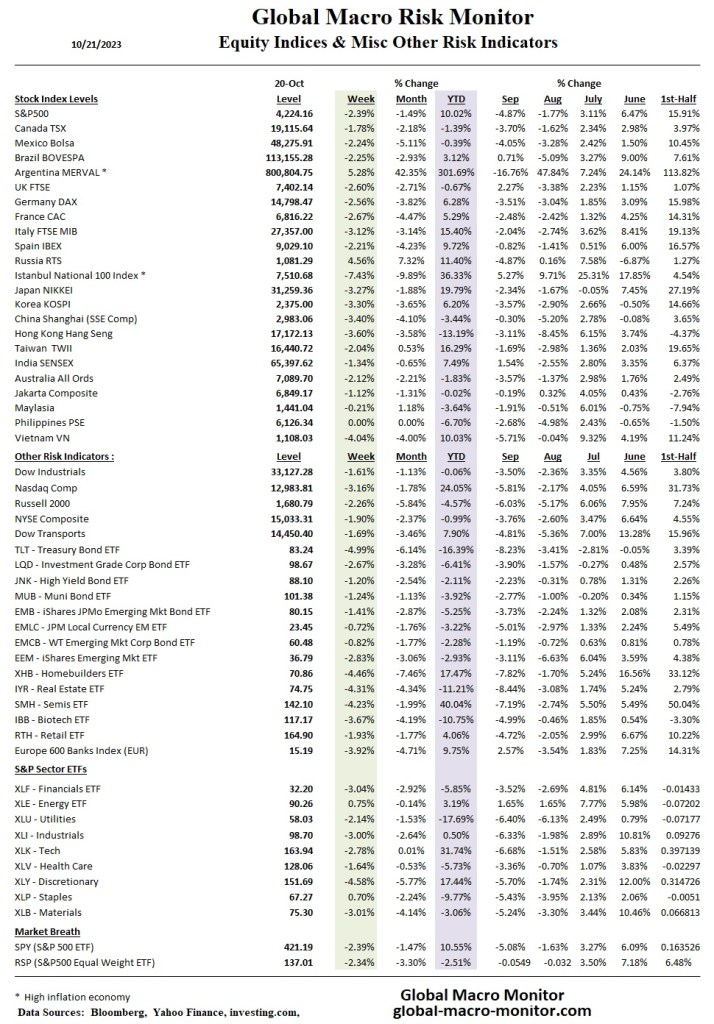
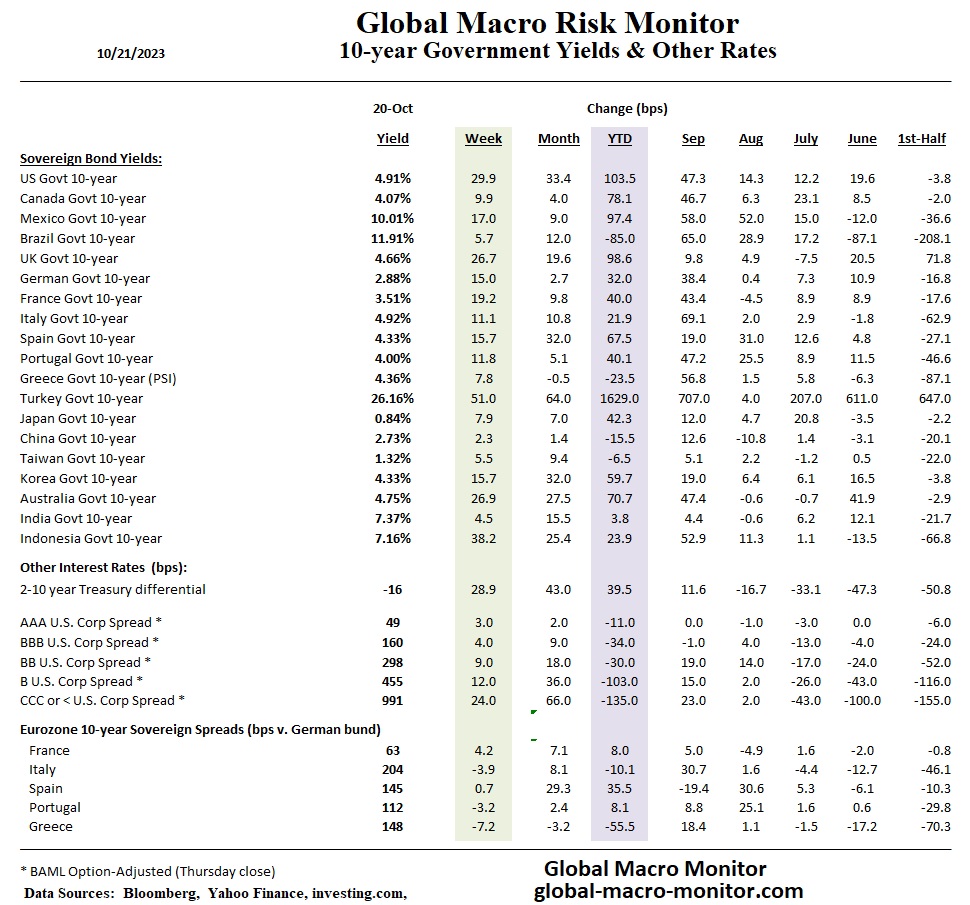
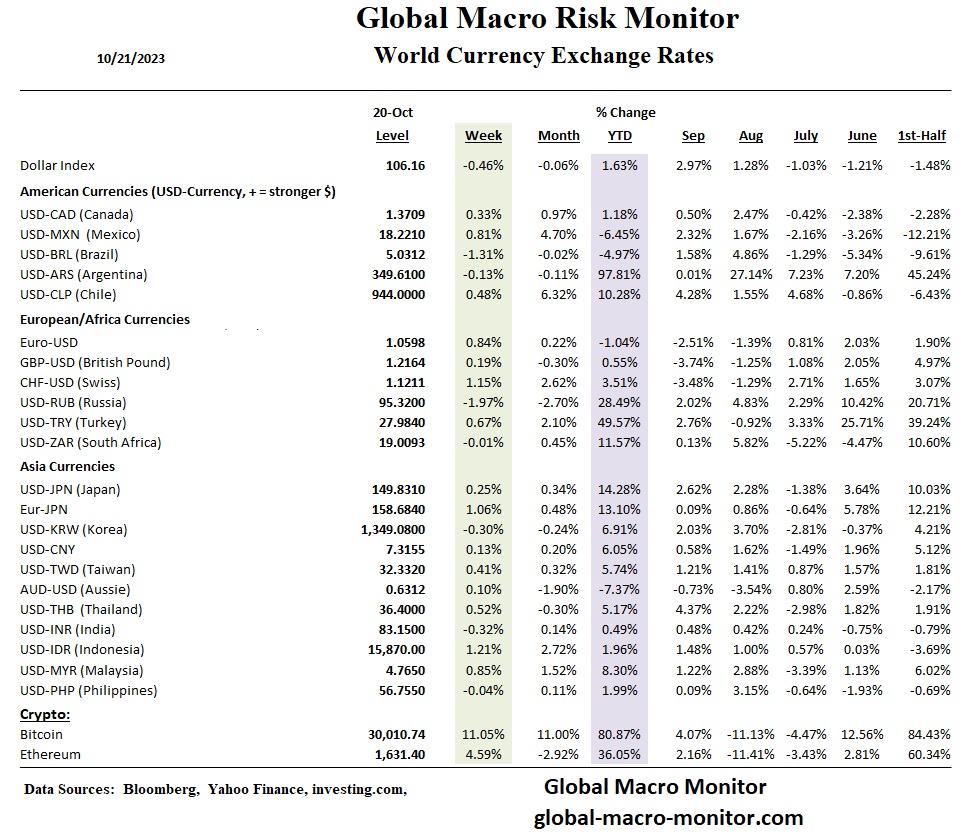
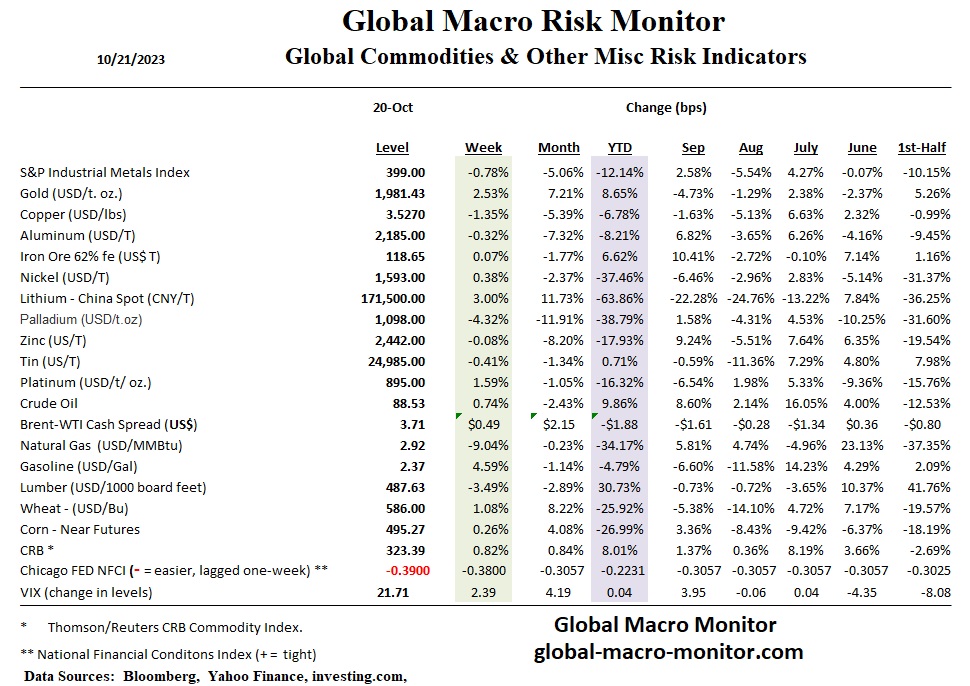
Global Risk Monitor: Week In Review – October 20

Posted in Uncategorized | Leave a comment

Black Monday, 1987: Inside The U.S. Treasury

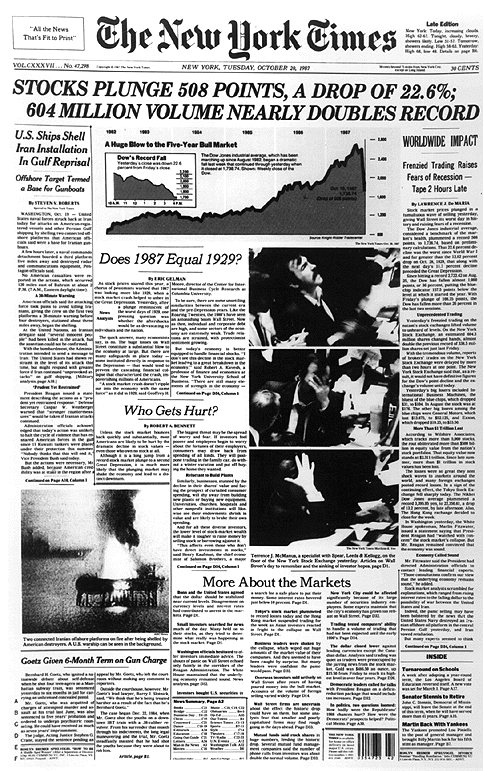
Wondering if the FinMedia will mention one thing about today being the 36th  year anniversary of the Great Crash of 1987

Originally Posted
October 19, 2020

By Liam McPherson

The following exchange took place between President Reagan and reporters after the market close on Black Monday, October 19, 1987.  Leaving to visit the First Lady in the hospital, President Reagan spoke just after the market lost over 20 percent of its value on the day.

Q: What about the market? Tomorrow will it go down again?
President Reagan:  I don’t know. You tell me.

Q: Is the market your fault?
President Reagan: Is it my fault? For what, taking cookies to my wife?

Q: Reaganomics?

President Reagan:  I just told you. Good Lord, we reduced the deficit over last year by $70 billion. And all the other things I’ve told you about the economy are as solid as I told you. So, no, I have no more knowledge of why it took place than you have.

Thirty-three years ago today, now infamously known as Black Monday, my grandfather, M. Peter McPherson, was Deputy Secretary of the U.S. Treasury and acting Secretary that day, while Treasury Secretary James Baker was in the air traveling to Europe. McPherson was the most senior Treasury official left in Washington to handle the crisis.

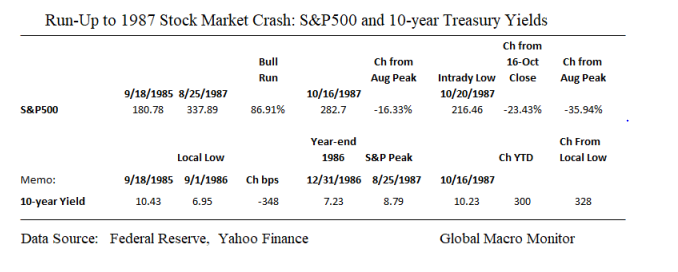
The stock market had already peaked in August after an almost 100 percent rally in the prior two years.  By late August, the DJIA had gained 44 percent in a matter of seven months, raising concerns of an asset bubble, and had become very volatile as interest rates had been rising rapidly since bottoming in September of the prior year.

Similar to 1929, where the stock market peaked in early September, the markets had already begun to unravel, foreshadowing the record losses that would develop that Monday in October.

As the markets around the world began to crash, my grandfather convened with the U.S. Treasury’s Undersecretary of Domestic Finance and the Department Chief of Staff to discuss the government’s appropriate response.  The Dow Jones eventually closed 508 points down, or a 22.61 percent, almost double the historic Crash of 1929, where the Dow fell 12.8 percent in one day.

Government Kicks Into Action

According to my grandfather, the situation demanded that his team put together a plan to calm the markets. The economy was doing fine, and there were no signs of recession.  Real GDP growth came in at 3.5 percent in 1987.

Jitters about the U.S. trade deficit, rising interest rates, and the path of the U.S. dollar during the Plaza Accord are oft-cited as the fundamental reasons that triggered the crash, but nobody knows for sure.  Trees don’t grow to the sky, and neither do markets.  Stocks markets do what stocks markets do, keep their own schedule, and march to their own drummer.

The team’s conclusion at Treasury that day was the market was under severe strain for technical reasons and complicated by the new computerized program trading related to portfolio insurance.  Nevertheless, the steep losses were causing significant dislocations in the financial markets.

Many large firms were under heavy liquidity pressure and were dangerously close to not making their margin calls and on the brink of failure.

My grandfather and his team placed a call to the then-new Federal Reserve Chairman, Alan Greenspan, only two months into the job, to encourage the issuance of a Fed statement that it would do whatever it takes to provide the liquidity to keep markets functioning.

It wasn’t the time to think about the policy’s broader economic implications, such as the potential moral hazard, as the plane was on fire and going down and desperately needed a rescue plan.

It was also clear Greenspan had been thinking along similar lines.

Fed officials drafted much longer statements for release, but Greenspan reasoned that a short, clear message would do the most to stabilize markets.

It is also important to point out that when Secretary Baker arrived in Europe late that day, he immediately began communicating with key finance ministers, such as those from Germany, Japan, France, and the UK to coordinate a global response to the financial crisis.

October 20

Greenspan issued his statement the next morning, October 20,

“The Federal Reserve, consistent with its responsibilities as the Nation’s central bank, affirmed today its readiness to serve as a source of liquidity to support the economic and financial system.” – FRB

In typical Greenspan fashion, the statement was vague in methodology yet resolute in purpose.

The market opened down and continued falling, there were no buyers and it appeared, at one point, the global financial system was headed for a complete meltdown.

“Tuesday was the most dangerous day we had in 50 years,” says Felix Rohatyn, a general partner in Lazard Freres & Co. “I think we came within an hour” of a disintegration of the stock market, he says. “The fact we didn’t have a meltdown doesn’t mean we didn’t have a breakdown.  – WSJ

Then at about 12:38 pm, with many stocks not trading and pressure growing to close the markets a miracle seemed to happen.

With the closing of the Big Board seemingly imminent and the market in disarray, with virtually all options and futures trading halted, something happened that some later described as a miracle: In the space of about five or six minutes, the Major Market Index futures contract, the only viable surrogate for the Dow Jones Industrial Average and the only major index still trading, staged the most powerful rally in its history. The MMI rose on the Chicago Board of Trade from a discount of nearly 60 points to a premium of about 12 points. Because each point represents about five in the industrial average, the rally was the equivalent of a lightning-like 360-point rise in the Dow. Some believe that this extraordinary move set the stage for the salvation of the world’s markets. – WSJ 

The rest, as they say, is history.

My grandfather felt that the Treasury’s phone call contributed to Greenspan’s thinking and as he made the decision to issue a statement to calm the market.  The statement was the most critical event in stabilizing the markets and preventing substantial economic damage to the U.S. and the global economy.

My grandfather spoke about how the simplicity of the message prevented speculation while instilling confidence.  Not unlike ECB President Mario Draghi’s, “whatever it takes” July 2012 speech, which saved the Euro currency, the European banking system, and ultimately the European Union during their debt crisis in 2011-12.

The Birth Of Stock Market Moral Hazard   

Some argue, including one of the regular authors on this website, the Fed’s response to Black Monday ushered in a new era of faux investor confidence and the moral hazard that the central bank will always backstop falling markets.  Thus, forever distorting market risk and real price discovery and contributing to the current boom-bust asset market cycle the global economy now experiences and will be extremely difficult to reverse.

Global Macro Monitor (GMM) often argues, which is not necessarily my own opinion, what was supposed to be a one-off market intervention in 1987 has now become the norm, which monetary policymakers will find it impossible to extract itself from, ultimately resulting in a major market and economic dislocation.  We shall see.

President Reagan’s Confidence And Sense of Calm

During the crisis, President Reagan, whose administration my grandfather served several key roles in, was an excellent communicator and never once conveyed a sense of panic in October 1987.

Though not having a financial background, President Reagan did have a degree in economics and understood the nature of markets and how they coveted a sense of calm and leadership from the government during such a crisis.

The following video is President Reagan speaking to the press at the White House on Black Monday as he is preparing to board Marine One to visit the First Lady in the hospital.

Skip to the dialogue, which starts 5:40 minutes in.

Note President Reagan’s incredibly calm demeanor and sense of confidence after the most massive stock market crash in U.S. history.

Posted in Equities, Equity | Tagged , | Leave a comment

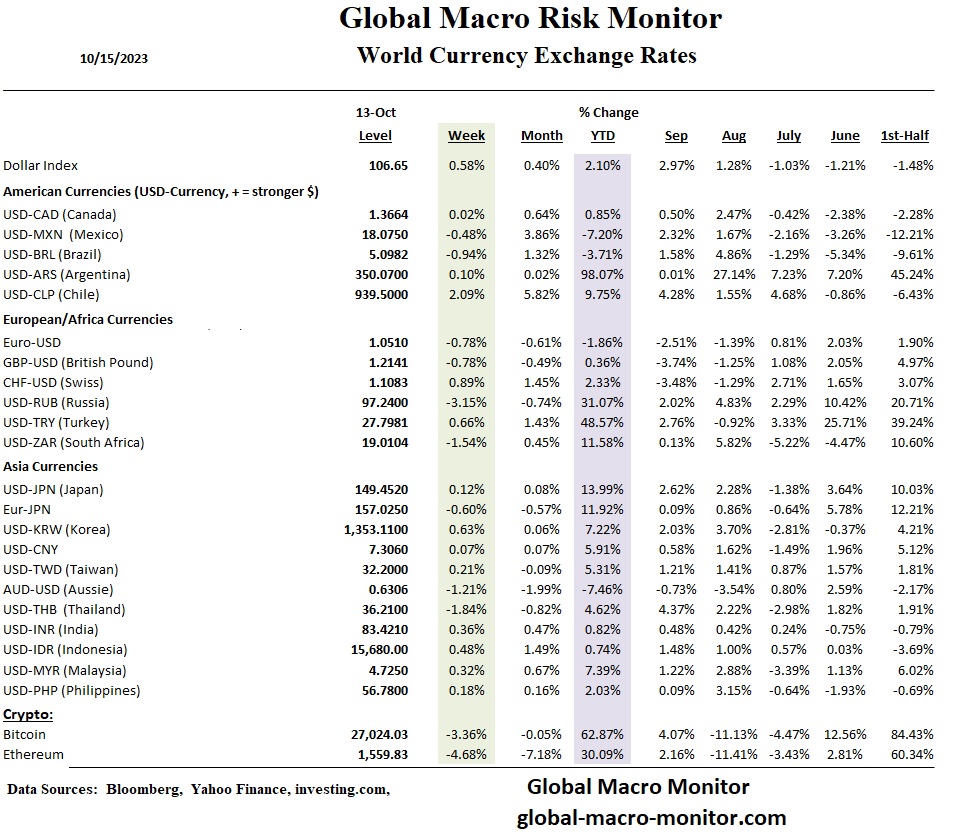
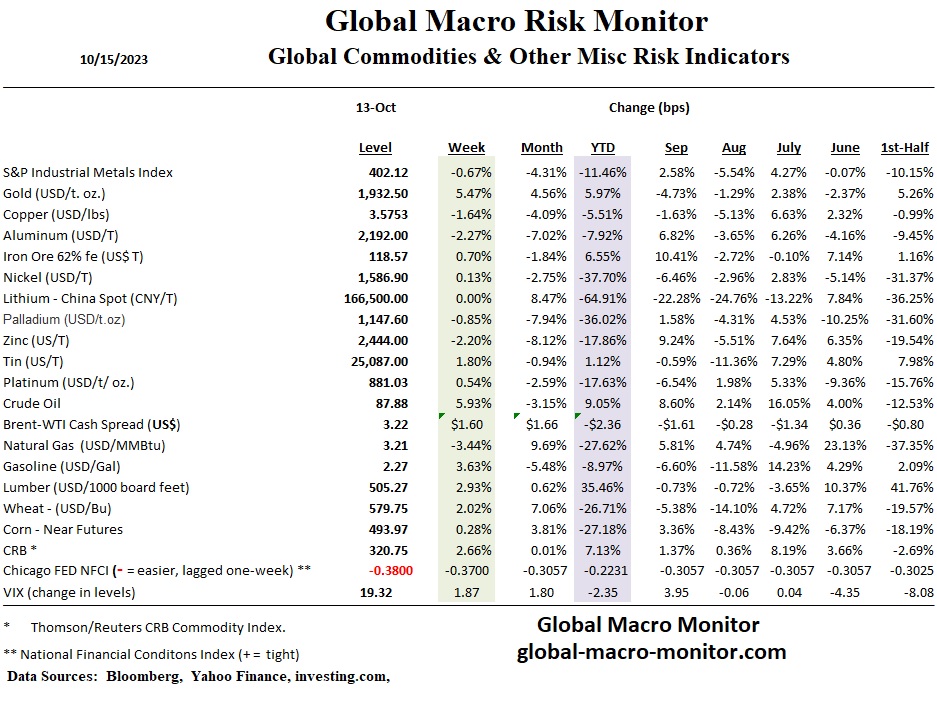
Global Risk Monitor: Week In Review – October 13

Posted in Uncategorized | Leave a comment

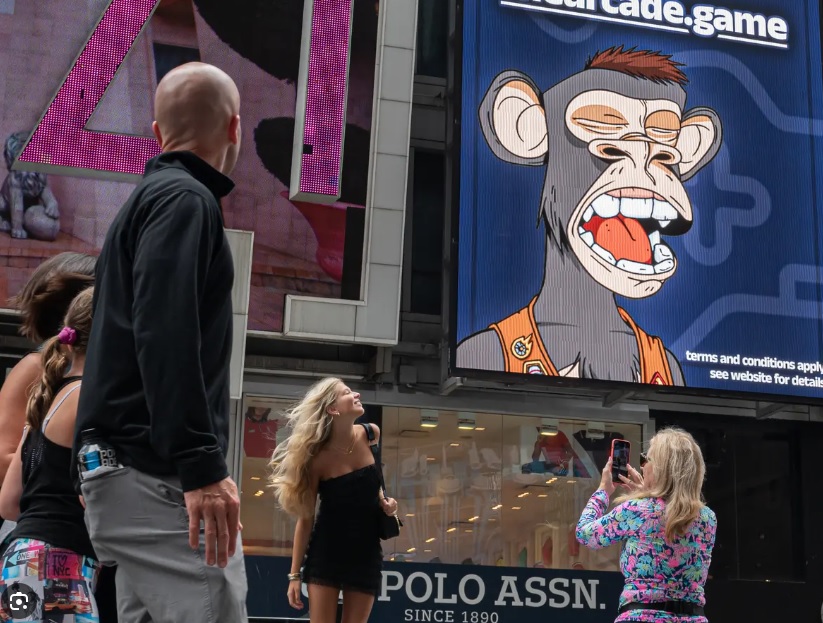
QOTD: NFTs – Wither The “Pet Rocks”

QOTD = Quote of the Day

…someone noted yesterday in The Wall Street Journal, 95 percent of those holding NFTs that they bought in 2021 are worthless investments today…Yahoo

Posted in Uncategorized | Leave a comment