How AI Robots May Become School Security Guards

Posted in Uncategorized | Leave a comment

Global Risk Monitor: Week In Review – July 14

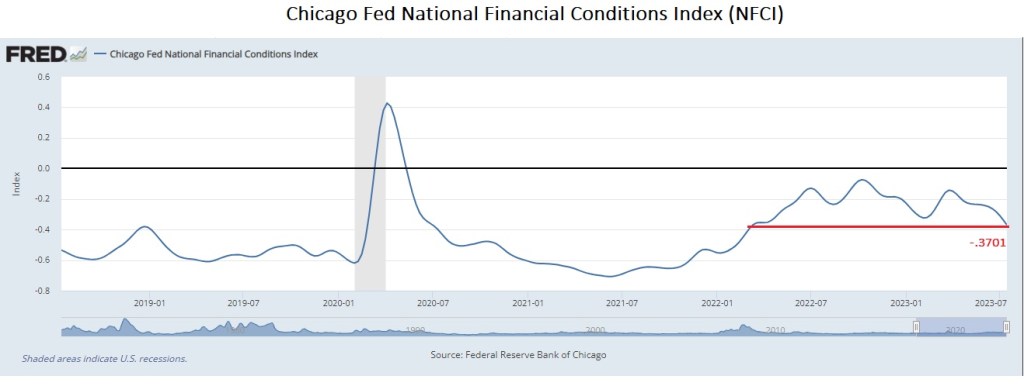
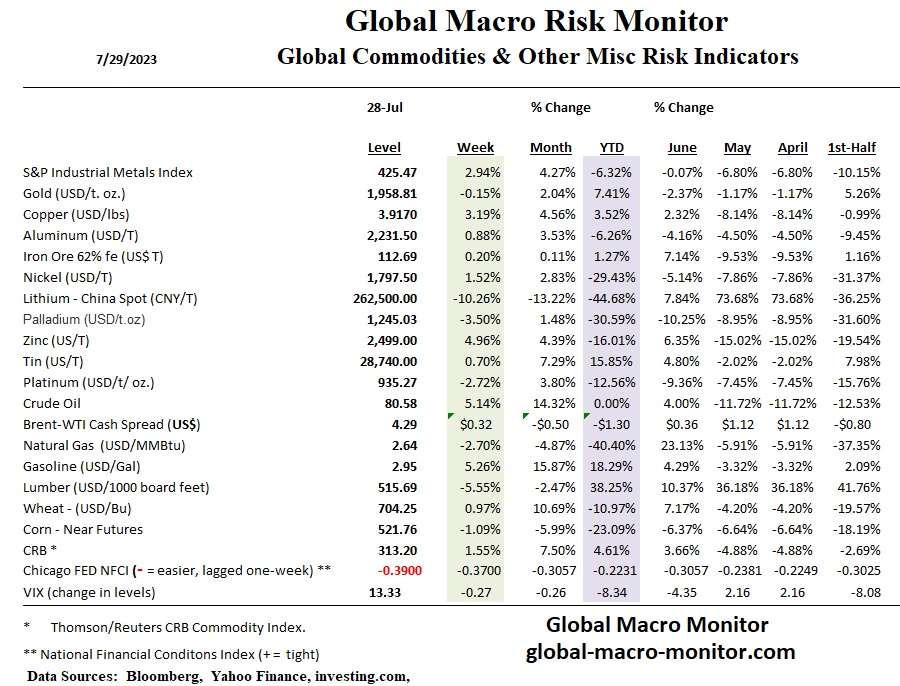
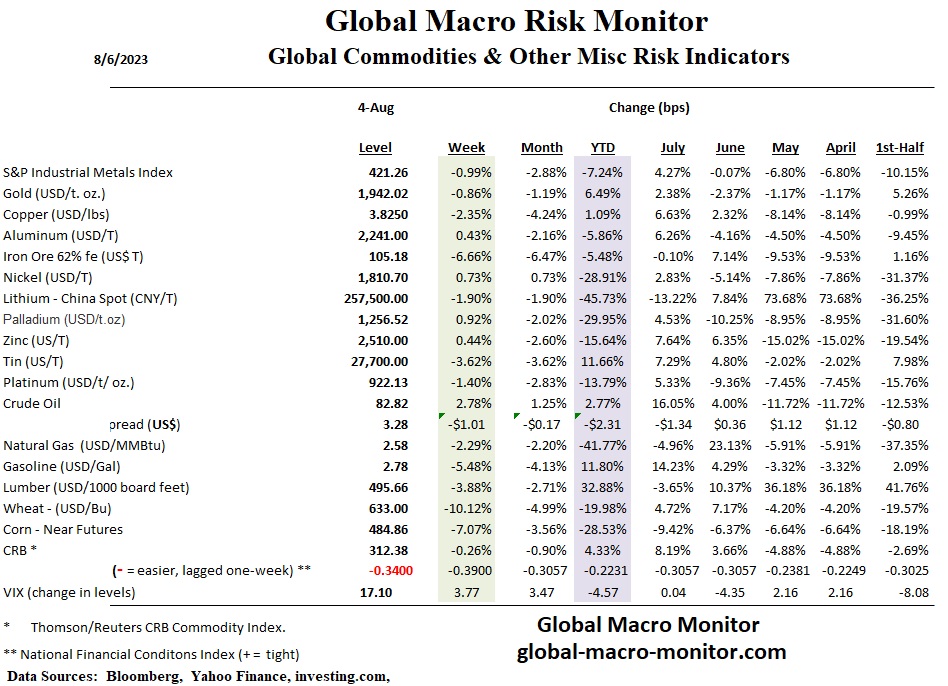
Wow, stunning that financial conditions, as measured by the Chicago Fed’s National Financial Conditions Index, (see last table), are as loose as they were back in April 2022, when the Fed Funds upper limit was at 50 bps versus 5.25 percent today.  Markets love it, but the Fed must be shitting razor blades.  They’ve got a tiger by the tail as they wait (and fret) for quantitative tightening to bite. 

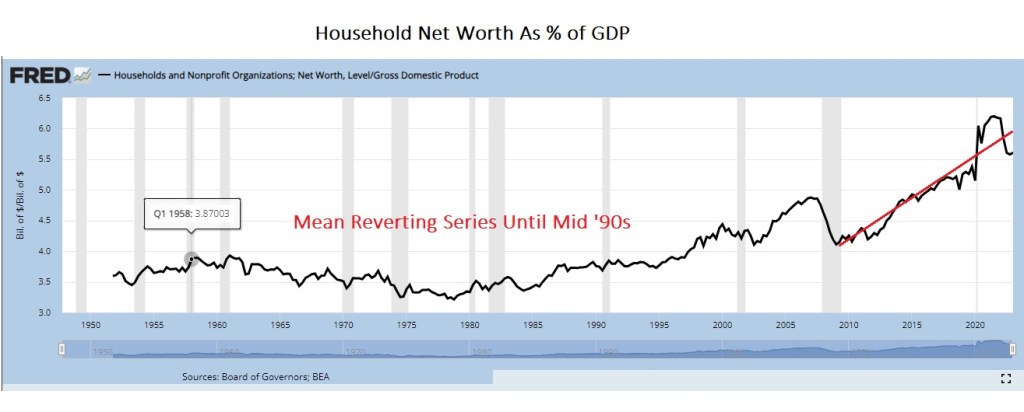
The U.S. central bank has only taken back about 14 percent, around $670 billion, of the almost $5 trillion they injected into the financial system during the pandemic.  We maintain there should be more of a focus on the quantity of money, which we define very loosely under the umbrella of household wealth, rather than obsessing over the price of money or interest rates.   Stay tuned. 

Posted in Uncategorized | Leave a comment

U.S. Budget Deficit: Strange Days Indeed

The U.S. budget data are just out, and there’s something happening here. What it is ain’t exactly clear.  For what it’s worth, we provide you with our insights.

The rolling twelve-month cumulative budget deficit – June to June – has spiked to $2.3 trillion, or based on our estimate of Q2 GDP to around 8.3 percent of GDP.   That data point is so far from the number we hear kicked around by analysts that it makes us question our own data, but we can’t find what we are missing. 

Just last month, the CBO reiterated their forecast of a $1.5 trillion FY2023 deficit, which ends in September,

CBO’s current projections show a federal budget deficit of $1.5 trillion for 2023 – CBO

Given the deficit is already $1.4 trillion with three more months remaining in the fiscal year, we see zero path to hitting the target. 

Today’s CBO report reports some shifts in certain payments added $23 billion to the June deficit (de minimis) and also notes it’s possible the 21 percent decline in income tax revenue, 

will be better understood as additional information becomes available; one factor may be smaller collections of taxes on capital gains and other types of income. – CBO

Watch this space, folks. We have no doubt it will soon be on the markets’ radar. 

Crowding Out Or More Leverage? 

The federal government’s financing needs are massive, and it can no longer depend on the central banks for financing.  The financing must come from somewhere and is a zero-sum game unless augmented by increased leverage from other sectors of the U.S. and global economy. 

The U.S. budget deficit is now larger than 95 percent of the world’s country GDPs.  

The “Leverage Cavalry” is on the way (see the last chart) with a short-term fix but almost certainly a longer-term problem.  

Chicago Fed’s National Financial Conditions Leverage Subindex

By tracking the Chicago Fed’s National Financial Conditions Leverage Subindex, market participants can monitor the level of leverage in the economy and assess its potential implications for financial stability. Increases in the index suggest rising debt burdens and heightened risks of financial distress, while decreases may indicate deleveraging and improved stability.

Stay tuned, folks. 

Posted in Uncategorized | Leave a comment

What It Takes To Convert Commercial to Residential

Posted in Uncategorized | 1 Comment

Divining The CPI Report From The PMIs

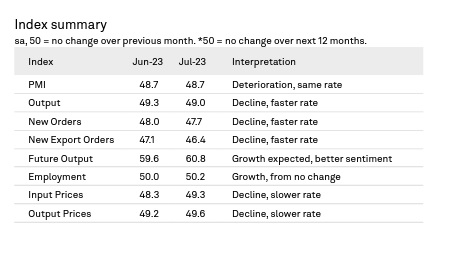
After a read of the recently released manufacturing and services Purchasing Managers Index (PMI) reports for June, goods prices are softening significantly. However, the service sector is still experiencing price pressures, albeit at a deaccelerating rate.

Services comprise over 60 percent of the CPI, with shelter around 35 percent of the basket.

Even though the manufacturing sector is in contraction, hiring continues as if the employers are hoarding workers, similar to how consumers hoarded toilet paper during the panic. Granted, the employment data is a lagging indicator, but recency bias is a real bitch to break.

Nevertheless, we are taking the under on tomorrow’s core inflation print. Our recency bias, which we own, is that manufacturing prices tend to lead the headline inflation data, which is underreported.

For example, a special surcharge appears on our bill every time we dine out. A 3.5 percent surcharge was added to the bill at brunch on Sunday! Argh! We’ve seen labor, transport, and energy surcharges, just to name a few. Check your bills, folks

PMI Price Components:

Here is our summary of the PMIs with a little help from our AI friend:

In June, the U.S. manufacturing sector experienced a decline in input costs for the second consecutive month, with material prices dropping the most since May 2020. Suppliers offered promotions to incentivize purchases of inputs. Only one manufacturing industry reported price increases in June, while the majority reported either the same or lower prices. Despite weak demand, manufacturers hired new workers.

On the other hand, the U.S. services sector faced higher cost burdens due to supplier shortages, increased interest rates, and higher wage bills. Input prices rose at the fastest pace in five months, but efforts to remain competitive led to slower increases in charges. However, service sector firms saw a significant rise in cost burdens, primarily driven by higher wage bills, supplier prices, and borrowing costs. Cost inflation accelerated, reaching its highest level since January. Twelve service industries reported increased prices, while three reported price decreases.

Place your bets!

Posted in Uncategorized | Leave a comment

How Banks Create Money | Economist

Posted in Uncategorized | 4 Comments

QOTD: I Can Buy Myself Flowers

QOTD = Quote of the Day

During SecTreas Janet Yellen’s visit to China, the government announced starting next month, China will impose restrictions on the global availability of gallium and germanium, obliging purchasers of these rare metals to obtain permits. This action underscores China’s prominent position as a major supplier of essential materials crucial for the production of various technologies utilized by consumers worldwide.

“This is no bouquet of flowers for Janet…The timing and symbolism could not be more clear to just about everybody in Asia, if not the rest of the world.” – Byron King, Paradigm Press 

Posted in Uncategorized | Leave a comment

Global Sector PMI: Manufacturing Flops, Services Pop

Based on the recent release of the June Global Sector PMI from S&P Global, the state of manufacturing in various global sectors during June 2023 shows a divergence in performance between manufacturing and services. Manufacturing-based sectors experienced a drop in output, while services sectors demonstrated growth. Here are some key observations:

  1. Manufacturing Sectors: a. Drop in Output: All six sectors that experienced a decline in output during June were manufacturing-based. The sectors with the sharpest drop in production were Forestry & Paper Products, Metals & Mining, and Chemicals. b. Input Costs: Inflationary pressures seemed to be softening, as June witnessed the lowest number of sectors with a rise in input costs in three years.

  2. Services Sectors: a. Growth and Performance: The five fastest-growing categories were all services sectors. Financials, particularly Insurance, showed rapid activity growth. Banks and Real Estate companies also experienced increased activity. b. Employment: Real Estate registered the fastest increase in employment among the 21 categories covered. Hiring activity and wage pressures in Real Estate pushed up staff costs.

  3. Other Observations: a. Tourism & Recreation: The Tourism & Recreation sector continued to grow solidly but at a slower rate than in the previous four months. The growth of new businesses in this sector also eased. b. Beverages & Food: Output in the Beverages & Food sector remained broadly unchanged. c. Healthcare Services: Workforce numbers in the Healthcare Services sector decreased significantly, reaching the second-largest extent on record (second to May 2020).

Overall, the manufacturing sectors faced challenges with declining output, while services sectors, particularly Financials and Real Estate, demonstrated growth. The softening of inflationary pressures and reduced input costs across various sectors indicate a potential easing of price pressures. However, the decrease in workforce numbers within the Healthcare Services sector suggests a notable exception to the overall resilience in staffing levels.

AI-Assisted

Posted in Uncategorized | Leave a comment

Global Risk Monitor: Week In Review – July 7

Yields spiking. 

Posted in Uncategorized | Leave a comment

COTD: Perceptions They Are A-Changin’

Interesting chart from the WashPost, comparing current polling with old polling.  

The data,

 …revisited 1948 polling from Fortune magazine in which people were asked whether they would use certain words to describe most of their fellow Americans. The results were striking, showing a distinct increase in negative perceptions of other Americans. 

At YouGov’s website, this was presented as adjacent bar charts. I decided to take the data and present it as a scatterplot. Below, you can see where each word was measured in 1948 (x-axis) and 2023 (y-axis) — and how different the two values are. Words that sit on the diagonal line, for example, are ones that were applied equally in both years. Words far from that diagonal are ones that moved a lot.

In 1948, half of Americans viewed their fellow Americans as “generous.” Now, the descriptor that was most widely applied was “selfish.”

Not a surprise, given that Joey Chestnut won’t even share his hot dogs.Washington Post

Posted in Uncategorized | 1 Comment