Interesting quote but don’t discount the deleterious wealth effect on aggregate demand of a “so-called” asset class wiping out $2 trillion in wealth in the past year. We have always maintained that the value expansion of an asset class with no parallel increase in production is inflationary. The same holds for stock market valuations driven primarily by multiple expansions rather than profit generation.
“Crypto space…is largely circular,” Yale University economist Gary Gorton and University of Michigan law professor Jeffery Zhang write in a forthcoming paper. “Once crypto banks obtain deposits from investors, these firms borrow, lend, and trade with themselves. They do not interact with firms connected to the real economy.” – WSJ
Thank goodness we didn’t buy that hot dog stand on 17th and Pennsylvania in downtown Washington!
A key problem is federal government employees are still largely at home. President Biden vowed in March that “the vast majority of federal workers will once again work in person.” Months later, it’s not even close to that. According to the Office of Personnel Management (OPM) Federal Employee Viewpoint Survey, nearly 40 percent said they work fully remotely or at home three or more days a week. Another 17 percent say they are at home one or two days a week. The DowntownDC Business Improvement District’s tracking indicates fewer than a quarter of federal workers are back in the office. Mayor Muriel E. Bowser (D) has been imploring the White House to change this. Allowing each agency to set its own rules was a mistake. Mr. Biden needs to set a clear policy of at least three days a week on-site for all federal workers who aren’t already back more than that.
They are the linchpin for downtown. When they aren’t around, lawyers, consultants, lobbyists and other workers also see little reason to return. While many big marquee law and other firms that have long dominated downtown D.C. have policies stating their workers should be in the office three days a week, few are enforcing it.
The fallout is evident. Walking along K Street Northwest from 14th Street to 20th — prime real estate near the White House — reveals 21retail spaces for rent and 10 office spaces for lease. At “happy hour” on a recent Friday, many bars along this stretch had plenty of available seats. This desolate scene would have been unimaginable a few years ago. – Washington Post
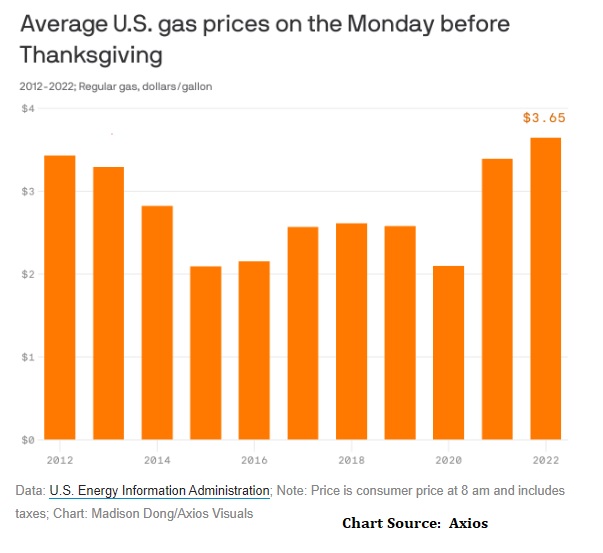
We are always intrigued by how the financial media cherry-picks nominal and real data. Though this week’s national average gas price tops all observations in the following chart, the current real gas price in 2012 dollars is roughly $2.81, down about 20 percent in real terms from Thanksgiving Week 2012.
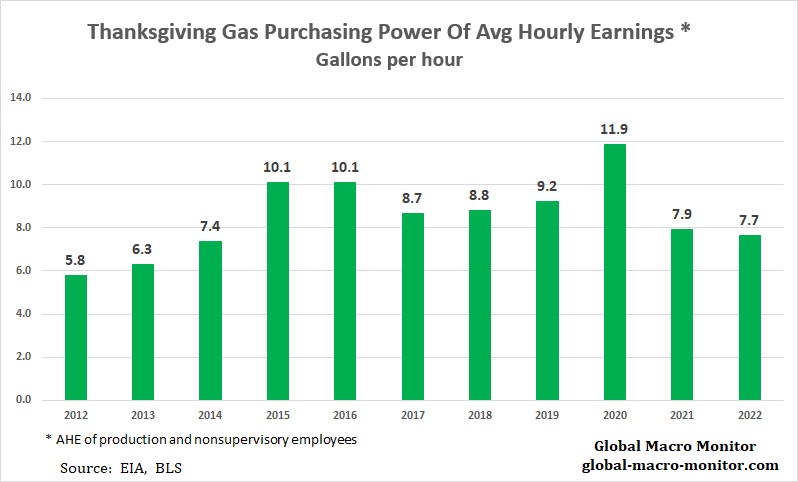
In more practical terms, the average hourly earnings of production and nonsupervisory employees can now purchase 7.7 gallons this Thanksgiving versus 5.8 gallons during the same holiday week in 2012. Some good news that will be buried in our holiday doom scrolling.
Gasoline prices are down sharply since briefly hitting a nationwide average of $5 per gallon in June, but motorists are still facing record Thanksgiving costs, Ben writes.
The big picture: While average pump prices heading into the holiday are above the 2012 mark, that’s not stopping a busy travel period.
AAA expects nearly 49 million Americans will drive to their destinations this week.
“Despite higher gas prices, travelers are hitting the road in a big way this holiday, for what is expected to be the third busiest Thanksgiving since 2000,” the group said in a release. – Axios
The FT’s global business columnist Rana Foroohar looks at why the US should bring manufacturing jobs back home. In the second of three films based on her new book, ‘Homecoming: the path to prosperity in a post-global world’, she follows the all-American supply chain of clothing company American Giant to see how it impacts jobs, businesses and communities. – FT
If you are not watching this space, you won’t know what hits you when it hits you.
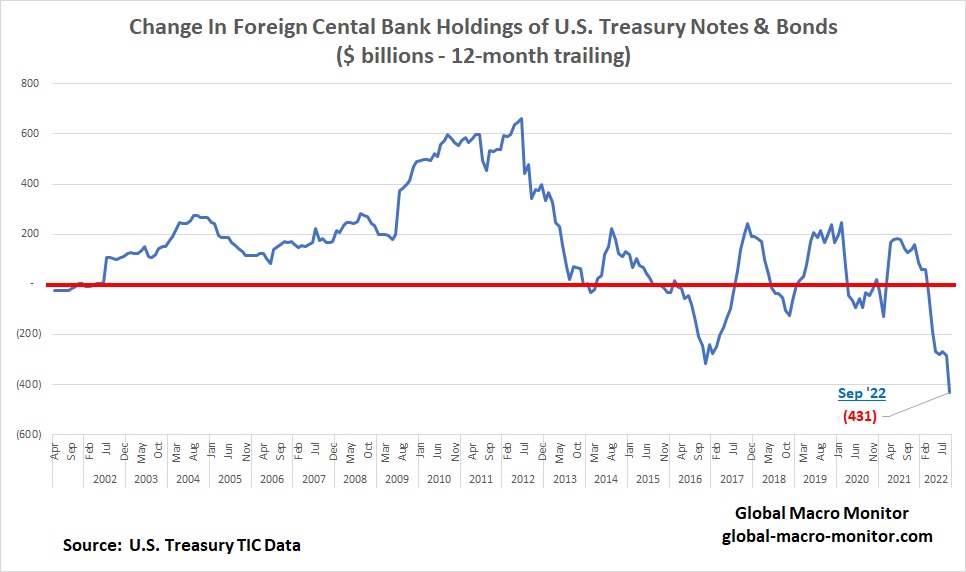
Central banks, both the Fed and foreign, have morphed from the largest buyers of Treasury notes and bonds over the past two decades into the largest net sellers.
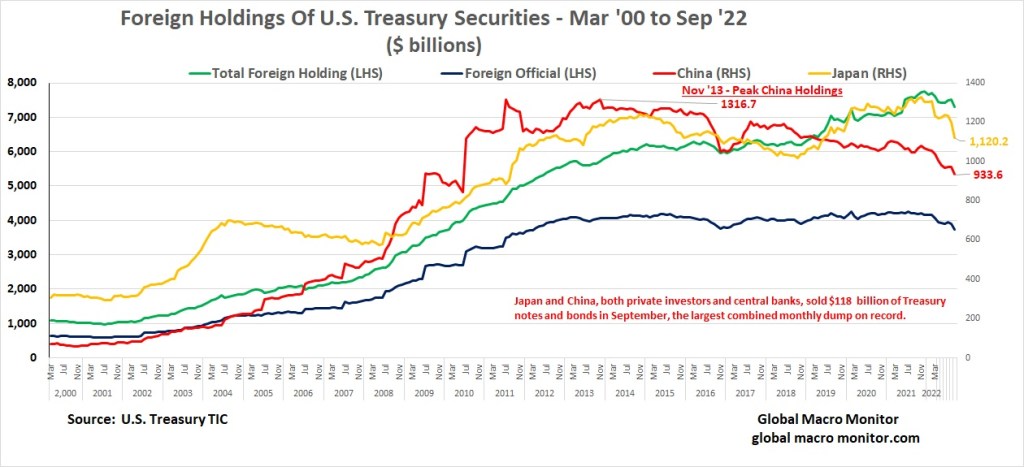
Japan and China Biggest Monthly Treasury Dump On Record
Japan and China, both private investors and central banks, sold $118 billion of Treasury notes and bonds in September, their largest combined monthly dump on record, which confirms our suspicions from a September post,
We also have no doubt Japan’s holdings are down from the latest observation in July. – GMM, Sep 29th
As of the end of September, the Japanese have sold $114 billion in coupon Treasuries since July, 9.2 percent of their holdings, and $208 billion from Japan’s peak holdings of $1.33 trillion in November 2021, down 15.7 percent.
The above goes a long way to explaining the below.
“In recent months, however, liquidity in the Treasury market has deteriorated further. This recent development is more concerning, as it seems as if market functioning has become a bigger source of risk, rather than just reflecting the uncertain fundamental environment.”
For most analysts, the liquidity problems in the Treasury market are not just about rapidly changing prices, they are also a reflection of a dearth of buyers, or an inability or unwillingness of the buyers in the market to mop up all the supply. The fact the Treasury department has begun discussing the prospect of buying back some of the most illiquid Treasury bonds, says HSBC’s Major, is an implicit acknowledgment that faltering demand has begun to cause problems. – FT
Our The Great Reset: The Bond Yield-Dollar Feedback Loop post provides a fairly reasonable framework to explain the dollar bond yield dynamic based on global capital flows. It’s an easy read and worth your time.
The Path to High (per) Inflation?
If the Fed is forced to step in and finance the U.S. Treasury as they did en masse with the COVID rescue packages or help in the rollover of Treasury refinancings, the economy will be set on a path of high inflation for many years to come.
Here is a reminder never to underestimate human ingenuity. The major reason why thinking linearly (straight-line extrapolating the past into the future) can get you into trouble and wreak havoc on your forecasts and prediction.
It’s disheartening to see two of sports’ GOATs caught up in the crypto implosion.
Can’t say they weren’t warned.
Tom Brady going to ruin his reputation by promoting crypto. Then, again, he promoted Trump in ‘16 and called an audible and ditched him. 👇🏽 go to 1:10 minutes https://t.co/PAAggS4FPS
FTX and former chief executive officer Sam Bankman-Fried were sued by an investor over claims that the cryptocurrency exchange now in crisis targeted “unsophisticated investors” using celebrity endorsers including Tom Brady and Stephen Curry, who are also named as defendants.
In a complaint filed Tuesday in federal court in Miami, Oklahoma resident Edwin Garrison is asking to represent a class of “thousands, if not millions, of consumers nationwide.” That includes all investors in the US who were enrolled in yield-bearing FTX crypto accounts, which he alleges constitute unregistered securities in violation of US and Florida laws. – Bloomberg, Nov 16th















 Global Macro Monitor