
Because the equilibrium price of gold is an unknown, the yellow metal keeps running. There is no real metric to determine its fundamental value — a real rate of interest and price-earnings or price to book ratio, for example. This is also the case with most commodities. And, in a world of zero interest rates, the opportunity cost of holding gold is extremely low. 
Analysts are struggling to find a fair value target price, using comps such as the “real”price high, the gold/S&P500 ratio, and the gold/crude oil price ratio. We know gold is being fueled by global monetary expansion in the form of: 1) the massive accumulation of foreign exchange reserves by Central Banks over the past seven years; and 2) most recently, the printing of money, i.e., quantitative easing, by the world’s major central banks. CNN reports,
“…some are arguing that gold is too pricey because it is trading at a historically high level when compared to a widely watched index that tracks the dollar versus a basket of other currencies…But Marion points out that this index only includes six currencies and is heavily weighted toward the euro. He said that if you look at gold prices when compared to another dollar index that the Federal Reserve uses, which is comprised of 26 currencies, gold still is trading about 50% below its peak price…gold would have to rise another $650 or so an ounce before it would truly look overvalued. That puts you close to $2,000 an ounce.”
Nobody knows the “right” price and that is why the commodity, in our opinion, will surprise to the upside.
Gold is the Tower of Terror trade, however, as the sell-offs are nothing short of hair raising. Size positions must be monitored very closely with disciplined stop losses. As we hit $1,300 we’ve reduced our gold position, waiting for a $25-30 pullback where we will be buyers; and have also swapped a portion into silver, the poor man’s gold, which is beginning to outperform and still far from its January 1980 all-time high (see chart below).
The November election is probably the biggest risk for gold as the Republicans and Tea Party members are more inclined toward “hard money” polices. Though it is unlikely a change in Congress will stop the printing press or accumulation of reserves by foreign central banks, just the uncertainty could create a nice buying opportunity. 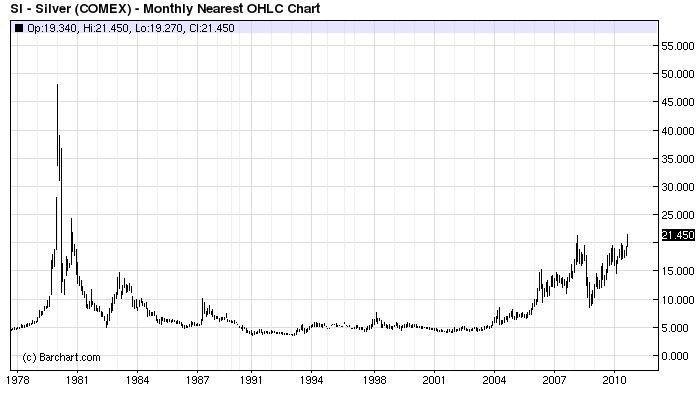
Some say Gold is nothing more than a fear trade.” We agree: we are afraid when we are too long, not long enough, or not long at all!

 Global Macro Monitor
Pingback: Will the Republican “Young Guns” Lasso Gold? | Global Macro Monitor