
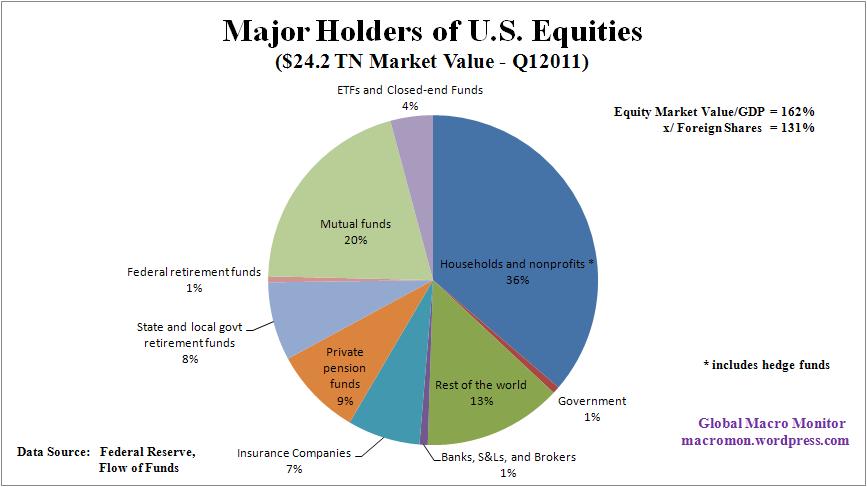
The following chart shows who holds U.S. equities, including foreign shares traded in the U.S.. at the end of March 2011. Notice that 36 percent of the market value of shares were held by the household sector. Our good friend, Charles Biderman of TrimTabs, does point out that the household sector includes “among other things, hedge funds, endowments, non-profit organizations, and direct purchases of equities by investors.” Furthermore, according to the Federal Reserve,
financial assets and liabilities of the household sector are largely derived as residuals because reports on the balance sheet activities of households are generally not available, except intermittently. In other words, the FFA starts with known economy wide totals for individual transaction categories and then amounts reported to be held by other sectors are deducted, leaving the household sector with the remainder. For most transaction categories, such as home mortgage debt and time deposits, this method seems reasonable because the household sector is the largest holder. Yet uncertainty about the accuracy of the asset and liability estimates in the FFA household sector remains and at times, the FFA estimates have been in question because of their residual nature.
Nevertheless, the chart does give a decent snapshot of the major holders of U.S. equities. Stay tuned, we will be back with more analysis on this topic. Click on chart for better resolution.
 (click here if chart is not observable)

 Global Macro Monitor
Pingback: Tuesday links: model building | Abnormal Returns
Pingback: Tuesday links: model building | HOUSE
Pingback: Who Owns the U.S. Equity Market? | The Big Picture
Pingback: Who Owns the U.S. Equity Market? | Jackpot Investor
Question: What does the x/foreign shares value refer to?
Is it equity market value/GDP excluding foreign shares?
Thanks
Paris, It is U.S. domestic equity value less foreign shares, such as ADRs from, say, among others, China and Brazil, for example. Hope that helps. Cheers.
Yes thanks.
“Households and nonprofits” includes hedge funds? That seems like a pretty important distinction to make.
Exactly! But that’s the Fed’s methodology. All we have.
Any idea why they lump hedge funds in with households and nonprofits? Doesn’t make any sense to me.
A, Most likely because they don’ t have the balance sheet info and lump it in as a residual. They may change as/if the hedgies become more regulated. Thanks for the post.
Pingback: Soylent Green is Made of… Profit! « Bourbon Myths