
The shortage of GPs [doctors] in England has been caused by multiple factors, including doctors leaving the profession early because of an increasing workload linked to a rising population. The shortage predates Britain’s vote last year to leave the EU, but the Royal College of GPs said before the June general election that Brexit might exacerbate the shortfall.
…“There is an inherent conflict between the need to hire international staff in order to maintain public services and the Brexit-related agenda of reducing immigration,” he added. — FT
And in the U.S.,
A new report by the Association of American Medical Colleges (AAMC) predicts that a shortage of physicians in the U.S. is going to grow worse.
The report estimates a shortfall ranging from 34,600 to 88,000 doctors by 2025, compared to what our growing and aging population may need. By 2030, the shortfall is expected to total anywhere from 40,800 to 104,900 doctors. – CBS
And this,
Healthcare is a critical part of the U.S. economy, providing jobs for millions of Americans and trillions of dollars in expenditures. However, growing health needs of baby boomers, coupled with acute shortages of health workers, are straining the sector. Unfortunately, labor force issues will be exacerbated in the coming years as retiring baby boomers strain the system and up to one-third of physicians retire because they fall into that same age category.
Currently, more than one-quarter of physicians and surgeons in the United States are foreign-born. In addition to physicians, roughly one-fifth of nurses and home health and psychiatric aides, and more than one-sixth of dentists, pharmacists and clinical technicians in the United States were foreign born in 2010. When foreign-born professionals account for 16% of all civilians employed in healthcare occupations and one-fourth of practicing physicians, the system really does depend on a functioning immigration system. There are simply not enough native-born healthcare workers to meet the growing demand–especially in the geographic areas with the greatest need. – Forbes
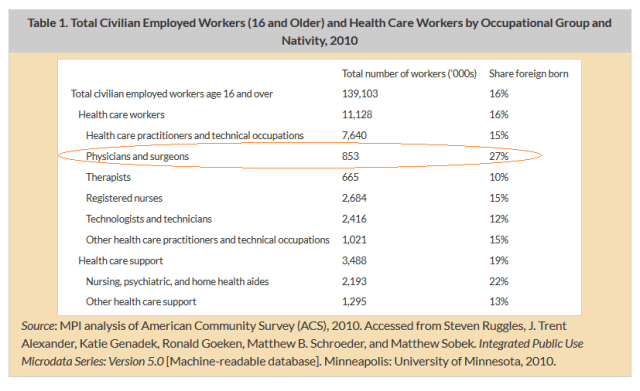

 Global Macro Monitor
This has much more to do with AMA and the Mafia style licensing tactics. It’s a barrier to entry and it has been for decades. American and foreign candidates by the tens of thousands are turned away every year. Other than litigation licensing this is the most corrupt system around. We’re in finance and I think you’ll all agree with me that we deal with a particular “expert” in our field that works in ivory towers and helps shape national economic policy. Their opinion/input is considered good as gold and therefore beyond reproach. I’m talking about the PhD economist of course. Licensing regimes are par for the course in every profession now also. MWhatever service an entrepreneur wants to try and provide he/she has to get the ok from some board or group first. That’s one way to deter small business development. Sorry for the rant, but I’ve seen similar reports and the problem is easily addressed, but much like unions they fight for crazy high pay and by limiting overall practicing doctors/surgeons/nurse practitioners demand remains high
Agree. AMA going to fight Med iTech very hard. Doctors on your wrist monitor will be the thing of the futures.
https://macromon.wordpress.com/2012/04/03/nonlinear-thinking-the-future-of-medical-services/