Global Macro Monitor
Monitoring the Global Economy
Skip to content
  • Home
  • About
  • Articles
  • Calendar
  • Contact
  • Disclaimer
  • Knowledge Base
  • Market Wizards
  • Mentions
  • Toolkit
← Draghi’s Monetary Policy Statement
Trump Says Unified Korea Could Happen →

U.S.-German Trade, Stagflation & World Current Accounts

Posted on April 27, 2018 by macromon

We have updated our ranking of the world’s 2018 Current Account Balances (CAB) by country from largest surplus o largest deficit in the ginormous table below.  The data are from the recent April 2018 IMF’s World Economic Outlook database.

Before checking out the G20 and world ranks, let’s  review a little theory and understand what drives the current account, or that nasty word “trade deficits.”

Current Account Balance

The following equation defines the current account balance.

CAB_Definition

What Drives The Current Account 

Contrary to popular belief and political bias, a country’s overall current account or trade balance is not so much the result of “fair” or “reciprocal” trade but defined primarily by the net savings in the home country’s  private and public sector.

It is explained clearly by the following national income identity, which we have posted several times over the years.

(S-I) + (T-G) = Current Account Balance (Foreign Savings)

 (S-I) is the ‘private savings balance’ or the difference between private sector savings (S) and investment (I); (T-G) is the ‘government balance’ or the difference between tax receipts (T) and all government expenditure (G); (X-M) is the difference between exports (X) and imports (M) and is usually called the simple ‘current account balance’.  – George Irvin

If a country runs an overall  savings deficit in the public and private sector, by definition, it has to run a current account deficit, which is simply importing foreign savings to fill the gap  of domestic savings over investment.

And a large current account deficit is not always a bad thing, especially depending on it’s financed. For example, Mozambique runs large current account deficits due to huge investments in its gas sector, and financed by foreign direct investment flows from big oil multinationals.

Trump’s Twin Deficits

We posted this  last January 2017, almost a week before President Trump was inaugurated,

If President Trump succeeds in implementing his proposed tax cuts and $1 trillion infrastructure spending plans,  the U.S. current account deficit, by definition, will, once again, balloon as net public savings will decline and, we believe, will be complemented by a decline in net private savings as business investment and private consumption increases.

The tax cuts have been implemented, the budget deficit has ballooned, and public savings have declined.

Voilà!  Tke a look at what is happening with he  U.S. trade deficit.

We hear about a pickup in capital expenditures by the business sector, and if not offset by personal savings, the trade and current account deficits will further continue to balloon.
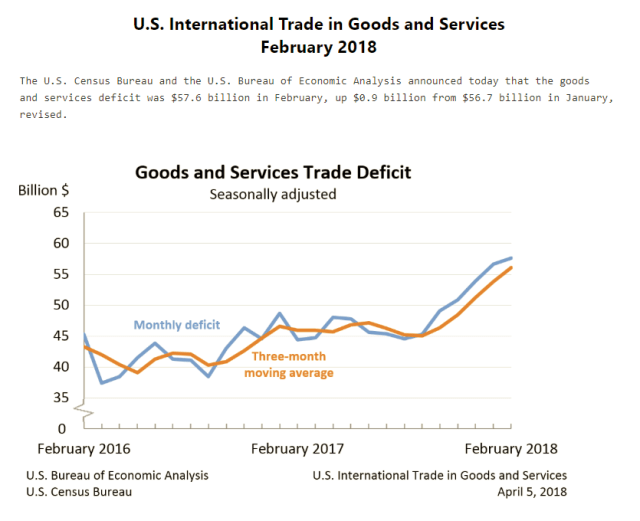
 

Apr27_U.S. Trade

If the U.S. had “reciprocal trade” – i.e., higher tariffs — without an offsetting increase in private or public savings,  the overall trade or current account deficit would remain roughly the same, but economic growth would be slower, and inflation would be higher.  That is stagflation.

The administration will be chasing its tail, as the external deficits continue deteriorate trying to impose external balance by higher tariffs, rather than restoring internal balance through adjusting savings.

In others, FUBARing the economy, and resulting in stagflation.

The trade or current account deficit is simple a safety valve or pressure release for too much domestic demand relative to savings,  which keeps inflation and interest rates lower than they would otherwise be.

Better Trade Deals Through Opening Markets

We agree it is optimal to negotiate better trade deals, especially with China as they are big boys now,  but we should not delude ourselves into thinking it is going to improve the over trade and current account balance.    There are much better ways for the country to protect those who have been hurt by free trade than imposing tariffs..

We don’t think the president and the administration are free traders but are more  motivated to protect certain industries and labor groups in the President’s political base.

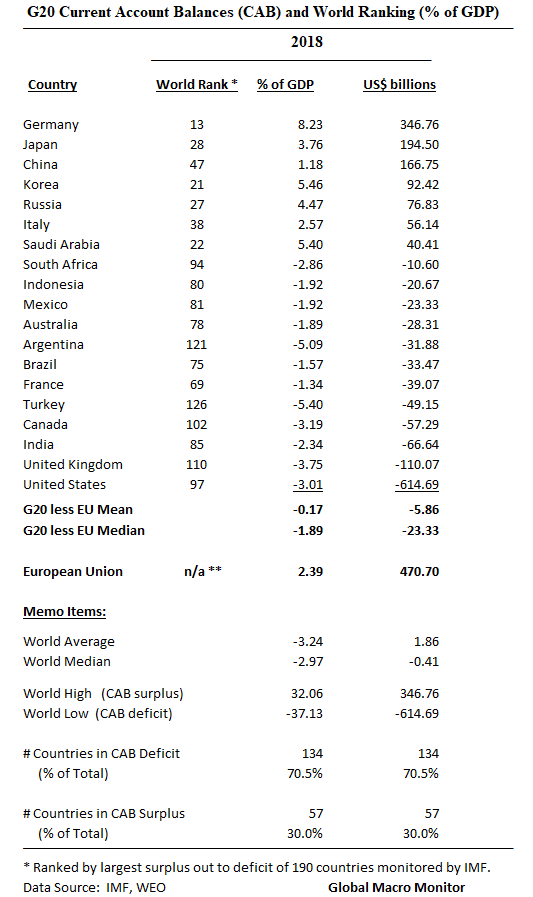
G20 Current Accounts

Now check out the G20 current accounts.

As we write the largest surplus and largest deficit countries in the world are holding a joint news conference in Washington..

Not hearing much about the underlying cause of the imbalances (note the U.S. has cut its current deficit in half over the last ten years).

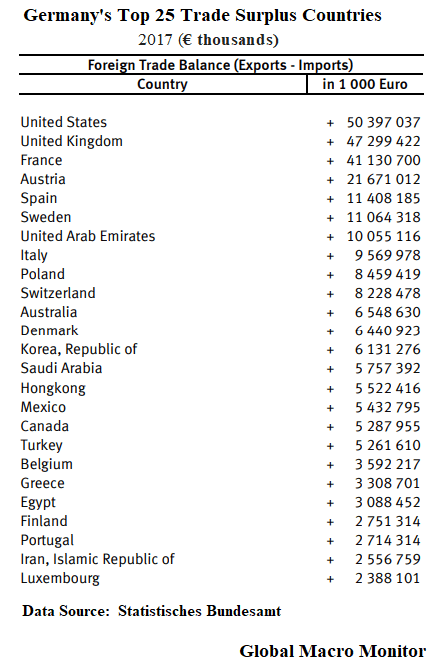
Also, don’t understand where President Trump is coming up with his $151 trade deficit number with Germany he is putting out there.  The Census Bureau calculates a deficit in goods and services with Germany in 2017 at -$67.7 billion.

He may be referring to just imports of goods.  He also seems to be conflating NATO contributions.

Does it even matter anymore in our post-Truth world?  Don’t bother me with the facts, ma’am.

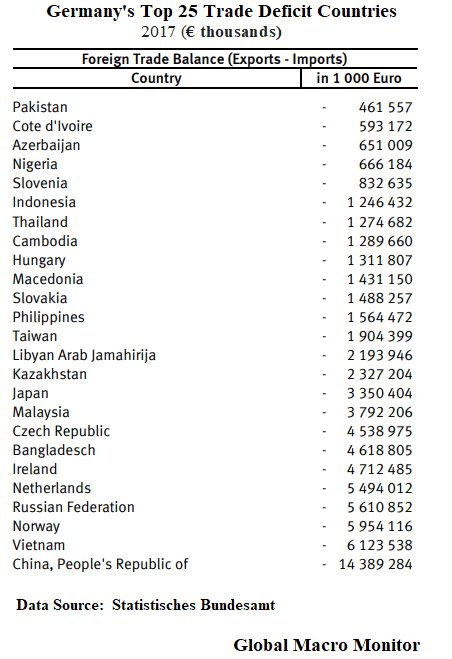
German Trade Surplus By Top Countries

Before the G20, first Germany”s  2017 top trade surpluses and deficits by country.
 

Apr27_Germany Trade Surplus


Apr27_Germany Trade Deficits


Note Germany’s current account surplus of over 8 percent of GDP.   The country has had a free ride with its exchange rate  and participation in the Euro.  The old Deutsche Mark would probably be 20-30 percent higher in value than the Euro.   The common currency makes German exports super competitive.

Pressure Coming

Nevertheless, the country is going to come under intense pressure to stimulate domestic demand to reduce the surplus, which would be very positive for the Eurozone economies.

 

Apr27_EU_CAB


Apr27_W_CAB


Share this:

  • Click to share on X (Opens in new window) X
  • Click to share on Reddit (Opens in new window) Reddit
Like Loading...

Related

This entry was posted in Euro, Germany, Policy, Politics, Uncategorized and tagged Germany, Trade Deficits, U.S., World Current Account Balances. Bookmark the permalink.
← Draghi’s Monetary Policy Statement
Trump Says Unified Korea Could Happen →

8 Responses to U.S.-German Trade, Stagflation & World Current Accounts

  1. Pingback: T-Minus… Prepare For Much Higher Long-Term Rates - aroundworld24.com

  2. Pingback: T-Minus… Prepare For Much Higher Long-Term Rates | State of Globe

  3. Pingback: T-Minus… Prepare For Much Higher Long-Term Rates – open mind news

  4. Pingback: T-Minus… Prepare For Much Higher Long-Term Rates | Real Patriot News

  5. Pingback: T-Minus… Prepare For Much Higher Long-Term Rates | Investing Daily News

  6. Pingback: T-Minus… Prepare For Much Higher Long-Term Rates - megaprojectfx-forex.com

  7. Pingback: T-Minus… Prepare For Much Higher Long-Term Rates – customchakra.com

  8. Pingback: T-Minus… Prepare For Much Higher Long-Term Rates – forexoperate.com

Leave a comment Cancel reply

This site uses Akismet to reduce spam. Learn how your comment data is processed.

  • In economics, things take longer to happen than you think they will, and then they happen faster than you thought they could.

    – Rudiger Dornbusch


  • Enter your email address to subscribe to this blog and receive notifications of new posts by email.

    Join 1,220 other subscribers
  • Follow @macromon
  • Contribute To GMM


    Donate Button with Credit Cards

  • Categories

    • 3D Printing
    • Agriculture
    • AI
    • Algos
    • Apple
    • Automation
    • Banking
    • BFTP
    • Bitcoin
    • Black Swan Watch
    • Bonds
    • Brazil
    • Brexit
    • BRICs
    • Budget Deficit
    • Capital Flows
    • Cartoon of the Day
    • Cashless Society
    • Chart of the Day
    • Charts
    • China
    • Clean Tech
    • Climate Change
    • Coach C
    • Commodities
    • Coronavirus
    • COVID
    • Credit
    • Crude Oil
    • Currency
    • Cyprus
    • Daily Risk Monitor
    • Day In History
    • Debt
    • Demographics
    • Disinflaton
    • Dollar
    • Earnings
    • ECB
    • Economics
    • Economist
    • Egypt
    • Electric Vehicles
    • Emerging Markets
    • Employment
    • Energy
    • Environment
    • Equities
    • Equity
    • Euro
    • Eurozone Sovereign Spreads
    • Exchange Rates
    • Fed
    • Finance and the Good Society
    • FinTech
    • Fiscal Cliff Monitor
    • Fiscal Policy
    • Food Prices
    • France
    • Futurist
    • Game Theory
    • General Interest
    • Geopolitical
    • Geopolitics
    • German Bund
    • Germany
    • Global Macro Watch
    • Global Reset
    • Global Risk Monitor
    • Global Stock Performance
    • Global Trend Indicators
    • Gold
    • Google
    • Greece
    • Healthcare
    • Heat Map
    • Hedge Funds
    • Housing
    • Human Interest
    • Immigration
    • Impeachment
    • India
    • Inequality
    • Inflation/Deflation
    • Infographics
    • Innovation
    • Institutional Investors
    • Interest Rate Monitor
    • Interest Rates
    • Interviews
    • Italian Yields
    • Italy
    • Japan
    • Jobs
    • Lectures
    • Macro Notes from Conference Calls
    • Manufacturing
    • Masters
    • Mexico
    • Monetary Policy
    • Movies
    • Muni Bonds
    • Muni Market
    • Natural Gas
    • News
    • Nonlinear Thinking
    • North Korea
    • Overbought Markets
    • Picture of the Day
    • PIIGS
    • PMIs
    • Policy
    • Politics
    • Population
    • Populism
    • Poverty
    • President Trump
    • Qunat Strategies
    • Quote of the Day
    • Quotes
    • Rare Earth Elements
    • Readership
    • Reads
    • Real Estate
    • Relative Strength Index
    • Robert Shiller
    • RSIs
    • S&P500
    • Sector ETF Peformance
    • Semiconductor prices
    • Semiconductors
    • Social Media
    • Socialism
    • Song for the Week
    • Sovereign Debt
    • Sovereign Risk
    • Spain
    • Sports
    • State and Local Government
    • Tail Risk
    • Technical Analysis
    • Technology
    • The Big Reset
    • The Weekend Read
    • This Day In Financial History
    • Trade War
    • Trades
    • Tweet of the Day
    • Ugly Chart Contest
    • Uncategorized
    • US Releases
    • Video
    • Volatility
    • Wages
    • Week Ahead
    • Week in Review
    • Weekend Reads
    • Weekly Eurozone Watch
    • Whales
  • Recent Posts

    • QOTD: Beijing’s Realpolitik
    • Global Risk Monitor: Week in Review – Dec 12
    • Tilly Norwood & AI Take On Hollywood
    • From Portugal to Turkey: A Look at the Diverging Economic Fortunes of 2025
    • December 7, 1941
  • Meta

    • Create account
    • Log in
    • Entries feed
    • Comments feed
    • WordPress.com
  • Archives

    • December 2025
    • November 2025
    • October 2025
    • September 2025
    • August 2025
    • July 2025
    • June 2025
    • May 2025
    • April 2025
    • March 2025
    • February 2025
    • January 2025
    • December 2024
    • November 2024
    • October 2024
    • September 2024
    • August 2024
    • July 2024
    • June 2024
    • May 2024
    • April 2024
    • March 2024
    • February 2024
    • January 2024
    • December 2023
    • November 2023
    • October 2023
    • September 2023
    • August 2023
    • July 2023
    • June 2023
    • May 2023
    • April 2023
    • March 2023
    • February 2023
    • January 2023
    • December 2022
    • November 2022
    • October 2022
    • September 2022
    • August 2022
    • July 2022
    • June 2022
    • May 2022
    • April 2022
    • March 2022
    • February 2022
    • January 2022
    • December 2021
    • November 2021
    • October 2021
    • September 2021
    • August 2021
    • July 2021
    • June 2021
    • May 2021
    • April 2021
    • March 2021
    • February 2021
    • January 2021
    • December 2020
    • November 2020
    • October 2020
    • September 2020
    • August 2020
    • July 2020
    • June 2020
    • May 2020
    • April 2020
    • March 2020
    • February 2020
    • January 2020
    • December 2019
    • November 2019
    • October 2019
    • September 2019
    • August 2019
    • July 2019
    • June 2019
    • May 2019
    • April 2019
    • March 2019
    • February 2019
    • January 2019
    • December 2018
    • November 2018
    • October 2018
    • September 2018
    • August 2018
    • July 2018
    • June 2018
    • May 2018
    • April 2018
    • March 2018
    • February 2018
    • January 2018
    • December 2017
    • November 2017
    • October 2017
    • September 2017
    • August 2017
    • July 2017
    • June 2017
    • May 2017
    • April 2017
    • March 2017
    • February 2017
    • January 2017
    • December 2016
    • November 2016
    • October 2016
    • July 2016
    • June 2016
    • May 2016
    • April 2016
    • March 2016
    • February 2016
    • January 2016
    • December 2015
    • November 2015
    • October 2015
    • September 2015
    • August 2015
    • July 2015
    • June 2015
    • May 2015
    • April 2015
    • March 2015
    • February 2015
    • January 2015
    • December 2014
    • November 2014
    • October 2014
    • September 2014
    • August 2014
    • July 2014
    • June 2014
    • May 2014
    • April 2014
    • March 2014
    • February 2014
    • January 2014
    • December 2013
    • November 2013
    • October 2013
    • September 2013
    • May 2013
    • April 2013
    • March 2013
    • February 2013
    • January 2013
    • December 2012
    • November 2012
    • October 2012
    • September 2012
    • August 2012
    • July 2012
    • June 2012
    • May 2012
    • April 2012
    • March 2012
    • February 2012
    • January 2012
    • December 2011
    • November 2011
    • October 2011
    • September 2011
    • August 2011
    • July 2011
    • June 2011
    • May 2011
    • April 2011
    • March 2011
    • February 2011
    • January 2011
    • December 2010
    • November 2010
    • October 2010
    • September 2010
  • Email subscribers should always click the website version as many times the original post is edited and updated. Thank you.

Global Macro Monitor
  • Comment
  • Reblog
  • Subscribe Subscribed
    • Global Macro Monitor
    • Join 1,220 other subscribers
    • Already have a WordPress.com account? Log in now.
    • Global Macro Monitor
    • Subscribe Subscribed
    • Sign up
    • Log in
    • Copy shortlink
    • Report this content
    • View post in Reader
    • Manage subscriptions
    • Collapse this bar
 

Loading Comments...
 

    %d