
-
In economics, things take longer to happen than you think they will, and then they happen faster than you thought they could.
-
Join 1,201 other subscribers
Contribute To GMM

Categories
- 3D Printing
- Agriculture
- AI
- Algos
- Apple
- Automation
- Banking
- BFTP
- Bitcoin
- Black Swan Watch
- Bonds
- Brazil
- Brexit
- BRICs
- Budget Deficit
- Capital Flows
- Cartoon of the Day
- Cashless Society
- Chart of the Day
- Charts
- China
- Clean Tech
- Climate Change
- Coach C
- Commodities
- Coronavirus
- COVID
- Credit
- Crude Oil
- Currency
- Cyprus
- Daily Risk Monitor
- Day In History
- Debt
- Demographics
- Disinflaton
- Dollar
- Earnings
- ECB
- Economics
- Economist
- Egypt
- Electric Vehicles
- Emerging Markets
- Employment
- Energy
- Environment
- Equities
- Equity
- Euro
- Eurozone Sovereign Spreads
- Exchange Rates
- Fed
- Finance and the Good Society
- FinTech
- Fiscal Cliff Monitor
- Fiscal Policy
- Food Prices
- France
- Futurist
- Game Theory
- General Interest
- Geopolitical
- Geopolitics
- German Bund
- Germany
- Global Macro Watch
- Global Reset
- Global Risk Monitor
- Global Stock Performance
- Global Trend Indicators
- Gold
- Greece
- Healthcare
- Heat Map
- Hedge Funds
- Housing
- Human Interest
- Immigration
- Impeachment
- India
- Inequality
- Inflation/Deflation
- Infographics
- Innovation
- Institutional Investors
- Interest Rate Monitor
- Interest Rates
- Interviews
- Italian Yields
- Italy
- Japan
- Jobs
- Lectures
- Macro Notes from Conference Calls
- Manufacturing
- Masters
- Mexico
- Monetary Policy
- Movies
- Muni Bonds
- Muni Market
- Natural Gas
- News
- Nonlinear Thinking
- North Korea
- Overbought Markets
- Picture of the Day
- PIIGS
- PMIs
- Policy
- Politics
- Population
- Populism
- Poverty
- President Trump
- Qunat Strategies
- Quote of the Day
- Quotes
- Rare Earth Elements
- Readership
- Reads
- Real Estate
- Relative Strength Index
- Robert Shiller
- RSIs
- S&P500
- Sector ETF Peformance
- Semiconductor prices
- Semiconductors
- Social Media
- Socialism
- Song for the Week
- Sovereign Debt
- Sovereign Risk
- Spain
- Sports
- State and Local Government
- Tail Risk
- Technical Analysis
- Technology
- The Big Reset
- The Weekend Read
- This Day In Financial History
- Trade War
- Trades
- Tweet of the Day
- Ugly Chart Contest
- Uncategorized
- US Releases
- Video
- Volatility
- Wages
- Week Ahead
- Week in Review
- Weekend Reads
- Weekly Eurozone Watch
- Whales
-
Recent Posts
Meta
Divining The CPI Report From The PMIs
After a read of the recently released manufacturing and services Purchasing Managers Index (PMI) reports for June, goods prices are softening significantly. However, the service sector is still experiencing price pressures, albeit at a deaccelerating rate.
Services comprise over 60 percent of the CPI, with shelter around 35 percent of the basket.
Even though the manufacturing sector is in contraction, hiring continues as if the employers are hoarding workers, similar to how consumers hoarded toilet paper during the panic. Granted, the employment data is a lagging indicator, but recency bias is a real bitch to break.
Nevertheless, we are taking the under on tomorrow’s core inflation print. Our recency bias, which we own, is that manufacturing prices tend to lead the headline inflation data, which is underreported.

For example, a special surcharge appears on our bill every time we dine out. A 3.5 percent surcharge was added to the bill at brunch on Sunday! Argh! We’ve seen labor, transport, and energy surcharges, just to name a few. Check your bills, folks
PMI Price Components:
Here is our summary of the PMIs with a little help from our AI friend:
In June, the U.S. manufacturing sector experienced a decline in input costs for the second consecutive month, with material prices dropping the most since May 2020. Suppliers offered promotions to incentivize purchases of inputs. Only one manufacturing industry reported price increases in June, while the majority reported either the same or lower prices. Despite weak demand, manufacturers hired new workers.
On the other hand, the U.S. services sector faced higher cost burdens due to supplier shortages, increased interest rates, and higher wage bills. Input prices rose at the fastest pace in five months, but efforts to remain competitive led to slower increases in charges. However, service sector firms saw a significant rise in cost burdens, primarily driven by higher wage bills, supplier prices, and borrowing costs. Cost inflation accelerated, reaching its highest level since January. Twelve service industries reported increased prices, while three reported price decreases.
Place your bets!
Posted in Uncategorized
Leave a comment
QOTD: I Can Buy Myself Flowers
QOTD = Quote of the Day
During SecTreas Janet Yellen’s visit to China, the government announced starting next month, China will impose restrictions on the global availability of gallium and germanium, obliging purchasers of these rare metals to obtain permits. This action underscores China’s prominent position as a major supplier of essential materials crucial for the production of various technologies utilized by consumers worldwide.
“This is no bouquet of flowers for Janet…The timing and symbolism could not be more clear to just about everybody in Asia, if not the rest of the world.” – Byron King, Paradigm Press

Posted in Uncategorized
Leave a comment
Global Sector PMI: Manufacturing Flops, Services Pop
Based on the recent release of the June Global Sector PMI from S&P Global, the state of manufacturing in various global sectors during June 2023 shows a divergence in performance between manufacturing and services. Manufacturing-based sectors experienced a drop in output, while services sectors demonstrated growth. Here are some key observations:
-
Manufacturing Sectors: a. Drop in Output: All six sectors that experienced a decline in output during June were manufacturing-based. The sectors with the sharpest drop in production were Forestry & Paper Products, Metals & Mining, and Chemicals. b. Input Costs: Inflationary pressures seemed to be softening, as June witnessed the lowest number of sectors with a rise in input costs in three years.
-
Services Sectors: a. Growth and Performance: The five fastest-growing categories were all services sectors. Financials, particularly Insurance, showed rapid activity growth. Banks and Real Estate companies also experienced increased activity. b. Employment: Real Estate registered the fastest increase in employment among the 21 categories covered. Hiring activity and wage pressures in Real Estate pushed up staff costs.
-
Other Observations: a. Tourism & Recreation: The Tourism & Recreation sector continued to grow solidly but at a slower rate than in the previous four months. The growth of new businesses in this sector also eased. b. Beverages & Food: Output in the Beverages & Food sector remained broadly unchanged. c. Healthcare Services: Workforce numbers in the Healthcare Services sector decreased significantly, reaching the second-largest extent on record (second to May 2020).
Overall, the manufacturing sectors faced challenges with declining output, while services sectors, particularly Financials and Real Estate, demonstrated growth. The softening of inflationary pressures and reduced input costs across various sectors indicate a potential easing of price pressures. However, the decrease in workforce numbers within the Healthcare Services sector suggests a notable exception to the overall resilience in staffing levels.
AI-Assisted


Posted in Uncategorized
Leave a comment
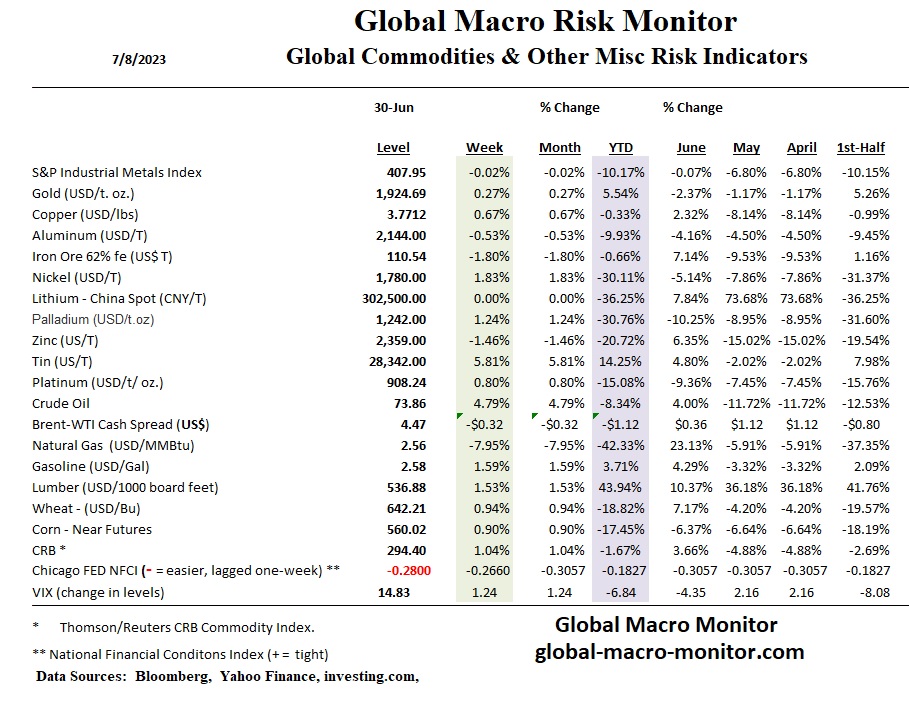
Global Risk Monitor: Week In Review – July 7
Yields spiking.


Posted in Uncategorized
Leave a comment
COTD: Perceptions They Are A-Changin’
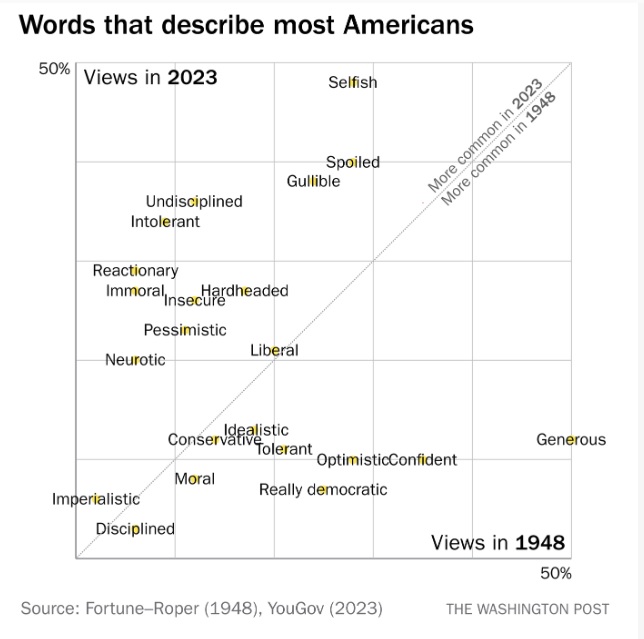
Interesting chart from the WashPost, comparing current polling with old polling.
The data,
…revisited 1948 polling from Fortune magazine in which people were asked whether they would use certain words to describe most of their fellow Americans. The results were striking, showing a distinct increase in negative perceptions of other Americans.
At YouGov’s website, this was presented as adjacent bar charts. I decided to take the data and present it as a scatterplot. Below, you can see where each word was measured in 1948 (x-axis) and 2023 (y-axis) — and how different the two values are. Words that sit on the diagonal line, for example, are ones that were applied equally in both years. Words far from that diagonal are ones that moved a lot.
In 1948, half of Americans viewed their fellow Americans as “generous.” Now, the descriptor that was most widely applied was “selfish.”
Not a surprise, given that Joey Chestnut won’t even share his hot dogs. – Washington Post
Posted in Uncategorized
1 Comment
When Will True AGI Arrive? (Sooner Than You Think)
AI is typically focused on solving specific problems, while Artificial General Intelligence (AGI) is designed to be able to solve any problem that a human can. Level of intelligence: AI systems are typically much less intelligent than humans, while AGI systems are designed to be as intelligent as humans or even more intelligent. – LinkedIn
Posted in Uncategorized
1 Comment
Happy Birthday, America!
Not a perfect union but a good one, and as Voltaire warned, “Don’t let the perfect be the enemy of the good.” We sense America is about to experience one of its biggest tests with the upcoming 2024 general election. Can the center hold?
We must remain watchful, alert, and proactive to maintain and safeguard our liberties. It serves as a reminder that freedom and the rights we enjoy require active and ongoing effort to protect them from threats and encroachments. Be vigilant.
Eternal vigilance is the price of liberty – Thomas Jefferson (maybe)
Here is Chat GPT’s chronology of events leading up to America’s Independence Day:
The Declaration of Independence, one of the most significant documents in American history, was created through a collaborative process involving several key figures. Here’s a brief overview of how it came to be:
- Growing Dissatisfaction: In the years leading up to the Declaration, tensions between the American colonies and Great Britain were mounting. The colonists felt increasingly oppressed by British policies, such as taxation without representation and restrictions on their freedoms.
- The Continental Congress: In response to these grievances, the Second Continental Congress was convened in Philadelphia in May 1775. Initially, the purpose of the Congress was to address the ongoing conflict with Britain and find a resolution.
- Drafting a Declaration: As the Revolutionary War escalated, the idea of declaring independence gained traction. On June 7, 1776, Richard Henry Lee of Virginia presented a resolution in the Continental Congress, stating that “these United Colonies are, and of right ought to be, free and independent states.” This resolution sparked a vigorous debate on the matter.
- Committee of Five: On June 11, 1776, a committee was appointed to draft a formal declaration. The committee, known as the Committee of Five, consisted of John Adams, Thomas Jefferson, Benjamin Franklin, Roger Sherman, and Robert R. Livingston. Thomas Jefferson, an eloquent writer, was assigned the primary responsibility of drafting the document.
- Jefferson’s Draft: Thomas Jefferson penned the initial draft of the Declaration of Independence in a matter of days. He drew inspiration from various sources, including Enlightenment thinkers such as John Locke, who emphasized natural rights and the consent of the governed.
- Revisions and Edits: Jefferson’s draft was reviewed and edited by the other members of the Committee of Five and then presented to the Continental Congress on June 28, 1776. The Congress debated and made numerous changes, resulting in a revised version.
- Final Approval: After further revisions, the Continental Congress adopted the final version of the Declaration of Independence on July 4, 1776. The document was officially signed by members of the Congress on August 2, 1776.
- Circulation and Impact: The Declaration of Independence was widely circulated throughout the colonies, rallying support for the cause of independence and inspiring people to join the revolutionary movement. Its powerful language and assertion of unalienable rights resonated with many and helped shape the American identity.
The Declaration of Independence proclaimed the colonies’ separation from Great Britain and laid the foundation for the establishment of the United States of America. It remains an enduring symbol of American values and ideals, including liberty, equality, and self-determination.
Posted in Uncategorized
4 Comments
QOTD: Thinking Exponentially
QOTD: Quote of the Day
People are really bad at thinking about exponential curves. – Sam Altman, Open AI

Posted in Uncategorized
Leave a comment

