The Crypto vs Dot.com Super Bowl

#CKStrong

Remember the 2000 Super Bowl at the peak of the dot.com mania, where newly minted dot.com companies spent most of their entire IPO proceeds to buy Super Bowl commercials to generate “eyeballs” to their websites to drive their stock price higher?  

Super Bowl XXXIV (played in January 2000) featured 14 advertisements from 14 different dot-com companies, each of which paid an average of $2.2 million per spot.[1][note 1] In addition, five companies that were founded before the dot-com bubble also ran tech-related ads, and 2 before game ads, for a total of 21 different dot-com ads. These ads amounted to nearly 20 percent of the 61 spots available,[1] and $44 million in advertising. In addition to ads which ran during the game, several companies also purchased pre-game ads, most of which are lesser known. All of the publicly held companies which advertised saw their stocks slump after the game as the dot-com bubble began to rapidly deflate.  

The sheer amount of dot-com-related ads was so unusual that Super Bowl XXXIV has been widely been referred to as the “Dot-Com Super Bowl”, and it is often used as a high-water mark for the dot-com bubble. Of these companies, 4 are still active, 5 were bought by other companies, and the remaining 5 are defunct or of unknown status.[when?] – Wikipedia

The Super Bowl commercials were clearly a signal that marked the top of dot.com mania, which crashed a few months later in March.  

Fast forward to the 2022 Super Bowl. 

Cryptocurrency’s biggest boosters would do well to remember tech’s most infamous sock puppet. The year was 2000; it was what would later be known as the “Dot-Com Super Bowl,” an NFL face-off during which tech companies bought up some 20 percent of the advertising real estate during the Big Game. A few years later, many of the companies that bought those ads were defunct or swallowed up by other firms—including Pets.com, which had run a commercial featuring a singing puppet made from a sock.

This warning comes not because crypto companies are looking to turn stockings into mascots (at least, not that we know of), but because they are currently pumping millions of dollars into buying up ad space during Super Bowl LVI. Crypto.com, which has been flooding the market with its Matt Damon-starring commercials lately, has a big spot running; cryptocurrency exchange FTX plans to give away bitcoin during its Super Bowl spot. Coinbase is also reportedly running an ad. The companies are playing coy about who will appear in them. Regardless, the message seems to be that crypto is hot and everyone should get on board. But as multiplearticleshave pointed out in the past week, the Crypto Bowl has echoes of those ill-fated tech-company ads of the past. – Wired

The dot.coms needed more eyeballs and the ads were generated to lure in more  “greater fools” to keep buying their worthless stocks to remain viable.  Ditto for crypto. 

We don’t know how this all ends but know thy history, folks.   Just sayin’.

The winner of the 2000 Super Bowl?  The Rams, gulp!


Posted in Uncategorized | 3 Comments

Best Super Bowl Prop Bets

#CKStrong

A prop bet – or proposition bet – is a wager that doesn’t necessarily correlate with the outcome of the championship game. Instead of betting on wins and losses, total score or point spread, you would bet on things like how many yards will Joe Mixon or Cam Akers rush for or how many touchdown passes Joe Burrow or Matthew Stafford will throw. – oddsshark.com

Best Odds

Coin Toss

Before every football game, a coin is flipped to determine which team will receive the ball first. The coin toss prop is one of the most popular Super Bowl prop bets you can make, with millions being won and lost on this bet each year.

For this bet, you have to guess whether the coin will land on heads or tails. There is a 50-50 chance for either result.

Fun Bets

Gatorade Shower

This image has an empty alt attribute; its file name is sb_gatorade-shower.jpg

Traditions run deep during football’s biggest night. One of the most exciting ones is the Gatorade bath. Players from the winning team dump an entire vat of icy-cold electrolyte water onto their head coach to celebrate their victory. Guess the correct color of the post-game Gatorade shower and you win!

Gatorade prop bets at Super Bowl betting sites let you wager on which color liquid will be poured on the winning coach of Super Bowl 56. The color of the liquid poured on last year’s winning coach was blue.

Gatorade color options include:Orange
Red
Lime/Green/Yellow
Clear/Water
Blue
Purple

National Anthem Super Bowl Props

The Star-Spangled Banner is performed before every sporting event in the United States and the Super Bowl is no exception. Anthem props range from the length of time it takes to belt out the song to whether the singer will forget a word.

Here are some of the Super Bowl prop bets that you could wager on for the Super Bowl LVI national anthem:

• How long will it take to sing the U.S. national anthem?
• Will the artist(s) forget or omit a word from the national anthem?
• Will any scoring drive take less time than it takes to sing the national anthem?

Halftime Show Props

The halftime show gives the audience a chance to take a breather from the intensity of the game and watch some of the greatest performers of our time (Dr. Dre, Eminem, Snoop Dogg, Mary J. Blige) put on an entertainment clinic. Halftime props deal with the show itself, and allow you to bet on things like the color of the singer’s shirt or if they’ll be wearing a hat.

You will find odds at your favorite sportsbook for the halftime show below:

• Who will sing first at the halftime show?
• Will Eminem make a political statement during the halftime show?
• Will a brand new song feature during the halftime show?
• Will all five artists collaborate together for a song?
• What will Eminem’s first song be?
• How many songs will be performed during the halftime show?
• Will Snoop Dogg smoke on stage?

Exotic Prop Bets

(for odds see here)

  • Will Any Player Propose To Girlfriend On Field After The Game
  • What Will Happen To the Price Of  Bitcoin During The Super Bowl
  • How Many Times Will Roger Goodell Be Shown On Broadcast
  • Commercial To Play First
  • Commercial To Play Last
  • Will The Halftime Show Have A Wardrobe Malfunction
  • How long will it take to sing the U.S. national anthem
  • Will any scoring drive take less time than it takes to sing the national anthem
  • What team jersey will Drake wear
  • What the first song performed at Half-Time show
  • Will a kicker hit the upright or crossbar
  • What will be mentioned first during Super Bowl MVP speech
  • Which Crypto company will air first
  • Will Al Michaels or Chris Collinsworth say the spread or toal
  • Will Joe Burrow be compared to Macaulay Culkin
  • Which Hollywood landmark will be shown first
  • What celeb will be shown first
  • What university will be said first
  • A player doing “the Ickey Shuffle” during the game
  • Will Peyton Manning bowl a strike in a Michelob Ultra commerical

Posted in Uncategorized | Leave a comment

Inflation Rages While The Fed Prints

#CK Strong

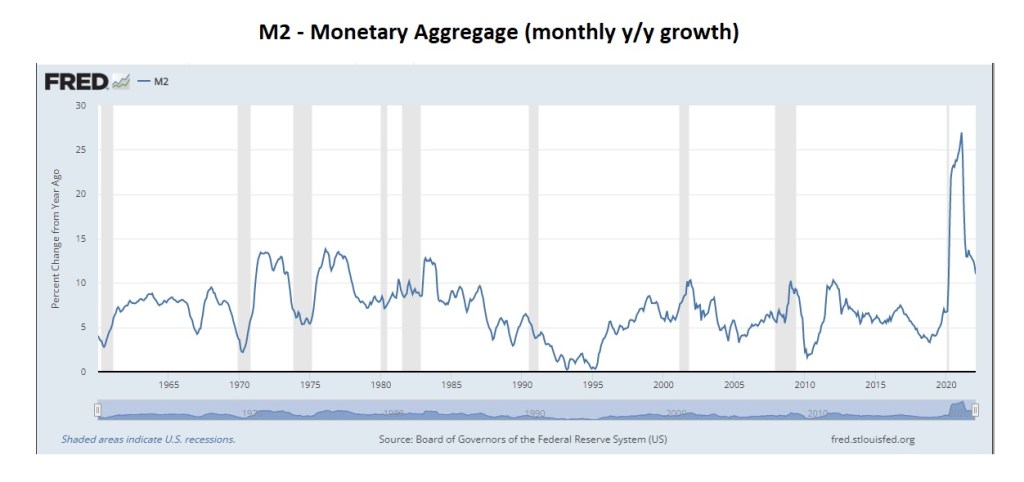
The CPI came in hot, hot, hot for January at 0.6 percent, exceeding expectations. Yet the Fed is still pumping, adding a total of $123 billion into the economy in 2022, which should end soon.

What the heck? Has the Fed morphed into the old Banco Central de Argentina?

It’s not the supply chain, Stupid!

The supply chain has been swamped and overloaded with too much demand. Ports are overwhelmed by too much traffic.

Sure, some price inflation results from real supply shocks, but this is primarily driven by excess demand, instigated by the overstaying of too much stimulus. We certainly agree that the initial stimulus package was needed, but it was very poorly structured. Come on, man, Wall Streeters taking PPP loans while many small businesses were shut out?

Semiconductor Shortage

Market wide semiconductor shortage? Think again.

Look at worldwide semi revenues, up 23.7 percent year-on-year in November. Some of that is inflation, but the quantity of semis produced continues to expand quite rapidly.

No doubt, in a few sectors there is a real supply shock where the quanity of certain semiconductor products are falling. Talk to most any semiconductor CEO and he/she will say the same.

Why Is The Fed Dragging Their Feet?

I think the Fed fears what we fear.

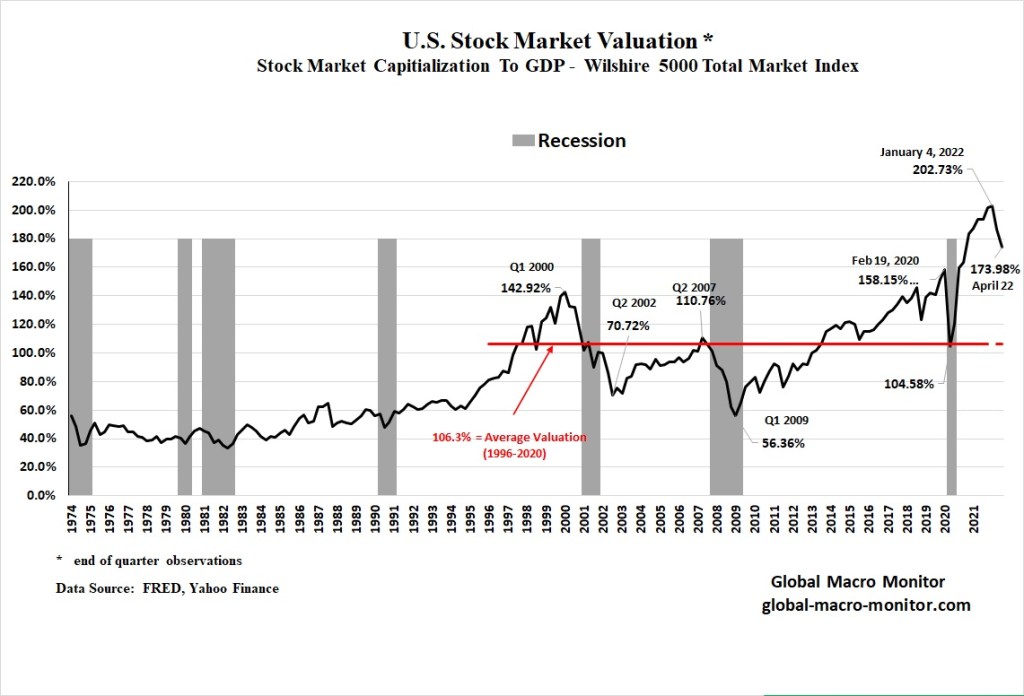
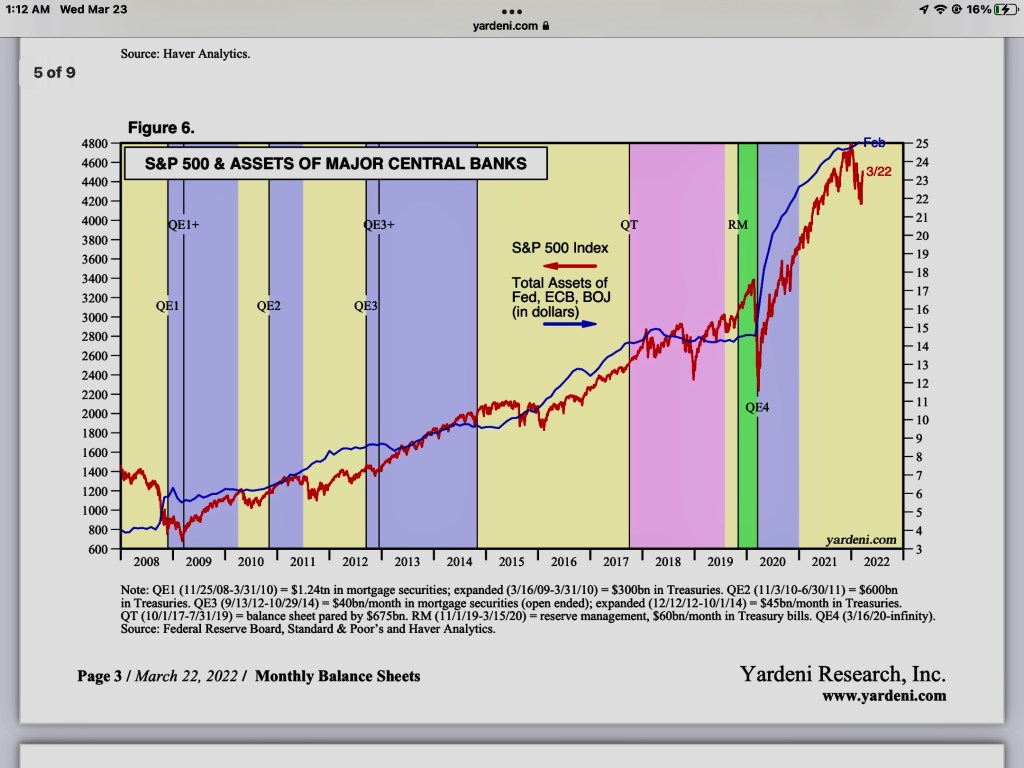
The U.S. economy is way too dependent on the asset markets with a stock market capitalization north of 2x GDP the last time we looked, which the Fed is mainly responsible for, by the way. That puts the U.S. economy in an unstable equilibrium.

If the Fed slams the oven door too hard, the soufflé collapses in on itself..

This is illustrated in the following chart, which we have posted several times.

The Fed needs to reach for the Draino, and fast, like several months ago.  

Stay tuned.  

Email subscribers should always click the website version as the original post is often edited and updated. Thank you.


Posted in Uncategorized | 20 Comments

Sufficiently Inefficient Efficient Markets

#CKStrong 

The efficient market hypothesis (EMH) says that prices reflect all available information. This leaves a lot of room for interpretation. Should asset prices be set by rational investors whose only concerns are systematic risk1 and expected returns? It seems implausible to link recent meme-stock price movements to economic risks. Rather, they seem fueled by investor demand to be part of a social movement, hopes to strike it rich with a lucky stock pick, or plain-old schadenfreude. – Franklin

After reading the following article this morning on the Chinese stock market, we are reposting a piece from back in the day about how algos have buried the Efficient Markets Hypothesis (EMH).

My professors in grad school would say this is impossible, and I have one word for them: GameStop! (h/t Harry The K.).

It’s stunning that the SEC and other policymakers have allowed this to go on.

Monetary policymakers really “have a tiger by its tail.”

This image has an empty alt attribute; its file name is china_algo_1.jpg

China has been cheering ecstatically for US-born freestyle skier Eileen Gu, who got a gold medal for China at the Beijing Winter Olympics during the women’s big air competition yesterday (Feb. 8). Now it turns out companies whose names resemble Gu’s Chinese name are also getting a lift.

It is not uncommon for small-cap companies listed in China to see their shares move due to news events, even if the firms have no connection at all with the newsmakers. In November 2020, a Chinese company whose name sounds like “Trump wins big” in Mandarin Chinese surged almost 10% on the final voting day of the US presidential election, whose two candidates were the Democratic party’s Joe Biden and the Republican party’s Donald Trump. – Quartz

This image has an empty alt attribute; its file name is china_algo_2.jpg

Does Anne Hathaway Drive Berkshire Stock?

Orignally posted on  

We posted last October our suspicions that algo/robo traders were driving the almost tick-for-tick correlation between the Australian dollar and the S&P500.  Remember those days of great fun?

Now, the Atlantic suspects that algorithms may, and we stress may,  have been written and programmed to buy Berkshire Hathaway (BRK-A) stock when Anne Hathaway is mentioned in the news!   Alexis Madrigal of The Atlantic writes,

A couple weeks ago, Huffington Post blogger Dan Mervish noted a funny trend: when Anne Hathaway was in the news, Warren Buffett’s Berkshire Hathaway’s shares went up. He pointed to six dates going back to 2008 to show the correlation. Mervish then suggested a mechanism to explain the trend: “automated, robotic trading programming are picking up the same chatter on the Internet about ‘Hathaway’ as the IMDb’s StarMeter, and they’re applying it to the stock market.”

The idea seems ridiculous. But the more I thought about the strange behavior of algorithmic trading systems and the news that Twitter sentiment analysis could be used by stock market analysts and the fact that many computer programs are simply looking for tradeable correlations, I really started to wonder if Mervish’s theory was plausible.

Madrigal checked in with John Bates, former Cambridge computer whiz whose company Progress Software writes algo strategies for hedge funds to ask, “Is this at all possible?  Bates, to his surprise, answered “Maybe.”

We come across all sorts of strange things in our line of business, strange correlations,” Bates told me. “And I’ve had a lot of interest in this for a long time because it’s really often the secret source for certain hedge funds.”

Companies are trying to “correlate everything against everything,” he explained, and if they find something that they think will work time and again, they’ll try it out. The interesting, thing, though, is that it’s all statistics, removed from the real world. It’s not as if a hedge fund’s computers would spit the trading strategy as a sentence: “When Hathway news increases, buy Berkshire Hathaway.” In fact, traders won’t always know why their algorithms are doing what they’re doing. They just see that it’s found some correlation and it’s betting on Buffett’s company.

Algo/robo trading appears to becoming not only more bizarre, desperate and reaching the level of the absurd.   Imagine a program, for example,  written to sell 10K S&P500 futures contracts in illiquid market on the news of a report of a butterfly flapping its wings at home plate at Wrigley Field momentarily interrupting  a Cubs game.  The selling drives the index down 2 percent.  Another program written to sell several thousand  contracts when the index moves down 2 percent in, say,  a 45 second time period then kicks in, driving the index down another 3 percent.  Several thousand other programs are written to sell  several thousand more contracts when the market is down 5 percent.   A tornado on Wall Street set off by the flapping of a butterfly’s wings in Chicago?  Hey, don’t entirely discount such a scenario.  This is probably not far from what happened during last year’s “Robots Gone Wild” flash crash which was kicked off by the bank burning Greek riots.

At least we have some theories behind our correlations, such as the Hang Seng as an indicator species for global risk appetite.   And we did make some money once buying Callaway (ELY), the proud sponsor of Phil Mickelson, the Friday before he won his first Masters.

But  good luck trying to trade against this type of nonsense.   We also wonder if the robot has been reprogrammed to sell rather than buy Nike (NKE) after Tiger’s downfall when he is now mentioned in the news.   As they say on the newly paved Street, just go with the flow algo!

Email subscribers should always click the website version as the original post is often edited and updated. Thank you.

Posted in Equities | Tagged , , , | Leave a comment

So You Think The Stock Market Is Volatile?

#CKStrong

It’s all relative, folks.

Thus far in the new year, there have been 25 trading days, of which six days have had moves on an absolute basis of over 1.5 percent (both positive and negative). During 2021 the average number of six daily moves over 1.5 percent during the previous 25 days was two, so, yes, volatility has certainly picked up.

Realized 25-day annualized volatility at the close of today’s trading was 19 compared to an average of 12 in 2021 and 27 in 2020. The VIX closed at 22.86 today, which seems a bit low to us.

The extraordinary volatility of 2020 was driven by the COVID stock market crash in February/March, the most volatile 25 -day period in post-war stock market history. The VIX failed bigly to anticipate future volatility and was at 14 when the bear market started on February 19th.

Too many yield-seeking vol sellers during quiet times have weakened the VIX as an anticipatory signal, in our opinion.  The VIX, expected volatility based on option prices over the next 30-day period, peaked at 85 in early April 2020, along with our measure of realized volatility.

In early April 2020, the 25-day realized volatility increased to over 90, absolutely stunning, and illustrated in the following chart.

The stock market anticipated the largest quarterly economic collapse in the county’s history, coming in Q2 2020, where real GDP fell 37.5 percent at a compounded annual rate. Interestingly, the S&P bottomed on March 23rd just before the start of Q2 as it heard the footsteps of the most massive global fiscal and monetary stimulus in history.

The 2020 economic and stock market collapse was most likely an aberration, not to be repeated. We seriously doubt global policymakers will flip the lights off on the economy ever again. Never say never?

Current Market

We expect volatility to remain elevated as the Fed starts to turn the monetary screws in March, but they are a long way from neutral. If the past is prologue, they will move at a snail’s pace. 

At some point during the tightening cycle, something will break, most likely the equity market first, if the Fed doesn’t get spooked by increased market volatility and lets inflation run, which will be political death for the political party in power.   Think 1980, Jimmy Carter, and Paul Volcker. 

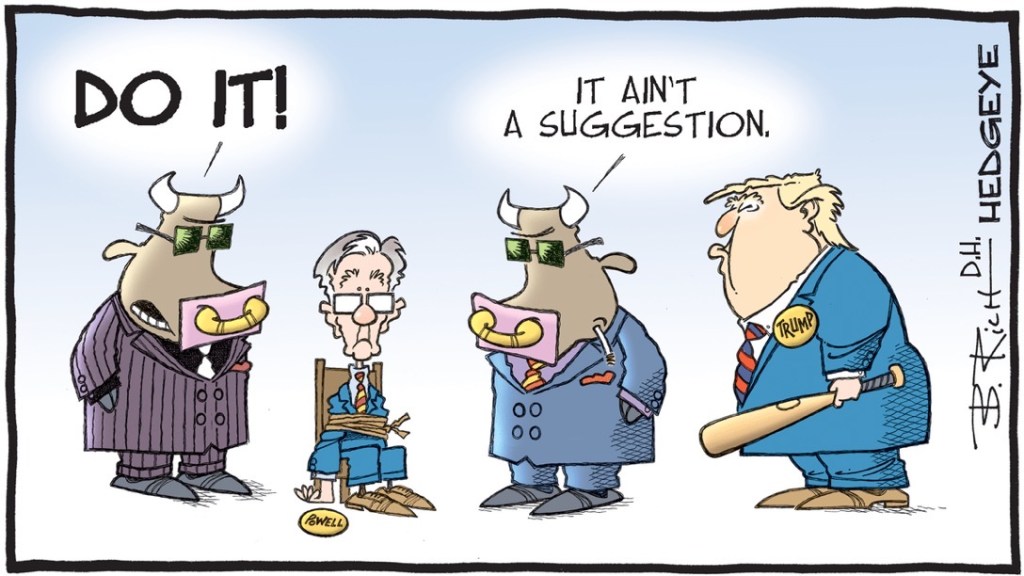
Jay Powell is no Paul Volcker and will have to earn his inflation-fighting bona fides.

Investors should certainly have some dry powder, lots, in our opinion, to put to work on the break.  The S&P500 is up 112 percent over the past five years, and since 1960,  second only to the move in the mid to late-1990s.

Valuations are extraordinarily elevated, and the market is overdue for a big dipper.  Nobody knows the timing of a major correction, which will likely be determined by how sensitive the market is to the coming monetary tightening cycle and how far and hard the policymakers have to squeeze to bring inflation under control.

Equities Are The Place To Be In The Long-Term   

There is no doubt, however, equities are where wealth is built over the long-term, reflected in the following chart.  

That is one scary chart and really should be scaled by taking the log of the S&P levels. 

Getting Out Too Early

I sold out at 3200, leaving 1300 S&P points on the table, which would have resulted in my firing if I were not in the fortunate position of being independent.  I also have trader status with the IRS, which cannot be revoked, so taxes are not an issue in my decision-making. My positions are marked-to-market at the end of the year, taxed on the mark, even if I haven’t sold or covered the position. 

However, most investors and portolio managers are not in my position and have to remain almost fully invested due to career risk and fear of missing out (FOMO).  I have always equated FOMO investing to fearing missing the four days of partying on the Titanic after it left the dock. No thanks, not my cup of tea, though I do get the trade. I really do, even in crypto. 

Putting the big fail of getting out too early in the past, I am currently positioned in my happy place and sleep well at night (even though I am a chronic insomniac). I hope you all are too, that is in your happy investing place.  

Scalping is the word for me. Stay tuned.    

Posted in Uncategorized | Leave a comment

S&P500 Key Levels & Realized Volatility

#CKStrong

Wow, wild swings. We wrote on January 6th,

Will the current sell-off morph into a Wiley E. Coyote moment and drive stocks over a cliff allowing them to fall to fair value, which, for most, is much lower?  We seriously doubt it until the Fed begins to remove lots of the stimulus and tighten monetary conditions. – GMM

Almost every big move this young year seems that traders were way offside.

We expect volatility to remain high before a new trend is established, which will come when the Fed starts tightening the screws, if, and a big if the Board has the spine, which we have our doubts.

The big moves last Friday and Monday (see chart below) may have been the shy tone that several Fed officials expressed earlier this week about the willingness to go to war on inflation.

Nevertheless, the wage/price spiral is accelerating. Take a look at Amazon after their earnings release today. Management announced that Prime membership fees would increase by $20, almost 20 percent, which we expect is to help offset their rising labor costs.

Amazon has well over 200 million Prime members, and it’s estimated that 60-70 percent of American adults are members. Inflation coupled with accommodative monetary policy is good for stocks in the short term, and Amazon’s stock is up over 15 percent in after-hours trading.

The longer the Fed waits or is too slow, however, inflation digs its roots deeper into the economy, and the more pain will be inflicted from the coming tightening cycle.

Posted in Uncategorized | Leave a comment

QOTD: America’s Monetary Orgy

#CKStrong

QOTD = Quote of the Day

…the Fed continues to ladle out the punch, even though the party is turning into an orgy. – Martin Wolf, “The Fed Is Too Late To Remove The Punchbowl,” FT

Posted in Uncategorized | Leave a comment

S&P500 Key Levels – January 27

#CKStrong

The market made a valiant effort to recapture the S&P’s 200-day today but failed and couldn’t hold its early gains.

Posted in Uncategorized | Leave a comment

S&P500 Key Levels – Jan 26

#CKStrong

Recapturing the 200-day at 4432.62 (+1.9%) relatively soon a must for Bulls to hold the line here.

Posted in Uncategorized | Leave a comment

S&P500 Key Levels

#CKStrong

S&P has some work to do. Today’s low a must hold. Today’s high at 4417.35 most likely taken out in the morning, a January close above the December low at 4495 usually a necessary condition for a positive year. Stay tuned.

Posted in Uncategorized | Leave a comment