
Key Points:
- Six of seven key battleground states outpaced national GDP growth in Q2 2024.
- Michigan and Wisconsin were among the top 10 fastest-growing states.
- Pennsylvania rebounded after contracting in Q1.
- Arizona, Georgia, and North Carolina saw higher-than-average growth.
- Nevada’s growth lagged at 1.8%, below the 3% national average.
- Harris is narrowing the gap with Trump on economic issues.
- A Bloomberg/Morning Consult poll shows Harris tied with Trump on everyday costs.
- Harris has an 11-point lead on middle-class welfare.
- Manufacturing and construction drove growth in several states.
- High prices for essentials continue to concern voters.
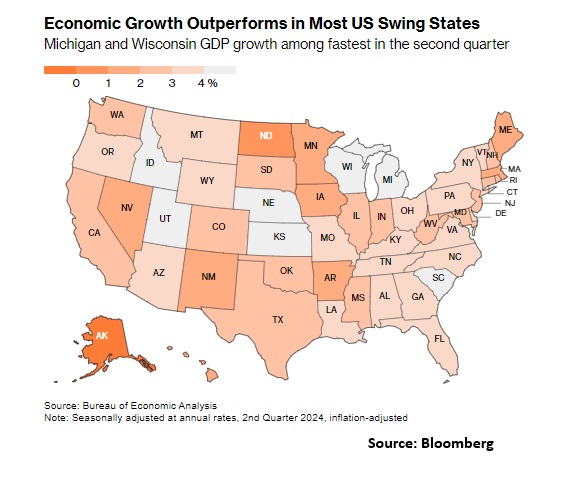
Six of the seven key battleground states in the upcoming U.S. presidential election registered economic growth faster than the national average in the second quarter. Michigan, Wisconsin, and Pennsylvania, which have been slower to recover post-pandemic, experienced a strong economic resurgence. Michigan and Wisconsin were among the top 10 fastest-growing states, and Pennsylvania rebounded after a contraction in the first quarter. The economic momentum in the swing states provides a political boost for Vice President Kamala Harris, who has been narrowing the gap with Donald Trump on economic issues in recent polls.

The “Sunbelt” battleground states—Arizona, Georgia, and North Carolina—also recorded growth above the national average. Nevada was the outlier where growth lagged, primarily due to challenges in its accommodation and food services sectors that are vital to the state’s economy.
Voters have consistently ranked the economy as their top concern, with Trump leading Harris on the issue in most polls. Harris is catching up, however, particularly on matters related to the cost of living and middle-class welfare. A recent Bloomberg/Morning Consult poll shows that Harris is nearly tied with Trump on handling everyday costs and holds an 11-point lead in helping the middle class.
A big caveat is that despite these positive trends, many Americans still feel economic pressure due to high prices, even as inflation slows. GDP growth doesn’t always translate to votes, as voters’ concerns remain focused on the tangible costs they face.
Source: Bloomberg

 Global Macro Monitor