
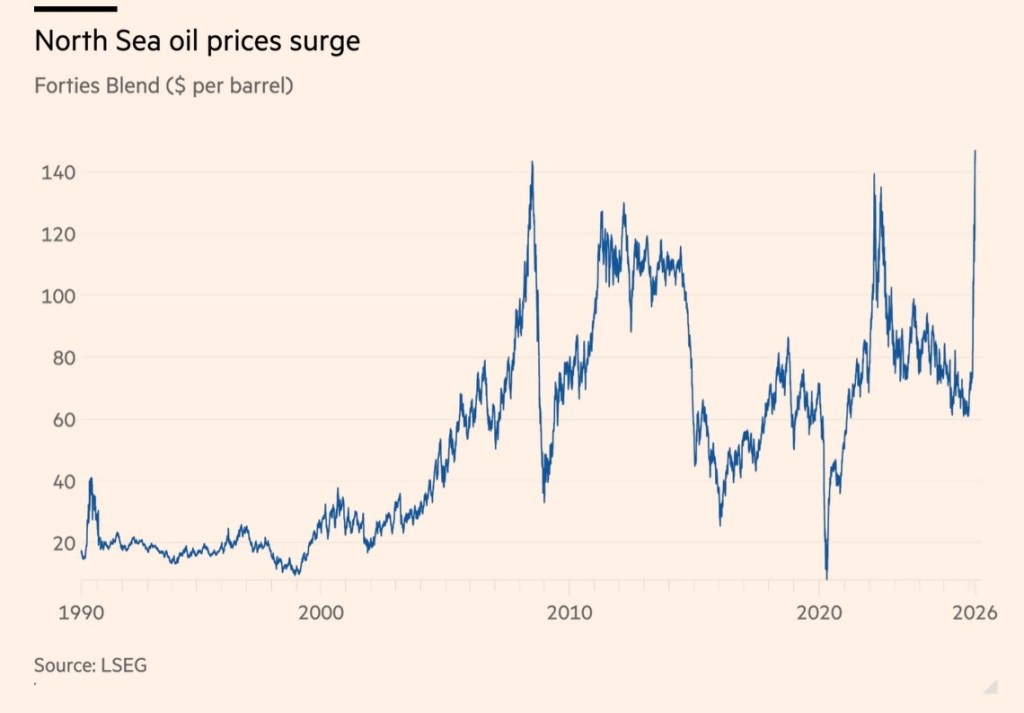
The global oil market is currently flashing a “code red” for portfolio managers and energy traders. While headline futures remain relatively anchored, the physical market is screaming of a systemic shortage. As reported by the Financial Times, a desperate scramble by European and Asian refiners to secure immediate supplies has catapulted North Sea physical prices to historic levels, fueled by Iran’s ongoing blockade of the Strait of Hormuz.
The $50 Basis Gap The most striking indicator of this crisis is the unprecedented decoupling of physical barrels from paper benchmarks. Forties Blend—a critical marker for immediate delivery—surged to nearly $147 a barrel this week. To put that in perspective, while the Brent June futures contract hovers around $97, the physical “Dated” Brent is trading at a staggering premium of roughly $50. This is no longer a speculative play; it is a frantic hunt for molecules.
Exchange Infrastructure Under Strain We are witnessing a rare breakdown in market mechanics. The volatility in Brent Contracts for Difference (CFDs)—the primary tool for hedging the gap between immediate and future delivery—became so extreme that prices breached the Intercontinental Exchange’s (ICE) reporting thresholds. With CFD spreads exceeding $30, the exchange essentially hit a circuit breaker, forcing trading into the less transparent “over-the-counter” (OTC) shadow markets. For hedge fund managers, this loss of price discovery and liquidity in standard hedging instruments is a significant red flag.
Geopolitical Disconnect Despite optimistic rhetoric from Washington suggesting that Iranian transit will resume “very quickly,” the data tells a different story. Goldman Sachs reports that exports through the Strait of Hormuz are currently at a mere 8% of normal levels. The vulnerability is most acute in Asia, where 80% of petroleum imports rely on this waterway.
The supply side is facing a “perfect storm.” Beyond the Hormuz bottleneck, Saudi Arabia’s capacity has been slashed by 600,000 barrels per day following strikes on the Khurais and Manifa fields, and the East-West pipeline—a vital bypass route—has seen its throughput crippled.
The Macro Outlook Portfolio managers should prepare for a prolonged “physical-first” rally. Even if a diplomatic breakthrough occurs tomorrow, experts warn it will take at least 20 days to resolve the logistical backlog. As Helima Croft of RBC Capital Markets aptly noted to the FT, futures are currently a “lagging indicator” for the grim realities of Middle Eastern waterways. In this environment, the physical market is the only truth-teller.

 Global Macro Monitor