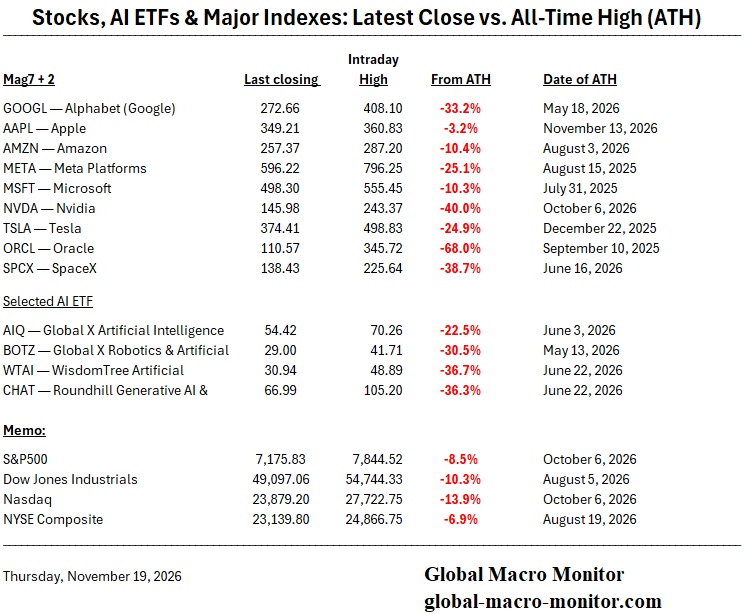
On the surface, the broader equity market still looks respectable for 2026. Most of the major benchmarks, including the S&P 500, Nasdaq, Dow, and Russell 2000, remain in positive territory for the year.
Look just beneath the headline year-to-date gains, however, and a far more sobering picture emerges. Almost every major index is now down double digits from its 2026 intraday peak, while the core engines of the AI boom are nursing severe bear-market losses.
- Nvidia (NVDA) is now down roughly 50% from its October high and 33% YTD.
- Oracle (ORCL) has cratered 68.0% from its peak.
- Alphabet (GOOGL) and SpaceX (SPCX) are off 33.2% and 38.7%, respectively.
- The VanEck Semiconductor ETF (SMH) has tumbled 40.5% off its June highs.
Not Your Speculator’s Shakeout
This does not feel like a typical shakeout or routine pullback within an ongoing bull market. Rather, it looks like a structural reassessment of the fundamental pillars that have carried both the economy and the equity market over the past few years.
As Reuters reported Friday, the SEC has opened an investigation scrutinizing Nvidia’s accounting practices, news that sent the stock plunging another 13%–14% on the day. Notably, the probe comes amid mounting scrutiny over complex vendor and circular financing arrangements across the AI ecosystem, in which Nvidia has backed AI startups and cloud providers and extended guarantees tied to data-center projects using its own chips. As Reuters observed, “Critics say such arrangements can make it harder for investors to assess the quality of chipmakers’ revenue and their true financial exposure,” a vulnerability underscored earlier this week when interim CEO Colette Kress acknowledged on the company’s earnings call that Nvidia would become “far more selective moving forward about AI industry financing deals”.
Don’t expect to hear this side of the story from the talking heads on financial TV, though. As Upton Sinclair famously put it, “It is difficult to get a man to understand something, when his salary depends upon his not understanding it.”
For those of us who lived through the dot-com boom, this playbook triggers an uncomfortable sense of déjà vu. Cisco Systems used the exact same vendor-financing model in the late 1990s to supercharge demand for its networking gear, until customer funding dried up, demand evaporated overnight, and the stock collapsed by over 80%.
Of course, we reserve the right to be wrong, and often are, because we are contrarians by nature. Nor are we saying AI is going away, just as the dot-com bust and collapse in the stock market did not end the internet. When the dust settled back then, it simply restored some sanity to the stock market and the economy. Well, at least for a little bit.
If there is a silver lining to this unwinding, however, it is that tightening financial conditions and a rattled equity market will likely force the Federal Reserve to curb its enthusiasm for further rate hikes.