In Honor Of Veteran’s Day: The Butterfly Effect

Originally Posted: November 11, 2018

To honor Veterans’s Day,  we are reposting our June 2017 butterfly piece, which illustrates how sleepwalking can lead the world into a war that nobody wants.

Vets

History’s Biggest “Butterfly Effect” Occurred On This Day

The butterfly effect is the concept that small causes can have large effects. Initially, it was used with weather prediction but later the term became a metaphor used in and out of science.

In chaos theory, the butterfly effect is the sensitive dependence on initial conditions in which a small change in one state of a deterministic nonlinear system can result in large differences in a later state. The name, coined by Edward Lorenz for the effect which had been known long before, is derived from the metaphorical example of the details of a tornado (exact time of formation, exact path taken) being influenced by minor perturbations such as the flapping of the wings of a distant butterfly several weeks earlier. Lorenz discovered the effect when he observed that runs of his weather model with initial condition data that was rounded in a seemingly inconsequential manner would fail to reproduce the results of runs with the unrounded initial condition data. A very small change in initial conditions had created a significantly different outcome.  — Wikipedia

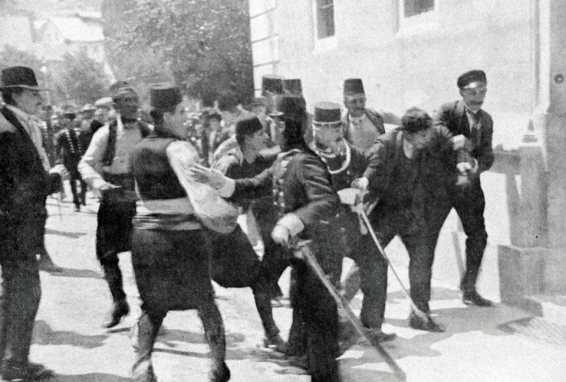
On this day in history, June 28, 1914, the driver for Archduke Franz Ferdinand,  nephew of Emperor Franz Josef and heir to the Austro-Hungarian Empire,  made a wrong turn onto Franzjosefstrasse in Sarajevo.

Just hours earlier, Franz Ferdinand narrowly escaped assassination as a bomb bounced off  his car as he and his wife,  Sophie,  traveled from the local train station to the city’s civic city.   Rather than making the wrong turn onto Franz Josef  Street, the car was supposed to travel on the river expressway allowing for a higher speed ensuring the Archduke’s safety.

Yet, somehow, the driver made a fatal mistake and tuned onto Franz Josef Street.

The 19-year-old anarchist and Serbian nationalist, Gavrilo Princip, who was part of a small group who had traveled to Sarajevo to kill the Archduke,  and a cohort of the earlier bomb thrower, was on his way home thinking the plot had failed.   He stopped for a sandwich on Franz Josef Street.

Seeing the driver of the Archduke’s car trying to back up onto the river expressway, Princi seized the opportunity and fired into the car, shooting Franz Ferdinand and Sophie at point-blank range,  killing both.

That small wrong turn,  a minor perturbation to the initial conditions, or deviation from the original plan,  set off the chain events that led to World War I.
Archduke_Jan27

Stumbling Into The Great War
Fearing Russian support of Serbia, Franz Josef would not retaliate by invading Serbia unless he was assured he had the backing of Germany.   It is uncertain as to whether the Kaiser gave Franz Josef Germany’s unequivocal support.   Russia, fearing Germany would intervene, mobilized its troops forcing Germany’s hand.

The great European powers thus stumbled into a war they didn’t want through complicated entanglements and alliances, and miscalculation.  Russia backing Serbia;  France aligned with Russia,  Germany backing the Austro-Hungarian Empire;  and Britian, who really didn’t have a dog in the fight except her economic interests, aligned with France and Russia.

Later the U.S. would enter the war due to Germany’s unrestricted submarine warfare threatening American merchant ships and the Kaiser floating the idea of an alliance with Mexico in the famous Zimmerman Telegram, which was intercepted by the British.

Of course, some will argue that Great War in Europe was inevitable

The great Prussian statesman Otto von Bismarck, the man most responsible for the unification of Germany in 1871, was quoted as saying at the end of his life that “One day the great European War will come out of some damned foolish thing in the Balkans.” It went as he predicted.  – History.com

Nevertheless,  maybe the course of history would have been different if not for that wrong turn on June 28, 1914, which created the humongous butterfly effect, which we still experience the consequences this very day.

The botched Treaty of Versailles  sowed the seeds the for World II.  The War contributed to the Russian revolution and Cold War.  The redrawing of borders in the Middle East after the War created the conditions for the instability and breakdown to tribalism the region experiences today.

A map marked with crude chinagraph-pencil in the second decade of the 20th Century shows the ambition – and folly – of the 100-year old British-French plan that helped create the modern-day Middle East.

Straight lines make uncomplicated borders. Most probably that was the reason why most of the lines that Mark Sykes, representing the British government, and Francois Georges-Picot, from the French government, agreed upon in 1916 were straight ones.  — BBC News

If Franz Ferdinand had not been murdered on this day in history,  that conflict between the Serbs and the Austro-Hungarian Empire may have been contained to just the Balkans.   Maybe.

The butterfly effect.  Think how many small events, decisions, mistakes, one small turn, or “minor perturbations” in plans have had enormous consequences in your own personal life.

Posted in Geopolitical, Uncategorized | Tagged , , | 9 Comments

Prof G. Dishes on the Election

This is by far the best analysis of the election we have seen.  Professor Scott Galloway of NYU is excellent.  Click on the video, and your 7 minutes will be well rewarded.

Click here to view the video. 

Posted in Uncategorized | Leave a comment

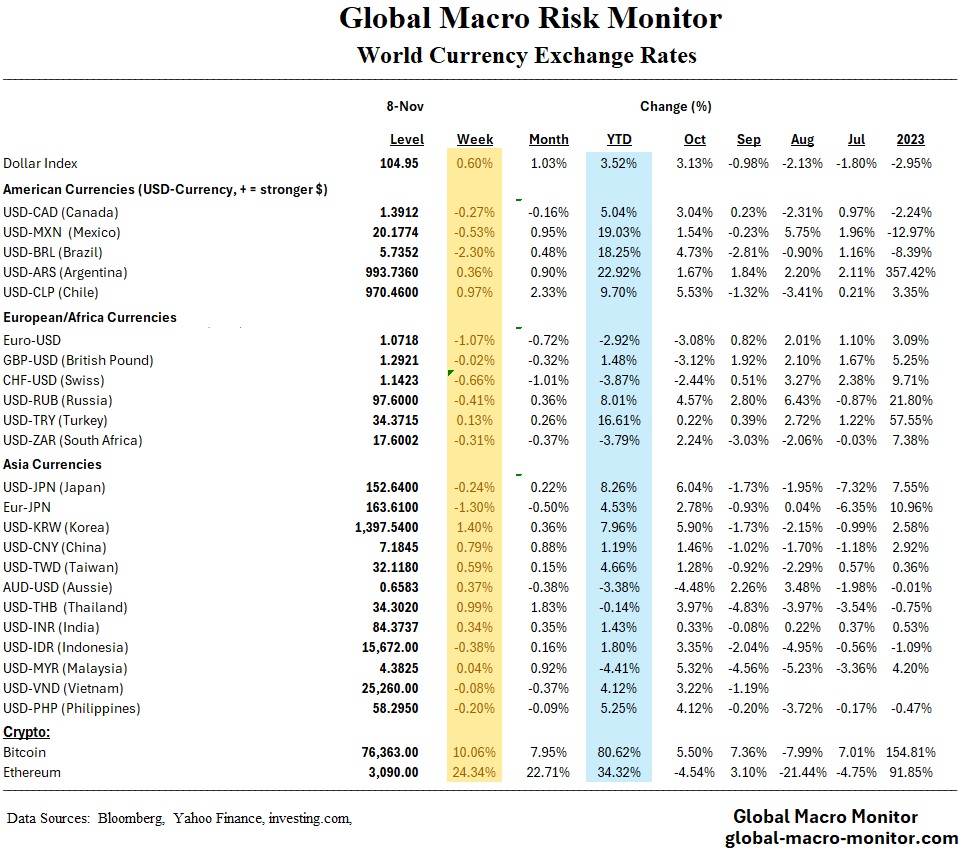
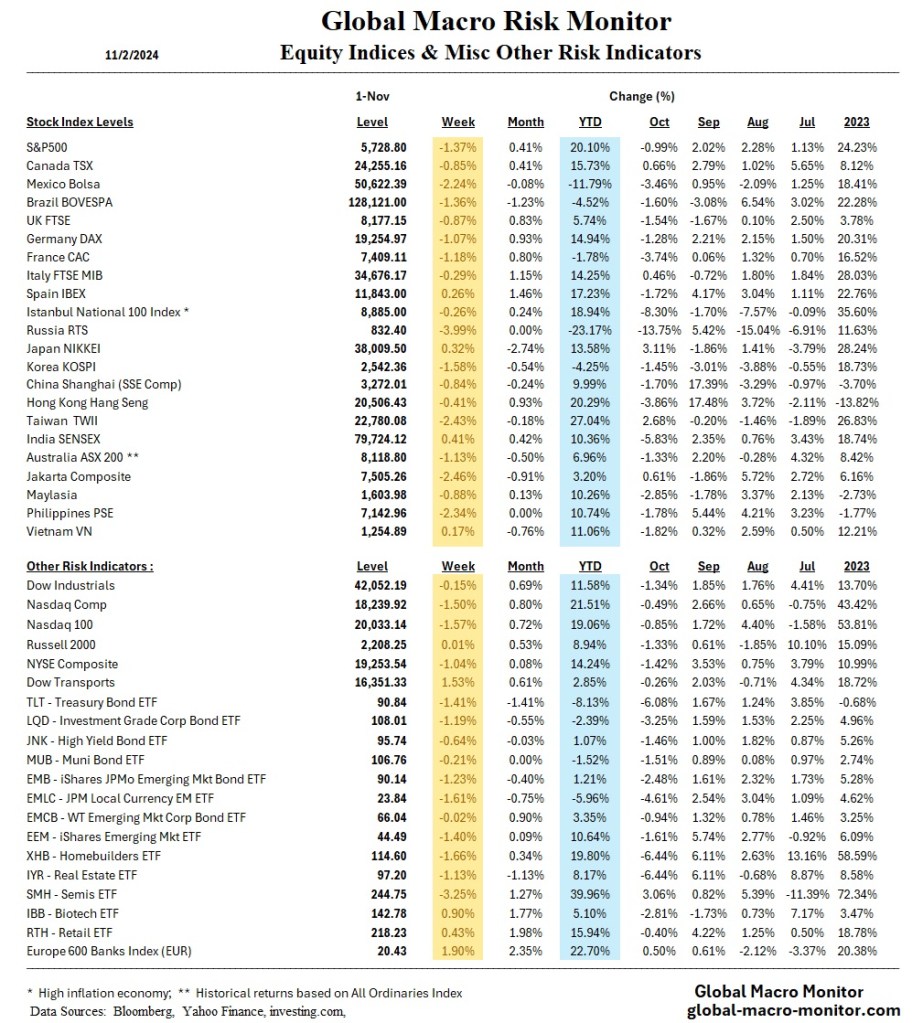
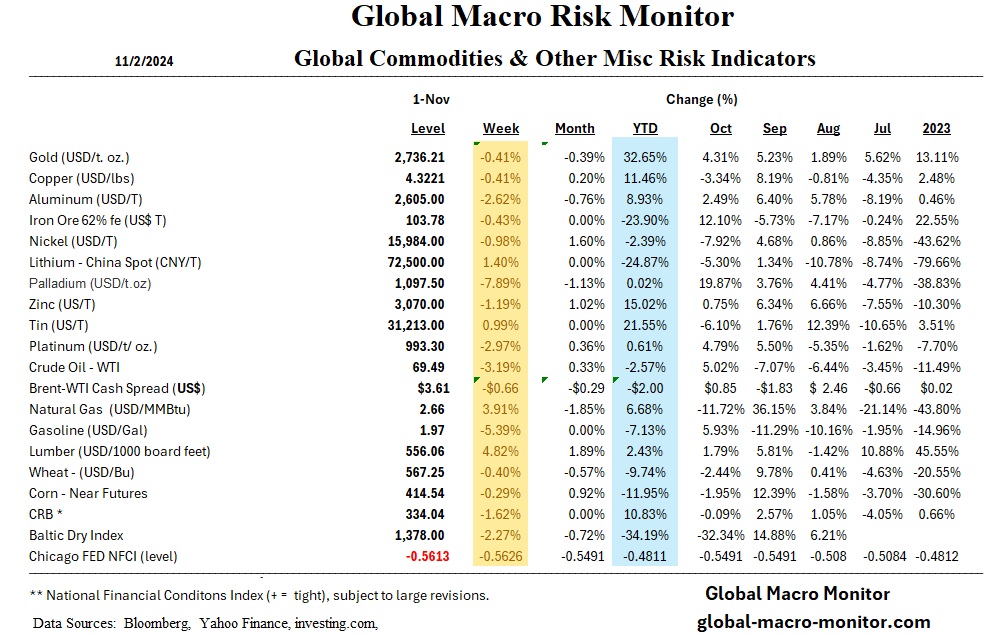
Global Risk Monitor: Week In Review – November 8

Posted in Uncategorized | Leave a comment

ROTD: Inflation Chickens Came Home To Roost

ROTD = Requote of the Day


Inflation is way too high given extremely easy financial and monetary conditions.  There will be blood…the Democrats should begin to worry. – Global Macro Monitor, June 2021

Posted in Uncategorized | Leave a comment

Taleb on Fragility of Markets, Political Risk, AI

Posted in Uncategorized | Leave a comment

Global Risk Monitor: Week In Review – November 1

Bearish Bonds

  • Jobs Report Impact: October’s weaker jobs report initially pushed yields down, hinting at possible accelerated Fed rate cuts, before a quick rebound.
  • Political Influence: Anticipated election outcomes, including potential stimulus under a new administration, could reintroduce inflationary pressures, potentially raising yields.
  • Fed Rate Expectations: Markets expect quarter-point Fed rate cuts in November and December, with a potential pause by early next year.
  • Treasury Auctions: Large-scale auctions for three-year, 10-year, and 30-year notes next week may pressure yields further amid heightened volatility.
  • Market Volatility: Bond market volatility is at its highest this year, with hedging activity spiking due to election and Fed-related uncertainties.
 

U.S. Treasury yields initially declined following Friday’s unexpectedly weak October employment report but rebounded sharply as traders discounted the distortions in the jobs data. Only 12,000 jobs were added in October, a significant slowdown from September’s revised gain of 223,000.

The 10-year Treasury yield, trading around 4.30% before the report, dropped to 4.23% before bouncing back to close the week at 4.37%, marking its highest level since July. Investors were quick to reassess the October report, noting that external factors, including hurricanes and strikes, likely affected the data.

October proved challenging for global bond markets, with yields rising worldwide. Speculation surrounding the U.S. election and the potential for not-so-bond-friendly fiscal policies of the new administration could heighten inflationary pressures. We highlighted these risks to the bond markets in our recent post.

Posted in Uncategorized | Tagged , , , , | Leave a comment

OQOTD: Tail Risk Delusion

OQOTD: Ominous Quote of the Day

By making Mr Trump leader of the free world, Americans would be gambling with the economy, the rule of law and international peace. We cannot quantify the chance that something will go badly wrong: nobody can. But we believe voters who minimise it are deluding themselves. – The Economist

Posted in Uncategorized | 1 Comment

Bond Market Fundamentals: Rising Risks

  • QT Scale: G10 central banks reduced balance sheets from $28 trillion to $21.5 trillion since March 2022.
  • Interconnected Risks: Simultaneous QT across central banks could spread funding stress across markets.
  • Bond Market Volatility: Shifting bond ownership to price-sensitive investors could increase volatility.
  • U.S. Treasury Impact: Increased free float Treasury securities could drive yields and volatility up.
  • Short-Term Debt Strategy: Treasury’s short-term debt issuance lowers current costs but risks future financing hikes.
  • Dealer Inventory Risks: Large dealer inventories may hinder sell-off absorption, heightening volatility in downturns.

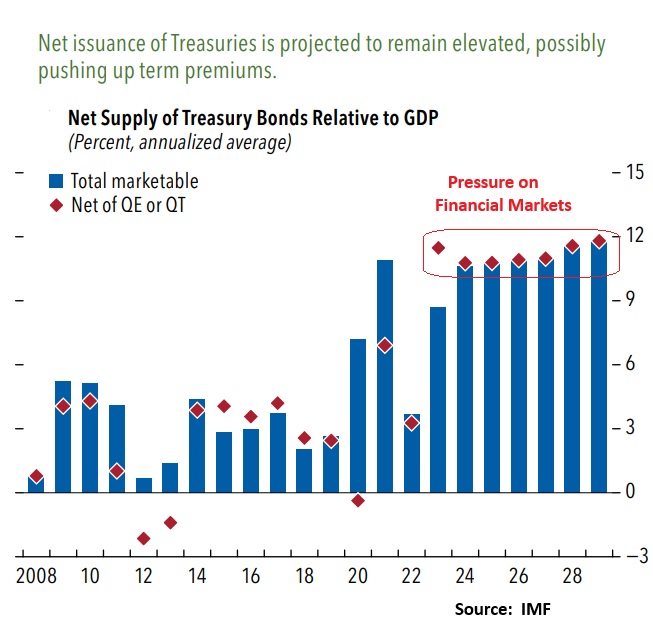
The International Monetary Fund has raised a cautionary alert on an issue we’ve highlighted at the Global Macro Monitor for years: the supply-demand dynamics of the U.S. Treasury market. We maintain that Treasury yields will face sustained upward pressure due to a significant increase in net issuance, rising from less than 3% of GDP—at times even negative after the Fed absorbed more than the entire annual net issuance—to well over 10% of GDP.

Additionally, the shift in bond ownership toward more price-sensitive investors and away from the largest buyers for the past few decades – the Fed and global central banks – will continue to drive volatility in government bond markets, particularly if issuance rises further to fund expanding fiscal deficits.

In the U.S., quantitative tightening (QT) has raised the proportion of free-float Treasury securities, a trend expected to gradually push yields and volatility higher. Furthermore, the Treasury’s increased reliance on shorter-term debt to manage immediate borrowing costs may lead to higher financing expenses over time. Large dealer inventories also pose a medium-term risk, as these holdings could limit dealers’ capacity to absorb Treasury sales in adverse market conditions, potentially amplifying sell-offs.

Finally, given the lack of spending restraint or public debt concerns among both presidential candidates, the likelihood of a “Liz Truss moment” in Washington next year is significantly higher than current pricing reflects. 

How to know?   Watch real yields and term premiums. 

Posted in Uncategorized | Tagged , , , , | 1 Comment

Lost In Aggregation: American Middle Class

While U.S. macroeconomic indicators—such as GDP growth, corporate profits, and stock market performance—signal prosperity, these metrics often obscure the reality facing the middle class. Aggregate data masks wage stagnation, rising cost-of-living pressures, and increasing debt burdens that are disproportionately felt by middle-income households. This discrepancy is significant, as middle-class financial strain limits consumer spending growth—a key economic driver. Data aggregation can dilute such nuances, so a closer examination of income distribution, real wage growth, and regional economic variations may reveal potential vulnerabilities in sectors heavily reliant on middle-class spending stability and resilience.

Posted in Uncategorized | Leave a comment

Japan Political Earthquake: LDP Tanks

Key Facts

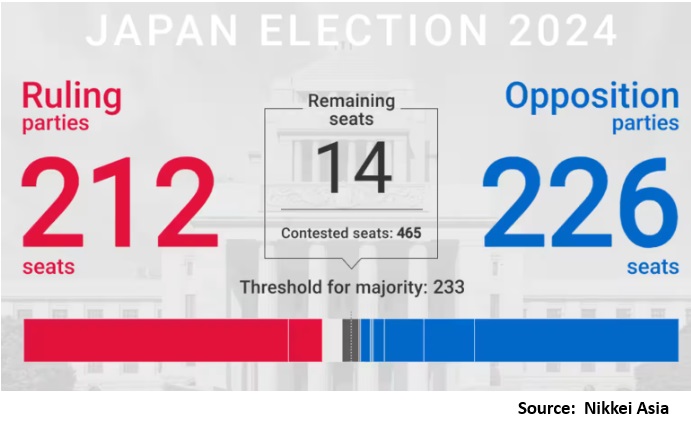
  • The LDP coalition lost its majority, holding only 214 of the 233 required seats.
  • Voter dissatisfaction stems from years of stagnant wages and rising costs.
  • The loss is the LDP’s worst electoral result since 2009.
  • Ishiba, newly appointed, is under pressure to resign and could become Japan’s shortest-serving leader.
  • Market analysts expect heightened volatility due to the political uncertainty.
  • The CDPJ gained seats, focusing on the LDP’s recent slush-fund scandal.
  • Turnout was low (53.8%), with young voters increasingly disillusioned by mainstream politics.

Japan’s ruling Liberal Democratic Party (LDP) faced a significant setback in today’s snap election, losing its parliamentary majority for the first time in 15 years. Far worse than anticipated, this outcome has thrust the country into political turmoil. The election, called by new Prime Minister Shigeru Ishiba amid a slush-fund scandal, was an attempt to secure public support but resulted in voter backlash over stagnant wages and rising living costs. As a result, the LDP will struggle to govern, facing possible policy gridlock and pressure for Ishiba’s resignation. Economic analysts caution that this upheaval could lead to market volatility and complicate Japan’s reform agenda. The main opposition, the Constitutional Democratic Party of Japan (CDPJ), capitalized on public discontent, securing significant gains.

Posted in Uncategorized | Tagged , , , , | Leave a comment