


The S&P500 closed today at a key support level, right on its upward trend line and just a few points under its 50-day moving average. The S&P is up 14.2 percent for the year. Critical support is 5390-5400, which, if it breaks, makes a 10 percent correction down to 5100 increasingly likely. That said, forecasting short-term moves in the stock market is a mug’s game. We just can’t help ourselves.

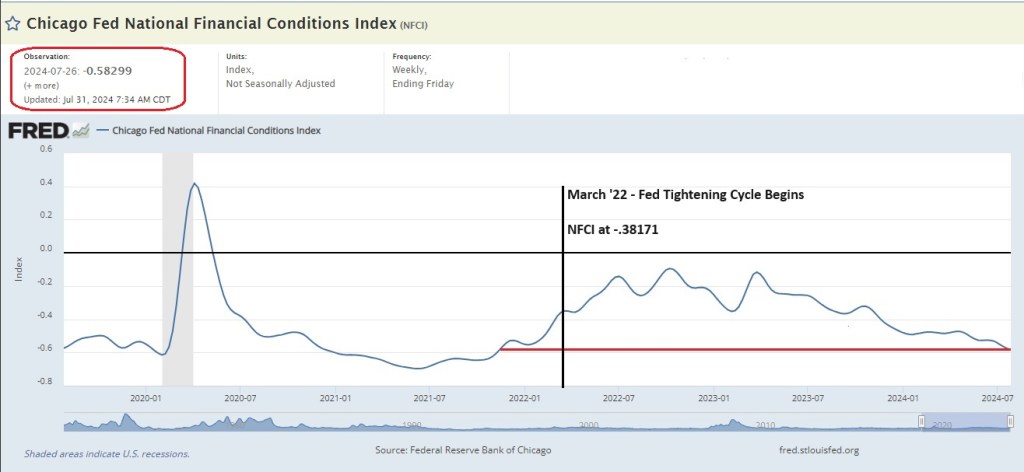
The Chicago Fed’s National Financial Conditions Index (NFCI) is significantly easier than when the Fed started the tightening cycle in March 2022 (see the chart below). As the market ramps up based on the expectation of a September rate, financial conditions are set to ease even further. In our opinion, there is far from a zero probability that the Fed will be forced to backpedal. Markets also create “liquidity,” which can stimulate demand.
Here’s a synopsis of today’s FOMC meeting:
Federal Reserve Chair Jerome Powell signaled that an interest rate cut may be coming at the September FOMC meeting, following the Fed’s decision to maintain its benchmark rate at 5.25%-5.5%, the highest in over two decades. Powell emphasized the Fed’s dependence on data and economic outlook when making this decision. Adjustments in the Fed’s language now reflect the FOMC’s attention to risks on both sides of its dual mandate: inflation and employment. The Fed acknowledged progress towards its 2% inflation goal, a moderated labor market, and easing inflation, yet stressed the need for “greater confidence” in inflation trends before reducing rates. Treasury yields dropped, and the S&P 500 gained, reflecting investor anticipation of a rate cut. Powell noted varying potential scenarios for rate cuts based on economic developments, underscoring a balanced approach to managing employment and inflation risks. The Fed’s shift in focus highlights the need to foster maximum employment alongside price stability.
The NFCI is constructed to have an average value of zero and a standard deviation of one over a sample period extending back to 1971. Positive values of the NFCI have been historically associated with tighter-than-average financial conditions, while negative values have been historically associated with looser-than-average financial conditions. – Chicago Fed
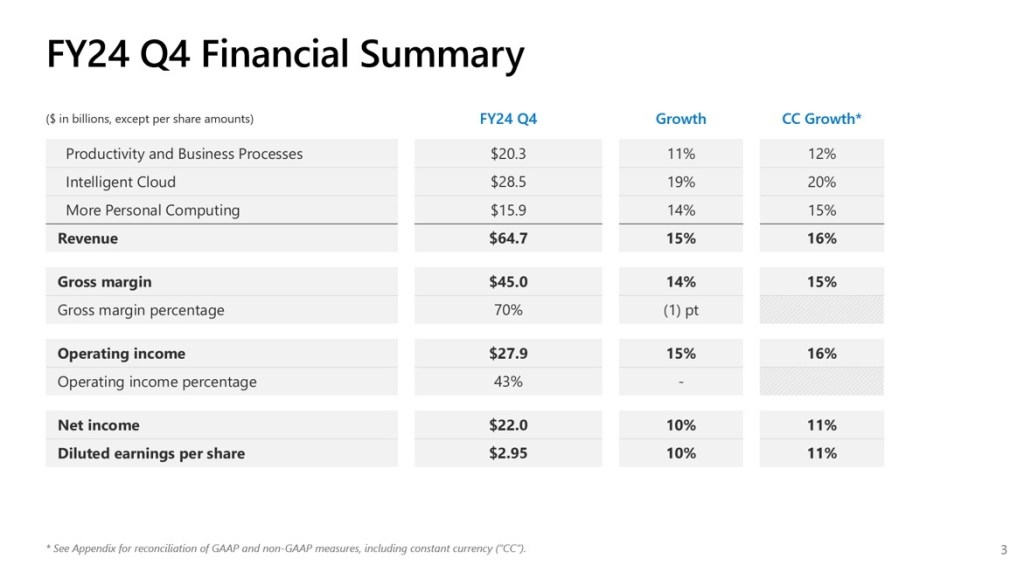
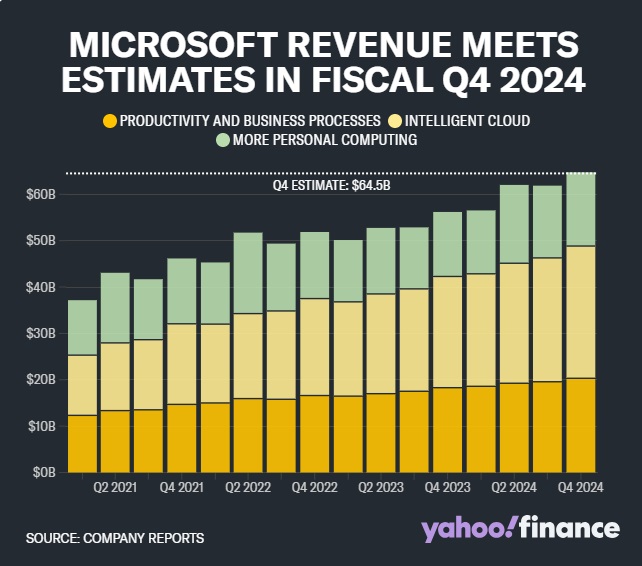
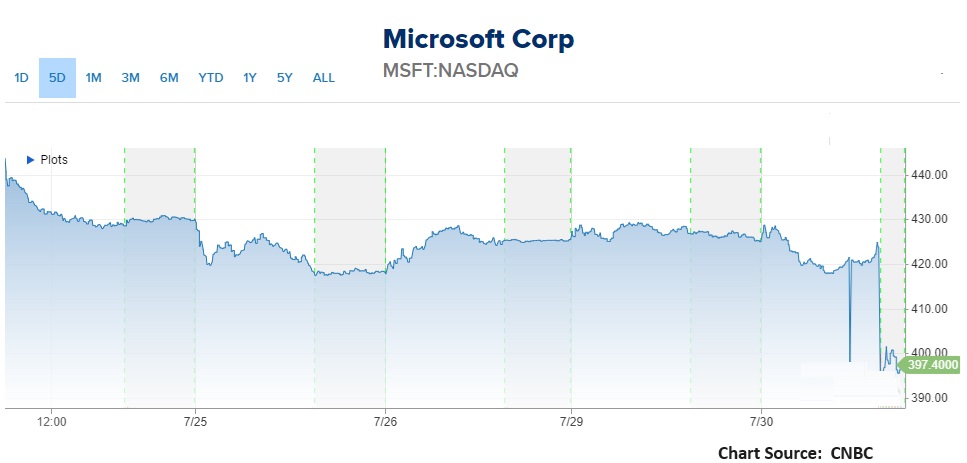
Microsoft (MSFT) reported its fiscal fourth-quarter earnings, surpassing Wall Street’s expectations on EPS and revenue but falling short of cloud revenue forecasts, notably in its Intelligent Cloud segment. Despite this, overall revenue increased by 15% yearly, with Intelligent Cloud revenue growing by 19%. The company highlighted that AI services contributed significantly to Azure and other cloud revenues, which grew by 29%. Following the announcement, Microsoft’s stock dropped over 7% in after-hours trading. The earnings report also impacted other AI-focused companies like Meta, whose shares declined by over 3%.
Key Facts:
“Gold medals aren’t really made of gold. They’re made of sweat, determination, and a hard-to-find alloy called guts.” — Dan Gable
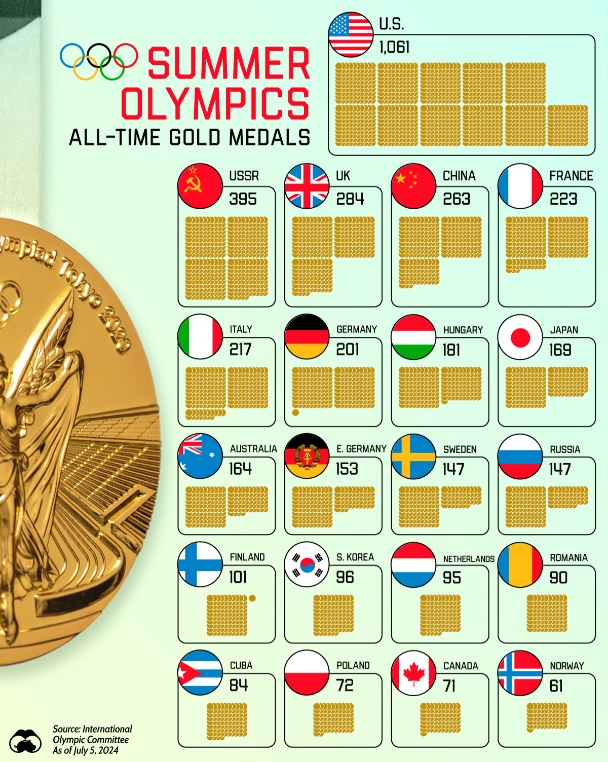
Awesome graphic from the Visual Capitalist.
This year, 10,500 athletes will compete across 329 events to billions of viewers worldwide. Kayaking and breaking (commonly known as breakdancing) will debut, while surfing and skateboarding return for their second Olympics.
This graphic shows the countries with the most medals in Summer Olympic sports, based on data from the International Olympic Committee.
During the vast majority of the 20th century, the U.S. won 10% of Summer Olympic medals.
Among the sports with the highest medal counts are track and field and swimming, with 344 and 257 gold medals, respectively. American swimmer, Michael Phelps, has won more medals than any Olympic athlete ever, with 23 gold medals under his belt.
Going further, almost 25% of all U.S. gold medals in Summer Olympic sports are from swimming.
Ranking in second is the former Soviet Union, with 395 gold medals. During a period of heightened focus on elite athleticism during the Cold War, the USSR earned more medals than any other country during the 1956-1992 Summer Olympics, with the exception of 1968. It even won the most medals in 1992 after the dissolution of the “Soviet Union”.
With 284 Summer Olympic gold medals, Great Britain falls next, thanks to its success in rowing, cycling, and track and field. Between 1984 and 2016, the Great Britain Team won a gold medal in rowing at every Summer Olympics game.
Since returning to the Summer Olympics in 1984 after 30-year absence, China ranks fourth worldwide. Approximately 75% of Olympic gold medals have come from six sports, all found in the Summer Olympic Games. These include the undeniable success in table tennis, diving, shooting, weightlifting, and gymnastics. Not only that, two-thirds of China’s Summer and Winter Olympic gold medals are won by women. – Visual Capitalist
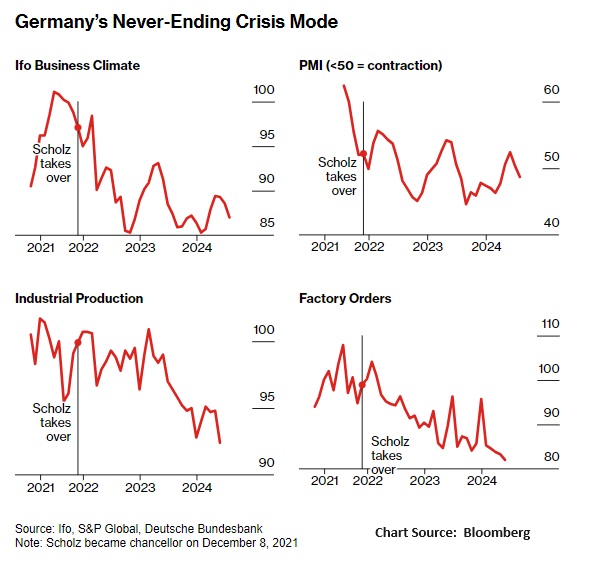
“We can no longer invest in the old, fossil-fuel technology and we don’t yet know in which new technology to invest.” – Martin Gorning, GIER

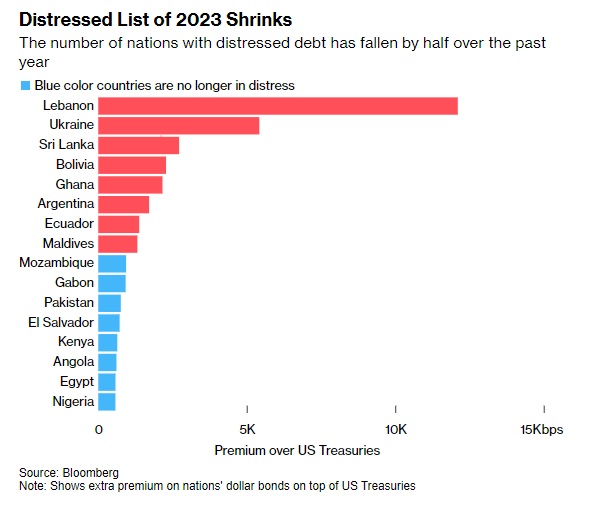
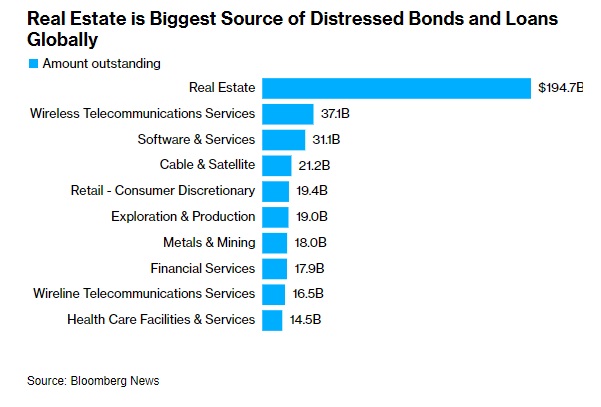
…reforms have also augmented fiscal strength and lowered the risk of default. The number of countries with bonds trading at distressed levels had subsequently halved in the space of a year, according to data compiled by Bloomberg. – Bloomberg
Japan has the highest share of childless 50-year-old women among developed countries – Nikkei Asia
The number of Japanese citizens fell at the fastest clip last year since data collection began in the 1960s, adding pressure on the nation’s social security system and shrinking labor market.The population of Japanese nationals dropped by more than 861,000 to 121.6 million over the year to January 1, extending a streak of decline to 15 years, according to the ministry of internal affairs on Wednesday. While the foreign population increased 11% to hit 3 million for the first time, it was not enough to make up for the shortfall in Japanese nationals. The overall population shrank by 0.4%. – Bloomberg
And it’s not just Japan.
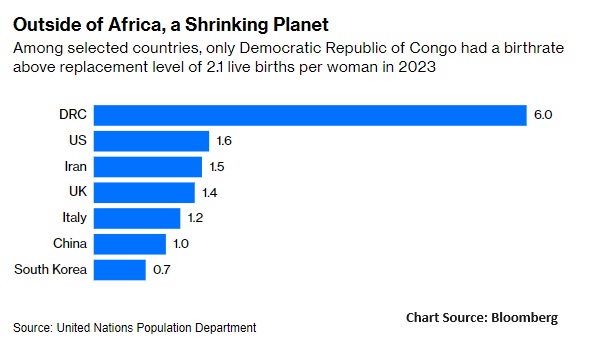
This fertility slump is in many ways the most remarkable trend of our era….More than half of the projected increase in the global population between 2022 and 2050 is expected to be concentrated in just eight countries: the Democratic Republic of the Congo [DRC], Egypt, Ethiopia, India, Nigeria, Pakistan, the Philippines and the United Republic of Tanzania…That is because already “close to half of the global population lives in a country or area where lifetime fertility is below 2.1 births per woman.” – Bloomberg




 Global Macro Monitor