



-
In economics, things take longer to happen than you think they will, and then they happen faster than you thought they could.
-
Join 1,086 other subscribers
Contribute To GMM

Categories
- 3D Printing
- Agriculture
- AI
- Algos
- Apple
- Automation
- Banking
- BFTP
- Bitcoin
- Black Swan Watch
- Bonds
- Brazil
- Brexit
- BRICs
- Budget Deficit
- Capital Flows
- Cartoon of the Day
- Cashless Society
- Chart of the Day
- Charts
- China
- Clean Tech
- Climate Change
- Coach C
- Commodities
- Coronavirus
- COVID
- Credit
- Crude Oil
- Currency
- Cyprus
- Daily Risk Monitor
- Day In History
- Debt
- Demographics
- Disinflaton
- Dollar
- Earnings
- ECB
- Economics
- Economist
- Egypt
- Electric Vehicles
- Emerging Markets
- Employment
- Energy
- Environment
- Equities
- Equity
- Euro
- Eurozone Sovereign Spreads
- Exchange Rates
- Fed
- Finance and the Good Society
- FinTech
- Fiscal Cliff Monitor
- Fiscal Policy
- Food Prices
- France
- Futurist
- Game Theory
- General Interest
- Geopolitical
- Geopolitics
- German Bund
- Germany
- Global Macro Watch
- Global Reset
- Global Risk Monitor
- Global Stock Performance
- Global Trend Indicators
- Gold
- Greece
- Healthcare
- Heat Map
- Hedge Funds
- Housing
- Human Interest
- Immigration
- Impeachment
- India
- Inequality
- Inflation/Deflation
- Infographics
- Innovation
- Institutional Investors
- Interest Rate Monitor
- Interest Rates
- Interviews
- Italian Yields
- Italy
- Japan
- Jobs
- Lectures
- Macro Notes from Conference Calls
- Manufacturing
- Masters
- Mexico
- Monetary Policy
- Movies
- Muni Bonds
- Muni Market
- Natural Gas
- News
- Nonlinear Thinking
- North Korea
- Overbought Markets
- Picture of the Day
- PIIGS
- PMIs
- Policy
- Politics
- Population
- Populism
- Poverty
- President Trump
- Qunat Strategies
- Quote of the Day
- Quotes
- Rare Earth Elements
- Readership
- Reads
- Real Estate
- Relative Strength Index
- Robert Shiller
- RSIs
- S&P500
- Sector ETF Peformance
- Semiconductor prices
- Semiconductors
- Social Media
- Socialism
- Song for the Week
- Sovereign Debt
- Sovereign Risk
- Spain
- Sports
- State and Local Government
- Tail Risk
- Technical Analysis
- Technology
- The Big Reset
- The Weekend Read
- This Day In Financial History
- Trade War
- Trades
- Tweet of the Day
- Ugly Chart Contest
- Uncategorized
- US Releases
- Video
- Volatility
- Wages
- Week Ahead
- Week in Review
- Weekend Reads
- Weekly Eurozone Watch
- Whales
-
Recent Posts
Meta
QOTD: The Fabless Nvidia
QOTD: Quote of the Day
Today it holds over 80% of the market in specialist AI chips…Even if AI mania cools, the technology is bound to be more useful than crypto, another craze that Nvidia cashed in on. – Economist

Fabless chip makers are companies that produce semiconductors for use in various types of electronics, such as digital cameras, smartphones, and the new technologically sophisticated “smart” cars.
The term “fabless” means that the company designs and sells the hardware and semiconductor chips but does not manufacture the silicon wafers, or chips, used in its products; instead, it outsources the fabrication to a manufacturing plant or foundry. – Investopedia
Posted in Uncategorized
Leave a comment
COTD: The Great Volcession
The U.S. stock market is surprisingly calm right now…A key reason: a growing divide between mainstream investors, who have largely been sitting out the 2023 stock rally, and the machines whose buying has been driving it…The market’s steady rise has puzzled analysts and portfolio managers as the S&P 500 has churned more than 9% higher this year (and the technology-focused Nasdaq Composite has risen 24%). One explanation: Quant funds, or those relying on computer models and automated trading, have been doubling down on equity markets as other investors have stepped back, citing high valuations and concerns about the likely course of the U.S. economy. – WSJ

Posted in Uncategorized
Leave a comment
College Enrollment Heading South, Women Rule
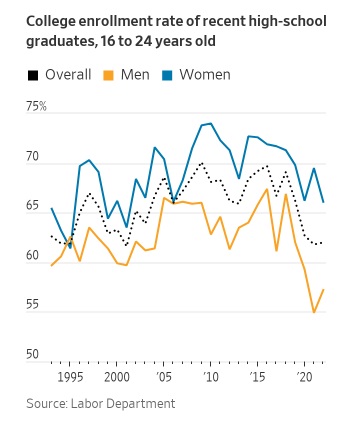
College enrollment has declined by about 15% in the past decade, according to federal data. The reasons include the high cost of university education, colleges closing and uneven returns from getting a degree, as well as the hot job market.
The college-enrollment rate has fallen for both men and women in recent years, but more so for men. Last year 66.1% of women who graduated from high school, ages 16 to 24, enrolled in college, nearly 10 percentage points higher than the rate for young men, which economists attribute to women enjoying greater financial returns from college. – WSJ
Money Points:
- The college enrollment rate for recent US high-school graduates, ages 16 to 24, declined to 62% last year from 66.2% in 2019.
- The rate topped out at 70.1% in 2009.
- The decline was steeper among men than women.
- The trend is driven by a strong labor market for less-educated workers.
- The shift is also being driven by a growing number of high-school graduates who are choosing to enter the workforce directly.
- Many employers are offering higher wages and benefits to attract workers.
- Some employers are also offering training programs and apprenticeships.
- The trend is being driven by a combination of factors, including rising tuition costs and student debt.
- Many students are also questioning the value of a college degree.
- Some students are choosing to pursue alternative forms of education, such as vocational training or online courses.
- The trend is expected to continue in the coming years.
- Some experts warn that the trend could have negative long-term consequences for the US economy.
- They argue that a highly educated workforce is essential for innovation and economic growth.
Posted in Uncategorized
Leave a comment
Sovereign Debt Crisis 2.0
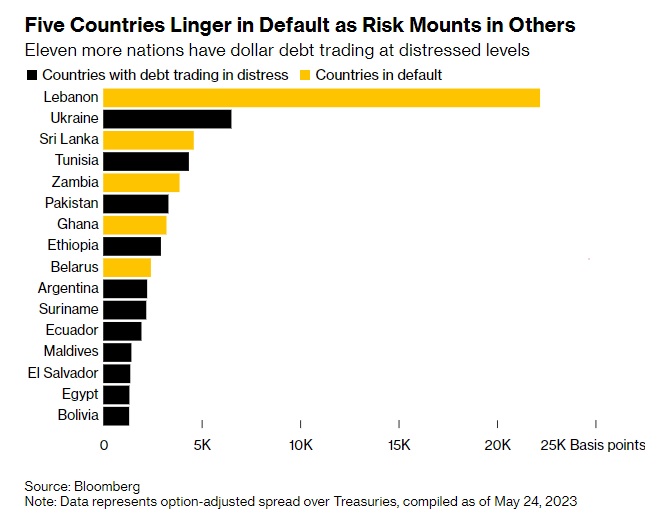
There are 11 emerging nations with dollar debt trading at a risk premium of at least 10 percentage points — a distressed level that signals the threat of default.
Lebanon, Sri Lanka, Zambia and others have already tumbled into default, locking the economies out of international capital markets until a deal can be struck with creditors. – Bloomberg
Money Points:
- A shakeup is brewing in the $1.6 trillion universe of emerging-market sovereign debt.
- Government defaults are rising to a record in the developing world.
- The debate is growing frantic over how to solve these debt crises.
- The International Monetary Fund (IMF) is pushing for a new global bankruptcy framework.
- The IMF’s proposal would allow countries to restructure their debts in an orderly way.
- The proposal has been met with resistance from some investors and governments.
- Some investors are concerned that the proposal would give too much power to debtor countries.
- Others worry that it would make it too easy for countries to default on their debts.
- The IMF argues that its proposal would help prevent future debt crises.
- The debate over how to solve sovereign debt crises is likely to continue for some time.
- Investors will need to be vigilant as they navigate this uncertain landscape.
- The stakes are high, as sovereign debt crises can have far-reaching economic consequences.
Posted in Uncategorized
1 Comment

