Black Monday, 1987: Inside The U.S. Treasury

Whoops, should have reposted this last night.  Better late than never. 

Didn’t hear one mention in the FinMedia about today being the 35th year anniversary of the Great Crash of 1987

Originally Posted
October 19, 2020
By Liam McPherson

The following exchange took place between President Reagan and reporters after the market close on Black Monday, October 19, 1987.  Leaving to visit the First Lady in the hospital, President Reagan spoke just after the market lost over 20 percent of its value on the day.

Q: What about the market? Tomorrow will it go down again?
President Reagan:  I don’t know. You tell me.

Q: Is the market your fault?
President Reagan: Is it my fault? For what, taking cookies to my wife?

Q: Reaganomics?

President Reagan:  I just told you. Good Lord, we reduced the deficit over last year by $70 billion. And all the other things I’ve told you about the economy are as solid as I told you. So, no, I have no more knowledge of why it took place than you have.

Thirty-three years ago today, now infamously known as Black Monday, my grandfather, M. Peter McPherson, was Deputy Secretary of the U.S. Treasury and acting Secretary that day, while Treasury Secretary James Baker was in the air traveling to Europe. McPherson was the most senior Treasury official left in Washington to handle the crisis.

The stock market had already peaked in August after an almost 100 percent rally in the prior two years.  By late August, the DJIA had gained 44 percent in a matter of seven months, raising concerns of an asset bubble, and had become very volatile as interest rates had been rising rapidly since bottoming in September of the prior year.
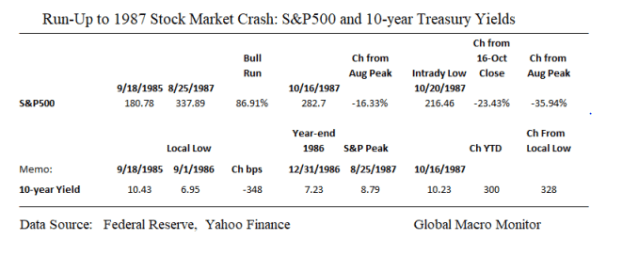
Similar to 1929, where the stock market peaked in early September, the markets had already begun to unravel, foreshadowing the record losses that would develop that Monday in October.

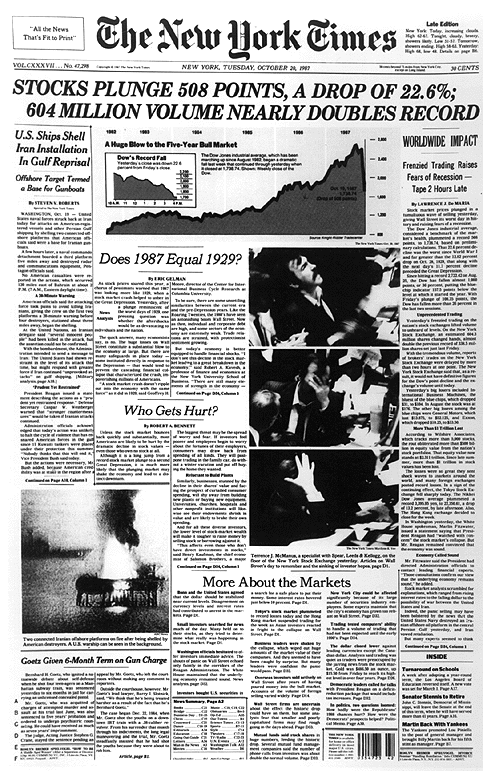
As the markets around the world began to crash, my grandfather convened with the U.S. Treasury’s Undersecretary of Domestic Finance and the Department Chief of Staff to discuss the government’s appropriate response.  The Dow Jones eventually closed 508 points down, or a 22.61 percent, almost double the historic Crash of 1929, where the Dow fell 12.8 percent in one day.

Government Kicks Into Action

According to my grandfather, the situation demanded that his team put together a plan to calm the markets. The economy was doing fine, and there were no signs of recession.  Real GDP growth came in at 3.5 percent in 1987.

Jitters about the U.S. trade deficit, rising interest rates, and the path of the U.S. dollar during the Plaza Accord are oft-cited as the fundamental reasons that triggered the crash, but nobody knows for sure.  Trees don’t grow to the sky, and neither do markets.  Stocks markets do what stocks markets do, keep their own schedule, and march to their own drummer.

The team’s conclusion at Treasury that day was the market was under severe strain for technical reasons and complicated by the new computerized program trading related to portfolio insurance.  Nevertheless, the steep losses were causing significant dislocations in the financial markets.

Many large firms were under heavy liquidity pressure and were dangerously close to not making their margin calls and on the brink of failure.

My grandfather and his team placed a call to the then-new Federal Reserve Chairman, Alan Greenspan, only two months into the job, to encourage the issuance of a Fed statement that it would do whatever it takes to provide the liquidity to keep markets functioning.

It wasn’t the time to think about the policy’s broader economic implications, such as the potential moral hazard, as the plane was on fire and going down and desperately needed a rescue plan.

It was also clear Greenspan had been thinking along similar lines.

Fed officials drafted much longer statements for release, but Greenspan reasoned that a short, clear message would do the most to stabilize markets.

It is also important to point out that when Secretary Baker arrived in Europe late that day, he immediately began communicating with key finance ministers, such as those from Germany, Japan, France, and the UK to coordinate a global response to the financial crisis.

October 20

Greenspan issued his statement the next morning, October 20,

“The Federal Reserve, consistent with its responsibilities as the Nation’s central bank, affirmed today its readiness to serve as a source of liquidity to support the economic and financial system.” – FRB

In typical Greenspan fashion, the statement was vague in methodology yet resolute in purpose.

The market opened down and continued falling, there were no buyers and it appeared, at one point, the global financial system was headed for a complete meltdown.

“Tuesday was the most dangerous day we had in 50 years,” says Felix Rohatyn, a general partner in Lazard Freres & Co. “I think we came within an hour” of a disintegration of the stock market, he says. “The fact we didn’t have a meltdown doesn’t mean we didn’t have a breakdown.  – WSJ

Then at about 12:38 pm, with many stocks not trading and pressure growing to close the markets a miracle seemed to happen.

With the closing of the Big Board seemingly imminent and the market in disarray, with virtually all options and futures trading halted, something happened that some later described as a miracle: In the space of about five or six minutes, the Major Market Index futures contract, the only viable surrogate for the Dow Jones Industrial Average and the only major index still trading, staged the most powerful rally in its history. The MMI rose on the Chicago Board of Trade from a discount of nearly 60 points to a premium of about 12 points. Because each point represents about five in the industrial average, the rally was the equivalent of a lightning-like 360-point rise in the Dow. Some believe that this extraordinary move set the stage for the salvation of the world’s markets. – WSJ 

The rest, as they say, is history.

My grandfather felt that the Treasury’s phone call contributed to Greenspan’s thinking and as he made the decision to issue a statement to calm the market.  The statement was the most critical event in stabilizing the markets and preventing substantial economic damage to the U.S. and the global economy.

My grandfather spoke about how the simplicity of the message prevented speculation while instilling confidence.  Not unlike ECB President Mario Draghi’s, “whatever it takes” July 2012 speech, which saved the Euro currency, the European banking system, and ultimately the European Union during their debt crisis in 2011-12.

The Birth Of Stock Market Moral Hazard   

Some argue, including one of the regular authors on this website, the Fed’s response to Black Monday ushered in a new era of faux investor confidence and the moral hazard that the central bank will always backstop falling markets.  Thus, forever distorting market risk and real price discovery and contributing to the current boom-bust asset market cycle the global economy now experiences and will be extremely difficult to reverse.

Global Macro Monitor (GMM) often argues, which is not necessarily my own opinion, what was supposed to be a one-off market intervention in 1987 has now become the norm, which monetary policymakers will find it impossible to extract itself from, ultimately resulting in a major market and economic dislocation.  We shall see.

President Reagan’s Confidence And Sense of Calm

During the crisis, President Reagan, whose administration my grandfather served several key roles in, was an excellent communicator and never once conveyed a sense of panic in October 1987.

Though not having a financial background, President Reagan did have a degree in economics and understood the nature of markets and how they coveted a sense of calm and leadership from the government during such a crisis.

The following video is President Reagan speaking to the press at the White House on Black Monday as he is preparing to board Marine One to visit the First Lady in the hospital.

Skip to the dialogue, which starts 5:40 minutes in.

Note President Reagan’s incredibly calm demeanor and sense of confidence after the most massive stock market crash in U.S. history.
Posted in Equities, Equity | Tagged , | Leave a comment

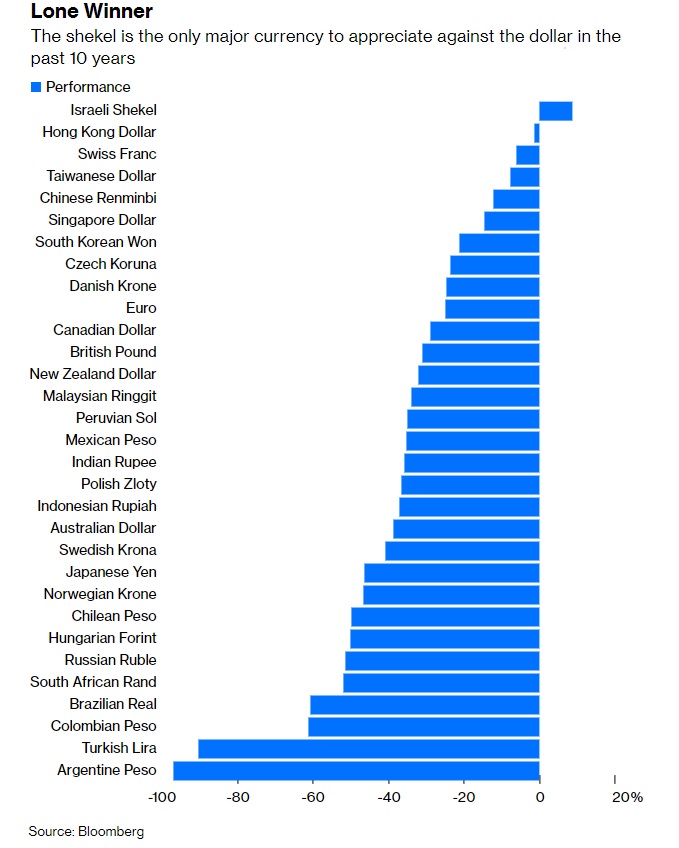
King Shekel: The Only Currency Up Against the $ In The Past 10 Years

Posted in Uncategorized | 1 Comment

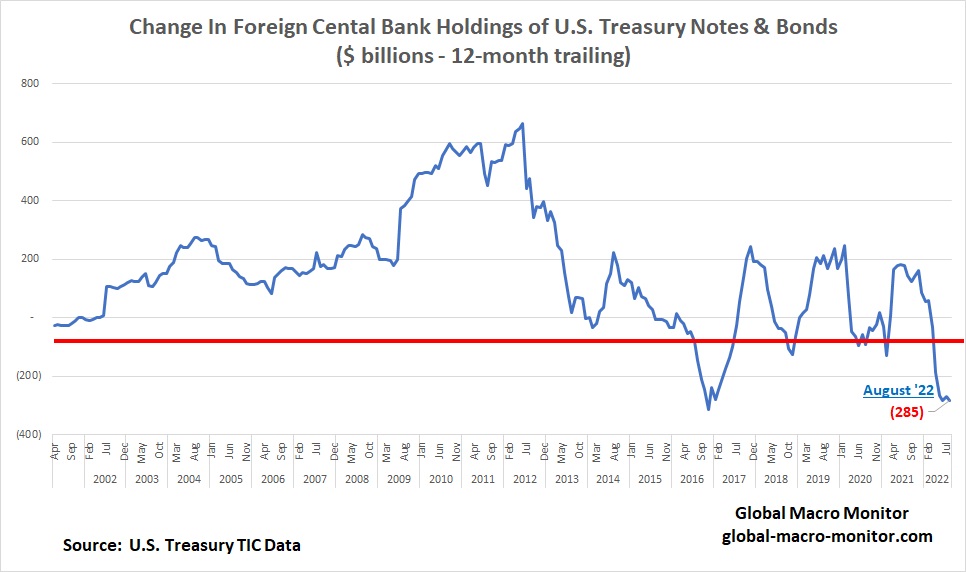
Foreign CenBanks Continue To Sell Treasury Securities

As we suspected in our last post on this subject, 

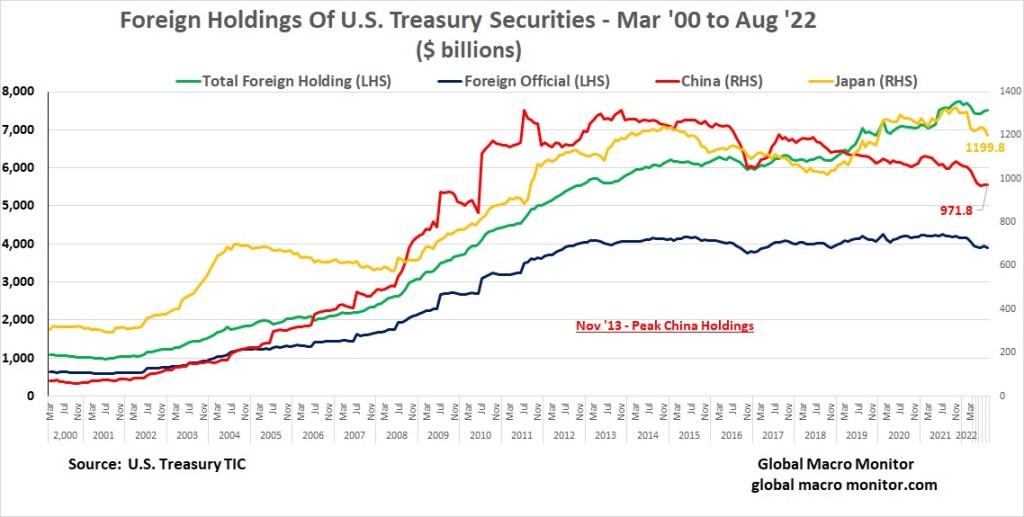
We also have no doubt Japan’s holdings are down from the latest observation in July. – GMM,  Sep 29th

Japan, the country (data is aggregated), sold $34.5 billion of its holdings of U.S. Treasury securities in August.   China holdings of Treasuries are down 26.2 percent from the November 2013 peak of $1.32 trillion to $972 billion in August. 

Central banks have zero price sensitivity to the U.S. bond market, providing, essentially a “free-ride” in financing the U.S. government.  This story is in its last chapter and has major repercussions for all markets. 

Posted in Capital Flows, China, Sovereign Debt | Leave a comment

The Two Futures Of Crypro | Big Think

Posted in Uncategorized | Leave a comment

Friday CK Chart Fest – October 14th

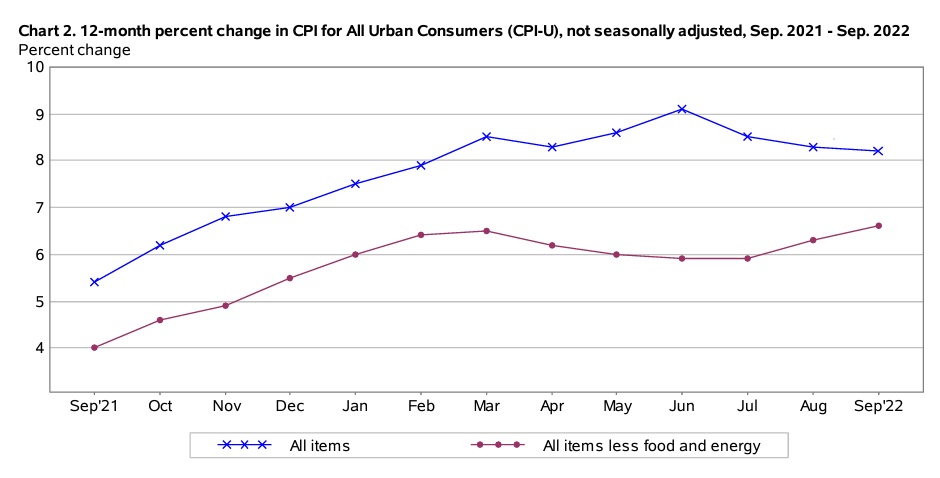
Inflation Remains Elevated

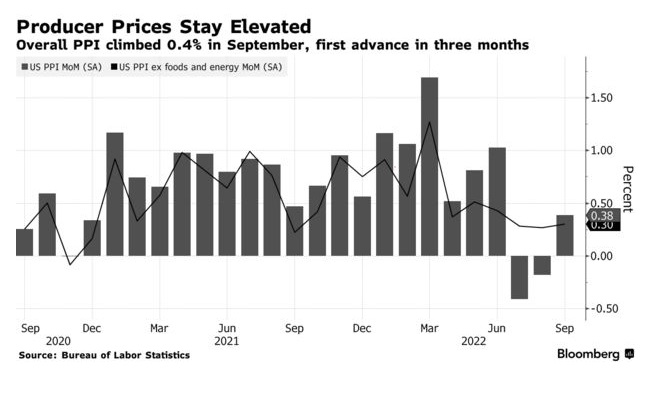
Producer Prices Bounce Back

This image has an empty alt attribute; its file name is ppi.jpg

Pepsico’s Inflation Driven Revenue Growth


Auto CapX In The U.S. Largest On Record

This image has an empty alt attribute; its file name is auto-cap-x-in-us-at-record.jpg

Taiwan Semi Cuts Q4 CapX Estimates & Inventories

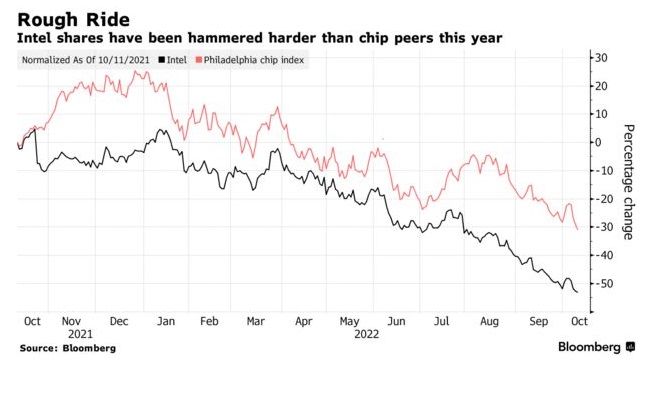
Intel’s Wild Ride

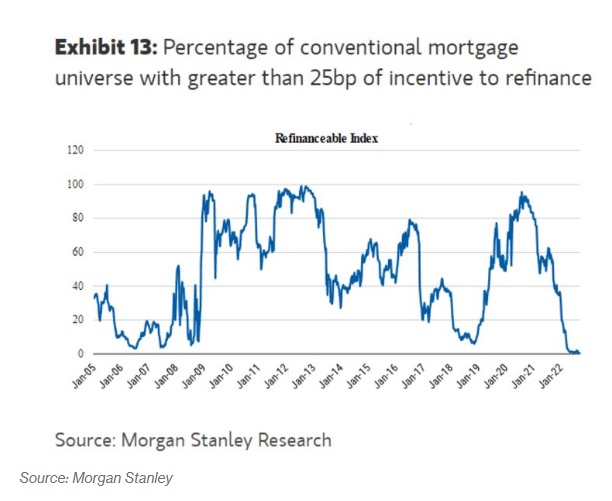
This image has an empty alt attribute; its file name is intels-wild-ride.jpgMortgage Refinancing Bear Market
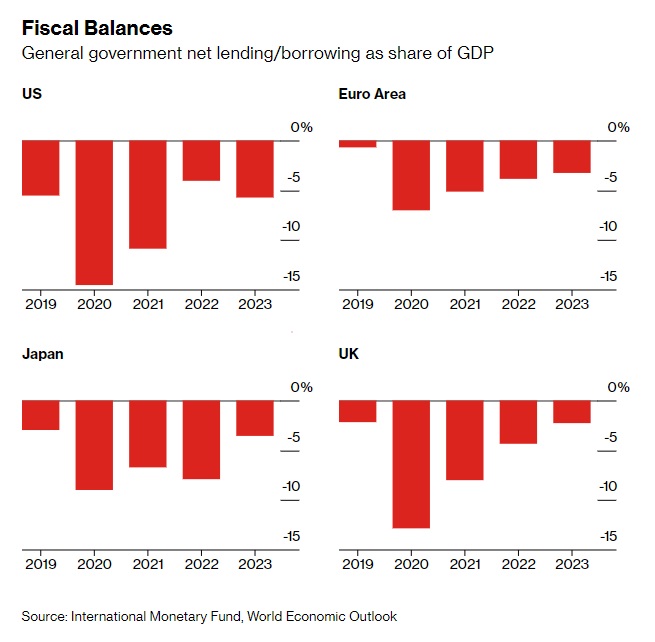
Global Fiscal Balances 

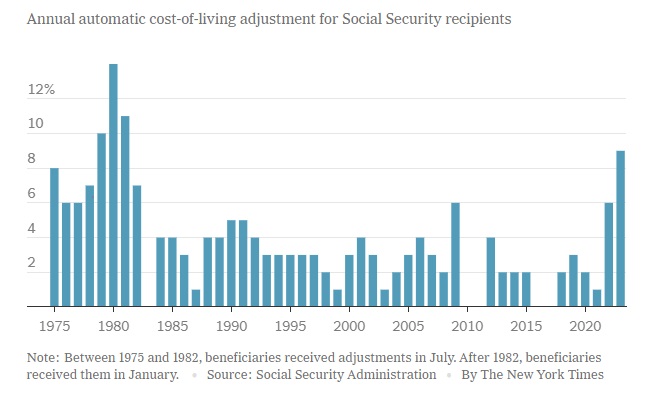
Social Security COLA Largest Since 1981

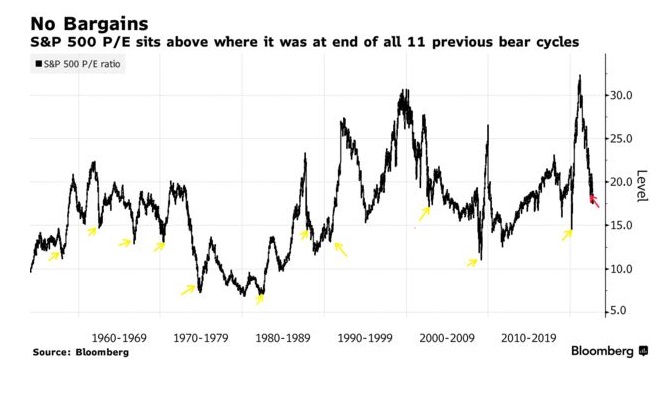
An Expensive Bear Market Bottom?

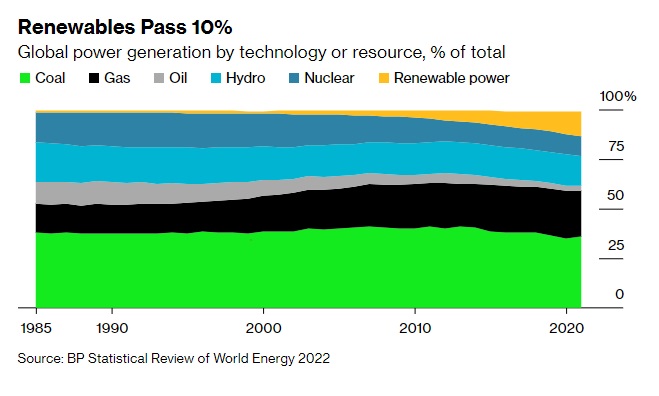
Renewables Now Generate 13% Of Global Power

Winter Is Coming To Europe

Who Is Helping Ukraine? 

Posted in Charts | 1 Comment

QOTD: Argentina-esque Inflation

QOTD: Quote of the Day

Though not the norm in the U.S., this is the type of inflation I saw in Argentina in the late 1980s for almost all goods and services and is unlikely to be the convention here unless the Fed is forced to support and finance the Treasury market.  More likely today than six months ago, but highly unlikely, nonetheless.  

‘It was March 2021, and the Federal Reserve Bank of St. Louis president couldn’t find the model he wanted in the local store, which was 90% empty. So he ordered online — only to be asked, when the bike was delivered four months later, for an inflation surcharge of around $200. He refused to pay, but came away distressed.

The idea that you’re changing prices in the middle of some transaction was alarming to me,” Bullard recalled in an interview last month. “It was very telling about the environment.”’  – James Bullard,  St Louis Fed President,  Bloomberg

Posted in Uncategorized | 4 Comments

Treasury Market: Factor Update

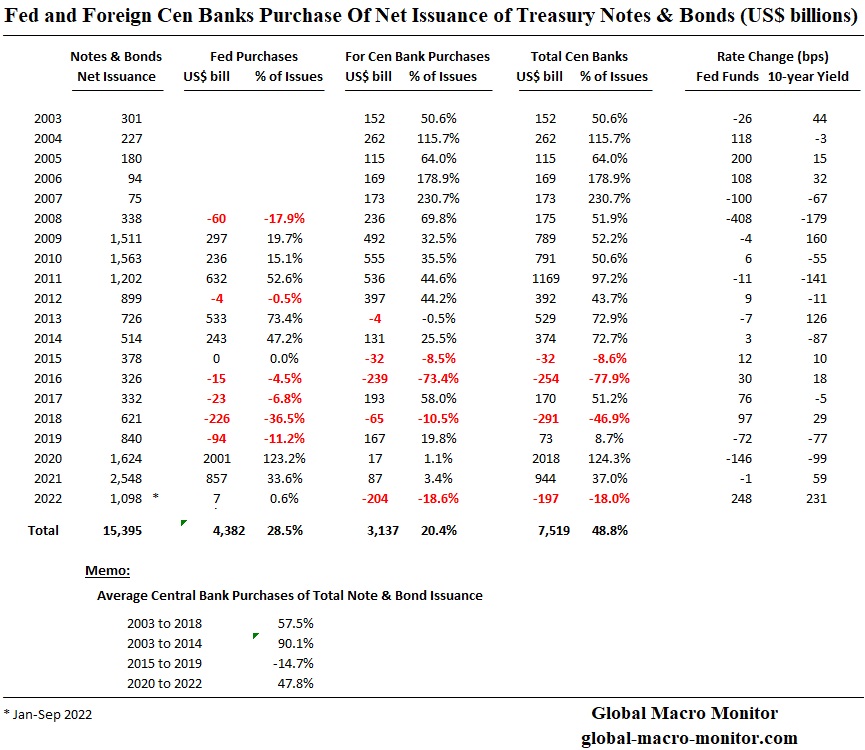
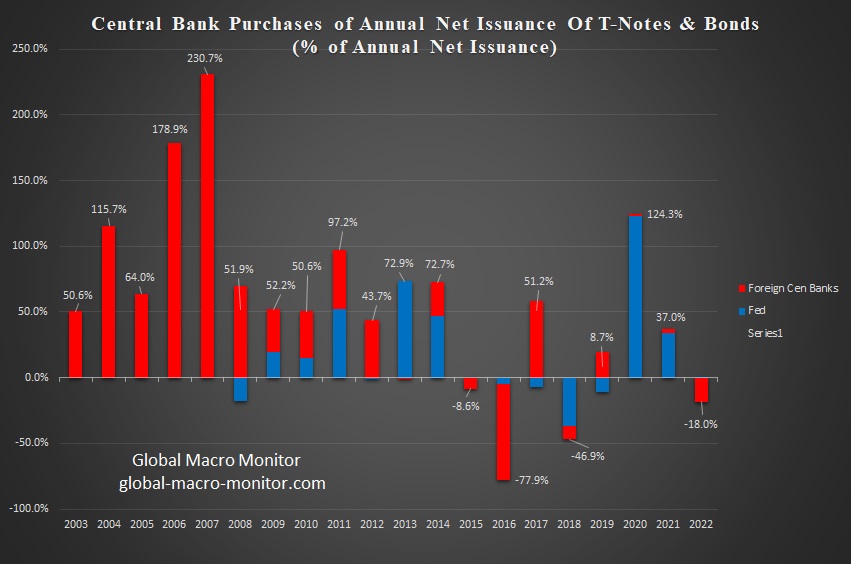
We have updated the data we promised in our recent post of a repost, Where The Next Financial Crisis Begins. Our narrative for why the Treasury market is convulsing with a lack of liquidity is that the largest buyers of notes and bonds over the past twenty years have been central banks, both the Fed and foreign, and now have become net sellers.  This will have huge implications for other markets. 

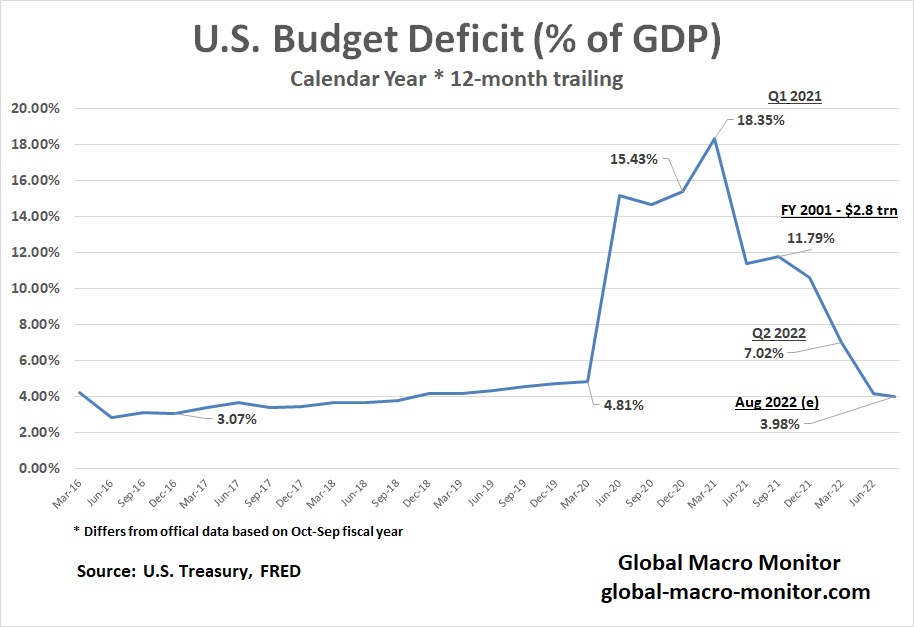
It’s just simple math, folks. The money to finance the U.S. deficits has to come from somewhere. With the central banks gone, it is now a zero-sum game. 

Time to familiarize yourself with the term “crowding out.” 

More narrative to come. 

Posted in Uncategorized | 1 Comment

Friday CK Chart Fest – October 7th

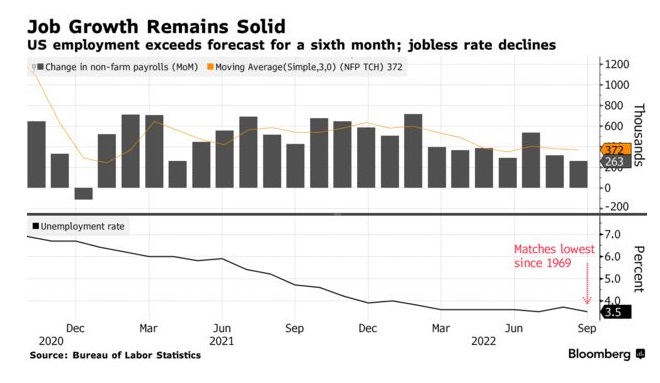
Continued Strength U.S. Labor Market

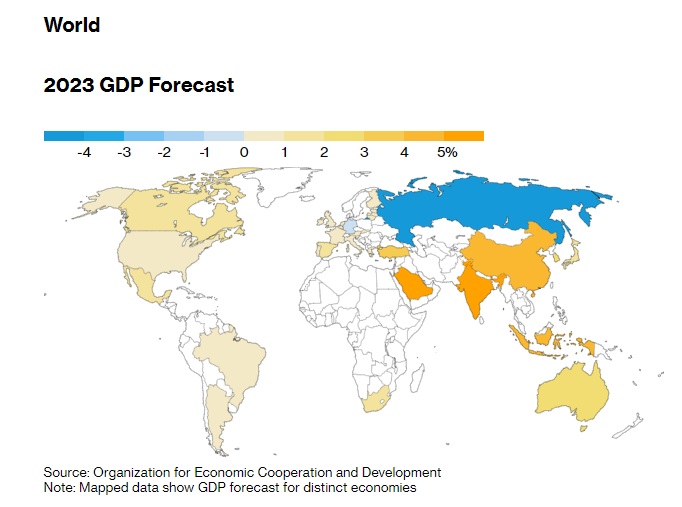
Global Growth Projections

Credit Party Is Over

Korea’s Power Generation 

Stepping On The Gas Inflation

Chips Dip

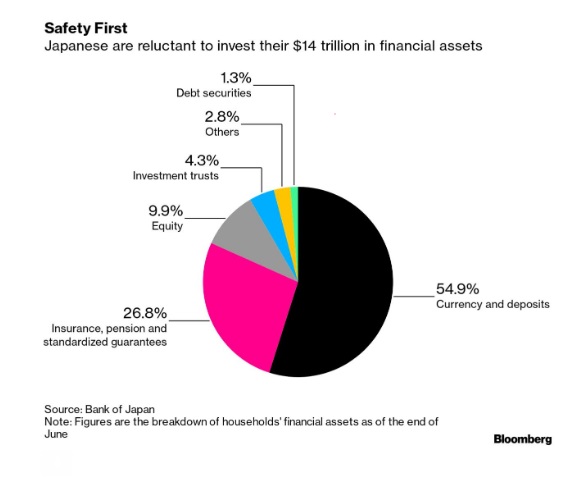
Conservative Mrs. Watanable

Posted in Charts | Leave a comment

Nonlinear Thinking: Surfing Wave Energy

Posted in Uncategorized | Leave a comment

Where The Next Financial Crisis Begins

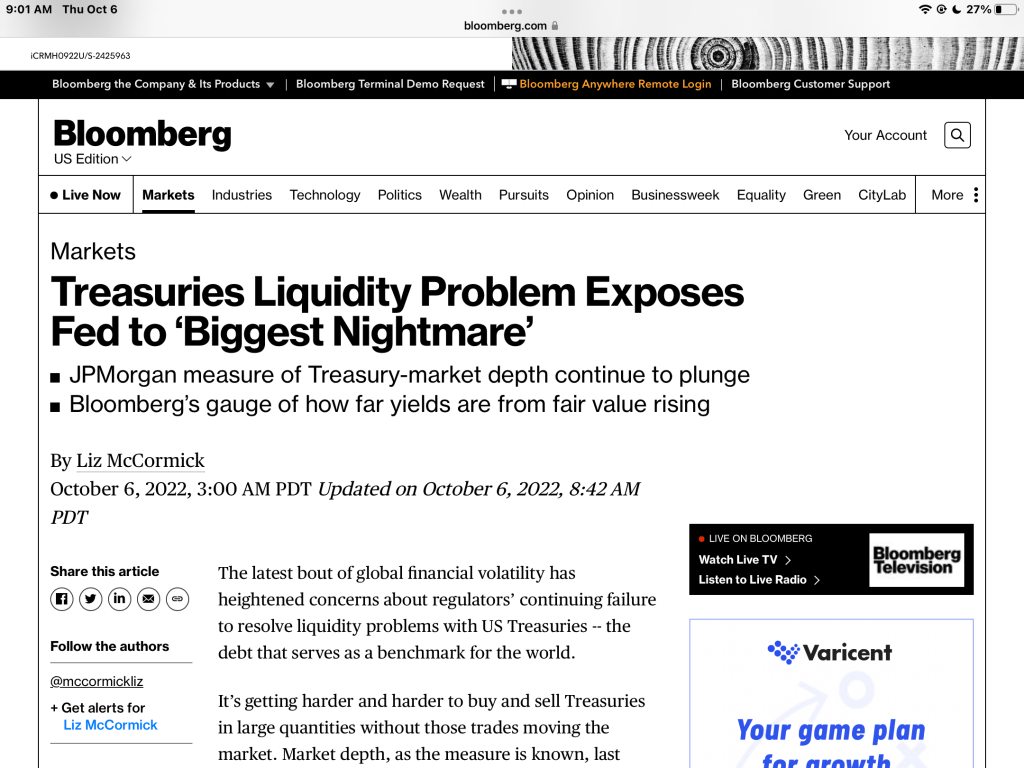
Our good friend, King David, just forwarded this Bloomberg headline to remind us of a post we made back in 2018, which we have reposted below.  Maybe, or maybe not, but you should have the following analysis in your quiver, at the very least to stress test your market narrative.   We do need to update the data, which are quite stunning and rather surprising.

It also fits hand in glove with our recent post, The Great Reset: The Bond Yield-Dollar Feedback Loop.

See Bloomberg article here.

Where The Next Financial Crisis Begins

Originally Posted on October 25, 2018 by macromon

We are not sure of how the next financial crisis will exactly unfold but reasonably confident it will have its roots in the following analysis.   Maybe it has already begun.

The U.S. Treasury market is the center of the financial universe and the 10-year yield is the most important price in the world, of which, all other assets are priced.   We suspect the next major financial crisis may not be in the Treasury market but will most likely emanate from it.

U.S. Public Sector Debt Increase Financed By Central Banks 

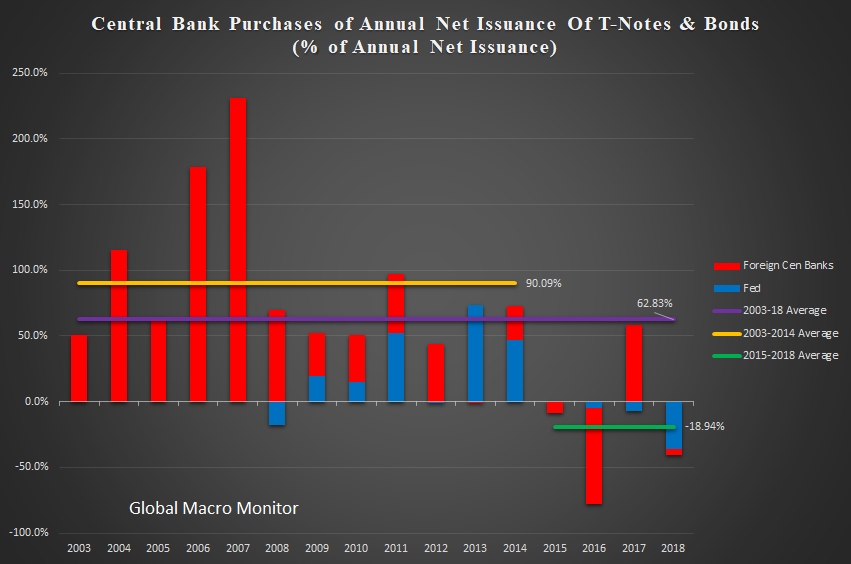
The U.S. has had a free ride for this entire century, financing its rapid runup in public sector debt,  from 58 percent of GDP at year-end 2002, to the current level of 105 percent, mostly by foreign central banks and the Fed.

Marketable debt, in particular, notes and bonds, which drive market interest rates have increased by over $9 trillion during the same period, rising from 20 percent to 55 percent of GDP.

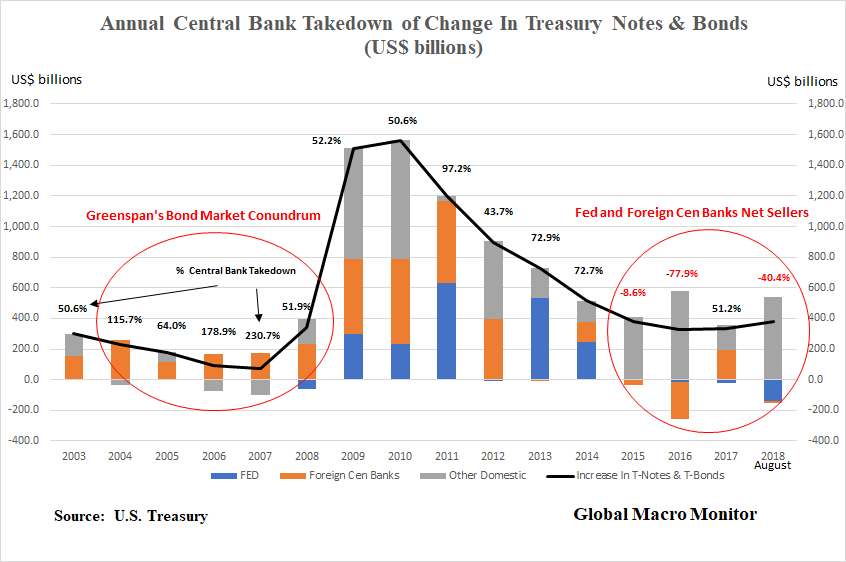
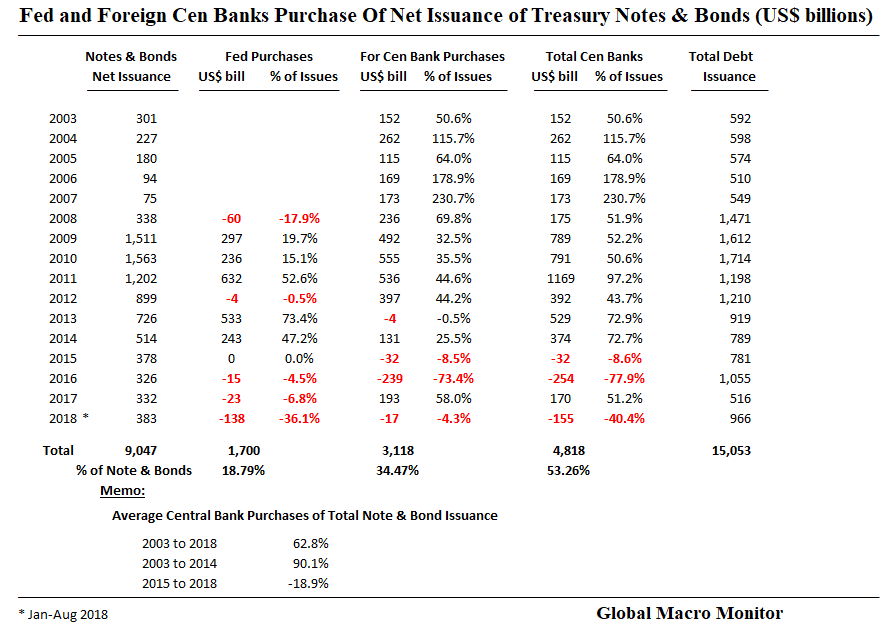
Central bank purchases, both the Fed and foreign central banks, have, on average, bought 63 percent of the annual increase in U.S. Treasury notes and bonds from 2003 to 2018.  Note their purchases can be made in the secondary market, or, in the case of foreign central banks,  in the monthly Treasury auctions.

In the shorter time horizon leading up to the end of QE3,  that is 2003 to 2014,  central banks took down, on average, the equivalent of 90 percent of the annual increase in notes and bonds.  All that mattered to the price-insensitive central banks was monetary and exchange rate policy.   Stunning.

Greenspan’s Bond Market Conundrum

The charts and data also explain what Alan Greenspan labeled the bond market conundrum just before the Great Financial Crisis (GFC).   The former Fed chairman was baffled as long-term rates hardly budged while the Fed raised the funds rate by 425 bps from 2004 to 2006, largely, to cool off the housing market.

The data show foreign central banks absorbed 120 percent of all the newly issued T-notes and bonds during the years of the Fed tightening cycle, freeing up and displacing liquidity for other asset markets, including mortgages.   Though the Fed was tight, foreign central bank flows into the U.S., coupled with Wall Street’s financial engineering, made for easy financial conditions.

Greenspan lays the blame on these flows as a significant factor as to why the Fed lost control of the yield curve.  The yield curve inverted because of these foreign capital flows and the reasoning goes that the inversion did not signal a crisis; it was a leading cause of the GFC as mortgage lending failed to slow, eventually blowing up into a massive bubble.

Because it had lost control of the yield curve,  the Fed was forced to tighten until the glass started shattering.  Boy, did it ever.

Central Bank Financing Is A Much Different Beast

The effective “free financing” of the rapid increase in the portion of the U.S debt that matters most to markets, by creditors who could not give one whit about pricing,  displaced liquidity from the Treasury market, while, at the same time,  keeping rates depressed, thus lifting other asset markets.

More importantly, central bank Treasury purchases are not a zero-sum game. There is no reallocation of assets to the Treasury market in order to make the bond buys.  The purchases are made with printed money.

Reserve Accumulation

It is a bit more complicated for foreign central banks, which accumulate reserves through currency intervention and are often forced to sterilize their purchase of dollars, and/or suffer the inflationary consequences.

Nevertheless, foreign central banks park much of their reserves in U.S. Treasury securities, mainly notes.

Times They Are A-Changin’

The charts and data show that since 2015,  central banks, have, on average been net sellers of Treasury notes and bonds, to the tune of an annual average of -19 percent of the yearly increase in net new note and bonds issued.  The roll-off of the Fed’s SOMA Treasury portfolio, which is usually financed by a further increase in notes and bonds, does not increase the debt stock, but it is real cash flow killer for the U.S. government.

Unlike the years before 2015, the increase in new note and bond issuance is now a zero-sum game and financed by either the reallocation from other asset markets or an increase in financial leverage.  The structural change in the financing of the Treasury market is taking place at a unpropitious time as deficits are ramping up.

Because 2017 was unique and an aberration of how the Treasury fnanced itself due to the debt ceiling constraint,  the markets are just starting to feel this effect.   Consequently, the more vulnerable emerging markets are taking a beating this year and volatility is increasing across the board.

The New Market Meta-Narrative 

We suspect very few have crunched these numbers or understand them, and this new meta-narrative, supported by the data, is the main reason for the increase in market gyrations and volatile capital flows this year.   We are pretty confident in the data and the construction of our analysis.   Feel free to correct us if you suspect data error and where you think we are wrong in our analysis.  We look forward to hearing from you.

Moreover, the screws will tighten further as the ECB ends their QE in December.  We don’t think, though we reserve the right to be wrong, as we often are,  this is just a short-term bout of volatility, but it is the beginning of a structural change in the markets as reflected in the data.

Interest Rates Will Continue To Rise

It is clear, at least to us, the only possibility for the longer-term U.S. Treasury yields to stay at these low levels is an increase in haven buying, which, ergo other asset markets will have to be sold.   If you expect a normal world going forward, that is no recession or sharp economic slowdown, no major geopolitical shock, or no asset market collapse,  by default, you have to expect higher interest rates.  The sheer logic is in the data.

Of course,  Chairman Powell could cave to political pressure and “just print money to lower the debt” but we seriously doubt it and suspect the markets would not respond positively.

Stay tuned.

Central Bank_2
Central Bank_5
Central Bank_10
Posted in Black Swan Watch, ECB, Fed, Uncategorized | Tagged , , | 1 Comment