QE2 leaves dry dock

By Boston Globe | September 2, 1992

BOSTON — With a thumbs-up from its captain and three cheers from its crew, the patched Queen Elizabeth 2 floated out of a South Boston dry dock yesterday and returned to sea, leaving a wake of hope for the region’s job-hungry shipworkers.”

We’re not making this up!


Posted in Uncategorized | Leave a comment

Medtronic sees deflation in device pricing…Is this so bad?

Beaker’s blog observes,

The medical device industry is shifting and entering a period of deflation after years of rising prices.   This according to Bill Hawkins, the CEO of Medtronic, who predicts the market prices for medical devices to decline 2 percent to 3 percent driven by healthcare reform and sluggish demand.

You think heart patients will succumb to “deflationary psychology“ and  wait a year for stint prices to fall?   My sense is that we have inflation in goods with inelastic demand, such as necessities, and deflation in luxury goods, where demand is more sensitive (elastic) to price.   Golf rounds on weekends are down 30 percent but up 10 percent on weekdays at the local course due to green fee price discrimination.    Do hospitals have a weekday rate?

The shift in relative prices do not fully show up in the inflation headlines  as the indexes are weighted averages and distorted by various other factors.    Interestingly, the huge housing price inflation of 2003-06 failed to show up in the CPI due to changes in how the government measured housing prices in the 1982.    Remember how it felt like inflation, but the data were telling us otherwise?

Wouldn’t it be nice to experience a little deflation in medical insurance?  Just asking…

Posted in Uncategorized | 1 Comment

End of Chimerica? China minimum wage to double by 2015

The tectonic plates of the global economy are shifting as China attempts to bolster domestic demand through wage increases.  Bloomberg cites a report in the South Morning China Post,

China plans to increase its minimum wage by at least 20 percent annually in the next five years, more than doubling it by 2015, to increase spending power and consumption, the South China Morning Post said, citing Huang Mengfu, a government adviser.

A risky gambit given that manufacturers will move offshore.  Bloomberg also reports China has lost the Calvin Klein bra maker,

China’s rising labor costs prompted Top Form International Ltd., a bra maker for Calvin Klein, to pick Southeast Asia for a new factory, adding to signs of a reshaping of the economy away from export-tied regions.

“We’ve halted plans to open a fourth factory in China,” Eddie Wong, group managing director and co-founder of Hong Kong- based Top Form, which also supplies brands including Maidenform, said in an interview yesterday. “We can consider other cities in China but it’s only a matter of time before wages will rise again and it will get more expensive for us.”

The country may believe that its domestic market has hit critical mass and the manufacturers who leave will be replaced by those seeking to sell into China.     Nevertheless,  we will be watching prices at WalMart and Costco very closely.   The sun is setting on Chimerica.

Though not updated to reflect today’s change,  here is a great graphic of the minimum wage throughout China’s provinces.

Posted in China | 5 Comments

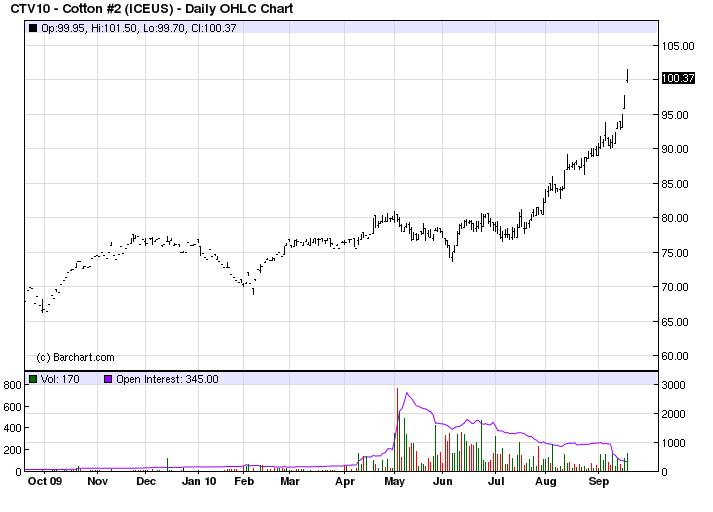
Cotton moves over $1 per pound for the first time in 15 years

Cotton going parabolic.  Corn flying.  I thought we’re in deflation? Combined with China wage pressures,  the days of the “cheap suit” are over. Buy those Christmas sweaters now and expect a margin squeeze for clothing retailers.   Hope the FOMC is tuned in.

The WSJ reports:

Prices have surged 33% since the beginning of the year due to bad weather in China, which is both the world’s No. 1 grower and importer, and the flooding that has washed out Pakistan’s fields. Global cotton inventories are estimated to fall 22% from a year ago as demand outstrips supply, according to the U.S. Department of Agriculture…

The rally has been driven by “panic buying,” said Sharon Johnson, a cotton analyst at First Capitol Group in Atlanta. “Right now, Chinese millers are just trying to find cotton, and there’s very little to be found.”

Speculative investors, or those looking to profit from price moves instead of using futures as a hedge, are piling in. The net number of bullish bets held by funds was 81,336, according to the latest data from the U.S. Commodity Futures Trading Commission released last week. This is more than triple the net long position recorded on July 20, when prices first began to soar.

Long cheap suits, short cotton futures!


Posted in Commodities | Leave a comment

QE2 to remain in the FED drydock

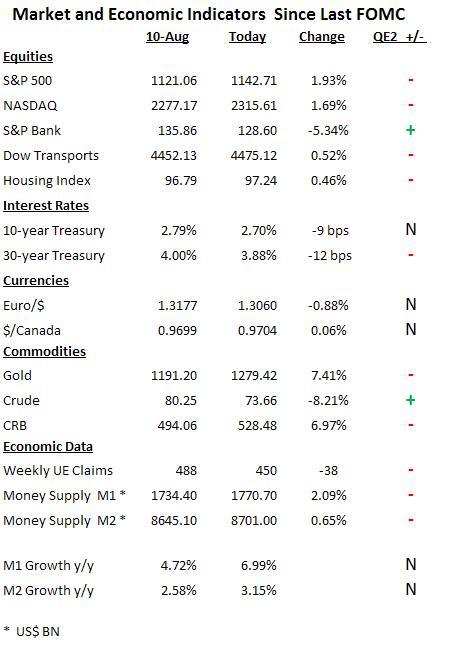
We expect nada from the Federal Reserve today.   Very little has changed since the August 10 FOMC meeting other than the spike in commodity prices and the level of noise. Members will be hard pressed to find reasons to move, except maybe to tinker with the maturity structure of their new bond purchases from the proceeds of maturing securities.   Gold could get spanked and test its old resistance of $1,265, where we would be buyers. Will the “extended period” language be enough to keep Gold rallying for an extended period?  Stay tuned!


Posted in Monetary Policy, Uncategorized | Leave a comment

Apple’s breakout lifts U.S. equities. Can the Shanghai follow?

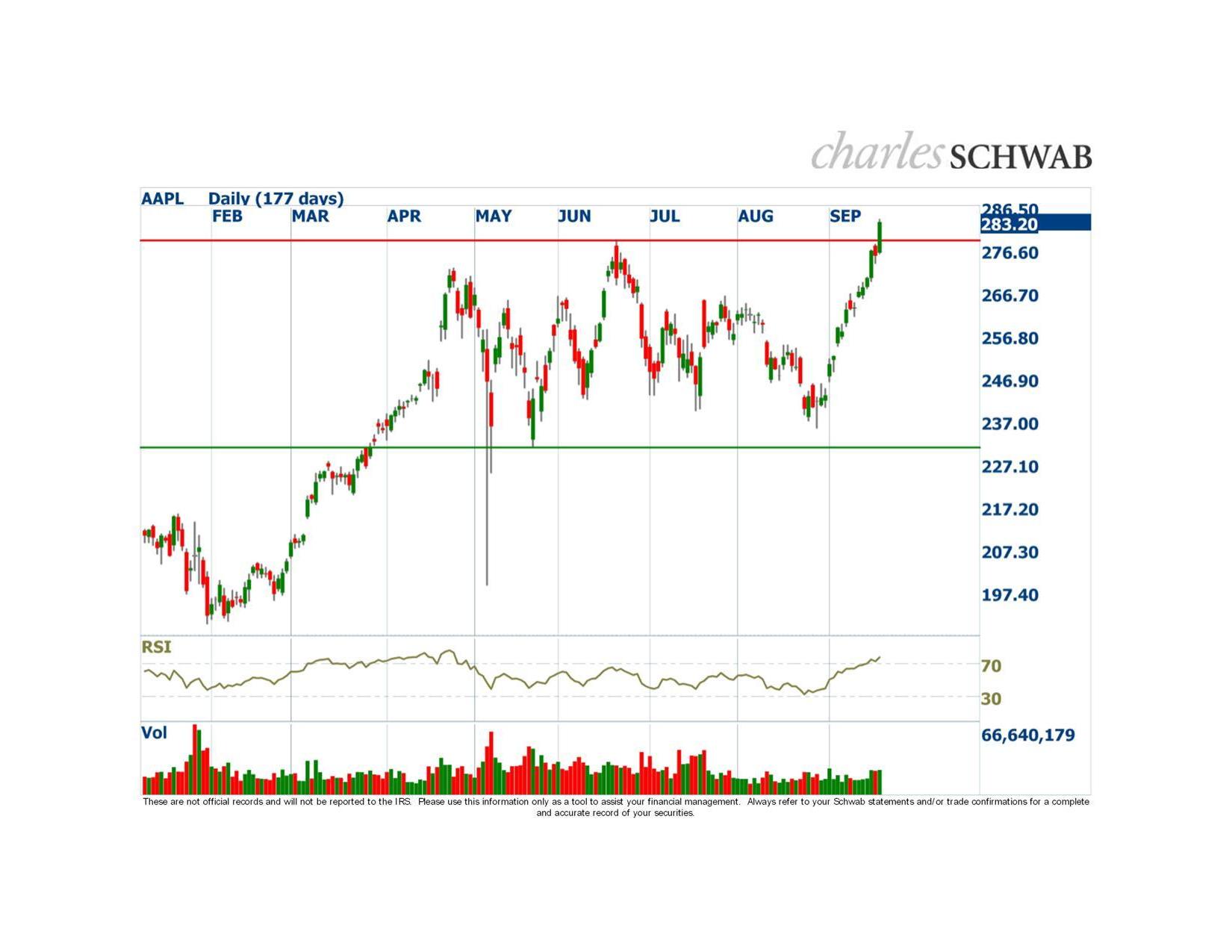
Apple pierced its June 21 high of 279.01 closing up almost 3 percent to a new all-time high.  The stock is up 18 percent in 19 trading days and the 14-day RSI is now above 77.  History dictates AAPL should consolidate around here for a few weeks.   After a similar 19 day  percent move in August ’09,  the stock traded in a 3.5 percent plus/minus monthly range before beginning its next leg higher.  Apple is the leader of the “new global economy” and THE BEST company in the world, in our opinion.  Keep it on your radar!

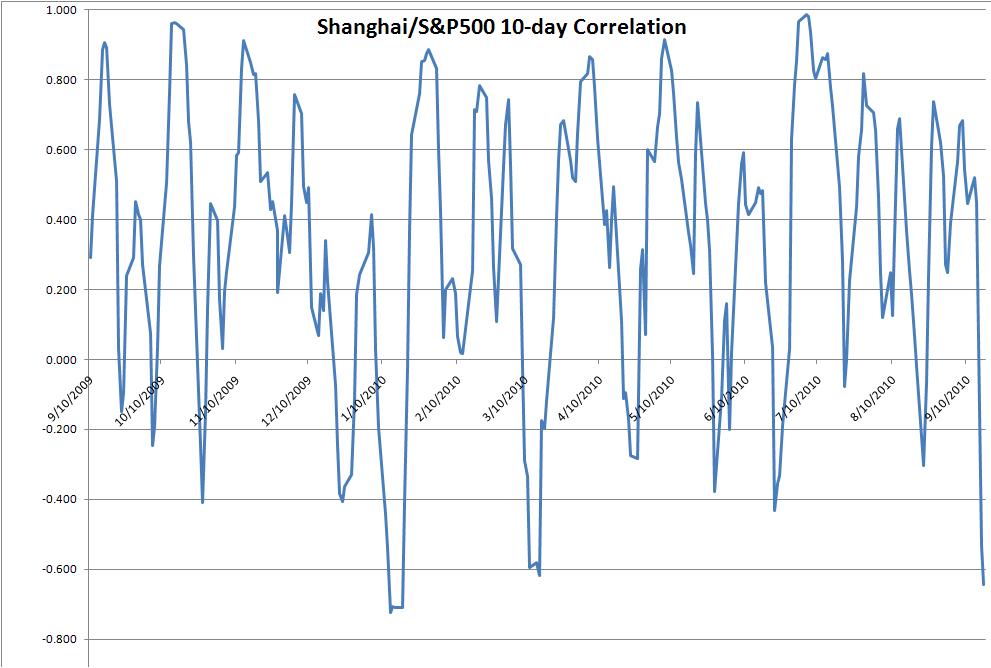
We wrote last night the extreme 10-day negative correlation between the S&P500 and Shanghai composite often signals a recoupling of the two indices.  Today the S&P broke through resistance, and then some, to close at a four month high.   We now need the Shanghai to confirm this move.  The index bounced off key support last night at 2572.

Posted in Uncategorized | 2 Comments

“Yield Panic” in Pensions?

The global pension crisis will be one of the major economic/political issues of the next 10 years.   We have seen the politics of pensions manifested on the streets of Greece and France this year.

Bloomberg reports that Japan’s Government Pension Investment Fund, which holds close to 70 percent of its assets in Japanese government and corporate bonds,  is considering investing in emerging market assets to boost returns.

““We currently have a hard time catching up with payouts since wages have been on a downtrend recently,” Tokyo-based Mitani was cited by the newspaper as saying in an interview.

Some will interpret the portfolio reallocation as a potential trigger that ushers in a Japanese Sovereign Debt Crisis.   Not so sure as it unlikely a massive flight from JGBs is about to take place.

More sure, however,  the tide of yield seeking capital flows will surge in the next few years. Good for high coupon/dividend plays with decent fundamentals.   The downside, however, is that the allocation of capital driven by necessity and less by theoretical choice (i.e., portfolio optimization), will likely increase volatility and the formation of asset bubbles.    Stay tuned!

Posted in Uncategorized | 1 Comment

S&P500 and Shanghai Composite about to recouple?

The short-term divergence of the Shanghai Composite and S&P500 is creeping onto our radar as Chinese stocks experienced the largest weekly loss in more than two months.  Fears of credit tightening have pushed the index to the lower end of a two month trading range.  The August closing low of 2572 is key support and a break there could take the index down another 7 percent to 2373.

Meanwhile, the S&P 500 is challenging the upper bound of a four month trading range.  The index touched 1131.47 on Friday, topping the June 21 high of 1131.23, and the August 9 high of 1129.24.  The index is very close, but has yet to top the August 9 closing high of 1127.79.

This week will be an interesting test for both markets.  Watch the China/U.S. divergence as the 10-day correlation is at an extreme -.65, a level where the two markets tend to recouple and begin to move together.

In March, the 10-day correlation hit -.62 in the midst of the S&P’s strong rally to its April 23 closing high of 1217.28.  After floundering for several days, the Shanghai Composite began a modest rally to close at the April 14 high of 3166.18, before a sharp sell-off.

In January, the 10-day correlation hit an extreme -.708, on January 18, just one day before the 1150  S&P500 peak and subsequent sharp 100 point two week sell-off .  The most recent highest close of the year on Shanghai Composite was made on January 19 just one day after the extreme 10-day correlation reading.

Though there is a lot of noise in a 10-day correlation,  it does appear, however, extreme readings do signal a moderate to significant move as the indices recouple.   Keep it on your radar!

Posted in Uncategorized | 2 Comments

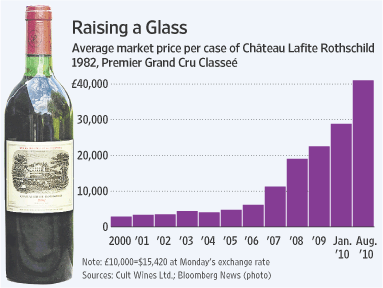
China Pushes Bordeaux Prices Higher

In early July, Hart Davis Hart Wine Co. began advance sales of Château Lafite Rothschild’s 2009 Bordeaux at $18,000 a case.

Within four days, the Chicago-based retailer and auction house had sold out. But its supplier’s price had risen, and Hart Davis Hart now sells the 12-bottle cases for future delivery at $23,000—about $1,900 a bottle…

But wine makers and merchants also credit booming demand from emerging economies, especially that of China, where labels like Lafite and Margaux have joined Prada and Hermés as badges of wealth. Last year, China passed the U.S. to become Bordeaux’s biggest export market by volume outside Europe.. – WSJ

Posted in China | 3 Comments

Corn Closes at $5.1325 bu, Up 58% Since Late June

The last leg of the market’s recent climb to 23-month highs has been fueled largely by the U.S. crop. On Sept. 10, the Department of Agriculture projected a yield of 162.5 bushels per acre, versus the 165 bushels estimated a month earlier. The USDA said that by 2011, supplies as a percentage of total usage would be at their lowest level in 15 years. Many traders expect crop projections to continue dropping, perhaps to 160 bushels per acre or lower. A wet early summer that washed away fertilizer, followed by hot nighttime temperatures that never gave the crop a chance to “rest,” are being blamed. – Barron’s

Posted in Commodities, Uncategorized | Leave a comment