Rare Earth Day

Rare Earth Elements (REE) have shown up on our radar as shares of Molycorp (MCP), one of the largest and only producers outside China,  has doubled in the past month.   REEs have no substitutes and are critical material inputs for high tech products,  including iPhones, electric cars, wind turbines, and defense applications, such as precision guided munitions, lasers, and communication and radar systems.

As the chart below illustrates, China produces and controls almost all the world’s REEs.  Because of their monopoly,  we’re sensing (though still under the radar)  a whiff of “Sputnik-esque” panic after the Chinese government blocked REE exports to Japan last Thursday as leverage to win the release of the fishing trawler captain, who was arrested on September 7 in the East China Sea.   The fisherman was released Friday and flew back to China on Saturday.

Both sides have downplayed the REE export embargo, but an article in this morning’s Nikkei news service titled, China Using Rare Earths As Diplomatic Weapon, reports,

“China shrewdly took advantage of a weakness in Japanese industry. But excessive global reliance on China for rare earths — it currently supplies 90% of the total — will not continue indefinitely…At the Mountain Pass rare-earth mine in the western U.S., which used to be the largest of its kind in the world, preparations to resume mining operations are under way with government support.”

Who operates the Mountain Pass mine?  Molycorp.  Though the company loses money,  it is our sense the events of the past week have made the operational success of Molycorp a National Security issue.   We have a modest position and will buy more on a pullback. Trade  as a diplomatic weapon is a potential Black Swan we will monitor closely.  Stay tuned!

Posted in Black Swan Watch, China, Commodities, Equities, Geopolitical, Rare Earth Elements | Tagged , , , | 2 Comments

Soft Landing in the Chinese Property Market

Andy Xie, the former Morgan Stanley economist and one smart dude, pens a great piece for Bloomberg on the Chinese property and reverses his previous view of an imminent crash. The fallout from a potential hard landing in China’ s property market is one of the reasons we keep an ample supply of Ambien close at hand. Xie writes,

“Recent developments have changed my mind. This bubble may not end suddenly, but with a slow leak. Previously, I thought the government would relax its credit-tightening policies in the fourth quarter, leading to another surge in property prices. The bubble would pop with a big bang in the second half of 2011 or in 2012.”

The money quote:

As Chinese real-estate prices deflate slowly now, and faster in 2012, the economy will hold up. Exports, consumption and infrastructure should sustain a 7 percent to 8 percent growth rate for the next decade. That seems low compared with recent years, but it will be much better for lifting wages, household living standards and corporate profits.

China has no home-equity loans for consumption. Those who hold more than 20 million empty flats will become poorer or bankrupt. The sales of Mercedes cars may shrink. But the middle class will be able to consume more as they pay less to buy flats from speculators.

Since we monitor global capital flows very closely, we find this interesting,

“In addition to credit policy, liquidity is tightening… After waiting for years [currency revaluation] without seeing the real thing, the hedge funds are fed up and don’t want to hang around anymore…The yuan non-deliverable forward market isn’t expecting significant appreciation for the next year.

That is having a big impact on hot money flow into China. The competition for deposits is heating up. Banks are offering products that are like deposits and with much higher interest rates than the policy rates.”

The lower probability of a hard landing in China the better for risk assets.   It will be interesting to see if Chinese equities can bounce off the lower end of their trading range given the country’s tighter liquidity conditions.  This, in out opinion,  would confirm the recent breakout in the U.S. market.   Stay tuned!

Posted in China, Commodities, Gold, Whales | Leave a comment

What is the “correct” price for gold?

Because the equilibrium price of gold is an unknown,  the yellow metal keeps running.  There is no real metric to determine its fundamental value — a real rate of interest and price-earnings or price to book ratio, for example.   This is also the case with most commodities.   And, in a world of zero interest rates, the opportunity cost of holding gold is extremely low. 

Analysts are struggling to find a fair value target price, using comps such as the “real”price high,  the gold/S&P500 ratio, and the gold/crude oil price ratio.   We know  gold is being fueled by global monetary expansion in the form of: 1)  the massive accumulation of foreign exchange reserves by Central Banks over the past seven years;  and 2)  most recently, the printing of money, i.e., quantitative easing,  by the world’s major central banks.  CNN reports,

“…some are arguing that gold is too pricey because it is trading at a historically high level when compared to a widely watched index that tracks the dollar versus a basket of other currencies…But Marion points out that this index only includes six currencies and is heavily weighted toward the euro. He said that if you look at gold prices when compared to another dollar index that the Federal Reserve uses, which is comprised of 26 currencies, gold still is trading about 50% below its peak price…gold would have to rise another $650 or so an ounce before it would truly look overvalued. That puts you close to $2,000 an ounce.”

Nobody knows the “right” price and that is why the commodity, in our opinion,  will surprise to the upside.

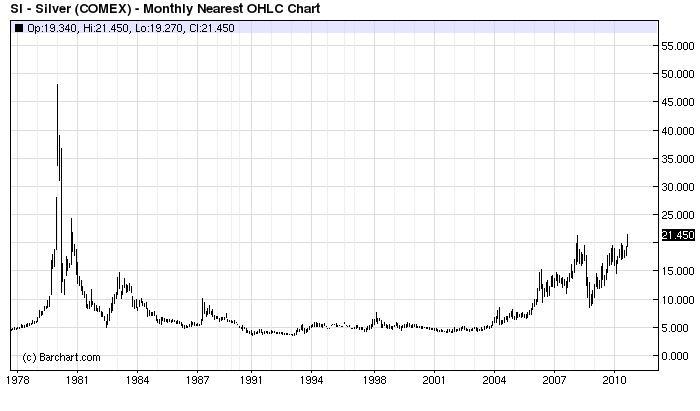
Gold is the Tower of Terror trade, however,  as the sell-offs are nothing short of hair raising.   Size positions must be monitored very closely with disciplined stop losses.    As we hit $1,300 we’ve reduced our gold position, waiting for a $25-30 pullback where we will be buyers; and have also swapped a portion into silver, the poor man’s gold,  which is beginning to outperform and still far from its January 1980 all-time high (see chart below).

The November election is probably the biggest risk for gold as the Republicans and Tea Party members are more inclined toward “hard money” polices.   Though it is unlikely a change in Congress will stop the printing press or accumulation of reserves by foreign central banks, just the uncertainty could create a nice buying opportunity.   

Some say Gold is nothing more than a fear trade.”   We agree:  we are afraid when we are too long, not long enough, or not long at all!

Posted in Commodities, Gold | Tagged , | 1 Comment

Gold ATMs Arrive in Europe

An ATM at the Westin Palace Hotel in Madrid dispenses gold for cash currency.   A similar machine was installed at the Emirates Palace Hotel in Abu Dhabi earlier this year.   We’ll  get nervous about our precious metal positions when we see these in WalMart.  Let us pray that the next step in this story is a giant leap we never have to experience.  That is, the day Gold becomes more than just a store of value, but also a de facto medium of exchange.

Posted in Gold | Tagged | Leave a comment

Commodities close at eight-month high

The CRB index is now just 3.5 percent below the Jan. ’10 post-bubble high and, this, with crude down over 10 percent.  Crude, heating oil, and natural gas make up about 18 percent of the index.   Look for commodity traders to get all lathered up as the CRB breaks through resistance,  maybe as early as next week.   It’ll be interesting to see if the Fed downplays QE2 if we get a huge spike in commodities.    Doubt it.   Fully expect crackdown on the specs to heat up.  Hope all enjoying the under invested buying panic in equities.  “Long may you run!.”

The Reuters/Jefferies CRB Index of 19 raw materials rose as much as 1.4 percent to the highest level since Jan. 15. Gold futures rose to a record, topping $1,300 an ounce, and silver futures jumped to a 30-year high. Corn, soybeans, wheat and cotton rallied.

The greenback fell to the lowest level since February against a basket of major currencies. Orders for U.S. capital equipment rebounded and German business confidence improved, fueling demand for higher-yielding assets. The Federal Reserve has kept borrowing costs low and may take more steps on monetary policy to bolster the U.S. economy. – Bloomberg


Posted in Uncategorized | Tagged | Leave a comment

Stephen Colbert Testifies in Congress on Immigration

Stephen Colbert testified this morning to the House Judiciary Committee’s Subcommittee on Immigration .  Checkout the video and note the different reactions from the Members versus their aides seated behind them.  They were not amused.

“…this is America! I don’t want a tomato picked by a Mexican. I want it picked by an American then sliced by a Guatemalan and served by a Venezuelan in a spa where a Chilean gives me a Brazilian.”…1:20 minutes

Don’t miss it…

Posted in Uncategorized | Leave a comment

David Tepper on QE2: “Everything Will Go Up”

“This might be one those [moments].”

CNBC’s excellent interview with David Tepper, one smart dude (OSD).  Tepper is a great hedge fund manager and made a bundle buying bank shares and preferreds when the you know what was hitting the fan.  He got his start in distressed debt.  Click link for the extended version of this must view interview.

“Either the economy is going to get better by itself in the next three months…What assets are going to do well? Stocks are going to do well, bonds won’t do so well, gold won’t do as well,” he said. “Or the economy is not going to pick up in the next three months and the Fed is going to come in with QE.

“Then what’s going to do well? Everything, in the near term (though) not bonds…So let’s see what I got—I got two different situations: One, the economy gets better by itself, stocks are better, bonds are worse, gold is probably worse. The other situation is the fed comes in with money.”

Check it out.

Posted in Whales | Leave a comment

The Squeeze in Global Rubber Supplies

Rubber is bouncing….

Goodyear Tire & Rubber and Cooper Tire & Rubber, the two largest U.S. tiremakers, have begun notifying customers they will raise tire prices by as much as 6.5% by early November. Bridgestone, the largest tiremaker by sales, said in late August that it’s increasing prices by up to 6% in Europe, the Japanese company’s second price increase this year…Tiremakers are passing on the higher costs, and future hikes can’t be ruled out. “We don’t do a lot of raw-material hedging” says Keith Price, a spokesman for Akron-based Goodyear. – Bloomberg


Posted in Commodities | Tagged , | 1 Comment

Ding-Dong in Hong Kong! Is that a bell ringing?

We don’t really hang with the deflation crowd much, but a hard landing in China is the one scenario that keeps us up at night.  China is the locomotive of the global economy and we monitor events there very closely.  In fact, we wrote early this week that the Shanghai Composite would have to rally off the bottom of its trading range to confirm Monday’s S&P500 breakout.

Real Estate Bubble

A couple of informative articles out of Hong Kong this week have rung our [alarm] bell. William Pesek’s excellent Bloomberg article, Bubble City’s $3.2 Million Flat Spells Danger, warns of the danger of Hong Kong’s property bubble,

On the surface, everything is great. The city’s $215 billion economy is growing 6.5 percent, confounding the skeptics. It’s good to be the gateway to China’s boom while the most developed economies fret about a double-dip recession.

Yet that proximity comes with a price, and a growing one. Few doubt that Hong Kong has a property bubble on its hands. Home prices have surged about 47 percent since the start of 2009. Who’s buying? Wealthy mainland Chinese.

The Federal Reserve’s zero interest rate policy (ZIRP) is the other force fueling the bubble, as Hong Kong’s currency peg to the dollar is a superconductor of U.S. monetary policy.  Hong Kong has even been referred to as the 13th Federal Reserve District.

Pesek writes Hong Kong is a microcosm of the mainland,

And even if Hong Kong is hot, it’s less of a bubble than, say, Shanghai. For now, at least.

China’s property bubble is nothing new and has been the subject of ongoing debate in the global markets.   But, even just a whiff of a hard landing would generate a massive sell-off in global asset and commodity markets.  No wonder Jim Chanos, one smart dude, maintains his negative view on China and short positions in commodities.

Wine Bubble?

Prices for Château Lafite Rothschild, the market leader, have doubled in the past six months. China’s largest bank, ICBC, is reported to have started buying wine on behalf of its clients. Classes on wine investing are taking off. Sniff its bouquet, however, and the wine boom has hints of tulip mania

The Economist’s, Days of Wine and Tulips, was even more surprising.  We linked last week to the WSJ, China Pushes Bordeaux Prices Higher, and it appears speculation may be a major force driving up wine prices.

After Hong Kong cut the sales tax on wine to zero in early 2008 imports skyrocketed,

The zero tax rate has attracted big auction houses to the wine trade in the ex-colony. David Elswood, the top wine man at Christie’s, says that Hong Kong has become more important than New York and London combined…

Although most of the new demand has a mainland-China connection, there have been buyers from South Korea, Japan, Indonesia and Thailand, all of which still tax wine heavily…Moving wine into these countries would be costly. But for many buyers that is beside the point. They are buying to invest, not to imbibe. Their bottles will remain in the vaults…

If people were buying to drink, one might expect the surge in prices and volumes to be broad-based. Instead, it is focused on a handful of famous names. These are, ahem, a more liquid investment: they can easily be resold. And using reputable auction houses reassures buyers that the wine is not counterfeit.

There you have it.  What appear to be late stage bubbles that, we know,  rarely end without tears.  Pass the Ambien!


Posted in Black Swan Watch, Uncategorized | 2 Comments

EU to wage war against speculation on commodity markets

Reports out of Europe a crackdown on the specs is in the works:

Brussels, like Washington, is planning to launch measures to regulate commodity exchanges and curb speculation, as well as step up transparency in food trade after the recent surge in agricultural commodity prices.

Regulators are wrongly focused on treating the symptom of speculation rather than the cause.   Go no further than Bagehot’s aphorism, “John Bull can stand many things, but he cannot stand two zero percent,” to understand what is happening in commodity markets.

Current  monetary policy has displaced and diverted liquidity into speculation.  Unlike, 2003-07, where credit expansion was fueling bubbles in almost assets,  current speculation is a zero sum game as sources of liquidity are reallocated from one market to another.   Interestingly,  gold and the soft commodities are rising at the expense of crude oil.

Liquidity is a necessary condition for speculation, but it also needs a fundamental “story.”   The drought in Russia, for example, is the spark and sufficient condition for speculation to take hold in wheat.   Ignorance of the “equilibrium price,” that is,  the “correct price” of  wheat or gold is unknown,  allows prices to significantly overshoot their fundamental value.

Increasing margin requirements on future contracts, for example, will have only a limited effect until John Bull is satisfied with a fair return on his savings. The late great, Charles Kindleberger,  is the READ and expert on speculation, in our opinion.   We were blessed with the opportunity to speak with him before he passed in 2003.


Posted in Commodities | Leave a comment