“All kingdoms are monarchies but not all monarchies are kingdoms.”
Queen Elizabeth’s husband [late husband] Prince Philip [was] related to the Romanovs through both his mother and his father. Philip is the grandnephew of Alexandra Romanov, Nicholas II’s wife, and the last Tsarina of Russia. He is also a cousin to the Russian royal family.
Philip’s children and grandchildren, including William and Harry, are therefore related to the Romanovs as well.
In fact, when the remains of two children thought to be Maria and Alexei Romanov were found in a field in 2007, it was Prince Philip’s DNA that was used to identify them, news which was revealed in 2016. – Town & Country
How is Queen Elizabeth related to other European monarchs?
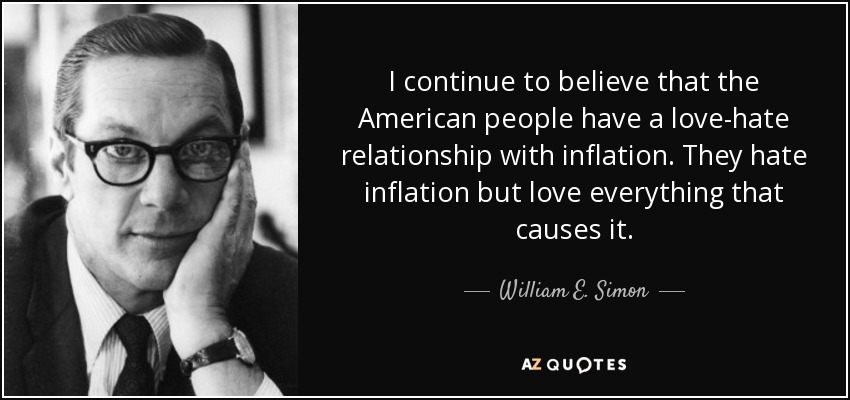
William Edward Simon was an American businessman and philanthropist who served as the 63rd United States Secretary of the Treasury. He became the Secretary of the Treasury on May 9, 1974, during the Nixon administration. After Nixon resigned, Simon was reappointed by President Gerald Ford and served until 1977 when President Jimmy Carter took office. – Wikipedia
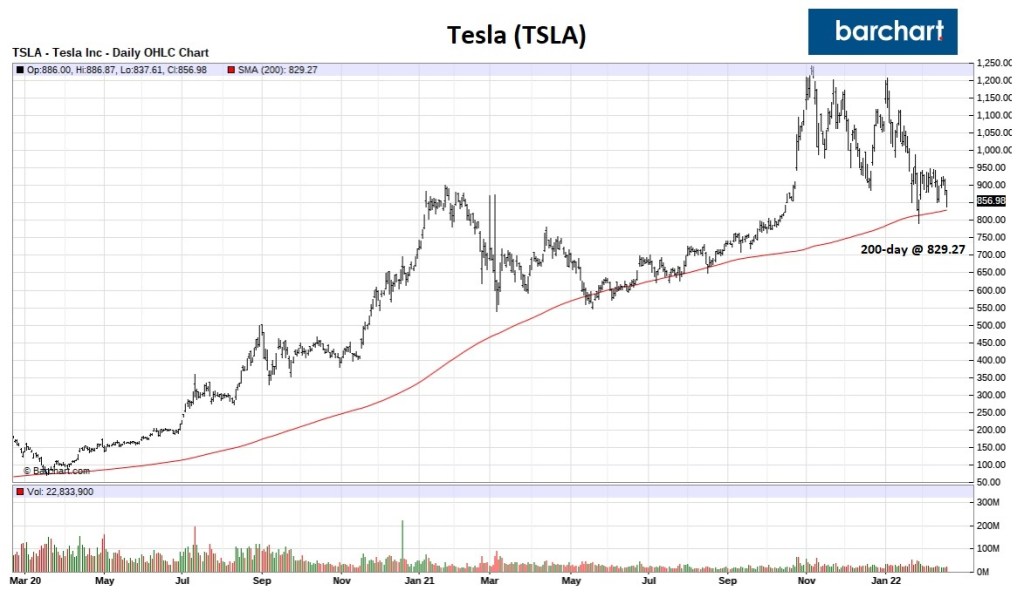
Tesla (TSLA), the poster child of the latest leg of the bull market, which began in March 2020, is again testing what has been its unpenetrable support at the 200-day moving average. The stock has to hold here. Maybe, maybe not.
Tesla stock is now in a bear market, down 31 percent from its January 4th high.
Crypto Crash
Moreover, Elon’s crypto hobby isn’t faring much better.
Bitcoin is down 47 percent from its wait for it… 9/11 high, and down 13 percent from the Crypto Super Bowl just eight days ago. Where art thou Tom Brady and Matt Damon?
Seriously, folks, do real currencies fall 50 percent in value in three months?
Mayor Of New York
The new mayor of New York City could have been in a world of pain and a lot poorer,
The above illustrates Bitcoin (BTC) fails the currency test, at least on two accounts: a stable store of value and a unit of account. Furthermore, BTC is, at best, a very inefficient medium of exchange, and we’re not even so sure about that.
My Bitcoin bros were all lathered up that the new mayor agreed to be paid in BTC.
Not so fast,
Adams officially received his first paycheck yesterday [Jan 21], which was converted to Bitcoin and Ethereumthrough cryptocurrency exchange Coinbase. According to the New York Post, the NYC mayor receives biweekly paychecks of about $5,900, amounting to a salary of $258,750 a year. – The Verge
You got that, folks? Converted to and not paid in crypto.
Major Adam’s salary is denominated in a unit of account of $258,750 per year and then converted to crypto and not the 3.77 BTC that would have been the case at the exchange rate when he made the announcement. Lucky for him.
God bless the early adopters who have made a killing, but it’s sad, in our opinion, to see an entire generation duped by what has now become a social movement. We blame the regulators who have allowed the markets to morph into the circus they have become.
We could be way wrong, and opinions about the future only become fact in hindsight, but we have seen this picture too many times, just with a different script and other actors.
Save Us Elon!
I wouldn’t be surprised to see an Elon Tweetfest soon. We love that guy, but we think he could use a little more maturity in his Tweeting.
Much cheaper than when Elon hosted Saturday Night Live last May and when he Tweeted the above. Dogecoin is down 82 percent from its high last May.
A store of value?
We don’t think so, and neither does Mr. Market.
Looks Like Elon Has Some Competition
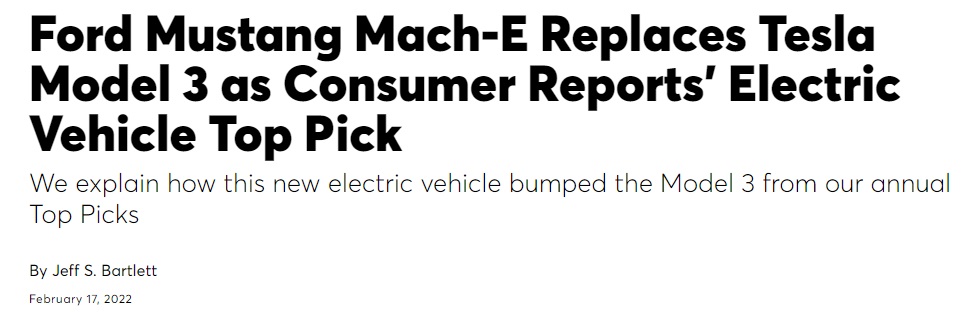
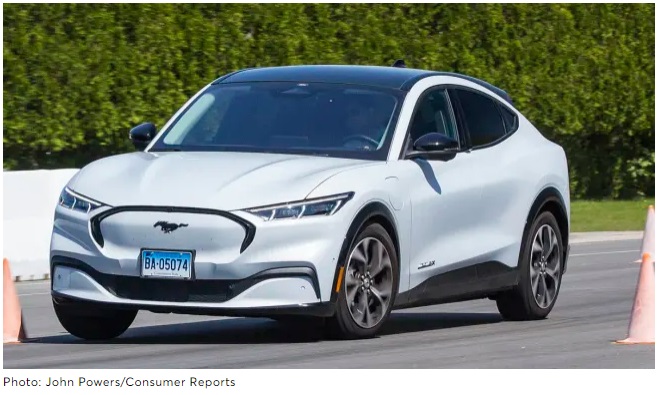
In its annual Top Picks, Consumer Reports highlights the standout cars, SUVs, and trucks across in 10 distinct categories. Tesla has dominated the electric vehicle category, with the Model 3 holding the EV Top Pick honor for the past two years. But now the Ford Mustang Mach-Ehas earned the accolade based on its Overall Score, which factors road-test score, predicted reliability, owner satisfaction, and safety. – Consumer Reports
If an automaker wanted to convert people from EV skeptics to EV evangelists, it’s hard to imagine a better vehicle for the job than the Ford Mustang Mach-E. It arrives in the familiar shape and size of the crossovers Americans love, at a price that competes with gas-powered alternatives, and with a design that gets noticed. The Mach-E has the range and charging speed to wave off the most common EV criticisms, and thanks to Electrify America’s recent work, there’s a nationwide charging network that makes long interstate trips not just possible but tolerable. – Car and Driver
As our CK would lecture us — cash flow, profits, and divies, baby. Old fashion? You bet your sweet something.
A reasonably informative video below, especially regarding inflation.
Not much mention of the growth of money driving excess demand, however.
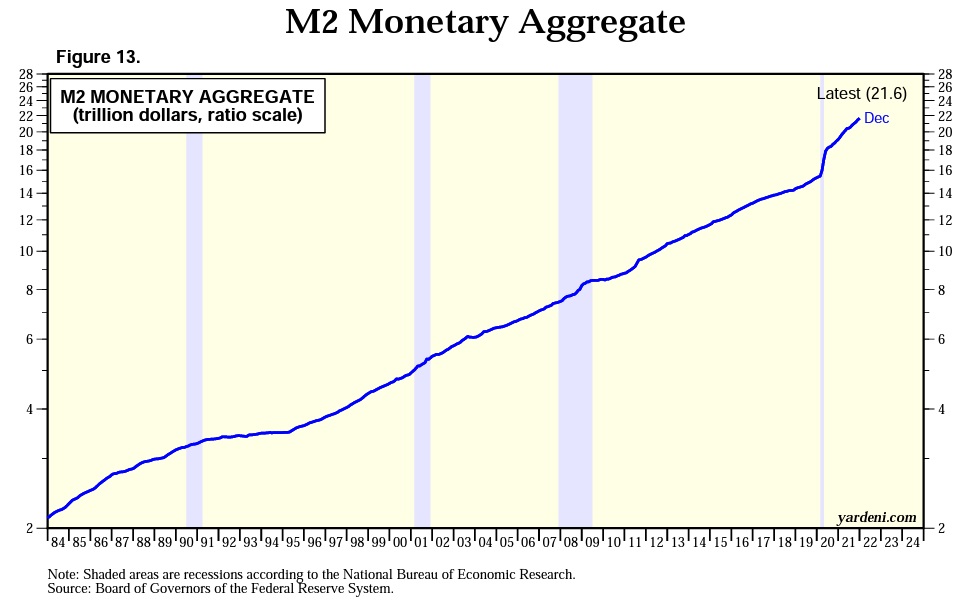
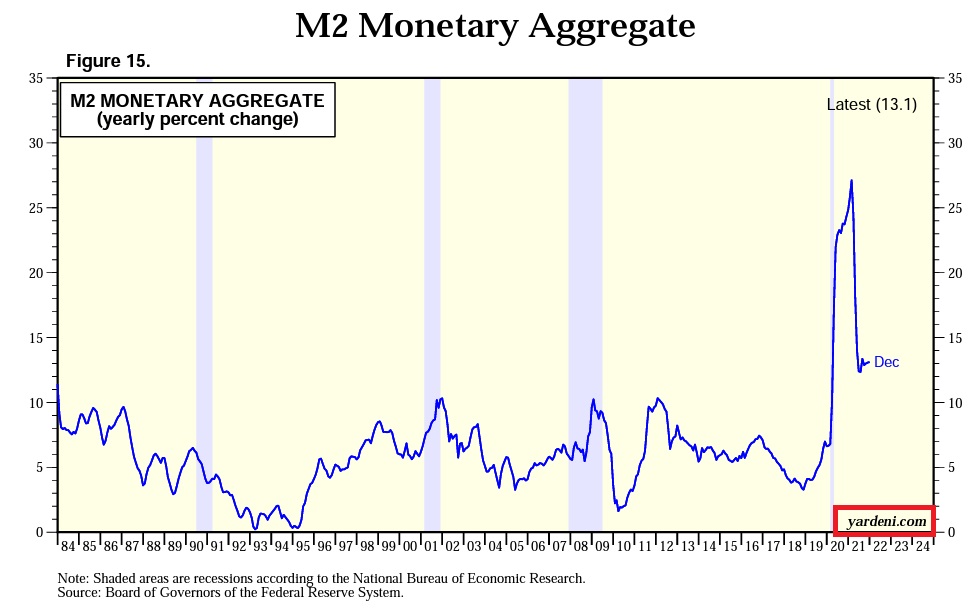
M2 (thanks to the great Ed Yardeni for the charts) is still growing over 10 percent, in the U.S. and most other major economies are or have also experienced rapid money growth. This monetary aggregate is a feeble measure of “money,” which is now almost impossible to define in our age of rapid technological change.
We question, shouldn’t a brokerage account, where you can lever up, say, the gold ETF and still write checks against it, as I used to do, be counted as money? What about crypto?
During the dot.com boom, for example, some restauranteurs in Silicon Valley took stock options as payment from new startups using their dining booths as offices and a dining hall. Is that considered money? It certainly met two of the three criteria: a medium of exchange and a unit of account, at least while it lasted.
When I worked in the Federal government back in the day as a grad student, I attended seminars where some economists advocated including stock mutual funds as part of the money supply measures when the monetary aggregates began to diverge from nominal GDP.
US Monetary Aggregates
Monetary Policy Is A Blackbox
Even Alan Greenspan said as much 25 years ago in his famous Irrational Exuberance speech, which is more true today than it was then.
There is, regrettably, no simple model of the American economy that can effectively explain the levels of output, employment, and inflation. In principle, there may be some unbelievably complex set of equations that does that. But we have not been able to find them, and do not believe anyone else has either.
Consequently, we are led, of necessity, to employ ad hoc partial models and intensive informative analysis to aid in evaluating economic developments and implementing policy. There is no alternative to this, though we continuously seek to enhance our knowledge to match the ever growing complexity of the world economy. — Alan Greenspan, Dec. 1996
Inflation Accelerating
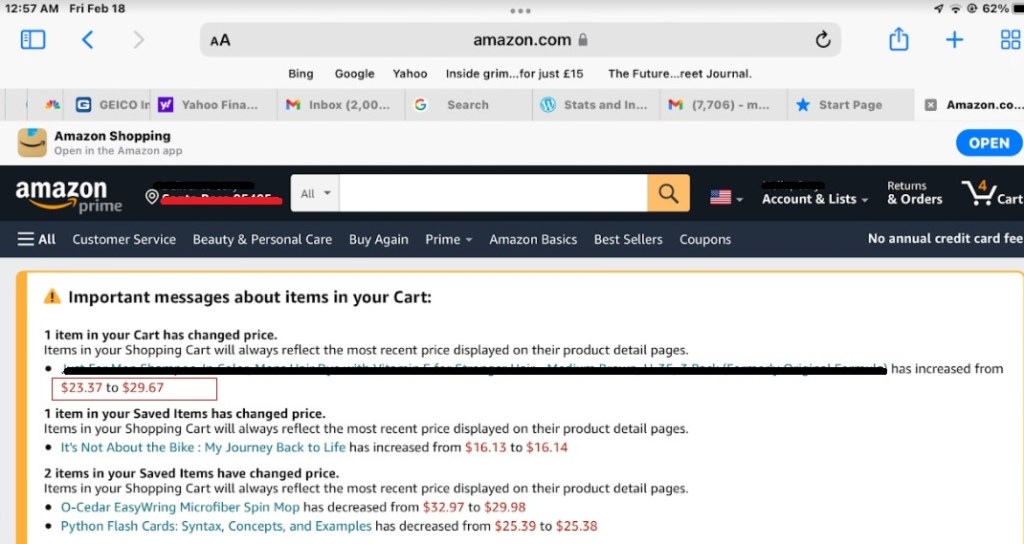
I woke to a ping on my iPad the other night to the following message from Amazon warning some prices in my basket had gone up overnight and gone up big. I am certainly not going to reveal my monthly hygiene product, but you get the point.
The upshot is companies continue to raise prices, not because they are greedy or evil, but because the point-of-sale demand is there, and they can pass on any rise in input costs, and then some. That is why businesses are in business, to make a profit, folks.
Profits, like fire, are amoral. A fire burned down my house in the NorCal 2020 wildfires but also cooks my food and keeps me warm at night.
Understanding Inflation In The Context Of Global Monetary Policy
Monetary policy is a challenging concept to grasp. Witness Greenspan’s quote above.
In my undergraduate American Presidency class, I recall reading about JFK, who would pen cheat notes on his hands before press conferences. Fiscal policy on one hand and monetary policy on the other as not to confuse the two.
I taught undergraduate economics for years, including several money and banking courses, and tried to use simple analogies and heuristics to help my students grasp these very complex issues.
Bathtub Overfloweth
If I had to use one today to explain what is going on with inflation and the supply chains, it would be the following simple picture of a bathtub overflowing:
Assume the water in the tub above is the global liquidity in the world economy. It consists of the base money created by the central banks, endogenous money created by the credit markets (my 18-year daughter just received an offer for an $18k line of credit), and all the other faux wealth created and associated with the ‘everything bubble,” which is extremely difficult to quantify.
The overflow is the inflation now wreaking havoc in the goods & services market. It will cause significant structural and political damage if it continues, such as the floor caving in and flooding the downstairs — ditto for the economy.
If inflationary psychology takes hold in the economy at large, as it has in the supply chain, well “Houston, we have a problem.” It is baffling to us that market analysts maintain, and even the central banks, that inflationary expectations are well anchored in, say, the 5-year breakevens.
Can we really infer an economic signal when the U.S. central bank has bought up, albeit indirectly, around 75 percent all coupon Treasury securities and almost 200 percent of the TIPs issuance since COVID? That price is about as well managed and meaningless, at least to us, as the price of sausage “back in the USSR…where the Ukraine girls really knock me out.”
We can sit here and wish inflation away, and it’s almost laughable that some “so-called” economists do so, but that ain’t going to happen, folks. The major central banks need to take action.
The bathtub as is the global economy are in significant disequilibrium.
What To Do?
The central banks control the faucet with their balance sheets and the temperature with interest rates.
The solution is quite simple, in theory.
Immediately, turn off the spigot (the Fed and ECB are still stunningly pumping away as we write), drain the liquidity to a more acceptable level (quantitative tightening), and increase the temperature to a comfortable level by raising interest rates, where the economy can bathe in a more stable and comfortable equilibrium, if one does exist.
Easier said than done, however.
Asset markets are addicted to the excess liquidity, where even the most worthless rubber duckies have floated to the rim as their excess valuations overfloweth on a monster scale. The market is, however, starting its dangerous speed wobble as the “dogs [rubber ducks] that don’t hunt” are rolling over hard and quite rapidly, as more than 40 percent of all Nasdaq stocks are now down over 50 percent from their highs.
The Fed and other major central banks almost certainly fear the coming asset devaluations, which need to adjust and regress down to their historical valuation water line.
Because the global markets and economies are so hooked on the crack of free money coupled with both the leads and lags of monetary policy and lack of clarity, the use of monetary policy to fine-tune economies is equivalent to threading a needle with boxing gloves. The central bankers are most certainly facing a difficult next few years.
Do you not know? Have you not heard? Wall Street is an everlasting marketing machine. — Book of GMM
Is The Street now day trading their market strategies?
Check out the opposing views from America’s largest bank, the eighth largest in the world. No wonder markets are volatile.
Johnny Whipsaw rules today’s markets.
My guess is they are practicing the Islamic proverb, whether they know it or not,
Trust in Allah but tie your camel.
Hedge your bets, speak cryptically and in double-entendre, claim you were correct whichever way the market turns, and collect the year-end bonus just as the Oracle Of CNBC does.
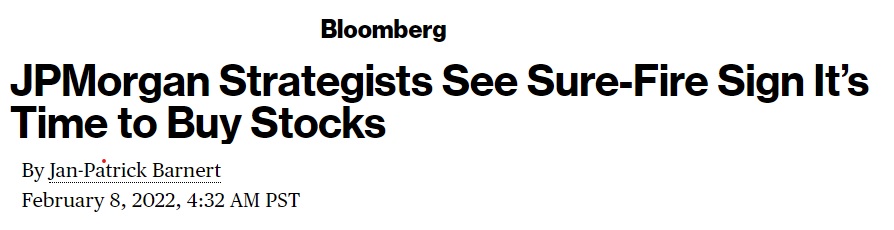
“We believe that equities still offer upside, and that the cycle is far from over,” the London-based strategists wrote in a Feb. 7 note. In addition to the VIX signal they look for more gains in earnings, a bottoming in Chinese activity and say investor sentiment has become too negative of late. – Bloomberg
Expectations about corporate earnings growth are quickly diminishing, JPMorgan Chase & Co. quant strategists said, warning that the gloom could spell more trouble for global stock markets after an underwhelming start to the year. – Bloomberg
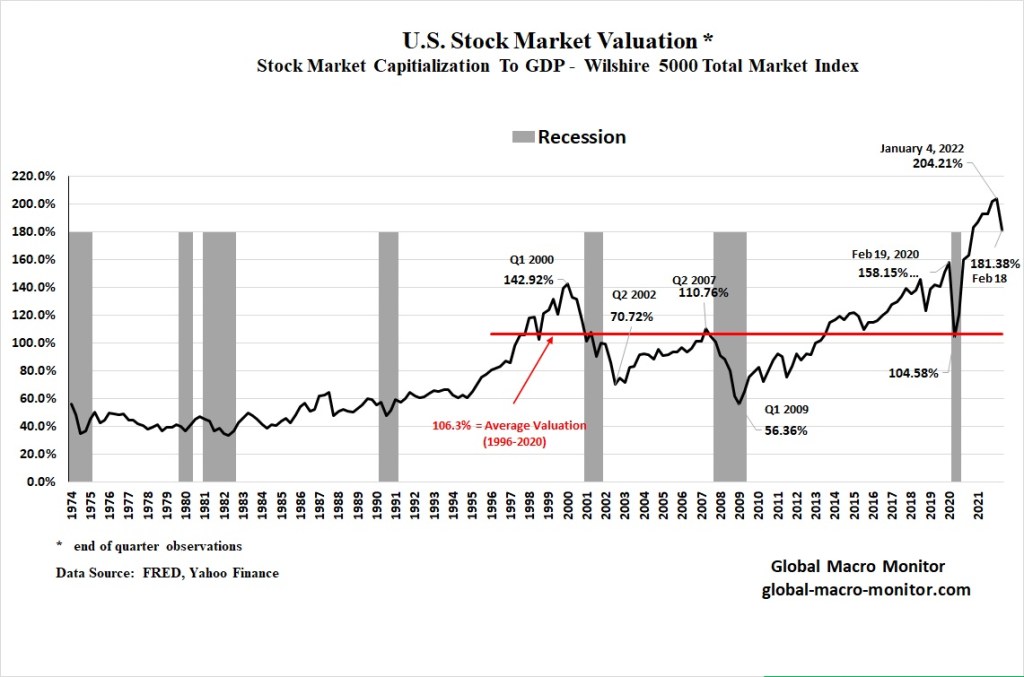
Moreover, it’s about time we hold them accountable for helping drive stocks into the stratosphere (see chart below), as the extreme valuations are now a significant constraint on the Fed’s ability and willingness to stamp out the inflationary fires.
The Fed Put, Are You Shitting Me?
Good Gawd, they are now even trying to estimate the level of the Fed put. No doubt, the Fed should intervene when markets crash (such as 1987, 2008, and 2020) to stave off systemic risk and a financial collapse but, come on, not to prevent markets from regressing to their fair values.
Do not these people realize the accumulation of all “Fed puts” over the years are a significant factor that has painted the economy into this god awful corner?.
The timing of this move, known colloquially as the “Fed put”, is of course unclear. But the BoA survey suggests it will occur when the S&P 500 falls below 3700 index points. – Financial Review
Moral Hazard
This type of moral hazard behavior is what blew up some of my trading accounts in 1998, betting Russia was “too nuclear to fail.” and would be bailed out by the IMF and U.S. government. Bill Clinton and Larry Summers disagreed.
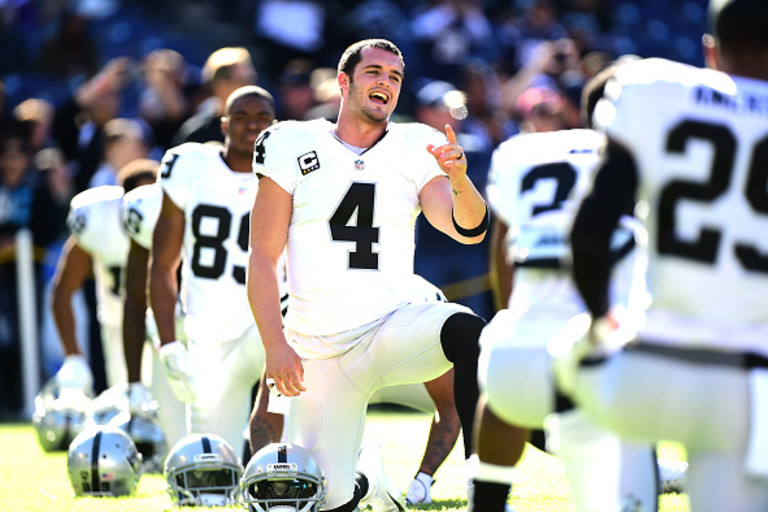
Seriously doubt this QB is ever going to win the NFL’s Walter Payton Award, He just doesn’t have the character. Follow the thread, the woman fractured her spine.
We are reposting a fun piece we posted back in the day after auditing a clean energy class at UC Berkeley.
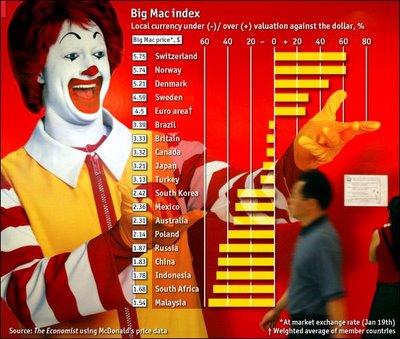
Carol K. reminded us after forwarding this cool annual dynamic of the Big Mac index based on purchasing power parity. When I would travel to a foreign country as a young economist, my first order of business was to visit a local McDonalds to audit Big Mac prices converted at the local exchange rate to get a sense how expensive the currency was relative to the U.S dollar.
OK, time for a little fun. You can try this and let us know if it works.
Almost everything today comes down to energy, right?
The rise in food prices is really nothing more than an energy problem. After all, food consumption is about the digestion of calories — one metric of energy measurement – to fuel the human machine.
Scientists have learned to “crack” the energy of foodstuffs, mainly corn and sugar, and convert these into transportation fuel. It gives new meaning to “cracking corn.”
If we could do the reverse and crack highly efficient refined fuels into foodstuffs, for example, we believe we have found the greatest arbitrage of all time.
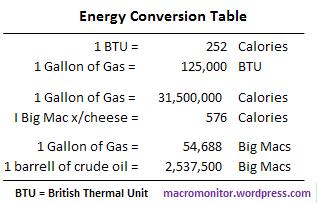
The Energy Conversion Table below shows that one British Thermal Unit (BTU) is equivalent to 252 calories and one gallon of gasoline is equivalent to 125K BTUs. Therefore, one gallon of gasoline is the energy equivalent of 31.5M calories.
The energy component of a Big Mac without cheese, for example, is 576 calories, so one gallon of gasoline is the energy equivalent of 54,688 Big Macs. Still with us?
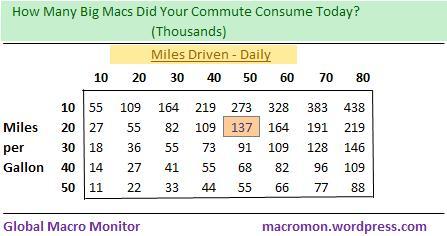
We’ve included the following table/matrix to show that if you drove 50 miles today in a car that gets 20 miles per gallon, you consumed the energy equivalent of 137K Big Macs. Yuck!
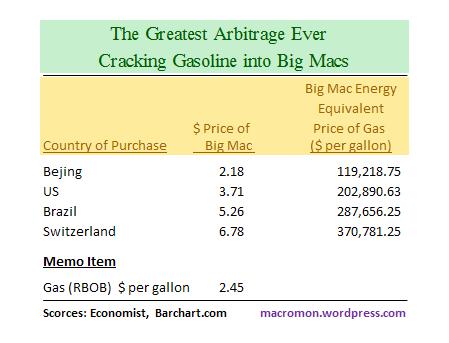
The last table, The Greatest Arbitrage Ever, shows the dollar price of a Big Mac in various countries (no wonder the Brazilians are now aligning with U.S. against China ‘s FX policy) and the Big Mac energy equivalent price of a gallon of gas. That is, one gallon of gas is the energy equivalent to 54,688 Big Macs and with the price of a Big Mac in Brazil at $5.26, the Big Mac energy equivalent price of a gallon of gas in, say Sao Paulo, is $287,656.25.
What an arb, no? Buying a gallon of wholesale gasoline in Rio for $2.45, “cracking” it into 54,688 Big Macs, and selling them at $5.26 for $287,656.25 sounds like a “splendid arbitrage” to us!
Fun exercise and we can’t wait for the e-mails from the economists on this one. Before you waste your time, remember, we’re not serious!







 Global Macro Monitor