
There’s lots of chatter about China buying gold. It was a big factor in Friday’s $30 move. Jim Cramer was all over it, pounding the table the “secular trend” is not going away.
The Wall Street Journal reported Friday,
Data cited Thursday by China’s state-run Xinhua news agency showed that China imported 209.7 metric tons of gold in the first 10 months of the year, a fivefold increase compared with the same period last year…
China’s import growth is a reminder of the country’s huge but nascent purchasing power.
It comes as the government loosens its restrictions on gold purchases by financial institutions and individual investors. In August, the country began allowing more banks to import and export gold, opening up the gold market to the institutions and their clients.
Then this week, the Chinese securities regulator approved the country’s first gold fund designed to invest in overseas-listed gold ETFs, a move analysts interpreted as another bullish sign for gold.
As the market focuses on China’s private demand, we look at the potential massive official demand from global central banks, with particular focus in this analysis on the BRICs. The Q4 2009 data from the IMF shows that 58 percent of official foreign exchange reserves from member countries are allocated to the U.S. dollar and 31 percent to the Euro.

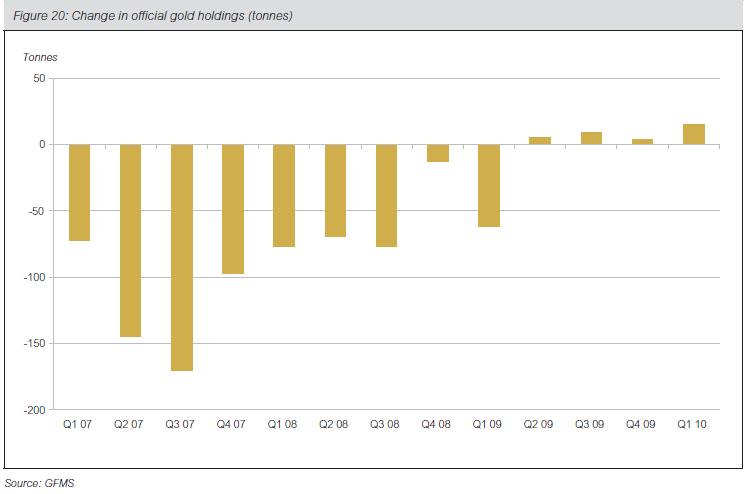
Given the choice of a reserve currency which is monetizing massive budget deficits and running large current account deficits or a reserve currency whose future existence is questionable, we believe emerging market central banks will be heavy buyers of gold over the next few years. Many are significantly under allocated and some have been big sellers of over the past ten years. Only recently have the central banks been net buyers as illustrated in this World Gold Council chart.
Of the BRICs, Russia’s central bank has been the most aggressive buyer of gold, increasing its official holdings by 244 tonnes over the past two years. Note, purchases may not be reported until later dates, such as China’s announcement in April 2009 that it had bought 454 tonnes of gold over a six-year period from 2003-2009.
The table below shows Russia and India’s official gold holdings as a percent of reserves are a multiple of those of China and Brazil. China’s reported gold holdings, for example, are only 1.70 percent of its reserves compared to India’s 8.10 percent. To reach a gold target of 5 percent of reserves, for example, which is more than 2 percent below the average of Russia and India’s gold holdings, the People’s Bank of China would have to purchase 2,046 tonnes and the Banco Central do Brasil 302 tonnes. The sum of the two is almost double the total holdings of the popular gold ETF, GLD.

Similar to the under allocated portfolio and hedge fund managers who are forced to buy a rising market, most emerging market central banks are under allocated to gold. We believe they are, and will be forced to chase gold up as it moves higher.
Gold is not about the destination, but about the journey. As long as the major reserve currencies are monetizing fiscal deficits, running large external deficits, experiencing sovereign funding crises, and maintaining near zero interest rates, gold will continue to move higher.

 Global Macro Monitor
Pingback: “A money-financed tax cut is…[a] ‘helicopter drop’ of money” | Global Macro Monitor
Pingback: Is Gold Just a Fear Trade? | Global Macro Monitor
Pingback: IMF Concludes Gold Sales | Global Macro Monitor
Pingback: PBOC Adviser Urges Central Bank to Diversify Reserves | The Garden of Princess Aileen 心灵的驿站