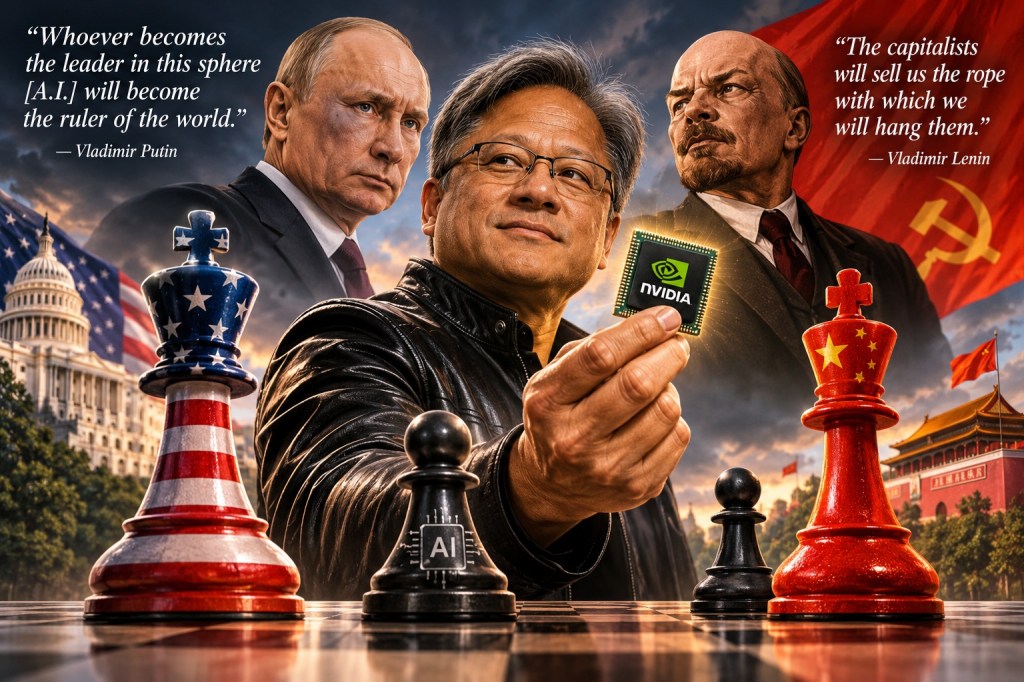
Whoever becomes the leader in this sphere [A.I.] will become the ruler of the world.”
— Vladimir Putin
“The capitalists will sell us the rope with which we will hang them.” — Vladimir Lenin
Two quotes, separated by nearly a century, offer an interesting perspective on the unfolding artificial intelligence revolution. And this week’s extraordinary events surrounding Nvidia CEO Jensen Huang provide a rather timely illustration of both.
Let’s start with Putin. He understood that artificial intelligence would become much more than another technological breakthrough. It would be a source of economic, military, and geopolitical power. The country that leads in AI will have an enormous strategic advantage over those that follow.
Now consider Lenin’s observation about capitalism. His point was that the relentless pursuit of profit could lead capitalists to supply their own adversaries with the very tools needed to defeat them.
Fast-forward to today.
Nvidia, the American company that makes the world’s most sought-after AI chips, has become arguably the most important corporate player in this global competition. Its founder and CEO, Jensen Huang, is one of the most influential figures in the AI industry.
But here’s where things get interesting.
After Huang’s departure from Nvidia, the company’s stock took a beating, contributing to a broader selloff in technology shares. President Trump personally intervened to persuade Nvidia’s board to reinstate him. According to the Associated Press, the falling stock market helped motivate Trump’s efforts. He was also concerned that losing Huang could leave the United States behind China in the AI race if a Chinese company recruited him.
The board reversed course. On Monday, November 23, Huang was back as CEO. Nvidia shares promptly surged 31.5 percent, adding nearly $1 trillion to the company’s market value. Apparently, some executives really are too important to lose.
But there is an important wrinkle in this story.
Huang has spent years lobbying Washington to allow Nvidia to sell its powerful AI chips to China. He views the Chinese market as an enormous business opportunity and has argued that American companies should compete there rather than surrender the market to Chinese manufacturers.
In an October interview with Fortune, Huang said Nvidia could be of “great service” to China by providing the computing resources its economy needs. He has argued that American companies can maintain their technological leadership while continuing to sell into the Chinese market.
From a corporate perspective, the logic is straightforward: China represents a potentially enormous market, and Nvidia shareholders stand to benefit from accessing it.
But from a national security perspective, there is another side to the equation. AI chips are not ordinary commercial products. They provide the computing power needed to develop increasingly sophisticated artificial intelligence systems, including technologies with military and intelligence applications.
Selling those chips to China means providing computing resources to America’s principal technological competitor. Even when the most advanced processors are restricted, access to less powerful generations can help Chinese companies expand their AI capabilities, develop their own technologies, and narrow the gap with American competitors.
This is precisely the tension at the heart of the Nvidia story.
The Trump administration was concerned that China might acquire Jensen Huang and his extraordinary technological expertise. Yet bringing him back also restores a CEO who has consistently pressed for greater access to the Chinese market.
In other words, Washington wants to keep the talent in America, but Huang wants to sell the tools to China.
There are arguments on both sides. Huang contends that excluding China from the American technology ecosystem could simply accelerate the development of competing Chinese chips and surrender a massive market to domestic competitors. National security officials, however, worry that supplying Chinese companies with advanced computing power could strengthen a strategic rival.
The question is whether the immediate profits from selling AI chips are worth the potential long-term strategic cost.
And that brings us back to Lenin, with a little help from Putin and some distinctly Chinese characteristics.
“We will rule the capitalists with the chips they sell to us.” — 艺术情报
Perhaps the greatest irony of the AI arms race is that America’s drive for corporate profits could help finance the technological rise of its greatest competitor. Wall Street gets its rally, Nvidia gets its market, and China gets access to computing power that could help it challenge America’s technological leadership.
Lenin might have appreciated the arrangement. Putin certainly understands the stakes.
The question is whether Washington does.