Meet Me In St. Louis Not On The Streets Of Philadelphia

Severity of Cases

Source: Shane Oliver  @ShaneOliverAMP

This is about as close as we will get to a pure lab experiment measuring the efficacy nonpharmaceutical interventions (NPIs) intended to reduce infectious contacts, folks.

The 1918 influenza pandemic resulted an estimated 500,000–675,000 deaths in the U.S. and 50–100 million deaths worldwide.

The intensity of the 1918 pandemic, whether assessed as total excess deaths, the rate of increase in the epidemic curve, or peak death rates, varied widely among U.S. cities. Cities also varied widely in their choice and timing of implementation of NPIs designed to reduce disease spread. Many cities closed schools, churches, theaters, dance halls, or other public accommodations; made influenza a notifiable disease; banned funerals or other public gatherings; or introduced isolation of sick persons. In some cases, these NPIs were put in place in the first days of epidemic spread in a city, whereas in other cases, they were introduced late or not at all.  — PNAS

Note how St. Louis flattened the death curve (not the infection curve) with aggressive action in banning public gatherings within a few days of the first cases being reported.  Philly was complacent, however, downplaying the threat and lagging in its policy response by just a few weeks more than St. Louis.  Two weeks!

The contrast of mortality outcomes between Philadelphia and St. Louis is particularly striking. The first cases of disease among civilians in Philadelphia were reported on September 17, 1918, but authorities downplayed their significance and allowed large public gatherings, notably a city-wide parade on September 28, 1918, to continue. School closures, bans on public gatherings, and other social distancing interventions were not implemented until October 3, when disease spread had already begun to overwhelm local medical and public health resources. In contrast, the first cases of disease among civilians in St. Louis were reported on October 5, and authorities moved rapidly to introduce a broad series of measures designed to promote social distancing, implementing these on October 7. The difference in response times between the two cities (≈14 days, when measured from the first reported cases) represents approximately three to five doubling times for an influenza epidemic. The costs of this delay appear to have been significant; by the time Philadelphia responded, it faced an epidemic considerably larger than the epidemic St. Louis faced. Philadelphia ultimately experienced a peak weekly excess pneumonia and influenza (P&I) death rate of 257/100,000 and a cumulative excess P&I death rate (CEPID) during the period September 8–December 28, 1918 (the study period) of 719/100,000. St. Louis, on the other hand, experienced a peak P&I death rate, while NPIs were in place, of 31/100,000 and had a CEPID during the study period of 347/100,000. Consistent with the predictions of modeling, the effect of the NPIs in St. Louis appear to have had a less-pronounced effect on CEPID than on peak death rates, and death rates were observed to climb after the NPIs were lifted in mid-November ().  — PNAS

Policy Failure

Here’s to hoping we are St. Louis and not  Philadelphia but our late start, dithering, and horrendous leadership, including misinformation and mixed messaging disseminated by the Administration almost surely condemns the nation as a whole to the fate of  The City of Brotherly Love  during the fall of 1918.

…Alex Azar [Secretary of Health and Human Services], he did go to the president in January. He did push past resistance from the president’s political aides to warn the president the new coronavirus could be a major problem. There were aides around Trump – Kellyanne Conway had some skepticism at times that this was something that needed to be a presidential priority.

But at the same time, Secretary Azar has not always given the president the worst-case scenario of what could happen. My understanding is he did not push to do aggressive additional testing in recent weeks, and that’s partly because more testing might have led to more cases being discovered of coronavirus outbreak, and the president had made clear – the lower the numbers on coronavirus, the better for the president, the better for his potential reelection this fall. — NPR

Upshot

Trust the scientists.  Though I  believe in miracles, and we are going to need a big one, but never bank one.

As the death toll rises and the economic carnage increases, there is going to be holy hell to pay come the November election.  

President Wilson And The 1918 Flu

Very eerie parallels of how President Woodrow Wilson handled the 1918 Flu.  See here.

Posted in Coronavirus, Economics, Politics, Uncategorized | Tagged , , | 1 Comment

No Time For A Victory Lap

President Trump gave the market what it was looking for today with a laser focus on containing the coronavirus and enlisting the private sector in the battle.   No focus on the stock market during the entire presser, which is, ironically,  one of the reasons why stocks rallied so hard.

Good for him and good for all of us.

No Victory Laps, Please

Much too early to take a victory lap, however,  as it is about to get much darker over the next month.

The following is ridiculous as much as it is absurd and reveals the mentality of the White House.

One bounce after a 27 percent crash in 17 trading days doesn’t make a bull market, folks.

Update March 14

https://twitter.com/northmantrader/status/1238803846333374464?s=21

Here Is The Reality

Gonna get very dark in the next month.  Kristof is a true saint, in our book.

Posted in Bonds, Equities, Uncategorized | Tagged , | Leave a comment

Godspeed, Tom Hanks


Posted in Uncategorized | Leave a comment

President Reagan On The ’87 Stock Market Crash

We are reposting this piece.  History rhymes.  The U.S. was in the midst of conflict with Iran during the 1987 crash as we are today.

The Fed tried to stem the selling today and who knows what would have happened if they didn’t step up.

Originally Posted on

President Reagan certainly understood the nature of markets.

That is they do whatever they are going to do, sometimes without a fundamental rhyme or reason.   Very different from the current occupant of the White House who seems to think every uptick in the S&P is all about him, and he is not afraid to take credit for the upside and tweet about it.

Before going to President Reagan’s  comments about the October 19, 1987 stock market crash,  we first review some data, which lends light on the 1987 crash.


Apr21_S&P_1987

The S&P500 had just completed a massive run from September 1985 before peaking on August 25, 1987, moving up almost 87 percent in less than two years.   That qualifies as a bubble in our view.

Yuuuge Decline In Interest Rates

Much of the move was attributed to a sharp drop in interest rates.

The 10-year Treasury yield fell almost 350 bps in less than a year before making a local bottom in September 1986.   Interest rates then began to move sharply higher, utterly roundtripping almost the entire move by the day of the crash.

The 10-year yield had risen 300 bps year-to-date on October 16th, closing back above 10 percent, increasing almost 150 bps just since the S&P peaked on August 25th.

The S&P500 was already down 16.33 percent from its high before crashing on October 19th.  Markets rarely fall out of the sky and usually signal something big is coming by a sharp rise in volatility.    Think of a Richter scale before a volcano blows.

Apr21_Richter Scale

This is why we take the early February volatility shock seriously and a signal of regime change, and give a much higher probability for a potential major price reversal than most in the market are anticipating.

4744572-George-Soros-Quote-Short-term-volatility-is-greatest-at-turning

Finally,  the S&P500 fell 23.43 percent from the October 16th Friday close to the intraday low on Tuesday before a mysterious buyer stepped into to the Major Market Index futures contract at 12:38 p.m, setting the stage for one of the most powerful rallies in history.

We believe the 1987 stock market crash was an accident waiting to happen due mainly to a toxic cocktail of a severely overbought market and rising interest rates.  All that was needed was a buyers strike coupled with some catalysts or reasons to bail and take profits.   The same reasons may or may not have mattered if not for such a toxic cocktail.

Given the nature of the New Economy, we seriously doubt the government will allow such a similar short-term crash, say, 15-25 percent,  to occur again.   We now have no doubt  the Fed will step up and announce they will do whatever it takes and become the buyer of last resort to keep the market from melting down in one or two days.

Why?   Because it would be the end of the world and they surely know it.

The thought of the Fed directly purchasing stocks as the Bank of Japan now does contradicts everything  Larry Kudlow’s dictum, “free market capitalism is the best path to prosperity” stands for.

Privatizing profits and socializing major Wall Street losses  are now forever institutionalized especially given the structure of our asset driven global economy.  The “Powell put” may now have a little lower strike price than many traders would like but it is absolutely still in place.  No doubt about it.

Oy veh!   Sorry deflationistas.

Iran Again

By the way, the U.S. was also in the midst of a conflict with Iran in October 1987.

An Iranian missile struck an American-owned tanker in Kuwaiti waters today, causing a huge explosion and setting the tanker ablaze, the Pentagon said.  – NY Times,  October 16, 1987

President Reagan’s Comments

Now to President Reagan.

Asked after the close if the stock market crash was his fault, the President delivers the ultimate money quote, in our book:

The President:  Is it my fault? For what, taking cookies to my wife?  – President Reagan,  October 19, 1987

Profound.   We can learn from the Gipper to refrain from trying to explain or attribute daily stock market moves to certain factors.   Any one of the catalysts we deem moved the market in a certain direction on a given day could have moved it 180 degrees the other way with a different set of technical conditions.

Reagan truly understood  market noise.

Full Transcript Of October 19, 1987 Informal Exchange With The Press

Here is the full transcript with reporters that day, October 19, 1987.

Stock Market Decline

Q. Mr. President, are we headed for another great crash?

Q. What about the stock market?

Q. Are we headed for another great crash?

Q. Stock market.

The President. Oh, the stock market. Well, I only have one thing to say: I think everyone is a little puzzled, and I don’t know what meaning it might have because all the business indices are up. There is nothing wrong with the economy, though.

Q. Panic.

The President. What?

Q. Panic, how—

The President. Maybe some people seeing a chance to grab a profit, I don’t know. But I do know this: More people are working than ever before in history. Our productivity is up. So is our manufacturing product up. There is no runaway inflation, as there has been in the past. So, as I say, I don’t think anyone should panic because all the economic indicators are solid.

U.S. Reprisal Against Iran

Q. Sir, about the Gulf—some people seem to think that the U.S. response was very, very, very minimal.

The President. Well, since so many of you keep calling it an oil derrick of some kind or platform, no. It was a command and control tower with radar and the ability to track shipping through the Gulf. And, so, we thought that it was an appropriate and proportionate response to their missile attack on a freighter, which wounded some of our people.

Q. What do you think the market’s going to do tomorrow? What about tomorrow?

Q. What’s the message to Khomeini?

Q. Are we now in a war with Iran?

The President. No, we’re not going to have a war with Iran. They’re not that stupid.

Stock Market Decline

Q. What about the market? Tomorrow will it go down again?

The President. I don’t know. You tell me.

Q. Is the market your fault?

Q. Is it your fault? she says.

The President. Is it my fault? For what, taking cookies to my wife?

Q. Reaganomics.

The President. I just told you. Good Lord, we reduced the deficit over last year by $70 billion. And all the other things I’ve told you about the economy are as solid as I told you. So, no, I have no more knowledge of why it took place than you have.

Q. What’s the message to Khomeini?

Q. Well, what would you tell the small investors?

The President. What?

Q. What would you tell the little old lady who lost money today?

Q. The little old ladies who lost their shirts.

The President. I don’t know of anyone. Are you talking about a specific case?

Q. I lost mine.

Q. Me.

Q. This one.

The President. Wait a minute! How about how many people must have sold out in order to get a profit because they bought it back before it was ever this high? I’ve got to go to the hospital.

Q. Give our best to Mrs. Reagan.

The President. Thank you, Andrea [Andrea Mitchell, NBC News]. That, I will do. She’ll be coming home soon.

Q. What’s your message to Khomeini?

Q. Invest in our stock market.

The President. If I really gave it to you, you wouldn’t be able to print it.

Note: The exchange began at 5:04 p.m. at the South Portico of the White House upon the President’s departure for Bethesda Naval Hospital,  


Posted in Equity, Uncategorized | Tagged , , , | Leave a comment

Trump & Co Must Abandon The Stock Market To Save It

No bottom in stocks or the economy until the test kits are ubiquitous.   We believe markets want an aggressive plan and action to treat the disease rather than focusing on the symptoms. Then markets will take care of themselves and find their appropriate levels.

WTF?  Where Are The Test Kits?

True story. A family member receives a text on the way to work this morning that her boss has a fever of 102 degrees with a diagnosis that she “ticked all the boxes for COVID-19.” They couldn’t test her because they didn’t have the test kits and she was put in quarantine for two weeks.

The Fed Steps Up

By the way,  this is from our Sunday night post, What Every Market Player Should Now Be Contemplating,

Can the U.S. government finance its $1.2 trillion plus annual deficits with an entire yield curve at less than 1 percent?  

We seriously doubt it and the Fed is going to have to step-up big time with QE, non-QE, or let’s just call it for what it is, monetization.

These yields are distorted and not true market rates, and now have become Airbnb rentals driven by haven flows, the MoMo crowd and ‘bots, and a proxy for stock shorts.

Long-term investors?  Think rent control distortions.   We will be closely monitoring  the monthly auctions for real demand.  – GMM,  March 8th

5D2486C7-969A-4847-A72B-110CE917E9D5

No Trillion Dollar Issuance At “Fake Yields”

After two shitty bond auctions this week showing tepid demand, bid/offer spreads blowing out in Treasury securities, and the 10-year yield spiking from 0.39 percent to 0.85 percent, the Fed steps up big time today.


Fed

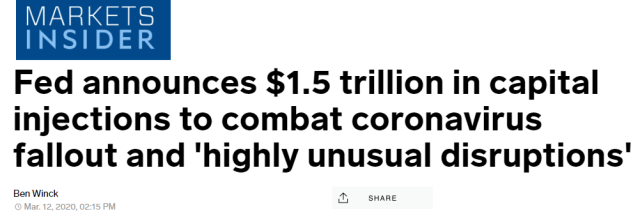
The Federal Reserve Bank of New York will start adding fresh capital to money markets on Thursday to pad against coronavirus risks and ease stresses on the Treasury-bill market.

The extraordinary funding measure first involves a $500 billion injection at 1:30 p.m. ET on Thursday, the bank said. The cash will be added to money markets through a three-month market repurchase agreement, or repo operation.

One-month and three-month repos for $500 billion each will be conducted on Friday and continue to be offered weekly through the calendar month, the bank added.  – Market Insider

The term “capital” is a bit misleading, in our opinion.

Upshot

Marginal buyers, such as haven flows, momentum algos, and stock shorts using bonds as a proxy, who determine the price or bond yield on your screens, can set rates at zero or below.  But that is not a price or yield where $1 trillion-plus of new securities can be issued or where the market can liquidate an enormous position.

Just think of the S&P500 level at the peak of 3393-ish.  Marginal buyers drove the price there — irrationally in our view — and we all marked our positions and investments at that level but, in reality, it was not a level where all could liquidate.

Stay tuned as we are working on a more in-depth piece on this very important subject. We suspect all the distortions created by monetary policy and government intervention to prop up markets are coming home to roost at the worst time possible.

Marginal buyers set prices.  Make sure you know who are the marginal buyers.

Good night and good luck.

Posted in Bonds, Equities, Inflation/Deflation, Interest Rates, Uncategorized | Tagged , , | 1 Comment

Mr. Market Wants What Korea’s Got

Posted in Uncategorized | 1 Comment

Potential Next Steps In The Coronavirus Crisis

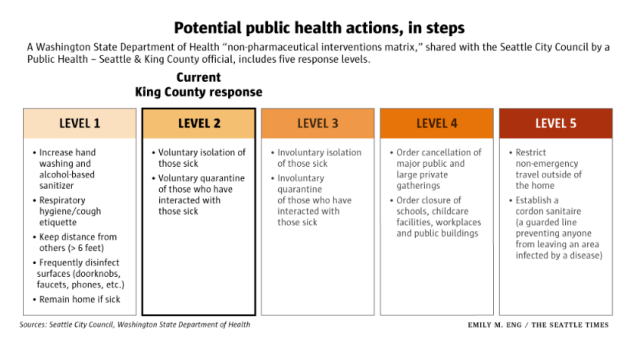
Washinton state lays out the next potential steps ” as its public-health officials are “at the ready” to order involuntary isolation and quarantines and are considering cancellation of major public events.

Coronvirus_Mar10

Patty Hayes, director of Public Health — Seattle & King County, outlined potential next steps in the area’s effort to slow the spread of the virus at a Seattle City Council meeting and said officials are talking about what to do.

Hayes shared a Washington State Department of Health chart that listed five levels of actions that officials could take. Gov. Jay Inslee hinted at the ongoing discussions Sunday on the CBS show “Face the Nation,” saying the state’s response could involve “reducing the number of social activities that are going on.”

Although King County’s first confirmed COVID-19 case was announced less than two weeks ago, the area’s response already has ratcheted through Level 1 and Level 2.  — Seatlle Times

Nobody knows the exact path of the current crisis or how and when it ends but it will end.  This too shall pass.

Posted in Coronavirus, Uncategorized | Tagged , | Leave a comment

Trump’s Presser Turns S&P Futures

The S&P futures contract has turned up after President Trump’s press conference, which he laid out an economic relief plan, including payroll tax cuts.

The contract has moved in almost a 100 point range or 3.5 percent in the 90 minutes it has been trading.

The market is very oversold and a bounce is natural.  We believe the S&P500 moves lower over the next few months, however, until we get a better handle on the coronavirus crisis.


Globex

Posted in Uncategorized | Leave a comment

Prediction Markets Begin To Price Blue Wave And Female VEEP

Big moves on PredictIt in the past week and starting to price a Blue Wave in the November election.

The Democratic House & Senate contract is up almost 70 percent since March 1 after Montana Gov. Steve Bullock (D) put the state’s Senate seat in play

These contracts are volatile and fairly illiquid.  We look at trends as a signal and not spot prices.

These markets really nailed the resurrection of Joe Biden last Super Tuesday.  See our piece,  Biden Rocks, Bernie Flops In Prediction Markets, which we posted last Monday.

Predict_March 9

Democratic VEEP

In your case your wondering, here are what the markets are predicting who gets the nod for the V.P. on the Democratic ticket. 

Predict2_March 9

Posted in Uncategorized | Leave a comment

What Every Market Player Should Now Be Contemplating

Can the U.S. government finance its $1.2 trillion plus annual deficits with an entire yield curve at less than 1 percent?  

We seriously doubt it and the Fed is going to have to step-up big time with QE, non-QE, or let’s just call it for what it is, monetization.

These yields are distorted and not true market rates, and now have become Airbnb rentals driven by haven flows, the MoMo crowd and ‘bots, and a proxy for stock shorts.

Long-term investors?  Think rent control distortions.   We will be closely monitoring  the monthly auctions for real demand.

The dollar?  Yikes!


Posted in Uncategorized | 4 Comments