QOTD: The IHOP POTUS

QOTD = Quote of the Day

For better and for worse, Mr. Trump is a chronic waffler. As such, the American public would do well to stay vigilant about what his administration is up to — and not be shy about applying pressure.

It has long been clear that Mr. Trump is not the decisive, resolute leader he imagines himself to be. His presidency is littered with plans and pronouncements that were walked back or abandoned — some good, some not so good. – NY Times

Posted in Uncategorized | Leave a comment

Gotta Love David Tepper!

Just your average, normal, billionaire Master of the Universe hedge fund manager, and owner of the Carolina Panthers on opening day Sunday.

He hasn’t changed one bit since the days when we first met him and has never forgotten his roots.  Not a pretentious or snobby bone in him.

What is the yield-to-death?”

Those words spoken by the legendary hedge fund king, and new owner of the Carolina Panthers, David Tepper, to my salesperson in 1993 when we were trying to convince him to buy a chunk of Peruvian busted bank loans at around 8 cents on the dollar.

Due Diligence

Tepper was half joking of course but he was covering all the bases as his fledgling hedge fund, Appaloosa Management, began to venture into the new emerging asset class of LDC debt.

He was, as any good trader and investor, skeptical and concerned about the country’s political stability.   The Shining Path, the Maoist guerrilla group terrorizing the country; the risk of a military coup d’etat, and all the uncertainties, which come with investing in an emerging market country.

I recall he did pull the trigger, and if my memory serves me correct,  it was, or one of, his first investments in the emerging markets.   If he held the position, and I am sure he did, the loans appreciated close to 1,000 percent over the next few years. GMM,  Sept ‘18

We love David Tepper.


Posted in Uncategorized | Leave a comment

Nature Beats Hollywood In Special Effects

Posted in Uncategorized | Leave a comment

What to expect from the August jobs report

About that 75 bps Fed cut in September….

Posted in Uncategorized | Leave a comment

Promises Made, Promises Kept?

Hearing rumors out of Mexico — and we reiterate rumors — that President  Andrés Manuel López Obrador (AMLO) has made a small purchase on Amazon this morning to help President Trump keep his campaign promise that “Mexico will pay for The Wall.”

Click here if you too want to pay for The Wall.

The Wall.png

Semantic fascism lives!


Posted in Uncategorized | Leave a comment

QOTD: No Mojo For BoJo

QOTD = Quote of the Day

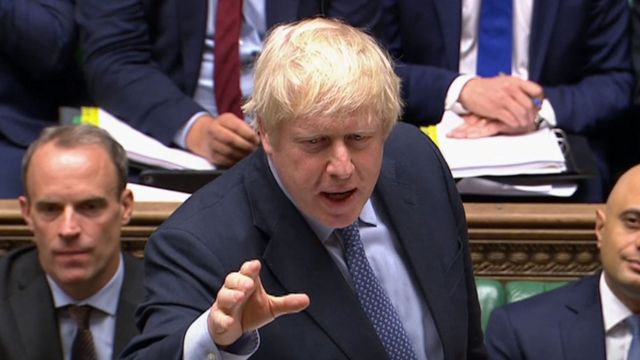
No prime minister has lost their first vote in office since 1783 — let alone their first 3. – Axios

1B71461C-1F15-4027-B89F-B760BA4CB733


Posted in Uncategorized | Leave a comment

Modern Monetary Theory (MMT) Has An Argentina Problem

Proponents of Modern Monetary Theory emphasize that a country that controls its own currency and borrows in its own currency, like the United States, cannot default on its debt. This is because the central bank can, if necessary, “print” the money needed to pay the government’s creditors…  —  Econofact

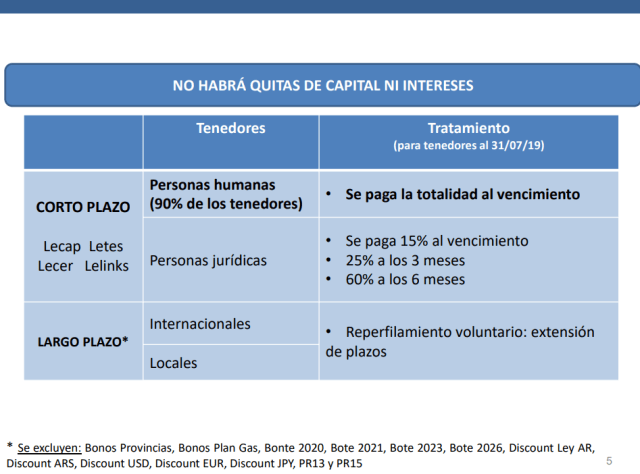
The MMT crowd has some ‘splaining to do after Argentina’s default on local currency Treasury Bills (Lecaps) last week.

We have argued for years with our MMT friends about the dubious assumptions and logic that Modern Monetary Theory is built, most importantly, that a sovereign borrower with an independent central bank and currency, by definition, cannot default.  Though the debate has evolved over the years to now what is the true definition of “full monetary sovereignty,” a free floating exchange rate is a big assumption, for example, it would always come down to the case of the 1998 Russian default on ruble Treasury bills known as GKOs.   to which the MMT crowd would retort, “special case.”  Ironically, the Russians paid their hard currency Eurobonds and defaulted on local currency debt, the complete opposite of what MMT concludes.

Argentina could have monetized the Lecaps last week and let the peso float and collapse as the maturing peso debt would have immediately been converted to dollars.  The government chose not to.

We would try to explain to our friends that when a sovereign borrower gets into trouble and experiences “rollover risk” and cannot refinance maturing debt due to a sudden stop of market financing,  a policy choice must be made.  Either monetize the maturing debt and send the country into hyperinflation as Bulgaria did in late 1996, or default and restructure as Russia did in 1998.    We suspect Russia chose the latter because much of their debt was held by foreigners, including hedge funds, such as David Tepper, who said the GKO trade was the worst of his career.

We detect, and we are open to be corrected, from our debates over the years that the MMT crowd believes a reserve currency country, such as the United States, cannot and will never experience rollover risk.  We wholeheartedly disagree.

If interest rates significantly increase in the highly indebted DM countries, such as the U.S and even Japan,  but especially DMs dependent on foreign financing, public sector finances could enter a doom loop leading them down the road to potential rollover risk.

We saw how the markets fell apart in Q4 when long-term interest rates broke higher in the U.S. to even just above 3 1/4 percent in late September.  That is not a very robust debt profile, folks, signaling, at least to us, the interest rate complex cannot normalize because debt is too high.  The Fed had to ride to the rescue even as the effective Fed Funds rate was barely positive.

Furthermore, as the only Joe other than the Yankee Clipper sums it best when it comes to fiat currencies,

Confidence is a very fragile thing – Joe Montana

As some point, any fiat currency, yes, even reserve currencies, can reach a tipping point into monetary inflation if confidence in its ability to maintain purchasing power is lost and money demand collapses.  Even the previous levels of “appropriate” or “normal” levels of money supply then become almost meaningless.

Negative Yielding Debt

Enter the bizarro world of negative-yielding debt we now find ourselves, driven by a QE induced structural shortage of long-dated risk-free fixed income instruments, trend following, negative convexity chasing algos with no context that negative rates are a no-no, and traders front running expectations of a new round of QE, wrapped in a narrative of a coming deflationary collapse.  More market nonsense, in our opinion, but we have to trade the hand the market has dealt us.  Even if the end game could, and most likely, will end in disaster, in our opinion.

Long-term credit risk-free bonds, originally intended to be held to maturity, have been transformed by negative yields into radioactive short-term hot potato trading vehicles that decay your portfolio and P&L the longer they are held.  Unless the ECB and BoJ are there to take out the traders at these negative yields, there is going to be a big problem.  That is always the case when “the greater fool theory” is the main driver of markets.

We have been writing and debating MMT  for years and have been consistent in the solid economic assumption there is no free lunch but MMT keeps evolving, as it should,

We still have ongoing debates with our good friends from the modern monetary theory (MMT)  about whether a major sovereign government can default if they have an independent central bank.   Yes, they can!

We had the same debate with our Argentine friends several years ago as to whether their government would or could devalue their currency when it was on an effective currency board.  Yes, they did!  And defaulted to boot.

Just as Russia chose to default on its GKOs (short-term ruble denominated treasury bills) in 1998 with an independent central bank,  the same can happen to a G5 country as we approach the upper bound of debt limits and the lower for longer interest rate meme seems to be sunseting in a post-Trump world.

When a highly indebted sovereign crosses the tipping point — and nobody knows where the tipping point is —  when the markets lose confidence in its ability to repay or rollover debt coming due and the window shuts on refinancing,  they face three choices:

1)  bailout – easy for a small country,  such as Greece,  but Italy or Japan are too big to bail;   2) hyperinflate – print money to pay maturing debt obligations and finance budget deficits.  An aside:  the Bulgarian central bank did this in 1996 resulting in hyperinflation, which peaked at a monthly inflation rate of 242%  in February 1997.   I was in the Bulgarian central bank in the fall of 1996, when a senior official looked me in the eye and said, [Gregor],  we will not let the government default on its treasury securities.”  I knew what was to come; and 3)  default and restructure.

Like the Russians,  the decision to hyperinflate, default, or go begging to the IMF, is a political one.  Russia saw that a high percentage of holders of its local currency debt was held by foreigners,  hedge funds such as David Tepper.

Tepper says that losing 29% ($80 million) on Russia when Russia defaulted after an IMF deal “the biggest screw-up in his career”.  – Ivanhoff Capital

The Russians made a political choice to default and inflict the pain on foreigners rather their domestic population through hyperinflation.   What was interesting is Russia continued to pay their dollar-denominated euro bonds, which had a relatively low debt service burden compared to the maturing GKOs.  The Russian government effectively carved out and gave implicit seniority to a specific component of their debt structure.  Totally contrary to what MMT predicts will happen, i.e.,  print money to pay the local debt and default on the hard currency external debt.  – GMM, January 2017

So the ball is in your court, MMT friends.

Please explain how Argentina just defaulted on its local currency debt with an independent central bank and currency, which they chose not to float?    No special case arguments, no circular logic of defining “monetary sovereignty,” and, yes, it was default and not a “reprofiling” as the government claims,

Just as the law of gravity does not stop at the borders of emerging markets neither should robust economic theories, if they are truly robust.  We are more open to kind of a “bounded” MMT under special circumstances and a given timeframe.  Universal?  NFW.

Upshot?

Deficits do matter.

It is hard to imagine how an MMT advocate would explain away the experience of Argentina. Perhaps the requirement that a country can issue its own currency is, in fact, a requirement that a country can issue debt in its own currency. That would explain why Argentinian outcomes differ from those predicted by MMT. However, it is hard to imagine that a country would be able to issue debt in its own currency for long if it were engaged in deficit spending to the extent MMT advocates propose. In other words, that explanation — while preserving the integrity of the original argument — undermines its practical application.

Alternatively, MMT advocates might fall back on the inflation constraint, which they acknowledge when pressed. If inflation picks up, they say, then countermeasures will be adopted. Again, we have an explanation that undermines the practical application of MMT. But it is even worse than that. Argentina did not adopt countermeasures. In suggesting that countries could just adopt countermeasures when inflation picks up, MMT fails to account for political incentives. Its advocates confuse the possible with the probable. 

Argentina’s experience gives us reason to doubt the practical relevance of MMT. In downplaying the costs of deficit spending and monetizing deficits, advocates of MMT enable political actors — even those with the best of intentions — to pursue policies that will ultimately reduce the living standards of the least well off.  — AIER, March 2019

Debating these issues are healthy.

As always, we reserve the right to wrong and to be corrected by our MMT friends, who still seem to be developing their theory.

Special thanks to our good friend, Leonardo in Buenos Aires for providing us with the background for this post.   Godspeed, our brother, to you and the good people of Argentina, especially the most vulnerable, during these difficult days.

Also thanks to the great economist, Constantin Gurdgiev, for his comments and steering us truer north.  Check out his blog,  True Economics

Appendix

Argentina_2

Argentia_Default_2

What Should Modern Monetary Theory Learn From Argentina?  – AIER
Argentina_3.png


Good background piece on Argentina’s debt and monetary problems

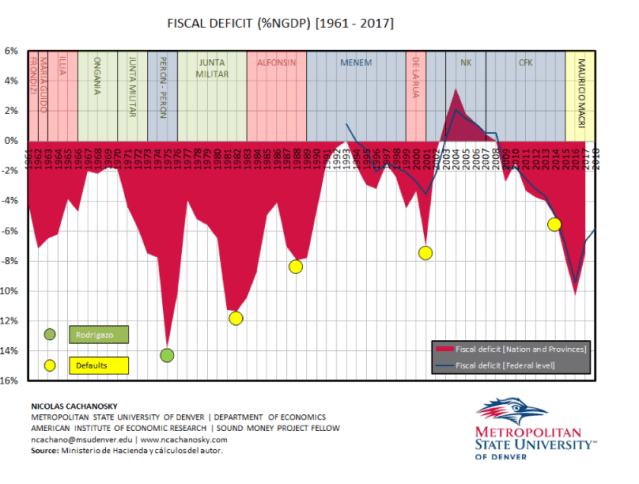
[T]he monetary and fiscal history of Argentina for the period 1960–2017, a time during which the country suffered several balance of payments crises, three periods of hyperinflation, two defaults on government debt, and three banking crises. All told, between 1969 and 1991, after several monetary reforms, thirteen zeros had been removed from its currency. We argue that all these events are the symptom of a recurrent problem: Argentina’s unsuccessful attempts to tame the fiscal deficit. An implication of our analysis is that the future economic evolution of Argentina depends greatly on its ability to develop institutions that guarantee that the government does not spend more than its genuine tax revenues over reasonable periods of time.  – FRB of Minneapolis

Great Twitter thread by Brad Setser
Argentina_1

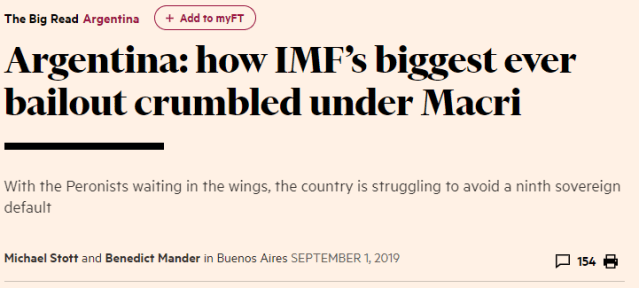
…Fifteen months later, the giant bailout has become a millstone around Mr Macri’s neck. Voters angry at the continuing recession delivered a stinging rebuke on August 11, handing a big victory to his Peronist rival Alberto Fernández in a primary vote. The contest is regarded as a reliable barometer for the election in October and its result panicked investors because it spelt disaster for Mr Macri’s chances.

Following days of market chaos in the wake of the vote, Mr Macri’s government bowed to the inevitable last week and asked creditors for more time to pay back Argentina’s $101bn of foreign debt, including the IMF money, as Buenos Aires struggled to avoid the country’s ninth sovereign default — and the third this century. Currency controls were imposed on businesses on Sunday after it lost an estimated $3bn in reserves in just two days last week.  –  FT, Sept 1

Posted in Uncategorized | 26 Comments

Does This Look Like Risk Aversion?

What Is Risk Averse?

The term risk-averse refers to investors who, when faced with two investments with a similar expected return, prefer the lower-risk option. Risk-averse can be contrasted with risk seeking.  – Investopedia

Austrian Century Bond

The price has risen 30% since June alone, when Austria reopened the bond to new buyers.  – Bloomberg, Aug 18th

Risk aversion?  Seriously?

That is how most of the market talking heads are explaining the behavior of global bond markets.   Piling into these bonds here is certainly not the land of the risk-free nor the home of the brave.  Unless buyers are certain the ECB will take them out at 225 in the next round of QE.


Posted in Uncategorized | 4 Comments

Rent Control Issues Hit 7-year Bond Auction

At least, that is our view.

We have worried out loud how global interest rate repression may cause ugly bond auctions. A problem that similarly arises in the rent-controlled housing market.

…we are watching the Treasury auctions closely and suspect they could get sloppy and ugly down at these yields.

With repressed yields a sort of “rent control” problem arises, where there is a shortage of funds at the given fake or below market yield.   Just as the case with a shortage of housing when rents are held below their market rates.

This is just a thought and first cut and needs to be further fleshed out.  — GMM, August 6th

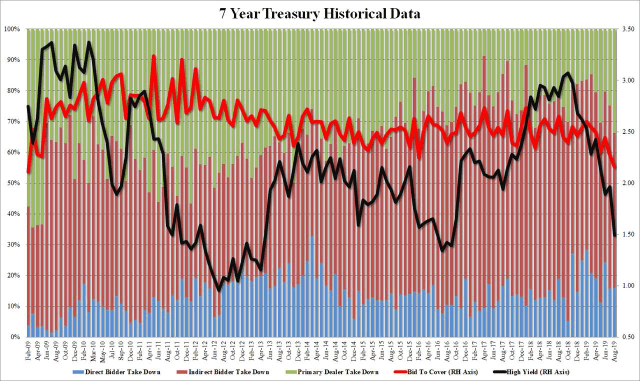
Today’s 7-year auction was ugly.  Zero Hedge describes it as “deplorable,”

The demand was, in a word, deplorable: the bid to cover slumped from an already low 2.274 to just 2.159, the lowest in over ten years, going back to February 2009, and far below the 2.44 six auction average. The internals were ugly as well, with Indirects barely taking down a majority of the auction, or 50.2%, down from 59.4% in July, and the lowest since December 2015. And with Directs allotted 16.1%, or also below the 19.9% recent average, it left Dealers holding 33.8%, the highest since December 2015.  – ZH, August 29th

7_year Auction.png

Source:   Zero Hedge

Current Interest Rate Environment

I spoke with a friend the other day, an academic economic historian, who will no doubt win the Nobel Prize one day.  He said never before in history has the sovereign debt markets behaved as they are today, i.e.,  the ubiquity of negative-yielding debt.

Why is that?

Because the world is headed for the worst deflationary bust in human civilization?

We don’t think so.  The central banks have been clear they will not let that happen.  Inflation will be the end game as the central banks will provide ATMs to consumers on every street corner to tap their Universal Basic Income (UBI) accounts if they have to.  They have signaled nothing less.   Modern Monetary Theory (MMT) will provide the intellectual and political cover.

Why then?

Momentum Trade

Since almost all yield curves of the DMs are inverted, we suspect its a ginormous duration momentum trade aided by a QE induced technical and structural shortage of risk-free fixed income instruments (central banks, including the Fed, own almost 50 percent of the U.S. market coupon curve).  All wrapped in the narrative of the coming global recession.

DM_Yield Curves

Source: RIA

As the momentum-driven algos with no context drive more and more long bonds across the Rubicon into negative-yield land, mainly in Europe and Japan,  the sheeple do follow by front running an expected new round of QE, believing they can sell the negative-yielding bonds to the ECB at almost any yield.  No more zero bound on long-duration bonds.

Why not -2 percent on the bund?  Why not -5 percent?  The ECB bid will be there to take out the buyers, no?


German_bond

Source:  Market Insider

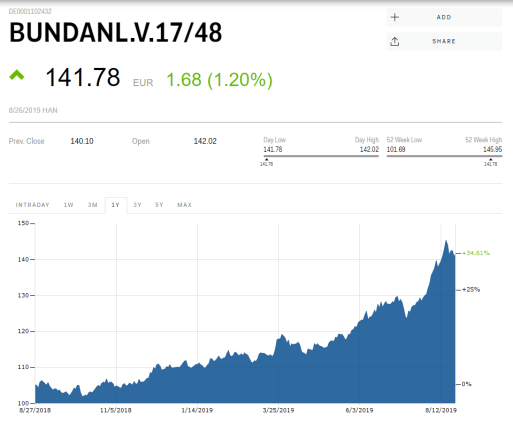
The 30-year Geman bund is up over an astounding 35 percent in the past 12 months.  Why buy Amazon stock when you get 30 percent-plus in risk-free German bonds?   Move out about 70 years and 700 kilometers south-east into the Austrian century bond and the returns are even more impressive or unbelievable,

Nothing illustrates the desperate hunt for yield among high-quality global issues better than Austria’s 100-year bond. The debt was issued at just below “par” (the nominal value of 100 used when first issuing bonds) in 2017, but in the two years subsequently it has more than doubled in worth to 210. That’s an annualized return of nearly 50%. The price has risen 30% since June alone, when Austria reopened the bond to new buyers.  – Bloomberg, Aug 18th

Wow!  A 30 percent price return since June in a low-coupon sovereign bond with massive interest rate risk!  Has somebody communicated to the buyers the ECB will be there with a 225 bid in the next round of QE?   Otherwise, that doesn’t appear to be risk-averse behavior to us and looks like one of the biggest bubbles we have ever seen, and we have seen many.

Austrian Century Bond

That “greater fool theory” is driving the global bond bubble, folks.  Caveat emptor.

We don’t know the market microstructure but our instincts lead us to believe it’s time to start thinking about getting shorty the Austrian century bond.

The End Game 

We doubt,  if Europe is serious in implementing fiscal stimulus and committing to significant deficit spending, and the U.S. keeps up with its massive new issuance, the current fake interest rates will allow for smooth sovereign bond auctions going forward, which should cause some to fail and/or get very sloppy, such as today’s 7-year U.S. Treasury auction.

Yields will have to rise to clear the market or a new round of QE will have to commence in earnest to monetize the deficits (see chart below), which will tip what has been an attempt by central banks to generate demand-pull inflation into monetary inflation.   Fiat currencies are a confidence game, after all, is said and done and printed.

Sorry, deflationistas.

We could be wrong but that is our view of the end game, folks.  A strong conviction held loosely.

How and how long it takes to play out is anyone’s guess.


Rent Control_2

Radioactive Long Bonds

This is not fuzzy math, folks.

Why would anyone in their right mind hold a negative-yielding long-duration bond in their portfolio, which is so radioactive it decays returns the longer you hold them?   One of the unintended consequences of all the nonsense going on today is that risk-free long-term sovereign bonds, intended to be held until maturity, have been transformed into short-term radioactive hot potatoes.    That can’t be good.

We hear that pension funds or banks by law have to hold a specific allocation to risk-free fixed income and are forced to buy these radioactive hot potatoes.  Were not that familiar with the regulations but to that, we say change the laws before the mushroom clouds start rising over these sectors.

P.S.

The stock market is trading like Trump is going to cave on slapping on the September 1st tariffs or remove them soon thereafter.   That is probably what the Chinese are hoping and will table first (note table defined the opposite in the U.S.) in the next round of passing the peace pipe if there is the next round.

Update 4:11 pm

Interesting comment from one of our friends down in Argentina.  The Banco Central De La Republica Argentina (BCRA) has no problem generating inflation.

You got a 2.1 bid to cover ratio! That’s great, here in Argentina yesterday we had to close the offering because the ratio was below 0.10. Only Public Institutions were amongst the offers. People are taking their savings out of the banks. Are you worried about deflation? Come back to Argentina, land of fine wine, fine meat and 50% inflation rates.  – Leo in B.A. 

Posted in Bonds, China, Credit, Uncategorized | Tagged , | 8 Comments

The People’s Republic of The Future

Great watch…

When it comes to technology, Shenzhen may well be the most fascinating city in the world. It makes the majority of our electronics. It clones the best technology Silicon Valley has to offer with ease. And, these days, Shenzhen buzzes with new ideas and an unrivaled energy that ensure it will play a major role in shaping our collective futures. In this episode of Hello World, journalist Ashlee Vance heads to the spectacle that is Shenzhen to experience it firsthand. The results are equal parts inspiring and disconcerting as tech-fueled entrepreneurs try to navigate an authoritarian regime.

https://www.bloomberg.com/hello-world


Posted in China, Video | Tagged , , | 13 Comments