It’s all the fault of Hillary’s emails. The Feds just aren’t committing enough resources to find them and “the server” and the little energy and assets spent to keep California from burning, the poles from melting, and the seas from rising are just too much, no? Gotta keep those fracking priorities straight!
SONOMA CO SHERIFF Alert: Civil Emergency Message until 03:45PM nixle.us/BDSLY Reply with a friend’s # to forward
Starting to see a bit of panic and hearing lots of angry talk in the long lines at the gas stations and stores about the anti-science crowd. If you’re a climate-denying “don’t come around no more.”
The chickens seem to be finally coming home to roost with the climate, the economy (though most are ostriches), debt and the global geopolitical situation.
I am going to whip out my Yeats to read by candlelight tonight.
Things are about to get nonlinear this evening and tomorrow when the hurricane gale force winds pick up. The danger is the burning embers, which can travel long distances whichever way the wind blows. At 60 plus mph winds, the fire becomes a blowtorch.
No, not the now annual October fires in California (helluva a Chinese hoax, btw) we’re running from but the S&P moving into the selling zone.
We are reposting a piece we published on the very day the market peaked in July right around here. The S&P came close to making a new high today, within 1/2 point and couldn’t even end at its closing high of 3025.86. Close, but no cigar, and sometimes a cigar is not just a cigar. Thank you, Sigmund.
We maintain this is good place to sell and set up shorts again. We will sell all day long up until 3125, at which point, we will cut and be forced to capitulate that “this time may be different.” The market should be able to look through another meaningless Potemkin trade deal with China, which leaves the world worse off than when negotiations began but it’s hard to bank should of. Arghh, we are obstinate but not stupid.
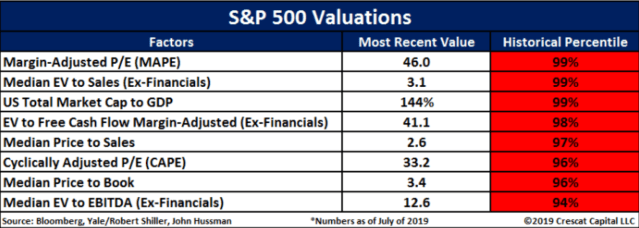
Stock valuations are at record highs and the markets are so, so gummed up and distorted by government intervention, mainly from the Fed — the ultimate socialism, in our book — that policymakers and market analysts have lost their compass and can’t tell true north from south, east from west or front from back. The cheerleaders were out in full force with their pom-poms this week, by the way. Our experience is that when it feels the hardest to sell, it’s time to sell.
Tight Liquidity
Nobody can seem to figure out this “liquidity problem” in the repo market and why banks with excess reserves are not arbing the Fed funds and repo rate.
1) Interest rate distortions. If prices are not allowed to move to their equilibrium levels, quantities will do the work. Go back and read some of our rent control analogies on how the repression of interest rates will lead to excess demand for liquidity, which can only be filled by haven flows or monetization, ie., the central banks. Ditto for a fixed exchange rate regimes, which come under pressure and central banks have sell their hard currency reserves to maintain the peg. Witness the now in the repo market.
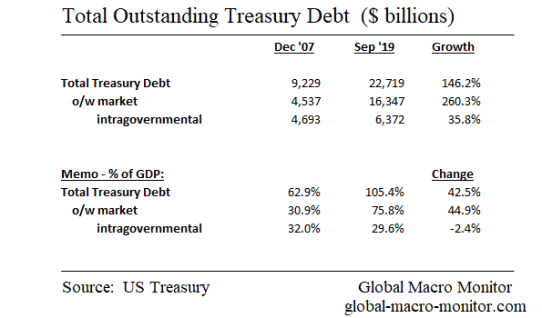
2) Larger budget deficits and structural changes in Treasury financing. The structural changes in the Treasury market and pro-cyclical deficits are wreaking havoc on liquidity and crowding out funding in other markets. See here.
Few understand that the U.S. G used to fund up to 50 percent of its annual budget shortfalls with the social security surplus (off-budget), limiting financing pressure from the government in the financial markets. No mas, comrades.
Social Security is now running monthly deficits, which will continue to get worse until the political geniuses in Washington fix it. The Treasury will have to increase its reliance on the market not only to fund the ballooning on-budget deficits but now an off-budget deficit (Social Security plus USPS).
Look for additional posts on this subject in the next few posts if our power stays on, which is increasingly unlikely. We have crunched some impressive and compelling data.
Finally, check out the twisted logic of the markets.
Rick Reily is one smart dude and the real brain at Black Rock. He, in essence, states in the following tweet that last October, interest rates were too high but now they are too low yet the market still needs liquidity from the Fed. Do you have a feeling we all are all just winging it? Grasping at straws?
In a well-functioning economy, interest rates would rise, reducing the demand for funding from, say, zombie companies and/or drive them out business and forcing the public sector to tighten budgets, for example, increasing real savings and therefore no need for the central bank to make up the shortfall.
Interest rates can’t rise, however, because it’s not a well-functioning economy. There is too much debt, too many market distortions, and the economy is too dependent on asset bubbles, which would burst like water balloons if rates were to rise. Just like the Q4 2018 U.S. stock market.
We have entered the selling zone — S&P 3025-3100 — to execute the Get Shorty trade. This also provides an excellent opportunity for long-term investors to start cutting back on risk if they have not already been doing so.
You know our view. Rarely should LT investors reduce risk in a significant manner, maybe just three to four times during their working lives, but this is one of those times, we believe.
Structural Headwinds
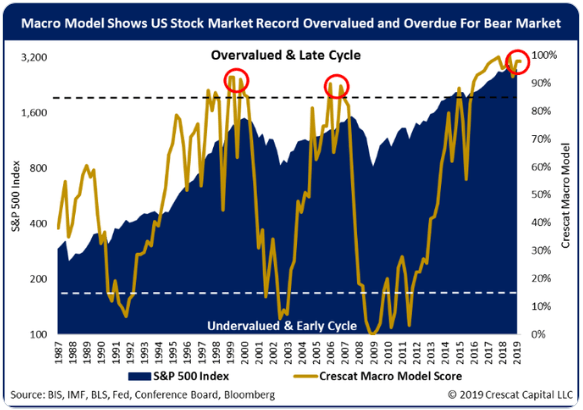
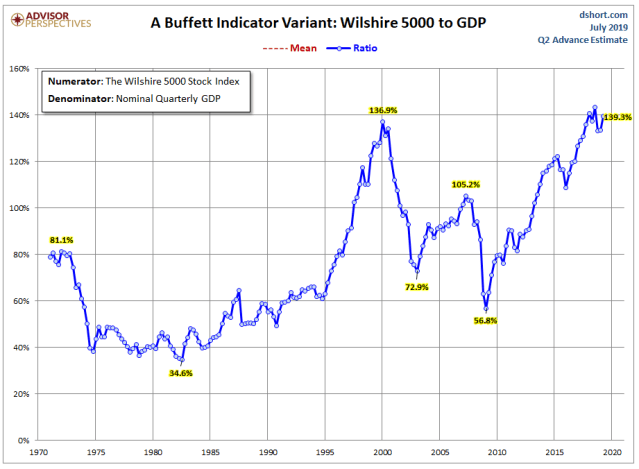
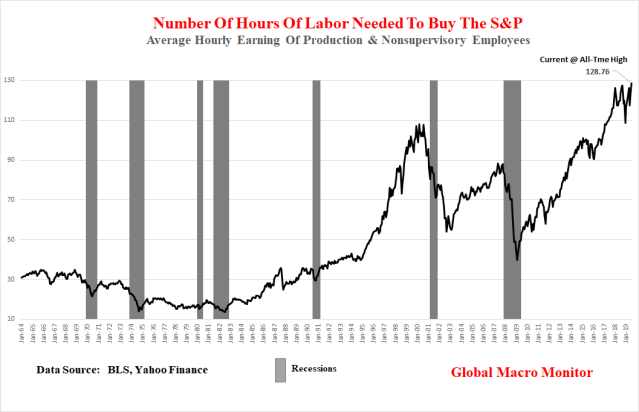
The tectonic plates of the global international economic order are breaking apart and moving in the wrong direction and valuations are at historic extremes.
Not to mention the absurdity that “billions upon billions” of fixed-income securities seem to enter the negative interest rate Twilight Zone on a daily basis.
Moreover, the Fed is about to take the unprecedented action of cutting rates next week with stocks at historical highs and inflation marching higher. That signals, at least to us, a Fed gone political and that policymakers have created a beast they cannot tame.
We expect the summer Friday afternoon ramp into the close, which will be an opportunity to start letting some go or setting some up. It’s hard to sell strength but much more enjoyable than selling into weakness and into a big hole.
Stocks Out Of Runway
The charts below illustrate that history dictates that stocks have very little room to run to the upside from current levels. We could be wrong and ‘this time may be different.”
We seriously doubt it, however, but discipline always trumps conviction and that is why we have a hard stop at 3125 to cover. We will then wait to put them out at even more absurd valuations.
Long-term investors that do sell should have a Plan B to get reinvested if they are wrong.
Good luck, folks. See ya’ thirty-plus percent lower.
Q: Why does San Francisco have so many homeless? A: Because the City has so many billionaires.
I once had a Twitter war with a Canadian, who was spewing some nonsense from a wing-nut article that San Francisco was a third-world city. Using the Socratic method in our debate, the first question I asked was if he had ever been to San Francisco? “Nope.”
Next question: Do you have a homeless population in your city? “Yep.”
I then tried to explain the reason why San Francisco has such a high homeless density was because the city is so wealthy, which drives up rents and home prices. How could SF be a third-world city if it was so wealthy? It didn’t even register with the peckerhead.
Now we have the data.
Full Disclosure
I lived in San Francisco for several years. It’s by far the best and most beautiful city in the world, in my opinion. One of three of the world’s most exotic cities: San Francisco, Hong Kong, and Rio de Janerio. Not to mention it has three World Series and three NBA championship rings (kinda, sorta) in the past ten years.
Live And Let Die
I would spend a week in New York and fly back home, and after landing at SFO, a river of peace would just flow through my veins. Seriously, it was like smoking some serious potent weed as I disembarked from the plane. Not that I partake, of course.
After arriving back to the City, I once got into a taxi and the driver asked where I had come in from. “New York City. ” He responded, “I used to live in New York. It’s a place where people spend the whole day barking at each other.” A lot of truth in that statement
It’s a city of everything for everybody, from lefty weirdness to the right-wing weird, and everything in between. Love it.
We once were going to move to Chapel Hill, NC, a great place to raise kids, great schools, great people, but I told the family, “it’s just not California.”
Too Many Billionaires
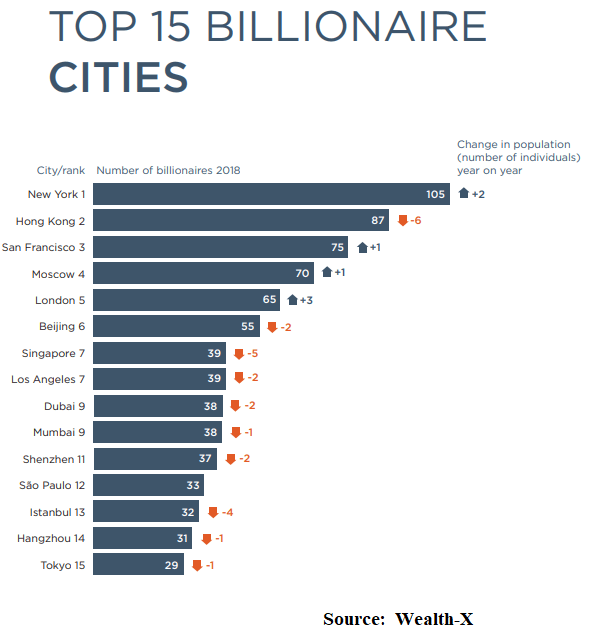
The following data helps explain San Francisco’s homeless problem, caused, in part, by skyrocketing rents and home prices. Not all of it can be explained by the following , but a large part can.
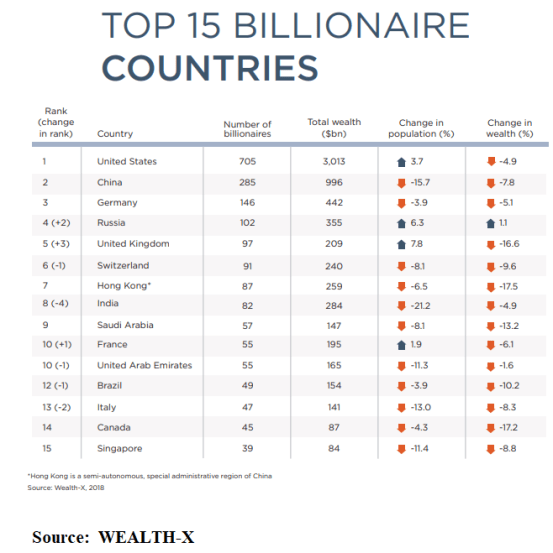
The City’s billionaire density if off the charts: one billionaire per every 11,600 inhabitants. If the U.S. as a whole had the same billionaire density, the country would have 28,200 billionaires instead of just 705 of the uber-wealthy.
What’s the solution? That’s above my paygrade but we are starting to hear a lot of proposals as the presidential campaign unfolds. And you know what I am talking about.
The San Francisco Paradox
How is it that San Francisco is by far the wealthiest city in the world as measured by billionaire density, yet, what some will say, is the country’s most liberal city?
We have always kind of believed it’s an evolutionary and natural selection thing. It goes back to the Gold Rush days.
America was birthed by risk-takers and the risk-takers of those risk-takers moved out west in the mid-1800s — the 49ers — to chase their dreams panning for gold.
That Wild West spirit and risk-taking culture still lives South of Market Street in San Francisco and Silicon Valley. It has also been helped by a huge Unicorn bubble, which is in the process of deflating.
Our sense is there will be fewer billionaires in San Francisco, same time next year.
Hard to believe the transformation of China over the past forty years.
Just before Deng Xiaoping led a large Chinese delegation in 1974 to a special session of the United Nations, the story goes, the government made a frantic search through all the banks in Beijing to find the money (hard currency) to pay for the trip. They could scrape together only US$38,000. This was the first time the leader of the People’s Republic of China would visit America and he couldn’t even afford to travel in first-class.
In 1981, 90 percent of the Chinese people lived in extreme poverty as defined by the World Bank. By 2013, that number had dropped to less than 2%.
China is now the world’s largest official creditor and home of 285 billionaires, second only to the 705 ultra-wealthy living in the United States.
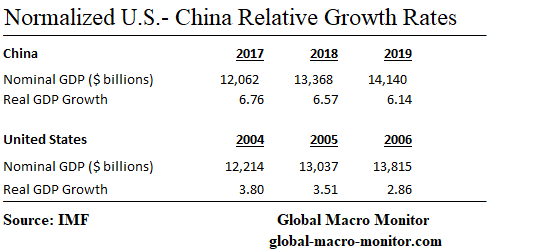
Now, economists fret over whether the country’s GDP is going to print at 6.3 or 6.0 percent. Still, absolutely stunning growth for a $14 trillion economy. It baffles us to hear the idjits claim China is on the verge of a Soviet-style economic collapse.
Get over it, China is not going away and they are not going to change the structure of their economy just because the self-proclaimed “world’s greatest negotiator” demands it. Xi is playing that guy like a Stradivarius fiddle.
When the U.S. economy was the same relative size, for example, it was generating less than half the growth China now experiences. There are many reasons for the differential we won’t go into but think manly in terms of labor force growth, savings, and capital accumulation.
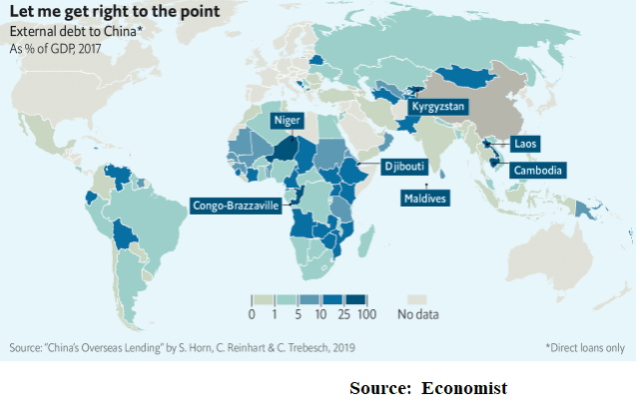
A new study by Sebastian Horn and Christoph Trebesch of the Kiel Institute for the World Economy and Carmen Reinhart of Harvard University offers the most comprehensive picture yet of China’s official credit flows (including state-owned banks). It adds to concern about whether China has sowed the seeds for debt problems abroad. They find that nearly half of China’s lending to developing countries is “hidden”, in that neither the World Bank nor the IMF has data on it. – Economist
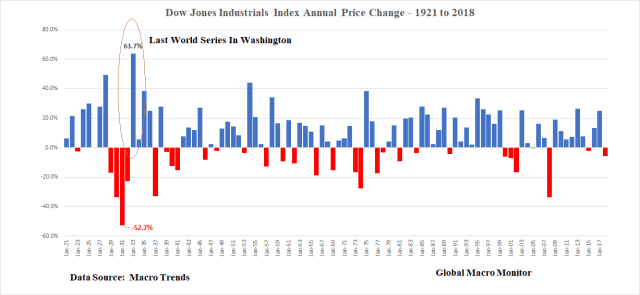
Wow! I can’t believe it’s been a year since we posted the following piece on the World Series, which begins tonight. The Houston Astros take on the NL champs, the Washington Nationals in the best of seven games. Washington, D.C. hasn’t hosted a World Series since 1933 when the then Senators lost to the New York Giants.
The Stock Market and Washington World Series
For the superstitious and those into spurious correlation, 1933 was the Dow Jones Industrials Average Index best year ever, increasing 63.7 percent after the FDR government came to power. Much of the price action was a big bounce and snapback after the big losses in the prior four years.
Taking the Nationals Senators
Since attending graduate school and starting my career in the nation’s Capitol, I have always had an affinity for D.C. teams. Washington did not have a baseball team at the time so to get my horsehide fix I would travel 40 miles north to Baltimore to watch Cal Ripken and the Orioles play.
Shortly after arriving in Washington I purchased a Senators shirt to workout in and did so religiously during my 5 years in the Capitol. I still have that shirt.
The original Washington Senators moved to Minnesota to become the Twins in 1960, and the new Senators franchise moved to Dallas in 1972 to become the Texas Rangers. The Nationals were created in 2005, born again from their previous life as the Montreal Expos.
Our money is and has been on the Nats at 20:1 (before playoffs began), as we believe know good pitching always stops good hitting. The ‘Stros have an excellent pitching staff but if Strasburg and Scherzer are on, nobody can touch them.
We are betting many Yankee fans are wishing President Trump’s tough immigration policies were in place when Jose Altuve, the smallest player in baseball, who beat them with a walk-off home run on Saturday night, came to the U.S. from Venezuela.
As a teenager in Venezuela, he was cut from an Astros tryout because the organization considered him too short. According to a 2014 Sports Illustrated profile, Altuve’s father coaxed him to return to the next tryout, where he earned his way into a deal with Houston and a signing bonus of $15,000, a small fraction of what the top amateurs typically receive. – Atlantic
During this Fall Classic, we paraphrase Emma Lazarus’ poem, The New Colossus, which is etched at the foot of the Statue of Liberty.
“Give me your tried, your poor baseball players Your huddled athletes yearning to play in the World Series, Send these, the home run hitters, to help entertiain me, I lift my lamp to the Fall Classic!”
Of the 50 players on the Nationals and Astros roster, 18, or 32 percent are from either Venezuela, the DR, Cuba, Mexico, or Brazil.
I am not going to feel ripped off or exploited by the Latin American countries as we watch the Dominican, Juan Soto and the Venezuelan, Jose Altuve battle it out for the next two weeks. Nor will we be upset that those two players “stole” a job from an American, they earned it!
The U.S. runs a yuuge trade deficit in baseball talent with the rest of the world (ROW), and thank goodness for that! Our guess is much of data, if any, probably shows up in the balance of payments data as foreign remittances as the players send some their earnings back home to family members. We have to think about and research this more but don’t wait for it.
At the end of the day, it’s much more fun and satisfying being both an American and a citizen of the world. If you’re not, try it, and enjoy.
During the 2016 season, Americans have watched a real World Series, with players born in at least 13 different countries. According to data made public by major league baseball, the leading country of origin for players on 2016 Opening Day rosters (and disabled lists) was the Dominican Republic (82 players), followed by Venezuela (63) Cuba (28), Mexico (12), Japan (8), South Korea (8), Canada (6), Panama (4), Colombia (3), Curacao (3), Brazil (2) and Taiwan (2). (Note: Puerto Ricans are U.S. citizens by birth.)
Today, approximately 26% of major league baseball players are foreign-born, a more than five-fold increase from the 1940s. In the World Series, the Chicago Cubs have 6 foreign-born players and the Cleveland Indians have 5 foreign-born players on their rosters. – Forbes
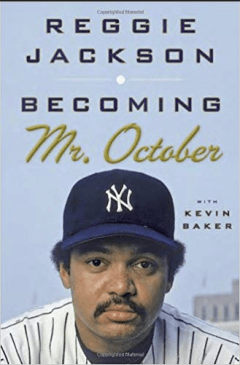
Check out our personal story about Reggie Jackson, Mr. October.
Ahh, the Fall Classic!
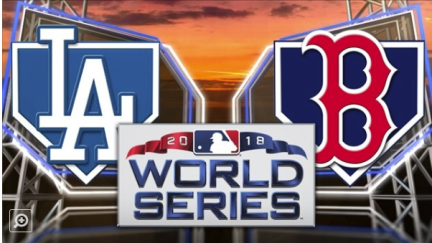
We’re not talking about October stock market corrections but the World Series! The Boston Red Sox and Los Angeles Dodgers square off tonight to begin the 114th October Classic.
The last time the two teams met was in 1916 when the Dodgers were test driving a new nickname, the “Robins.” The Red Sox beat Brooklyn four games to one. Casey Stengel starred for the Robins, and Babe Ruth pitched thirteen shutout innings after giving up a run in the first inning to win the fourteen-inning game two. The winning players share (World Series bonus) was $3,910 ($87,500 in 2018 dollars) versus the last year’s Astros’ player share of $438,901.
Mr. October
No baseball player is more synonymous with the World Series than Mr. October himself, Reggie Jackson.
Jackson earned the nickname “Mr. October” with his performance in Game 6 of the 1977 World Series against the Los Angeles Dodgers. Down 3-2 in the fourth inning, the Yankees outfielder hit a two-run home run and did the exact same thing in the fifth inning. Then in the eighth, he hit another home run to put the Yankees up 8-3. His performance secured the win and the series for New York.
– Athlon Sports
The first twenty-five years of my life was baseball, 24/7, an obsession that almost compares to today’s techno-addicted youth.
My baseball career ended due to an injury, but also mainly the lack of emotional maturity and the ability to pull out of an ugly hitting slump. Nothing worse for your confidence than cruising along during the season hitting .350, then to fall into a 2-for-50 tailspin. Then comes the vicious circle thinking you will never get another hit. Ironically, baseball players can fail 70 percent of the time, and still hit .300, making it to the Hall of Fame.
It’s very similar to what happens to your psyche and P&L, trying to trade crude oil and natural gas against the ‘bots. You gotta shake off the bad ones and move on. I could’ve been somebody, damn it!
I did have a headstart in baseball as a young teen working with the Los Angeles Dodgers, first as a batboy, then batting practice pitcher, and adjunct bullpen catcher. Later, I would spend some time with the Atlanta Braves and Oakland A’s.
I caught Tommy John (TJ) — the real one, who had the surgery named for him – for almost the entire season he was out before his remarkable comeback. He could barely extend his hand after the surgery but refused to give up. I would try to hide in the outfield before games but would soon hear Red Adams, the Dodgers pitching coach, calling me to come to the bullpen.
TJ was very wild when he first started on the comeback trail, bouncing curveballs in the dirt, which too often ended up smacking me in the family jewels. It was a painful year, and it’s amazing that I could still have children. Tommy John is one of the greatest human beings ever.
Reggie
One winter or spring during the off-season, can’t recall, I get a call from my boss to come to Dodger Stadium for a few days as Reggie Jackson was going to film a television commercial. He said the production company might need a pitcher or catcher and I should be around to help Reggie around the clubhouse and stadium.
I wasn’t in the union so being in the commercial was out.
Over the next three days, Reggie and I became very close. He treated me like I was his little brother. Reggie had this larger than life image, with a reputation for a larger than life ego.
He took a lot of heat for that quote, and still denies it, and I certainly didn’t see the Reggie ego the media often portrayed. He was super kind, friendly, down to earth, always made time for you, and was just a great guy to hang out with. He made you feel comfortable and not conscious you were in the presence of one of baseball’s greatest stars. It was very much like a good day hanging with your big brother.
Self-centered egomaniacs don’t treat the little people like that.
One thing that really stood out over our three days together was how Reggie spoke. He sounded like an university professor, very intelligent, Later I found out he has an IQ of 160, the same as Steven Hawing! That is genius zip code.
Pumas
What really sealed the deal was when Reggie finished filming and was about to leave. He handed me a piece of paper with an address and phone number:
22 Yankee Hill Oakland, Ca (415) xxx-xxxx
He said when I was in the Bay Area; I would never stay in a hotel but with him. I believe that house burnt down in the 1991 Oakland Hills fire.
He then asked for my shoe size and address. We shook hands and parted ways.
About a week later five boxes of Puma tennis shoes came in the mail. Thank you, Reggie!
Baltimore Orioles
The next season, the A’s traded Reggie to the Baltimore Orioles as a rental. He was playing out his option and Charles Finley, the A’s owner, would never pay Reggie’s new market rate.
My little brother idolized Reggie, so when the O’s were in town, I took him to a game. After the game, I went down to the dugout to say hi as Reggie trotted in from the outfield. He invited me into the clubhouse. I asked Reg if my little brother could accompany me. He said absolutely.
I had told Reggie about my brother, and when we get into the clubhouse, he points to his locker and says, “Geoff, anything, take anything you want. My uniform, glove, anything.” Big egos and the self-absorbed don’t treat little people like this.
I love Reggie Jackson.
Pete Rose
Pete Rose was the same way, by the way. Always thinking and caring about the little guy.
The commish of baseball, Bart Giamatti, my favorite actor’s father, died just eight days after banishing Charlie Hustle from baseball. Just sayin’.
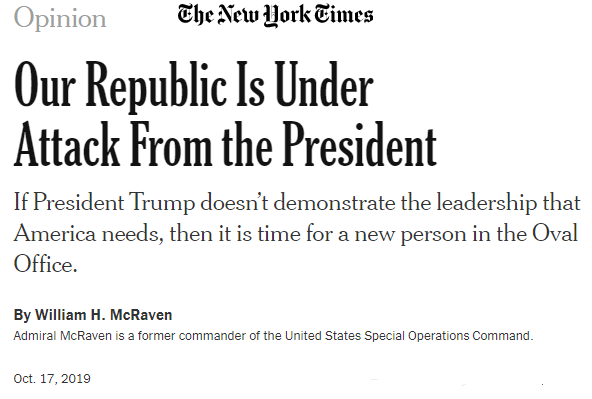
“I don’t like the Democrats, but Trump is destroying the Republic! – Retired Four-Star General (See Admiral McRaven’s editoral below)
Last week was a very bad week for President Trump and may, in hindsight, be the tipping point of his presidency and the Republican Party. We list and explain the four political bombshells that exploded, which we believe will work its way through the American political system and eventually adversely impact the risk markets.
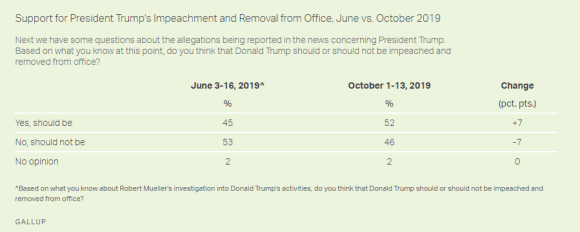
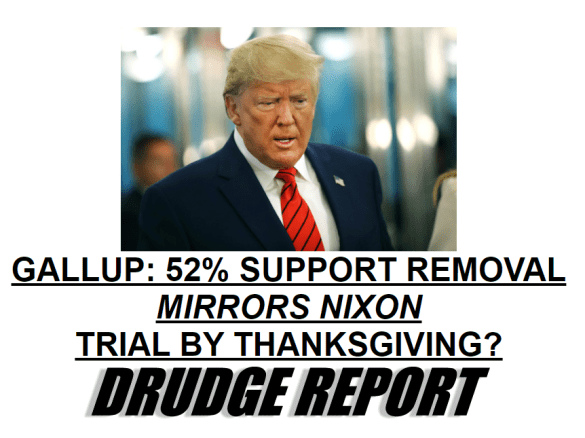
Senate Republicans will soon have to choose between Mr. Trump or the rule of law and the Constitution. Public opinion is quickly moving toward the later, where a majority of the country now supports the impeachment and removal of President Trump.
We suspect public opinion for impeachment and removal will continue to move north putting pressure on Senate Republicans, especially the 23 who are running for re-election next year. They will be no longer be able to evade and obfuscate their support for Trump and will be forced to go on record for the history books during a Senate trial early next year.
We think resignation is more likely than removal but Trump won’t go quietly, increasing the political risk on the American street. President Trump is becoming increasingly toxic to the Republican Party and we sense they know it.
The President consistently polls 20-30 points underwater with women and younger voters.
Mr. Market and President Warren
Our priors are that a huge 2020 Blue Tsunami swamps the White House, Senate, and House is a much higher probability than is currently priced. The markets will soon have to discount the potential for a President Warren, backed by a Democratic House and Senate, and we don’t believe it will be a bullish repricing.
Political Demographics
The math of the country’s political demographics just are not conducive to anything close to a Red Tide in 2020 or beyond, and last week’s events reinforced it. Far, far from it.
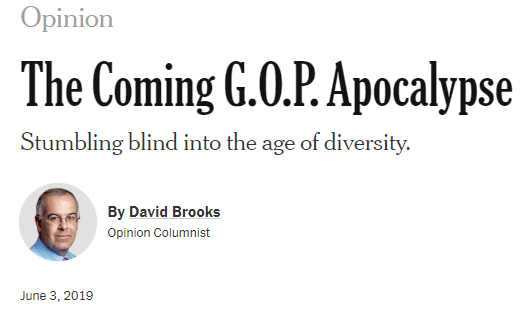
In fact, the math over the next few decades is going to be brutal for Republicans.
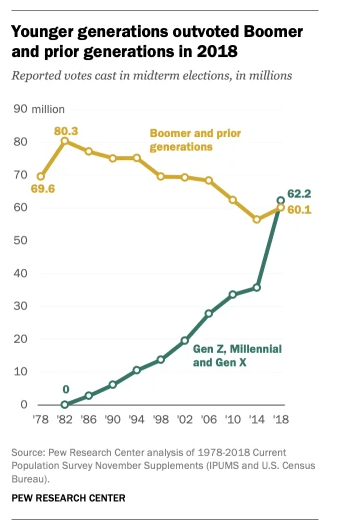
The younger generations, who are woke, are left of the salad fork, and now, for the first time, a larger voting block than the boomers.
A Democratic voter’s race, sex or education level doesn’t predict which candidate he or she is leaning toward, but age does.
In one early New Hampshire poll, Joe Biden won 39 percent of the vote of those over 55, but just 22 percent of those under 35, trailing Bernie Sanders. Similarly, in an early Iowa poll, Biden won 41 percent of the oldster vote, but just 17 percent of the young adult vote, placing third, behind Sanders and Elizabeth Warren.
As Ronald Brownstein pointed out in The Atlantic, older Democrats prefer a more moderate candidate who they think can win. Younger Democrats prefer a more progressive candidate who they think can bring systemic change. – NY TImes
If the young, who traditionally to like stay home and play on their iPhones on election day, come out and vote en masse in 2020, as they did and almost doubled their turnout in the 2018 midterms, you best start getting used to saying, President Warren, Speaker Pelosi, and Majority Leader Schumer.
Mr. Market is going to have big trouble getting there.
A retired four-star admiral, who led the raid and capture of Osama Bin Laden pens an Op/Ed piece that states the country is effectively under attack by the President of the United States. Then the POTUS is openly mocked by his former Defense Secretary and a four-star General at Thursday’s annual Al Smith dinner. Stunning and unprecedented.
These great patriots aren’t exactly “deep state” bureaucrats and can’t be easily dismissed with a 6:00 AM Tweet.
We think President Trump really hurt himself by trashing his former defense secretary and retired four-star General James Mattis during the now-infamous “all roads with you lead to Putin” meeting with Congressional leaders that went way-off the rails at the White House on last Wednesday. President Trump called Mattis “the world’s most overrated general.”
The “Warrior Monk” is well respected and loved throughout the U.S. military and defense community.
“I earned my spurs on the battlefield,” he said at a charity gala in New York on Thursday night. “Donald Trump earned his spurs in a letter from a doctor.” – Washington Post
Ouch!
At least watch the first two minutes of the following video of his speech on Wednesday, then fast forward to minute 8:00, where the General cites President Lincoln. Better yet, watch the speech in its totality.
Along with most of the country, we really admire the Warrior Monk, especially after reading this story,
…Mattis has a compassionate side to him. The story goes that Mattis stood duty on Christmas back when he was a brigadier general so that a younger Marine could spend the holiday with his family.
…retired Marine Gen. Charles Krulak, who was commandant when the story took place. Every Christmas during his tenure, Krulak delivered cookies to every Marine duty post around Washington and Quantico, Va.
Back in 1998, he was making his final delivery to Marine Corps Combat Development Command headquarters at Quantico when he asked the Marine on duty who the officer of the day was.
“The young Marine said, ‘Sir, it’s Brigadier General Mattis.’”
Krulak thought the Marine had misunderstood him, so he asked again, but he got the same answer.
“I looked around the duty hut and in the back, there were two cots: One for the officer of the day and one for young Marine. I said, ‘OK, let me cut through all of this: Who was the officer who slept in that bed last night?’
“And the Marine said, ‘Sir, Brigadier General Mattis.’”
At that moment, Mattis walked around the corner.
“So I said to him, ‘Jim, what are you standing the duty for?’ “And he said, ‘Sir, I looked at the duty roster for today and there was a young major who had it who is married and had a family; and so I’m a bachelor, I thought why should the major miss out on the fun of having Christmas with his family, and so I took the duty for him.’ ” — Stars & Stripes
What a good man and incredible warrior.
The Other Four Star
Go no further for more evidence the President is losing the confidence of the top military brass, at least, publicly, of retired admirals and generals, than Admiral McCraven’s Op/Ed in the NY Times. McRaven, is a retired Navy Seal, and was charged with the raid that captured Osama Bin Laden. I just finished his book, Sea Stories: My Life in Special Operations, where he devotes a fascinating and gripping chapter to Operation Neptune Spear.
Here are the money quotes from his NY Times piece,
…beneath the outward sense of hope and duty that I witnessed at these two events, there was an underlying current of frustration, humiliation, anger and fear that echoed across the sidelines. The America that they believed in was under attack, not from without, but from within.
These men and women, of all political persuasions, have seen the assaults on our institutions: on the intelligence and law enforcement community, the State Department and the press. They have seen our leaders stand beside despots and strongmen, preferring their government narrative to our own. They have seen us abandon our allies and have heard the shouts of betrayal from the battlefield. As I stood on the parade field at Fort Bragg, one retired four-star general, grabbed my arm, shook me and shouted, “I don’t like the Democrats, but Trump is destroying the Republic!
..We are not the most powerful nation in the world because of our aircraft carriers, our economy, or our seat at the United Nations Security Council. We are the most powerful nation in the world because we try to be the good guys. We are the most powerful nation in the world because our ideals of universal freedom and equality have been backed up by our belief that we were …champions of justice, the protectors of the less fortunate
If our promises are meaningless, how will our allies ever trust us? If we can’t have faith in our nation’s principles, why would the men and women of this nation join the military? And if they don’t join, who will protect us? If we are not the champions of the good and the right, then who will follow us? And if no one follows us — where will the world end up?
…if this president doesn’t understand their importance, if this president doesn’t demonstrate the leadership that America needs, both domestically and abroad, then it is time for a new person in the Oval Office — Republican, Democrat or independent — the sooner, the better. The fate of our Republic depends upon it. – Admiral McRaven former commander of the United States Special Operations Command
2. G7 At Trump National Doral — The Damage Is Done
Though President Trump almost immediately reversed himself on holding next year’s G7 Summit at one of his properties, caving to major pushback from the Republican Senate, the political damage is done. How many moderates do you think he lost by this blatant act of corruption?
One thing we have learned with and since the election of Donald Trump is the electorate doesn’t do swamp. Ask Joe Biden, who is now plummeting in the polls as voters become aware of the jobs and money his son, Hunter, made, through the nepotism of his father. It may have not been illegal but it sure as hell was swampy.
Nothing compares to the ultimate swampiness of Trump trying to hold the G7 at Trump National Doral, however. It’s jaw-dropping swampiness and, more important, outright illegal.
We pecked out the following on Friday afternoon fully anticipating the G7 was never going to happen at Trump National Doral. We weren’t expecting such a quick reversal, however, but think you will find what we wrote informative, if not a bit entertaining, nonetheless.
We thought, at least, at the very last resort (pun intended) the Federal courts would step in never allow it under the “phony”, according to President Trump, Emoluments Clause of the U.S Constitution, Article I, Section 9:
Clause 8, Titles of Nobility and Emoluments
“Clause 8: No Title of Nobility shall be granted by the United States: And no Person holding any Office of Profit or Trust under them, shall, without the Consent of the Congress, accept of any present, Emolument, Office, or Title, of any kind whatever, from any King, Prince, or foreign State.” – U.S. Constitution
We suspect President Trump lost the support of many, if not most of the remaining moderates just by the announcement the G7 Summit will be held at his Trump National. That is about as swampy as it gets, folks.
Walking it back won’t bring the moderates back but may eventually add to one of his articles of impeachment.
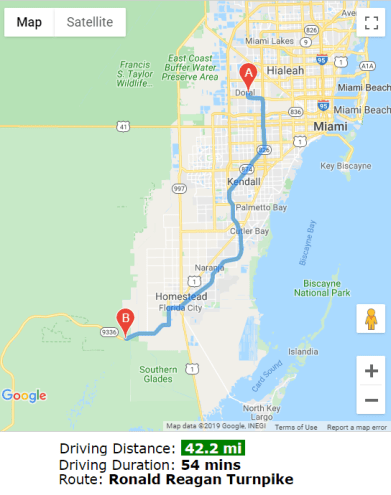
Nonetheless, the choice of Doral was very apropos as it’s location is only 42 miles north of the Everglades National Park, one of the world’s most famous swamps.
Do the math, folks, that is less distance than 10 rounds of golf from the 7,510 yards Tips at Doral’s Blue Monster golf course.
3. Confessions Of An “Acting” Chief of Staff
President Trump’s acting Cheif of Staff, Mick Mulvaney’s quid pro quo and “get over it” presser on Thursday may go down as one of the most famous confessions since Saint Augustine’s classic book.
He walked it all back the next day in the Augustinian spirit of “Lord, make me chaste – but not yet!” We wait with great anticipation to see if walks back the walk back under oath or after he is thrown under the greyhound.
We are not going to comment on the news conference but will let you view it in full, right here.
4. Trump and Pence Rolled By Erdogan Like A Cheap Cigar
Donald Trump got “rolled” by Turkish President Recep Tayyip Erdogan, a National Security Council source with direct knowledge of the discussions told Newsweek.
In a scheduled phone call on Sunday afternoon between President Trump and President Erdogan, Trump said he would withdraw U.S. forces from northern Syria. The phone call was scheduled after Turkey announced it was planning to invade Syria, and hours after Erdogan reinforced his army units at the Syrian-Turkish border and issued his strongest threat to launch a military incursion, according to the National Security Council official to whom Newsweek spoke on condition of anonymity
…”President Trump was definitely out-negotiated and only endorsed the troop withdraw to make it look like we are getting something—but we are not getting something,” the National Security Council source told Newsweek. “The U.S. national security has entered a state of increased danger for decades to come because the president has no spine and that’s the bottom line.” – Newsweek
We are all for bringing our troops home and ending the forever wars. But these troops are not coming home and they were tantamount to the Dutch boy with his finger in the dike holding back the dam from breaking. The dam is now broken and we will witness the consequences of the disastrous flood unfold during the next year of the presidential campaign. Not Republican positive, in our opinion.
America Throws The Kurds Under The Bus, Again
The poor Kurds. I do remember how Bush #41 left them hanging out to dry after the first Gulf War for Sadaam to slaugter.
Nothing in this world is certain except death, taxes, and America betraying the Kurds.
The U.S. has now betrayed the Kurds a minimum of eight times over the past 100 years. The reasons for this are straightforward.
The Kurds are an ethnic group of about 40 million people centered at the intersection of Turkey, Syria, Iran, and Iraq. Many naturally want their own state. The four countries in which they live naturally do not want that to happen. — The Intercept
Upshot
The world seems Fubared with little hope but we can’t stop fighting, folks. Republican, Democrat, or Independent.
Should stocks be making new all-time highs? We don’t think so, but they seem to want to, for now.
We believe the market is in a long topping process, are at historically high valuations, and on the eve of an ugly bear market. Not much upside, lots of downside, and we just laid out another potential catalyst.
We don’t know the future and nobody else does. We also, as always, recognize we could be wrong but not because we haven’t done our homework.
Subscribers should always do a second read of the material posted by clicking on our blog as we often add important and interesting edits.
Running Out Of Free Lunches
We are almost out of free lunches, folks, and will be posting only sporadically unless your support increases. Donate whatever you think is fair by clicking on the PayPal button just below the Twitter and search icons on the upper right-hand side of the blog. You do not need a PayPal account and can use almost any credit card.
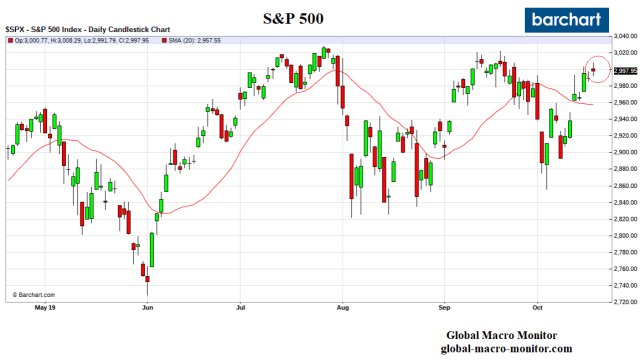
Spinning tops and dojis both represent indecision. Dojis are smaller, with small real bodies and small upper and lower shadows. The Spinning top has long upper and lower shadows. Both patterns occur frequently and are sometimes used to warn of a reversal after a strong price move. Both types of candlesticks rely heavily on confirmation. A strong move after the spinning top or doji tells more about the new potential price direction than the spinning top or doji itself. – Investopedia
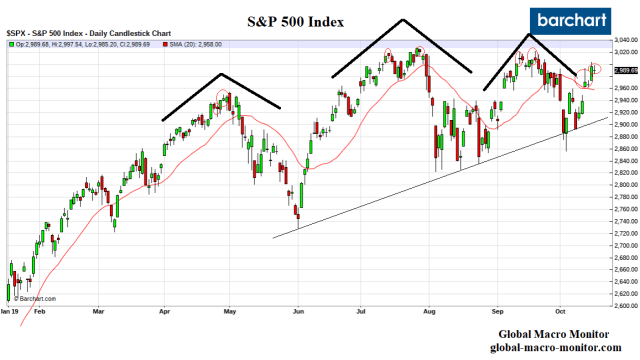
Can’t believe we’ve been sucked into the daily market noise but the recent price action seems kind of important as to whether stocks either break or breakout here. See our last two posts here and here.
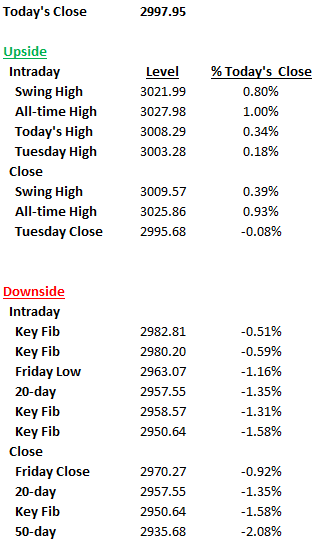
The S&P closed higher than Tuesday’s close, which is positive but it couldn’t hold its gains and was rejected at around 3009, very close to the recent swing closing high.
Key Levels
There does seem to be a lot of confidence and self-interest in the Street that stocks are about to break higher. And it doesn’t appear there are many sellers and the market trades like speculators are short.
No Short Interest
However, we came across the following Bloomberg piece that dispelled that notion and reinforces our bearish bias.
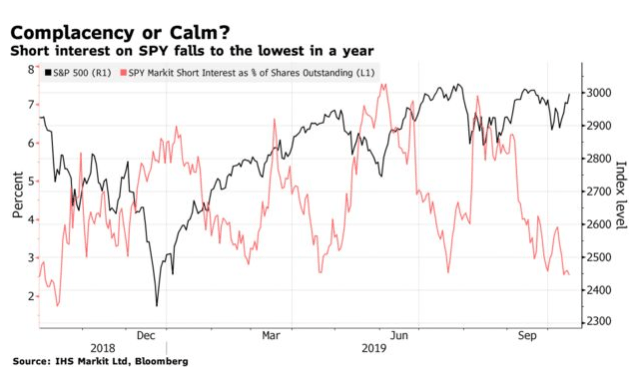
Bets against U.S. stocks haven’t been this low since last October — just before the deepest sell-off in a decade.
Short sales in the SPDR S&P 500 ETF Trust as a percentage of shares outstanding fell to just 2.6% this week, according to data from IHS Markit Ltd., signaling optimism that American equities can push back toward all-time highs. But the setup has some investors on edge.
“Is it another sign of complacency? Smells like it,” said Yousef Abbasi, global market strategist at INTL FCStone. “The market is being stubbornly optimistic in the face of several headwinds. It does feel dangerous.” — Bloomberg, Oct 17th
We have learned through the years when we “feel” like the market is going to move in some direction, it is usually wrong. We will stick to our flight indicators, such as the daily candles to give us direction.
In summary, the candlesticks seem to be signaling an imminent reversal, valuations are historically expensive, and short interest is at a 52-week low.
We are looking for confirmation and sell trigger with a break below 2958.
As always, we reserve the right to be wrong and often are.
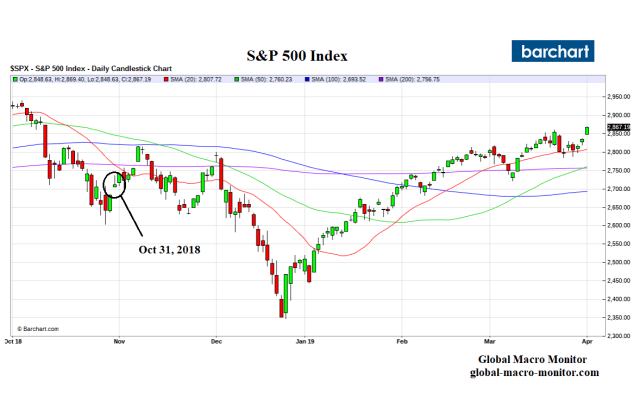
In our Saturday post, Heads Up! Friday’s Rare S&P Shooting Star Candlestick, we pointed out the S&P500 had formed a rate shooting star Doji candlestick on Friday with price action that had been observed only once since 2010, last Halloween day.
Take a look at last Halloween’s S&P shooting star. The index consolidated the next few days then gapped up with a nice long green candle, which probably sucked in many traders into long positions. The next day the S&P formed a long-legged Doji before rolling over to eventually crash to the December 2018 low, forcing the market socialists to call, no scream for a Fed rescue.
Upshot
The key now is to watch the price action next week.
A break on Monday of 2960 (see below for key support levels) or the formation of more Doji candlesticks will further reduce the market fog and indicate the market is probably headed for some trouble. — GMM, Oct 12th
Since Saturday’s post, the S&P500 has formed two daily Doji candlesticks during the past three trading days, including today. These are signs of indecision by traders.
Our sense is that many traders are expecting a breakout to new highs and were probably sucked into long positions with Tuesday’s big move.
Doji City And Price Reversals
Our observation of the price action over the past few years is that when Dojis begin to become ubitiquous it’s a warning, signal, and confirmation of a potential major price reversal. It’s not a guarantee but after Friday’s shooting star candle followed by the price action similar to last Halloween, coupled with the head & shoulders formation, we are on full alert.
Key Levels
To the upside is Tuesday’s intraday high of 3003.28 and 3021.99, which would negate the head & shoulders pattern. A close above 2995.68 (Tuesday’s close) and then 3007.39 would be positive.
To the downside, is the 20-day moving average at 2958, which coincides with some key Fibo levels, is a must hold. A break there would trigger a definite sell and, of course with a stop-loss.
Upshot
Short-term trading is very difficult and, in our opinion, has turned into a mug’s game since the rise of the trading ‘bots and algos. We have learned the hard way with some very expensive lessons. Thus, we don’t pay much attention to the daily noise anymore unless we believe a big move may be setting up.
Market Manipulation.
Moreover, the powers that be have tried their very best to keep the market moving higher. Beat the Tweets? Come on, man!
Unless, of course, you know they’re coming.
Read the following, then feel free to throw up. Make sure to click on the link and read the entire piece.
In the last 10 minutes of trading at the Chicago Mercantile Exchange on Friday, September 13, someone got very lucky. That’s when he or she, or a group of people, sold short 120,000 “S&P e-minis”—electronically traded futures contracts linked to the Standard & Poor’s 500 stock index—when the index was trading around 3010. The time was 3:50 p.m. in New York; it was nearing midnight in Tehran. A few hours later, drones attacked a large swath of Saudi Arabia’s oil infrastructure, choking off production in the country and sending oil prices soaring. By the time the CME next opened, for pretrading on Sunday night, the S&P index had fallen 30 points, giving that very fortunate trader, or traders, a quick $180 million profit.
It was not an isolated occurrence. Three days earlier, in the last 10 minutes of trading, someone bought 82,000 S&P e-minis when the index was trading at 2969. That was nearly 4 a.m. on September 11 in Beijing, where a few hours later, the Chinese government announced that it would lift tariffs on a range of American-made products. As has been the typical reaction in the U.S. stock markets as the trade war with China chugs on without any perceptible logic, when the news about a potential resolution of it seems positive, stock markets go up, and when the news about the trade war appears negative, they go down.
The news was viewed positively. The S&P index moved swiftly on September 11 to 2996, up nearly 30 points. That same day, President Donald Trump said he would postpone tariffs on some Chinese goods, and the S&P index moved to 3016, or up 47 points since the fortunate person bought the 82,000 e-minis just before the market closed on September 10. Since a one-point movement, up or down, in an e-mini contract is worth $50, a 47-point movement up in a day was worth $2,350 per contract. If you were the lucky one who bought the 82,000 e-mini contracts, well, then you were sitting on a one-day profit of roughly $190 million.
…But these wins were peanuts compared to the money made by a trader, or group of traders, who bought 420,000 September e-minis in the last 30 minutes of trading on June 28. That was some 40% of the day’s trading volume in September e-minis—making it a trade that could not easily be ignored. By then, President Trump was already in Osaka, Japan—14 hours ahead of Chicago—and on his way to a roughly hour-long meeting with China’s President Xi Jinping as part of the G20 summit. On Saturday in Osaka, after the market had closed in Chicago, Trump emerged from his meeting with Xi and announced that the intermittent trade talks were “back on track.” The following week was a good one in the stock market, thanks to the Trump announcement. On Thursday, June 27, the S&P 500 index stood at about 2915; a week or so later, it was just below 3000, a gain of 84 points, or $4,200 per e-mini contract. Whoever bought the 420,000 e-minis on June 28 had made a handsome profit of nearly $1.8 billion.
Traders in the Chicago pits have been watching these kinds of wagers with an increasing mixture of shock and awe since the start of the Trump presidency. They are used to rapid fluctuations in the S&P 500 index; volatility is common, of course. But the precision and timing of these trades, and the vast amount of money being made as a result of them, make the traders wonder if all this is on the level. Are the people behind these trades incredibly lucky, or do they have access to information that other people don’t have about, say, Trump’s or Beijing’s latest thinking on the trade war or any other of a number of ways that Trump is able to move the markets through his tweeting or slips of the tongue? Essentially, do they have inside information?
..given how fishy and coincidental the trading in e-minis seems to be these days, the SEC or CFTC would be doing a great service (and their job) for the American people by investigating who is behind these lucrative trades, and what they knew before they placed them. At the moment, what we’re getting from them is an indifferent shrug.
Federal regulators might start here: In the last 10 minutes of trading on Friday, August 23, as the markets were roiling in the face of more bad trade news, someone bought 386,000 September e-minis. Three days later, Trump lied about getting a call from China to restart the trade talks, and the S&P 500 index shot up nearly 80 points. The potential profit on the trade was more than $1.5 billion. — Vanity Fair, Oct 16th
If the above has any semblance of truth, that kind of swampiness makes the Pantanal in Brazil look like the marsh at our local park. The fact we have to even think about this kind of bullshit makes us wanna hurl.
As always, we reserve the right to be wrong.
Running Out Of Free Lunches
We are almost out of free lunches, folks, and will be posting only sporadically unless your support increases. Donate whatever you think is fair by clicking on the PayPal button just below the Twitter and search icons on the upper right-hand side of the blog. You do not need a PayPal account and can use almost any credit card.