Picture of the Year: For Whom the Can Tolls

If there is one picture we’ve posted, and we’ve posted it several times, that encapsulates 2012, it is this one.   Think Ernie as the allegory for the fiscal and monetary policymakers across almost all developed countries.

Let’s give them credit for stabilizing the financial and economic crisis — which they helped cause, by the way —  but in terms of fixing the problems and implementing the necessary structural reforms?  A big FAIL!

In our days at the World Bank,  when working with troubled economies that had been been cut off by the financial markets we followed a two step process.   First, the IMF would move in and try to stabilize an imbalanced economy through fiscal and monetary reform.   Then the World Bank would come in and help the country implement structural reforms, such as fixing their pension system and labor markets.  These SALs, or structural adjustment loans, were an aside from the Bank’s normal infrastructure lending.

Chile was our baby in the mid-1980’s and is now an economic superstar.   They took the painful and necessary steps to reform their economy and pension system.  We were also privileged to work with Poland as an economic and financial adviser in the early-1990’s when they were coming out of communism and restructuring their external debt.   Poland is now an economic superstar.

The U.S., Japan, France, the U.K.  could learn from Chile and Poland.

We expect more absurd policies, motivated by political pain aversion, to be floated, tested, and implemented over the next few years that will increase systemic risk and geopolitical tensions.

Massive monetization?  Central banks canceling debt?  Currency wars?

Japan may be the first test.  Think collapse of money demand and potential hyperinflation.  Imagine the contagion when the “printing money fixes all” meme collapses.

Yeah, yeah, yeah… look at excess capacity.   That’s not the issue.  Japan has structural problems that won’t be fixed by more money printing and stability of the money demand function will be the real issue.   We rarely hear the point even raised, much less discussed.   Well, maybe once or twice.

Only when markets revolt will the policymakers in these countries get serious about structural reform, in our opinion.  The political systems lack leadership and seem to be corrupted by special interests to deal with the real issues and long-term fixes.

We’re glad it looks they averted the cold turkey or crash adjustment shock, which surely would have caused a recession, but we’re disheartened Washington doesn’t have it within them to implement a glide path to structural adjustment.   They just won’t learn or heed the words of Alan Greenspan during the Asian crisis in the late 1990’s,

Reality eventually replaces hope, and the cost of the delay is a more abrupt and disruptive adjustment than would have been required if action had been more pre-emptive.

Have a great,  safe and sober New Year,  happy compotations tonight,  and we will see you back here in the Year of the Schnake!

Ernie_Kicking the CanErnest Hemingway “kicking the can down the road.”

(click here if picture is not observable)
Posted in Picture of the Day | Tagged , , , , | 4 Comments

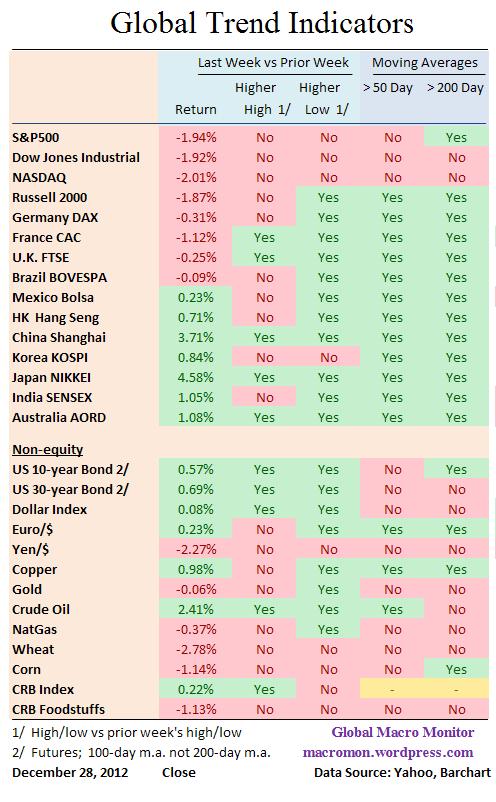
Global Trend Indicators

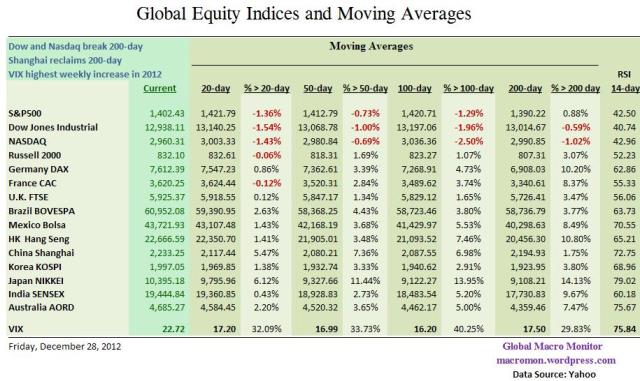
WIR_Global TrendWIR_Equity_MA(click here if table is not observable)

Posted in Global Trend Indicators | Tagged , , , , , , | 2 Comments

Macedonians protest government overspending

Now this is different!  If only………..

Macedonians have marched against the government in the capital, Skopje, but unlike the rest of Europe – its not against austerity cutbacks. Demonstrators accuse the authorities of going on a spending spree which they claim wastes too much of the country’s financial resources. Al Jazeera’s Aljosa Milenkovic reports from Skopje.

AlJazeeraEnglish

(click here if video is not observable)

Posted in Fiscal Policy | Tagged , , | 1 Comment

Week in Review

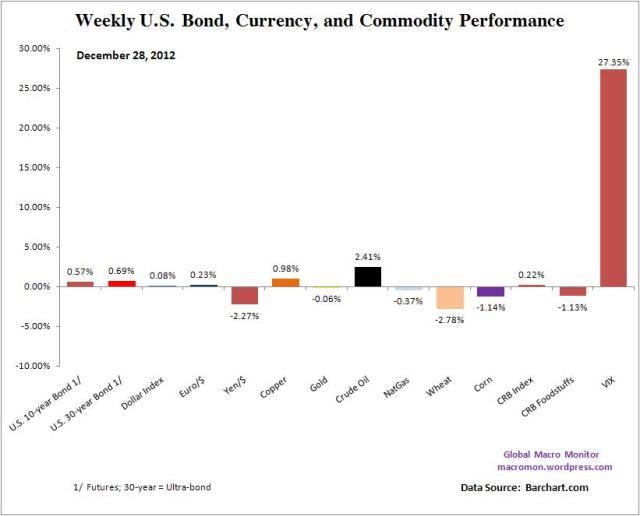
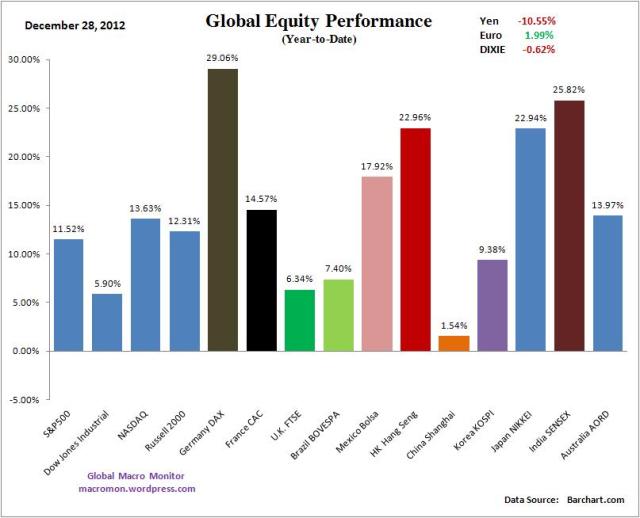
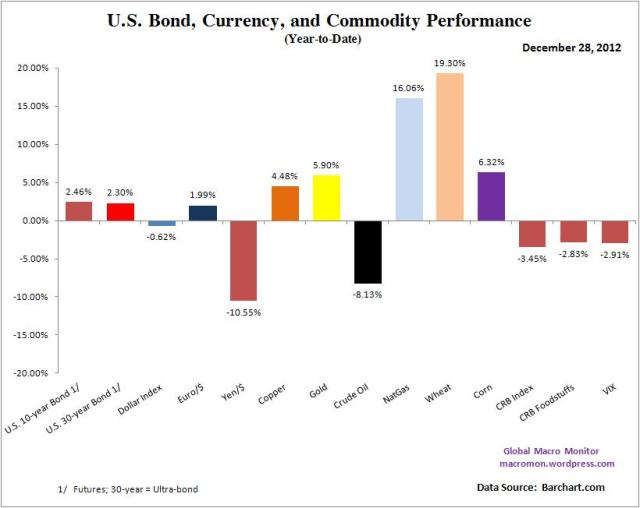
WIR_Key LevelsWIR_Equity_WeekWIR_Bond_WeekWIR_Equity_YTDWIR_Bond_YTD(click here if charts are not observable)

Posted in Week in Review | Tagged , , , , , | 2 Comments

Worst Words of 2012 – Dictionary.com

Love this list from Dictionary.com – sometimes a selfie is just a selfie!

2012 has been an interesting time in the life of our lexicon. From new coinages to new usages, English has had a nice growth spurt. Some neologisms quickly outgrow their usefulness, or through overuse, they become meaningless, like an overplayed song on the radio. Here are a few terms that many people have grown tired of in 2012.

Fiscal Cliffthe most-used term in 2012 politics.
This phrase rose to prominence when Ben Bernanke, the chairman of the United States Federal Reserve, used it in a speech in February. “Fiscal cliff” is meant to describe what will happen to America’s tax policy and spending plan in 2013 if Congress fails to address certain plans that are already in motion.

Is it actually a cliff? Not really. In fact, as the deadline draws nearer, it has been more accurately described as a “fiscal slope.”

Selfie — a picture you take of yourself by holding the camera at arm’s length, recognizable by the fact that your arm is in the picture.

Epichyperbolic synonym for incredible, great, important.
This word is so overused that it has been on banished word lists three years running. But epic refuses to be banished.

Humblebrag — using humility to cover up the fact that you’re actually bragging. This technique often backfires, making the brag worse, i.e. “People just won’t stop texting me, you’re lucky you have so much time to yourself.”

TLDRacronym for “Too Long, Didn’t Read.”
How about TLSI (Too Long, Skimmed It)?

To trend/trendingto become popular.
As we predicted in our unheeded January list of words to banish from 2011, this unspecific verbification is still going strong.

To curate to organize information on a web page or other non-museum entity.
Museums have curators, galleries have curators–are you a curator because you found 10 cute puppy photos and posted them on your wall? Probably not. Did we just curate this banished words list? We’d rather not say.

Bubbleused as a suffix to describe any group or community.
The college bubble, the liberal bubble, the conservative bubble, the California bubble, the American bubble…if we get to the “Earth bubble” something is going to pop.

Hashtaga Twitter symbol that has grown into an orthographic monster.
What began as a “pound sigh” or “number sign” and became a method for Twitter users to search tweets with common topics has morphed into the new URL. (Wondering what “URL” stands for? Watch the computer terms slideshow.) See our thorough discussion of the hashtag–and its real name–here.

To reach across the aisle –an attempt at bipartisan politics in the United States Congress.
What separates Democrats from Republicans? Is it fiscal policy? Social issues? No, it’s the aisle! Our legislators need only to reach across that small span of carpet to govern cooperatively, but once that gap is breached, what do they do? Perhaps they lightly drop an olive branch on the opposing party’s desk, or yank them back to their side by the lapel. We don’t know–the term only goes to the aisle.

Hipster — the flannel-wearing, liberal arts-educated, indie music-listening, director name-dropping, craft beer-drinking, 20-or-30-something dude or dudette that you’ve definitely seen.

Since the early aughts, the word “hipster” has become more and more prevalent and simultaneously more and more annoying to many English speakers. According to the Google Ngram Viewer, use of the word “hipster” spiked in 1961, dropped by over half in the mid 80s and clawed its way back to prominence in the new millennium.

YOLO acronym for “You Only Live Once.”
Thanks Drake. Thanks a lot. The fun catch phrase born in the rapper’s single “The Motto” has spread like a forest fire through the vocabularies of what feels like every English speaker under 25, and now the term is just an excuse for teenagers to act like idiots. Sure, go ahead and YOLO. As far as science can tell us, you do only live once. But before you eat that live tarantula, take a minute and think about how long you want to be YOLOing for.

Posted in General Interest | Tagged , | Leave a comment

On The Edge

Dec28_Fiscal Cliff

(click here if infographic is not observable)

Posted in Fiscal Cliff Monitor, Fiscal Policy | Tagged , | 1 Comment

Weekend Lecture: The Calculus of Consent

Given that Congress will be cramming this weekend to meet their Monday night deadline, we thought you’d find this lecture informative.    One of us taught at George Mason University when Buchanan won his Nobel Prize.

Wikipedia nails the philosophy of Public Choice Theory.  A bit wonky but stick with it. Buchanan is excellent.

While many political scientists define the political process as a system in which the policy decisions are viewed as a private interest vs. public interest struggle, Buchanan and Tullock suggest that the public interest is simply the aggregation of private decision makers.

Think they’re working for the public interest?    The lecture is wonky.

Gordon Tullock is an economist and professor emeritus of Law and Economics at George Mason University, and is best known for his work on public choice theory.

James Buchanan is a Nobel Prize winning economist who is also widely recognized for his work in the field of public choice theory and constitutional economics.

Tullock and Buchanan co-authored The Calculus of Consent: Logical Foundations of Constitutional Democracy in 1962. In it, they laid the groundwork for what is today known as public choice theory — the application of economic thinking to political issues.

In this lecture, given to mark their book’s 25th anniversary in 1987, Tullock and Buchanan talk about the impact of the Calculus of Consent on political and economic academia. Richard E. Wagner, currently the director of economics graduate programs at George Mason University, also comments.

(click here if video is not observable)

Posted in Lectures | Tagged , , , | 2 Comments

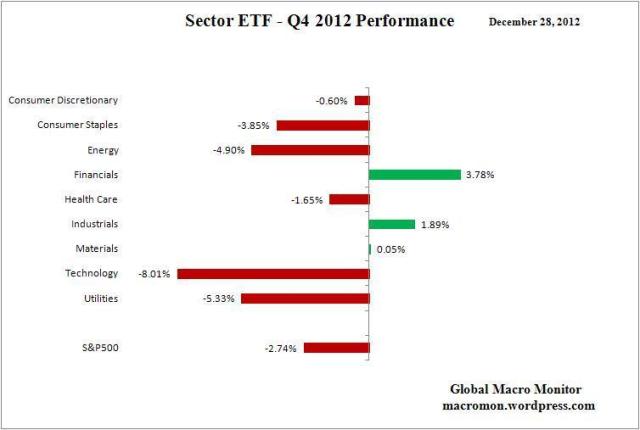
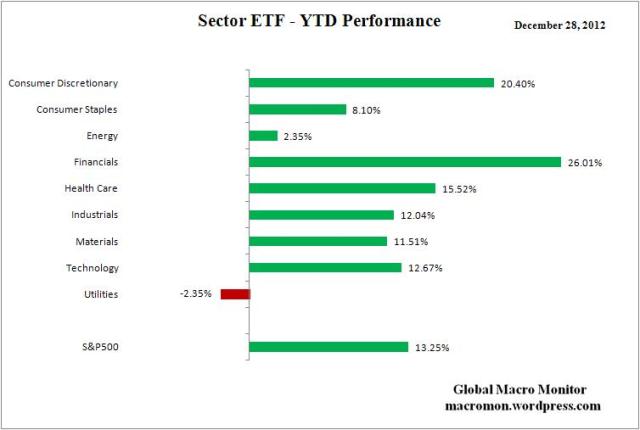
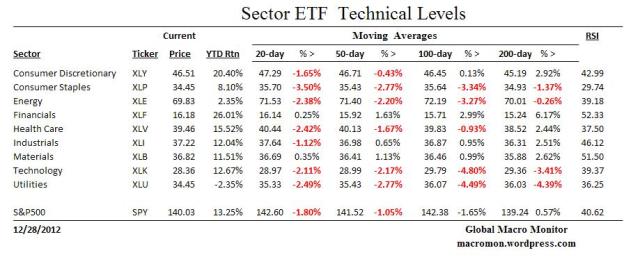
U.S. Equity Sector ETF Performance – December 28

ETF_WeekETF_QuarterETF_YTDEFT_Technicals(click here if charts are not observable)

Posted in Sector ETF Peformance | Tagged , , , , | 2 Comments

Weekly Eurozone Watch

Key Data Points
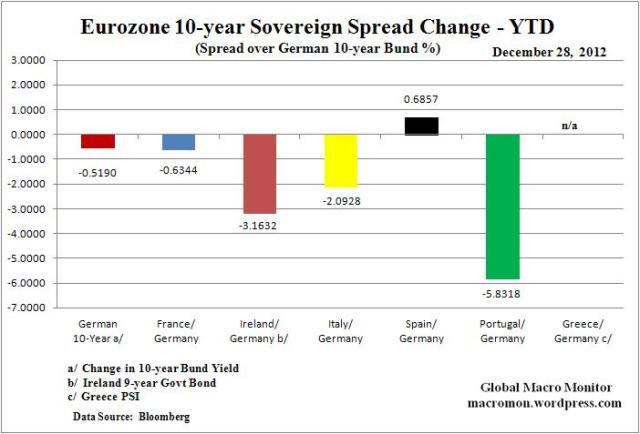
German 10-year Bund 7 bps lower;
France 8 bps wider to the Bund;
Ireland 8 bps wider;
Italy 9 bps wider;
Spain 7 bps wider;
Portugal 7 bp wider;
Greece 7 bps wider;
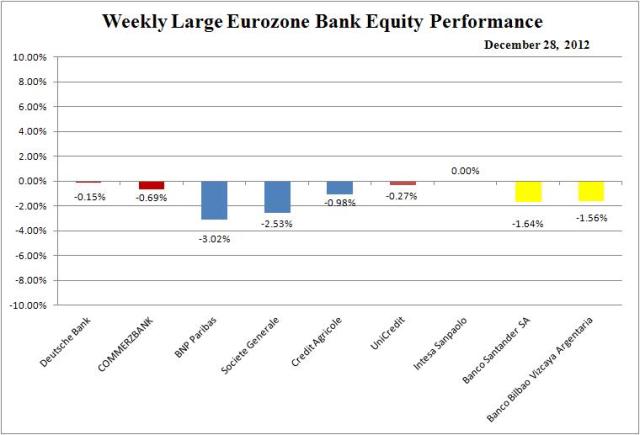
Large Eurozone banks weekly change,  0.22 to -3.0 percent;
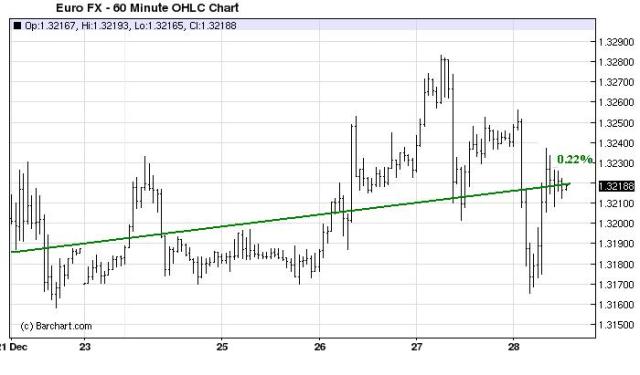
Euro$ up 0.22 percent.

Comments
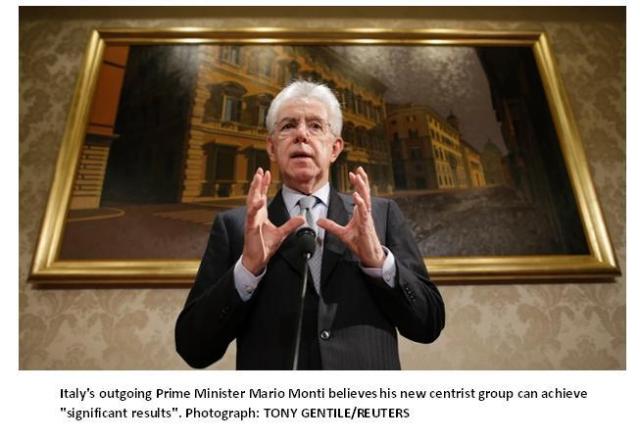
– Mario Monti announced he will run as a full-blown prime ministerial candidate in the Italian elections;
– German finance minister Wolfgang Schaeuble speaking on the Eurozone crisis, “I think the worst is behind us”;
– Spain’s house prices are expected to fall another 30 percent over the next decade;
– Ireland’s house prices rose at the fastest pace in six years;

Source:  Guardian and Telegraph

Dec28_Monti

We are not thinking of asking the European Central Bank to intervene and buy bonds in the secondary market…But we can’t rule it out in the future.

– Mariano Rajoy,  Prime Minister of Spain

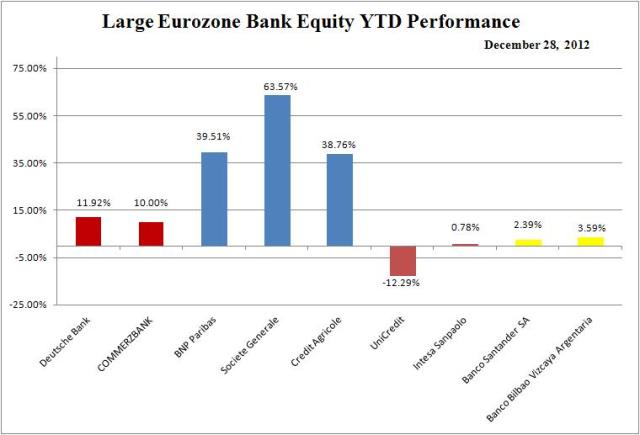
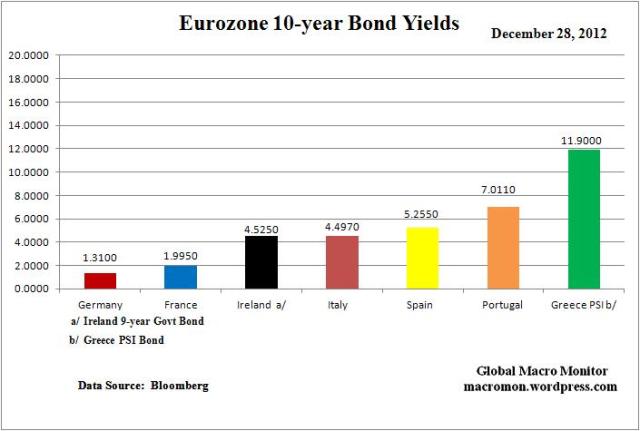
WEW_Spread_YTDWEW_Bank_WeekWEW_Spread_YTDWEW_Bank_YTDWEZ_YieldsWEW_EuroFX(click here if charts are not observable)

Posted in Weekly Eurozone Watch | Tagged , , , , , | 2 Comments

Stratfor: Options and Conditions for a Spanish Bailout

Stratfor Europe analyst Adriano Bosoni discusses the financial assistance options that the European Union could provide Spain and the conditions they would include.
For more analysis, visit: http://www.Stratfor.com

(click here if video is not observable)

Posted in Euro, Eurozone Sovereign Spreads, Spain | Tagged , , | Leave a comment