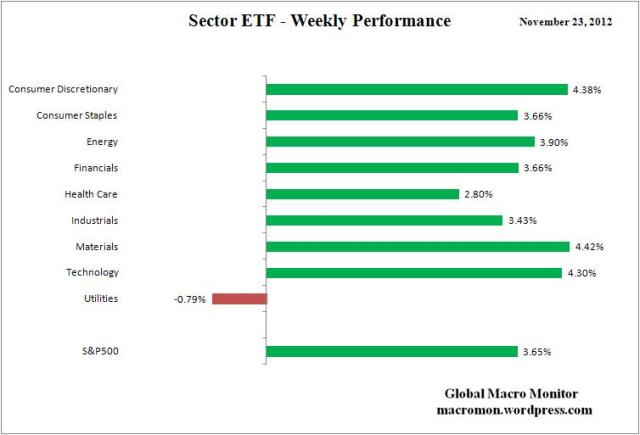
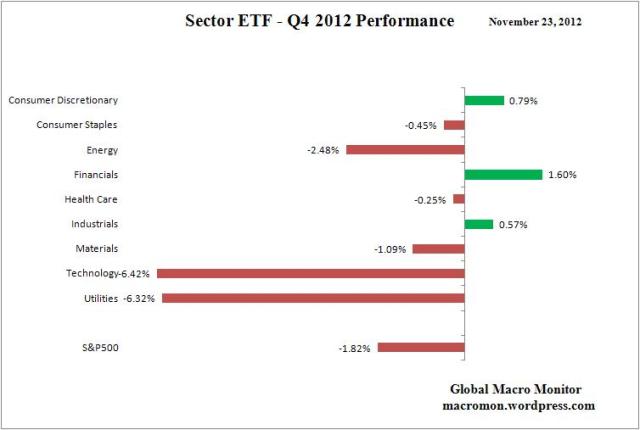
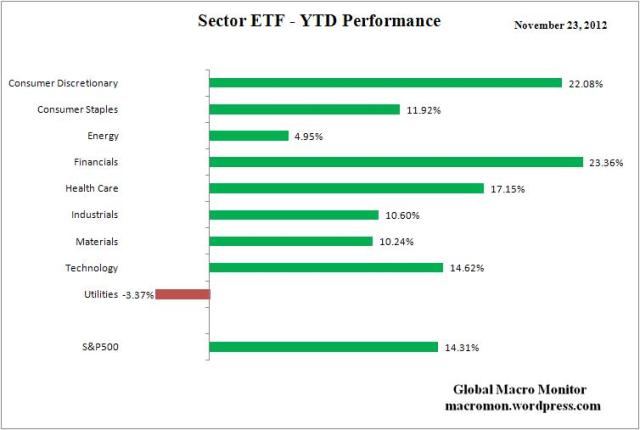
U.S. Equity Sector ETF Performance

(click here if charts are not observable)

Posted in Sector ETF Peformance | Tagged , , , , , | 3 Comments

Cliff Diving – Day 10

What fiscal cliff?

The markets seem to have ignored it – the S&P500 has ramped over 65 points from last Friday’s low, albeit on very low volume.  Furthermore, Dan Clifton over at Strategas notes,

Since the election, the number of major news articles using the phrase “fiscal cliff” average about 650 stories in a 24-hour period. Over the past 24 hours just 209 articles were released.

Equities moved higher in today’s shortened trading session with S&P500 (SPY), up 1.36 percent and now down just a little over 1 percent since the election.  Those trying to fade the rally got a nice Black Friday facial as stocks gathered strength into the close.

The big move since last Friday’s lows has been on low volume.  Markets were not only helped by the absence of politicians but also yesterday’s China’s PMI first expansion print in 13-months,  good feelings over a Greek debt deal, and the rise in German business confidence.  Stocks also seem to be getting lathered up over the potential for a very healthy holiday shopping season.  You go, American consumer!

Gold moved through its 50-day moving average, which has been a key resistance level.  The VIX continues to move down on:  1) lack of fear;  2)  income-seeking volatility sellers; or 3) all of the above.   You decide.

We also like the way Apple traded today.  Since its mega volume 7 plus percent move on Monday, the stock has opened at its high of the day and sold off to close near its lows.  The bears tried again today, but the stock gained some steam into the close taking out Tuesday’s intraday high.  We’re still looking for the 200-day at $597 and it feels the market is starting to sense a monster holiday season for Apple.  They certainly have a bigger product mix this year.

Next week will be a key test to see if Santa is fact or fiction this season as the cliff rhetoric should get hotter.  We’ll be watching the market’s ability to hold its recent gains from this low volume stock ramp.  We remain constructive, but with a very quick trigger finger, however.  The S&P500 remains above its 200-day moving average and we will let the market tell us when it is time to sell,  not our emotions and fear of the unknown.

Have a great weekend.

What would a real fiscal cliff panic look like?

Stocks down hard;  Russell 2000 down harder;  consumer discretionary down hard;  gold up;  dollar down;  VIX spiking;  and defense stocks in the tank.

Bonds?   Tough to extract a clear signal with the Fed’s financial repression, but,  initially,  the cowboys would most likely be in buying on recession fears and increased worries about going over the cliff.

(click here if table and chart are not observable)

Posted in Fiscal Cliff Monitor | Tagged , | Leave a comment

Weekly Eurozone Watch

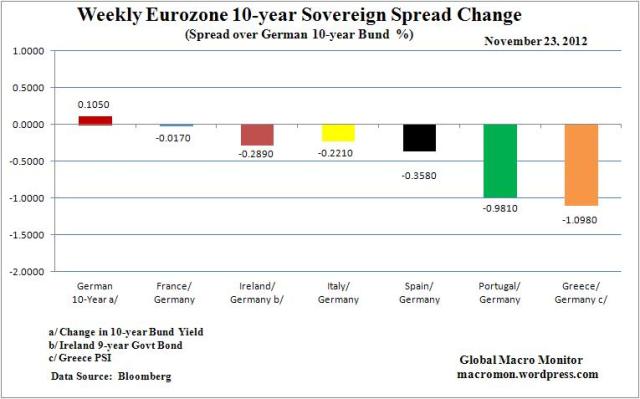
Key Data Points
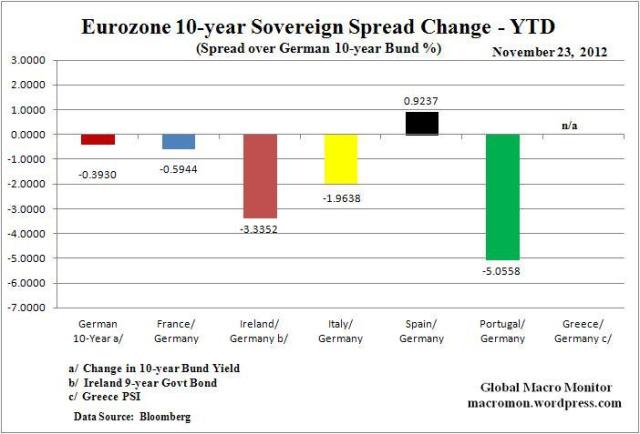
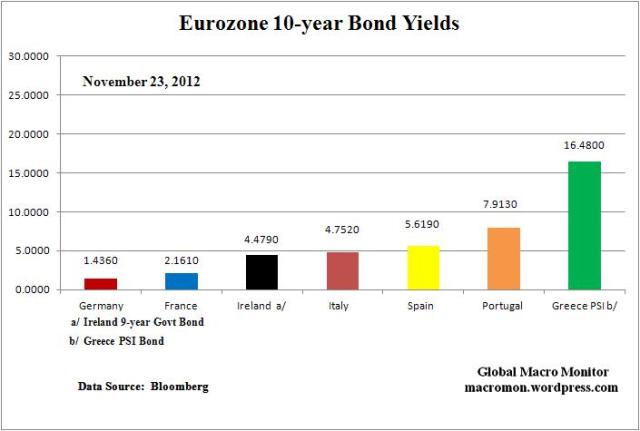
German 10-year Bund 10 bps higher;
France 10-year 2 bps tighter to the Bund;
Ireland 29 bps tighter;
Italy  22 bps tighter;
Spain 36 bps tighter;
Portugal  98 bps tighter;
Greece 110 bps tighter;
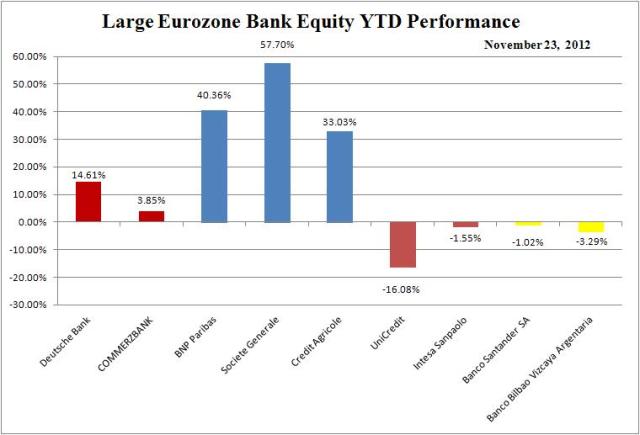
Large Eurozone banks up 1-11 percent;
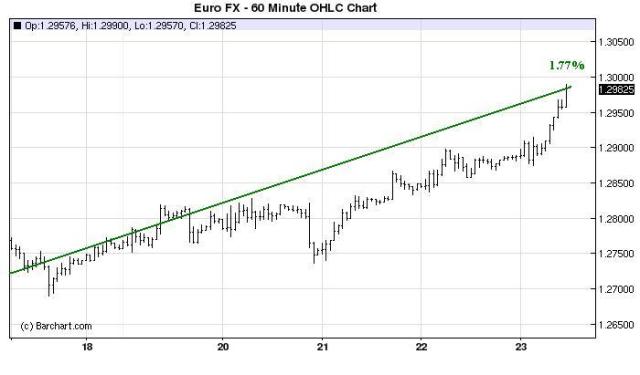
Euro$ up to up 1.77 percent.

Quote of the Week

The chances that Catalonia will ever move to full-fledged independence are next to zero, and the region’s politicians are mostly using the threat to renegotiate the terms of its financial relations with Madrid.
Pierre Briançon, Reuters Breakingviews

Picture Poster of the Week

Comments
Ireland 10/9-year bond yield and spread to the German bund  lowest weekly close of year;
French banks, BNP and SocGen, highest weekly close of the year;
Greece says official lenders closer to debt deal – Reuters;
German business confidence unexpectedly rises for first gain in eight months – Bloomberg;
Catalonia to vote Sunday on split with Spain – The Australian;
EU budget talks collapses – FT.

Charts

(click here if charts are not observable)

Posted in Weekly Eurozone Watch | Tagged , , , , | 3 Comments

Economist Special Report: France

The video is a follow-up of  our post last week.

France is slowly heading towards a crisis, says John Peet. Can the country be reformed before it is too late?

(click here if video is not observable)

Posted in France | Tagged , | 1 Comment

Happy Franksgiving!

We always thought Thanksgiving was celebrated on the last Thursday in November.  Didn’t President Lincoln proclaim it?

By the President of the United States of America.

A Proclamation.

The year that is drawing towards its close, has been filled with the blessings of fruitful fields and healthful skies. To these bounties, which are so constantly enjoyed that we are prone to forget the source from which they come, others have been added, which are of so extraordinary a nature, that they cannot fail to penetrate and soften even the heart which is habitually insensible to the ever watchful providence of Almighty God. In the midst of a civil war of unequaled magnitude and severity, which has sometimes seemed to foreign States to invite and to provoke their aggression, peace has been preserved with all nations, order has been maintained, the laws have been respected and obeyed, and harmony has prevailed everywhere except in the theatre of military conflict; while that theatre has been greatly contracted by the advancing armies and navies of the Union. Needful diversions of wealth and of strength from the fields of peaceful industry to the national defence, have not arrested the plough, the shuttle or the ship; the axe has enlarged the borders of our settlements, and the mines, as well of iron and coal as of the precious metals, have yielded even more abundantly than heretofore. Population has steadily increased, notwithstanding the waste that has been made in the camp, the siege and the battle-field; and the country, rejoicing in the consiousness of augmented strength and vigor, is permitted to expect continuance of years with large increase of freedom. No human counsel hath devised nor hath any mortal hand worked out these great things. They are the gracious gifts of the Most High God, who, while dealing with us in anger for our sins, hath nevertheless remembered mercy. It has seemed to me fit and proper that they should be solemnly, reverently and gratefully acknowledged as with one heart and one voice by the whole American People. I do therefore invite my fellow citizens in every part of the United States, and also those who are at sea and those who are sojourning in foreign lands, to set apart and observe the last Thursday of November next, as a day of Thanksgiving and Praise to our beneficent Father who dwelleth in the Heavens. And I recommend to them that while offering up the ascriptions justly due to Him for such singular deliverances and blessings, they do also, with humble penitence for our national perverseness and disobedience, commend to His tender care all those who have become widows, orphans, mourners or sufferers in the lamentable civil strife in which we are unavoidably engaged, and fervently implore the interposition of the Almighty Hand to heal the wounds of the nation and to restore it as soon as may be consistent with the Divine purposes to the full enjoyment of peace, harmony, tranquillity and Union.

In testimony whereof, I have hereunto set my hand and caused the Seal of the United States to be affixed.

Done at the City of Washington, this Third day of October, in the year of our Lord one thousand eight hundred and sixty-three, and of the Independence of the Unites States the Eighty-eighth.

By the President: Abraham Lincoln

William H. Seward,
Secretary of State

This year there are five Thursdays in November, the last on the 29th.   WTF?

In August 1939, Lew Hahn, general manager of the Retail Dry Goods Association, warned Secretary of Commerce Harry Hopkins that the late calendar date of Thanksgiving that year (November 30) could possibly have an adverse effect on retail sales. At the time, it was considered bad form for retailers to display Christmas decorations or have “Christmas” sales before the celebration of Thanksgiving.

In keeping with a custom begun by Lincoln in 1863, U.S. Presidents had declared a general day of thanksgiving to be observed on the last Thursday in November. By late October of that year, President Roosevelt decided to deviate from this custom and declare November 23, the second-to-last Thursday, as Thanksgiving that year.[1]

The plan encountered immediate opposition. Alf Landon, Roosevelt’s Republican challenger in the preceding election, called the declaration “another illustration of the confusion which [Roosevelt’s] impulsiveness has caused so frequently during his administration. If the change has any merit at all, more time should have been taken working it out… instead of springing it upon an unprepared country with the omnipotence of a Hitler.” While not all critics were political opponents of the president, most parts of New England (then a Republican stronghold relative to the rest of the nation) were among the most vocal areas. James Frasier, the chairman of the selectmen of Plymouth, Massachusetts (the commonly alleged location of the first Thanksgiving holiday) “heartily disapproved”.

The short-notice change in dates affected the holiday plans of millions of Americans. For example, many college football teams routinely ended their seasons with rivalry games on Thanksgiving, and had scheduled them that year for the last day in November; some athletic conferences had rules permitting games only through the Saturday following Thanksgiving. If the date were changed, many of these teams would play their games for empty stadiums or not at all. The change also caused problems for college registrars, schedulers, and calendar makers…

After announcing August 31, 1939, that he would similarly designate November 21, 1940 (the next year), Roosevelt issued on October 31 his official proclamation calling for “a day of general thanksgiving” on November 23.[1] Such declarations amount to using the “moral authority” of the Presidency, and each state government can independently determine when to cancel work for state (and in some cases, municipal) employees. Twenty-three states’ governments and the District of Columbia recognized the non-traditional date, twenty-two states preserved the traditional date on November 30, and the remaining three – Colorado, Mississippi, and Texas – gave holidays in both weeks.

In 1940, 32 states’ governments and the District of Columbia observed the earlier date on November 21, while 16 states chose what some were calling the “Republican” Thanksgiving on the 28th.

On May 20, 1941, a Commerce Department survey found no significant expansion of retail sales due to the change.[citation needed] November of that year once again saw 32 states and the District of Columbia observing the holiday on the 20th, while the remaining 16 states did so on the 27th…

That new approach was embodied in a joint resolution of Congress, signed into law by President Roosevelt on November 26, 1941, and designating the fourth Thursday in November of each year as Thanksgiving Day.[3] (Prior to that in the 20th century, the phrase “Thanksgiving Day” had been used in the prose of the presidential proclamation only in Calvin Coolidge‘s first, among his six.) In November 1942, Roosevelt’s proclamation made mention of the joint resolution, and of the date it established as Thanksgiving Day, and called for observation “in prayer” of both it and the New Year’s Day to follow.

The majority of states immediately changed their laws to coincide with the nationally observed date. The first year following the joint resolution with five Thursdays in November was 1944, and Thanksgiving was observed on the 23rd of the month with exception of the States of Arkansas, Florida, Georgia, Idaho, Nebraska, Tennessee, Texas, and Virginia. (The nation was in the midst of World War II, and most nationwide celebrations as well as many regional ones were on hiatus at the time. It would not be until after the end of the war, 1945, that the new date of Thanksgiving would take full root.) Also in 1945, 1950, 1951, and 1956, November had five Thursdays. Texas was the last state to change its law, observing the last-Thursday Thanksgiving for the final time in 1956.
Wikipedia

Let’s be thankful the country is, at least, now united on the date of Thanksgiving!

Posted in Politics | Tagged , , | Leave a comment

Nonlinear Thinking: Pass the Turkey Genome

Interesting stuff(ing) from MIT’s Technology Review.   Seems we’re getting closing to a Barry Bonds of the Turkey World.  You think they will be admitted to the Hall of Game?

When many Americans see that roasted turkey on Thanksgiving, it may appear as if the bird has already reached perfection. But genomic scientists are searching for ways to improve the domesticated turkey so that it grows faster, produces better quality meat, and can resist farmyard afflictions.

The turkey genome project, which began in 2008 and is headed by the University of Minnesota and the Virginia Polytechnic Institute, is putting together its final assembly of A’s, T’s, G’s, and C’s, and is already developing tools that will allow livestock breeders to select better birds. “With the genome sequence, we are able to measure traits that we can’t easily measure in a farm setting,” says Julie Long, a research physiologist with the U.S. Department of Agriculture Research Service in Beltsville, Maryland, and a member of the turkey genome project. For example, disease resistance and the efficiency with which a bird turns its food into muscle are difficult traits to measure. “It’s pretty easy to tell which birds are growing bigger and faster,” says Long, “but there are other traits that we can’t really measure.” And that’s where the turkey genome comes in. 

Click here for full article.

(click here if picture is not observable)

Posted in Nonlinear Thinking | Tagged , , | Leave a comment

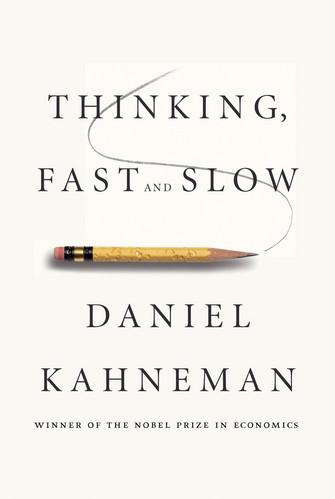
Thanksgiving Lecture: Daniel Kahneman

This is a great lecture presented by Google Talks.  Grab a turkey sandwich and  have a listen.  It may help in understanding your biases and destructive tendencies in trading.

Daniel Kahneman, recipient of the Nobel Prize in Economic Sciences for his seminal work in psychology that challenged the rational model of judgment and decision making, is one of our most important thinkers. His ideas have had a profound and widely regarded impact on many fields—including economics, medicine, and politics—but until now, he has never brought together his many years of research and thinking in one book.

In the highly anticipated Thinking, Fast and Slow, Kahneman takes us on a groundbreaking tour of the mind and explains the two systems that drive the way we think. System 1 is fast, intuitive, and emotional; System 2 is slower, more deliberative, and more logical. Kahneman exposes the extraordinary capabilities—and also the faults and biases—of fast thinking, and reveals the pervasive influence of intuitive impressions on our thoughts and behavior. The impact of loss aversion and overconfidence on corporate strategies, the difficulties of predicting what will make us happy in the future, the challenges of properly framing risks at work and at home, the profound effect of cognitive biases on everything from playing the stock market to planning the next vacation—each of these can be understood only by knowing how the two systems work together to shape our judgments and decisions.

Engaging the reader in a lively conversation about how we think, Kahneman reveals where we can and cannot trust our intuitions and how we can tap into the benefits of slow thinking. He offers practical and enlightening insights into how choices are made in both our business and our personal lives—and how we can use different techniques to guard against the mental glitches that often get us into trouble. Thinking, Fast and Slow will transform the way you think about thinking.

(click here if video and book are not observable) 

Posted in Video, Whales | Tagged , , | 1 Comment

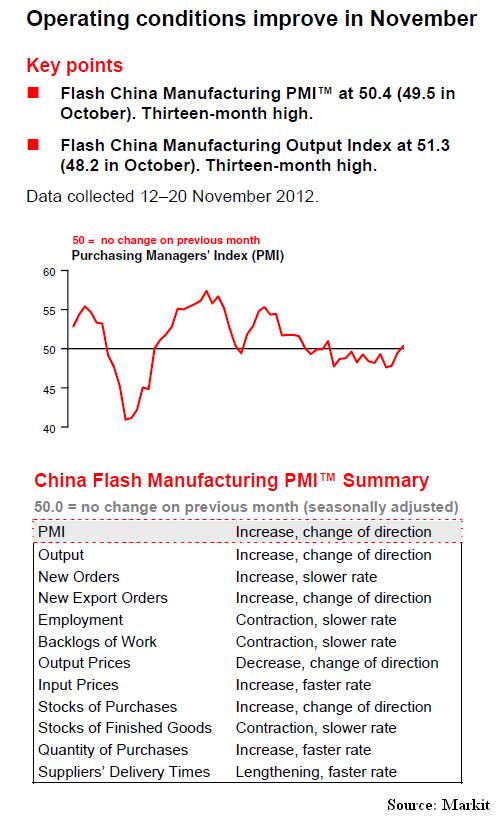
China Flash Manufacturing PMI at 50.4, Thirteen-month High

Markit reported this morning China’s manufacturing sector is expanding, just barely, for the first time in 13 months.  Ironically, all markets believe it x/ the Shanghai Composite, which made a new 3-year low yesterday.

Commenting on the Flash China Manufacturing PMI survey, Hongbin Qu, Chief Economist, China & Co-Head of Asian Economic Research at HSBC said:
“As November’s flash reading of HSBC manufacturing PMI bounced back to the expansionary territory for the first time in 13 months, this confirms that the economic recovery continues to gain momentum towards the year end. However, it is still the early stage of recovery and global economic growth remains fragile. This calls for a continuation of policy easing to strengthen the recovery.”

(click here if chart and tables are not observable)

Posted in China, PMIs | 2 Comments

Cliff Diving – Day 8

Watching paint dry!  Boring market.

Equities moved a little higher on the back of the Israeli/Hamas cease-fire announcement.  It’s easy to get ground up trying to trade such a directionless market.   No volume, but, still, the market is holding its gains and bears can’t break it.

The S&P500 (SPY) was up about .19 percent and the Russell outperformed again.   Financials were flat with consumer discretionary and defense outperforming.  Gold, dollar, and the bond flat and the VIX  up about 2 percent.

No real news on the fiscal front but hearing both parties have realized a quick deal is probably not likely.  Be prepared for the rhetoric to heat up, ergo increased volatility.

Have a great Thanksgiving!  We have much to be thankful for and have been blessed with the tools to help those less fortunate.  So let’s use them this holiday season!


What would a real fiscal cliff panic look like?

Stocks down hard;  Russell 2000 down harder;  consumer discretionary down hard;  gold up;  dollar down;  VIX spiking;  and defense stocks in the tank.

Bonds?   Tough to extract a clear signal with the Fed’s financial repression, but,  initially,  the cowboys would most likely be in buying on recession fears and increased worries about going over the cliff.

(click here if table and video are not observable) 

Posted in Fiscal Cliff Monitor | Tagged , , | Leave a comment

Stratfor: Update on the Israeli-Hamas Conflict

Here’s the LA Times on the cease-fire,

CAIROHamas and Israel agreed to a cease-fire that took effect Wednesday evening following a week of intense diplomacy to stop rocket fire and airstrikes that have pounded the Gaza Strip and Israel and raised fears of plunging the region into a wider war.

The truce began at 9 p.m. local time and appeared at least initially to be taking hold.

The deal was announced in Cairo by Egyptian Foreign Minister Mohamed Amr and Secretary of State Hillary Rodham Clinton, who flew to the region Tuesday night as hopes for a truce remained elusive amid heavy artillery exchanges.

And some good background from Stratfor on the bigger picture:

(click here if video is not observable)

Posted in Geopolitical | Tagged , , , | Leave a comment