
It can be very hard for ordinary investors to separate fact from hype.
— U.S. Department of Labor, warning against investing in cryptocurrency in 401(k) plans
1) Greed, 2) Grift, 3) Hype, 4) Enabling Delusions, 5) Overshoot, and 6) Shattered Dreams
h/t: The Polish Rifle
Don’t think even the great, but duped Tom Brady can bring this one back. The Fed, alone, began the extraction of over $1 trillion of liquidity from the economy over the next 18 months on Wednesday. We suspect not crypto positive.
Bitcoin is down 50 percent since the onslaught of the Super Bowl commercials trying to sucker in a new pool of greater fools. One helluva store of value currency.
The Super Bowl commercials were clearly a signal that marked the top of dot.com mania, which crashed a few months later in March.
Fast forward to the 2022 Super Bowl. – GMM, February 12, 2022
The Crypto Craze will go down as The GOAT of delusional financial bubbles. We are open to be proved wrong but doubt it.
Matt Damon, where are you? It was sad to see the super principled Steph Curry caught up hyping the sector. Where are the Lakers going to play next year?
One Last Thing
The creation of what was once a $3 trillion speculative asset class, created out of thin air, fueled by free money and delusuions with absolutely zero productive capacity, helped feed the inflation we now all experience. The crypto crash does take some marginal pressure off monetary policy, however.
Remember the 2000 Super Bowl at the peak of the dot.com mania, where newly minted dot.com companies spent most of their entire IPO proceeds to buy Super Bowl commercials to generate “eyeballs” to their websites to drive their stock price higher?
Super Bowl XXXIV (played in January 2000) featured 14 advertisements from 14 different dot-com companies, each of which paid an average of $2.2 million per spot.[1][note 1] In addition, five companies that were founded before the dot-com bubble also ran tech-related ads, and 2 before game ads, for a total of 21 different dot-com ads. These ads amounted to nearly 20 percent of the 61 spots available,[1] and $44 million in advertising. In addition to ads which ran during the game, several companies also purchased pre-game ads, most of which are lesser known. All of the publicly held companies which advertised saw their stocks slump after the game as the dot-com bubble began to rapidly deflate.
The sheer amount of dot-com-related ads was so unusual that Super Bowl XXXIV has been widely been referred to as the “Dot-Com Super Bowl”, and it is often used as a high-water mark for the dot-com bubble. Of these companies, 4 are still active, 5 were bought by other companies, and the remaining 5 are defunct or of unknown status.[when?] – Wikipedia
The Super Bowl commercials were clearly a signal that marked the top of dot.com mania, which crashed a few months later in March.
Fast forward to the 2022 Super Bowl.

Cryptocurrency’s biggest boosters would do well to remember tech’s most infamous sock puppet. The year was 2000; it was what would later be known as the “Dot-Com Super Bowl,” an NFL face-off during which tech companies bought up some 20 percent of the advertising real estate during the Big Game. A few years later, many of the companies that bought those ads were defunct or swallowed up by other firms—including Pets.com, which had run a commercial featuring a singing puppet made from a sock.
This warning comes not because crypto companies are looking to turn stockings into mascots (at least, not that we know of), but because they are currently pumping millions of dollars into buying up ad space during Super Bowl LVI. Crypto.com, which has been flooding the market with its Matt Damon-starring commercials lately, has a big spot running; cryptocurrency exchange FTX plans to give away bitcoin during its Super Bowl spot. Coinbase is also reportedly running an ad. The companies are playing coy about who will appear in them. Regardless, the message seems to be that crypto is hot and everyone should get on board. But as multiplearticleshave pointed out in the past week, the Crypto Bowl has echoes of those ill-fated tech-company ads of the past. – Wired
The dot.coms needed more eyeballs and the ads were generated to lure in more “greater fools” to keep buying their worthless stocks to remain viable. Ditto for crypto.
We don’t know how this all ends but know thy history, folks. Just sayin’.
The winner of the 2000 Super Bowl? The Rams, gulp!
A Happy Father’s Day! Ditto for all the single moms, who never had a father around to help with the kids. They are superheroes in my book and will be the first in the Kingdom.
I have a single mom friend, whose kids shower her with Father’s Day gifts, as she stepped up and did the job of both mother and father. She even walked her oldest down the aisle at her wedding.
Spiritual Experience
Everytime my daughters call me “daddy” – which is more scarce these days now as they grow older, and the term has morphed into just “dad” – it, still, after all these years, is a spiritual experience.

Ever since I was a young boy, I’ve followed basketball
From ‘Frisco down to Oakland The ‘Dubs can whip them all
But I ain’t seen nothing like them In any roundball hall
That Steph, Wiggo, Dray and Klay kid
Sure play a mean b-ball!
They’re the Pinball Wizards
There has got to be a twist
The Pinball Wizards
Love the sound of that three point swish!
Dub Dynasty > Duck Dynasty. Stunning season, stunning team. Great locker room chemistry. Great bunch of guys and awesome head coach. Humble, super-duper srars. Tremendous human beings. One for the GOATs.
Dream Ticket 👇

It won’t matter until it does, and then it will matter, and really matter. – GMM
We are reposting a piece on inflation from last summer. The markets’ myopia never ceases to amaze.
If you don’t want to read the repost, here’s the above quote in context.
Upshot
When today’s inflation print is put into the context of current financial conditions, as measured by the Chicago’s Fed Index, the U.S. economy has never seen this high short-term core inflation with such easy financial conditions, at least in the 50-year data set, we are looking at.
It won’t matter until it does, and then it will matter, and really matter.
Until then everyone’s making money, the Wall Street crowd tells us everything is awesome, and to party like its the 1920’s, maybe right off a fiscal cliff.
Wall Street and the government, who have a vested interest in low inflation prints, will promote the transitory narrative. Seniors and those on fixed-incomes will suffer until their Social Security cost of living increases (COLA) partially make them whole.
We also doubt seniors are buying used cars. Someone should go ask them if their monthly purchasing power is increasing or decreasing.
Markets
The markets?
They’ll get religion but the timing is tough. – GMM, July ‘21
The S&P500 closed at 4369.21 on the day of that post, 14 percent higher than today’s close. FOMO kills.
Our beloved Carol K. starts a new risky treatment this week to try and conquer her serious illness. Everyone at GMM and all of our readers are with you, girlfriend!
Can’t wait to hear the Chairman justify zero rate policy and deficit monetization with inflation roaring at > 5 percent. It would be entertaining, if it weren’t so damaging.
….CPI prints > 4 percent in May and you heard it here first. – GMM, April 29th
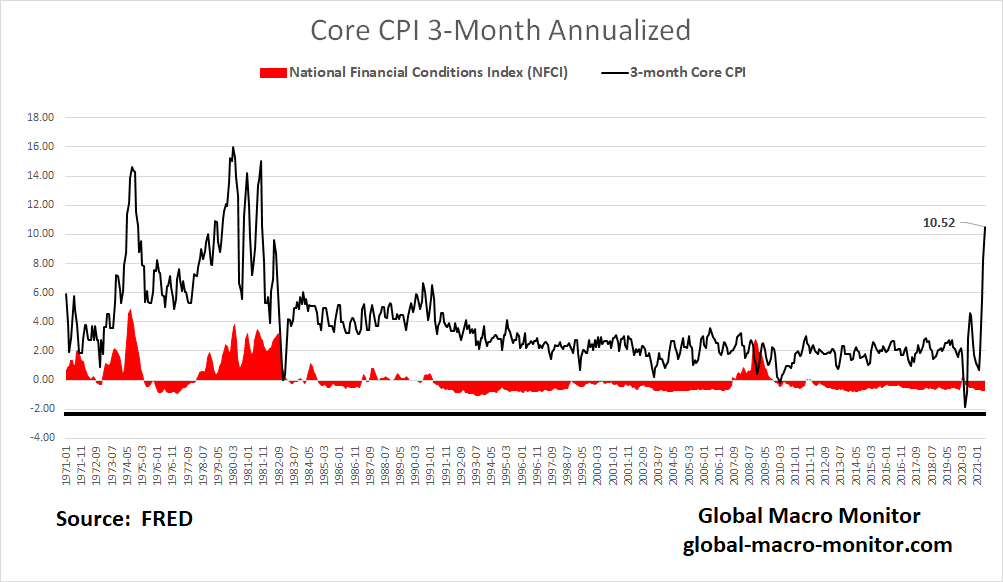
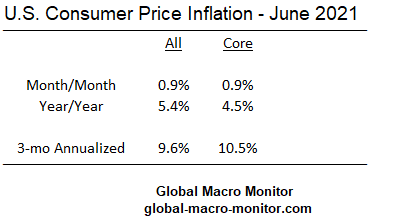
The past three months of core CPI inflation prints have been big, big, big — 0.9, 0.7, and 0.9 percent, respectively. There is zero “base effect” on these data, folks.
If annualized, as the GDP prints are, the economy hasn’t seen this type of three-month core inflation since 1981.
Sure, some have to do with the reopening, and some not.
Our priors are policymakers have distorted too many markets, over-stimulated the economy, and pumped too much high-powered money into the global economy. China rejoined the party last night.
My Lobster Roll Restaurant
We keep waiting for a new Lobster Roll (rare in Wine Country) restaurant to open up on my street, for example, and it’s taking forever. I spoke to the owner yesterday, who said he couldn’t find workers.
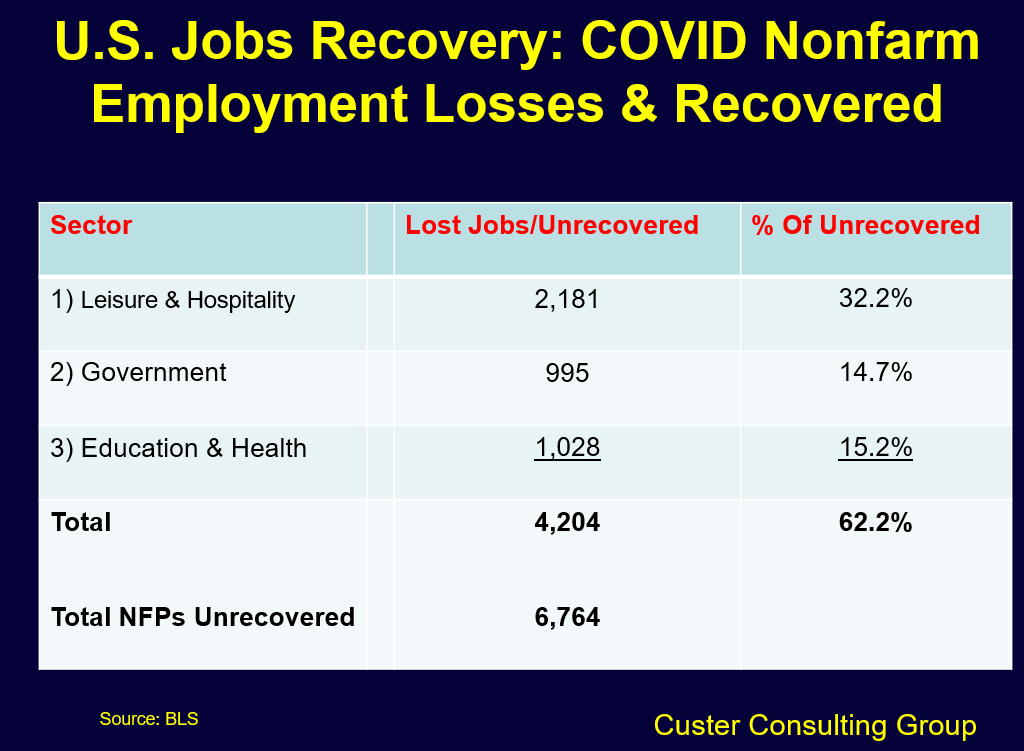
What the Fed believes is a demand problem to recover all the jobs lost to COVID is, in reality, a supply problem. Put the academic models down and go talk with the small businesses.
We maintain there is a shortage of labor at the given wage rates for much of the leisure and hospitality sector, which makes up about 12 percent of nonfarm payrolls yet 32 percent of unrecovered lost jobs lost to COVID. The jobs aren’t returning for lack of demand, mitigated by easy monetary policy. Still, most of the lost jobs are in three sectors, where we suspect will have to pay higher wages and benefits to attract workers.
We support higher wages if small businesses, which employ almost half the labor force, have the margins to pay and the ability to improve the productivity of their workers. Otherwise, they will pass the wage increases on with higher prices or shut the doors.
I believe we are witnessing that now.
Upshot
When today’s inflation print is put into the context of current financial conditions, as measured by the Chicago’s Fed Index, the U.S. economy has never seen this high short-term core inflation with such easy financial conditions, at least in the 50-year data set, we are looking at.
It won’t matter until it does, and then it will matter, and really matter.
Until then everyone’s making money, the Wall Street crowd tells us everything is awesome, and to party like its the 1920’s, maybe right off a fiscal cliff.
Wall Street and the government, who have a vested interested in low inflation prints, will promote the transitory narrative. Seniors and those on fixed-incomes will suffer until their Social Security cost of living increases (COLA) partially make them whole.
We also doubt seniors are buying used cars. Someone should go ask them if their monthly purchasing power is increasing or decreasing.
Markets
The markets?
They’ll get religion but the timing is tough.
When they do, however, and start selling assets, the “D” word, as in deflation will be back in the headlines because that is the kind of asset-dependent economy the U.S. has morphed into, folks.

The Inflation Dialectic
Recall our corner solution analysis on the inflation/deflation debate.
Marx (Karl, not Groucho) was wrong on many things but had a brilliant analysis of how society progresses through conflict, explained by the Hegelian dialectic. We apply it to monetary policy analysis
In the asset-dependent economy, where asset prices need to rise to stimulate demand as wages and income are insufficient to clear the goods market, valuations eventually overshoot, consumers begin to feel like millionaires, and start to spend that wealth.
Goods and service price pressures increase, monetary authorities react — not sure if they can now given valuation and debt levels — by pumping the breaks and asset markets flop. Wash, rinse, repeat.
We concede the wealth effect is much less prominent with the uber wealthy as they have much lower average and propensities to consume than the middle class but the asset markets have a much larger outsized effect than most economists tend to believe. This is being tested in real time with the COVID as real “helicopter money” is getting to the hands that need it and spend it. But inflation…
The thesis – inflation — sows the seeds for the anti-thesis forces – deflation – when monetary policy is perceived to be about to change. From that conflict arises the synthesis, a new and more convoluted monetary policy to prop up assets.
The dialectic is probably coming to an end, however, as inflation ticks up and the Fed is now perceived as the problem and not the cavalry.
Pray for transitory.
Stay tuned, folks.
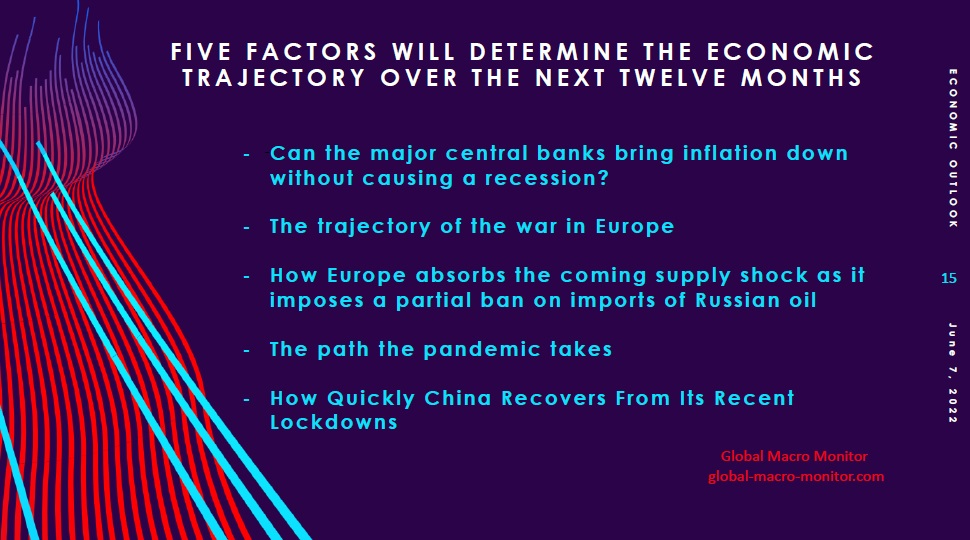
I am out of the country and thought you might be interested in my economic presentation prepared for a European manufacturing trade group (note the European bias and context).
Click here to view the full presentation. A loud shoutout to Focus Economics for helping with the quarterly forecasts.
When presenting to noneconomists the best practice is to Keep It Simple Stupid (KISS).
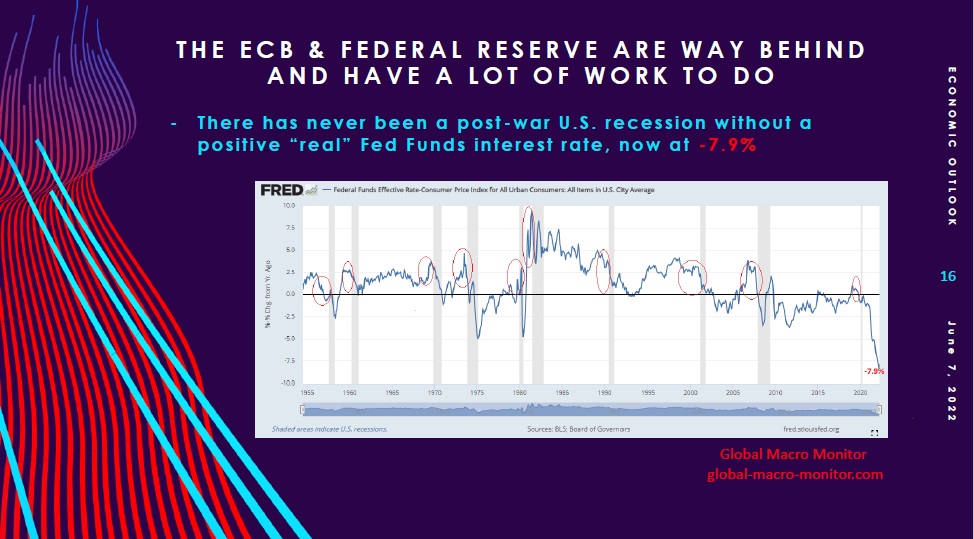
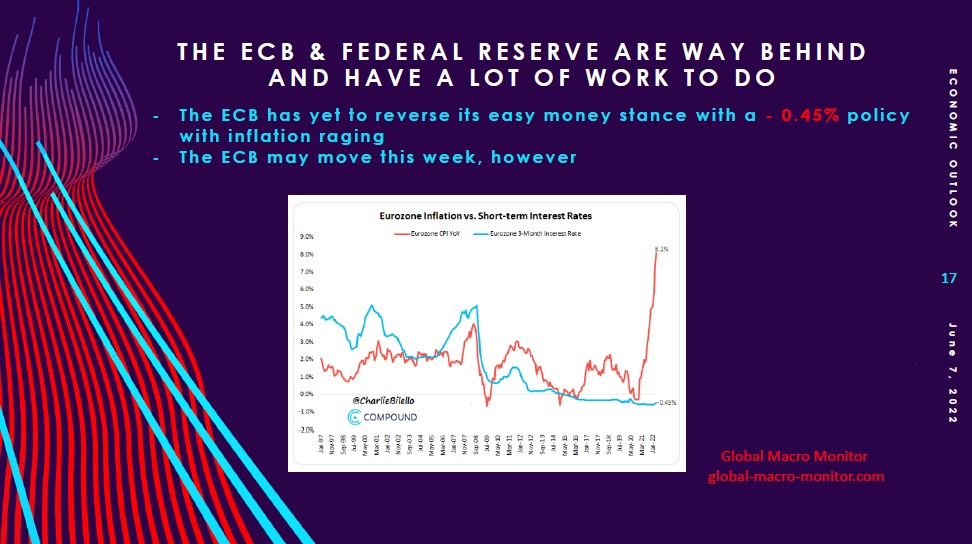
Europe is facing some big challenges ahead. The ECB still maintains a negative 45 bps policy rate as inflation rages around 8 percent. We suspect this is going to result in some major political blowback in Germany and other northern European countries toward the Eurozone.
More flybys to come during the summer. Stay tuned.



GMM will be laying low this summer, working on a special project, recharging our batteries, and working through the rest of the Five Stages of Grief after losing Carol K. We had planned a big reset and revamp of our website with her as a full partner. She was so close and fought so hard and bravely but her body was just too broken.
We are at the beginning of the end of Stage 1 – Denial. Now for the hard part.
We will be checking in on occasions, opining on the global economy and markets from time to time so keep us on your radar.
Good luck to you all in this Summer of Discontent.
See you in the fall.

The classic line from the cult movie, The Graduate, needs some updating.
Thank goodness for the creative destruction of capitalism. The following video epitomizes the answer to many of the world’s problems — private sector innovation and entrepreneurship. In many cases, a private-public sector partnership works even better. Put ideology aside and let’s get it done, folks.

 Global Macro Monitor