It’s Always About The Treasury Flows

Treasury_1

We have looked at the central bank holdings — both the Fed and foreign central banks — of marketable Treasury bills, notes, and bonds over the past twenty years and were quite surprised by our findings.   Our analysis may also help explain the mess now taking place in the money markets, which is taking massive Fed intervention to stabilize.

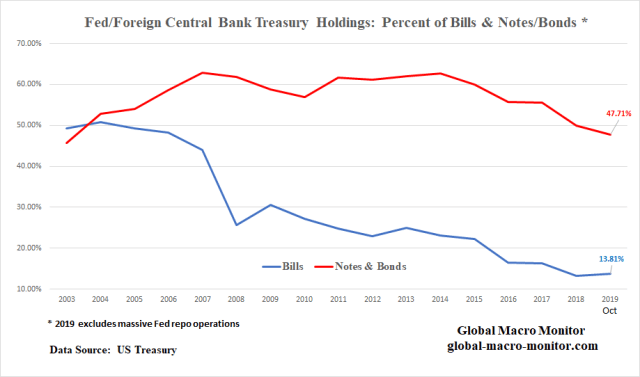
The above table of data illustrates the Fed and foreign central banks held almost 50 percent of the Treasury bills outstanding up until the Great Financial Crisis (GFC) and now hold only 13.81 percent of marketable bills as of October 2019.  Note the October data does not include Fed repo but only bills held outright in its SOMA portfolio and financed by an increase in reserves.

It also was surprising that even with the massive expansion of the Fed’s balance sheet during the QEs, their ownership of the outstanding marketable notes and bonds only increased from around 15 percent to 22 percent.   It does make sense considering there was a corresponding massive increase in Treasury debt issuance during the past ten years.

Treasury_2

Our September 2018 Post

We wrote a huge post on the structural changes taking place in the Treasury market in September 2018,  The Gathering Storm In The Treasury Market 2.0, warning there would be huge natural upward pressure on interest rates given these changes and/or the markets would come under pressure from the increased market supply risking “crowding out” of other markets.

Soon thereafter, the 10-year Treasury yield broke out crashing the stock market with the S&P falling 20 percent in just a little over two months.  We underestimated Judy how fragile markets to a only modest rise in long-term interest rates.

In no way was the Fed “too tight” in a monetary and credit sense in Q4 2018, in our opinion, with real interest rates still close to, or below zero and credit still abundantly available.  The market just couldn’t handle the massive new supply of debt caused by the combination of a growing budget deficit and the Treasury having to refinance the maturities coming due in the Fed’s SOMA portfolio.

Consequently, the stock market crashed bringing in haven flows and short-sellers using Treasuries as proxy stock shorts driving rates lower and the Fed eventually capitulating to the market and political pressure.

Marketable Debt Growing Faster Than Total Debt

One of the structural changes we flagged was that the Treasury could no longer rely on the Social Security surplus to fund itself as it now has moved into an annual structural deficit.  The added Treasury supply would put significant pressure on the market.  The debt table above illustrates how the Treasury is becoming increasingly reliant on market financing for its growing obligations.

The data show that even though the total public debt has grown 228.79 percent since 2003,  debt issuance to the markets has increased at a 50 percent faster clip, increasing by 361.91 percent, compared to the punk 83.72 percent growth in nominal GDP.

It is absolutely clear, at least to us, especially given that interest rates cannot increase to their equilibrium and market-clearing levels without crashing the markets (think Q4 2018) due to the sheer size of the total stock of debt outstanding, market disequilibria will always show up in unexpected places, such as in the cash markets.

The Fed, not only the lender of the last resort, is now called upon to plug the financing gap so the markets won’t blow up.  In a non-reserve currency, this would be very inflationary and it takes us back to our days as an economist following the high inflation economies of Latin America.

Banking System 

Much has been written about the lack of reserves in the banking system, which is not allowing for a natural arbitrage between the Fed funds and repo market.  Our priors were there was a distribution problem with excess reserves, where a few banks owned most of the reserves, which now appears to have been confirmed.    Nevertheless, we are not experts in this area and will leave it to others to explain.

Structural Fix In Money Markets? 

To get back to a level where central banks hold 44 percent of the T-Bill stock as they did before the GFC, the Fed would have to take down another $750 billion of  T-Bills into their SOMA portfolio funding it with an increase in bank reserves.   The fact foreign central banks have reduced their proportional holdings of bills,  from 19.8 percent in 2007 to 11.7 percent in October,  puts added pressure on the Fed.   Note also,  the Fed moved from holding T-Bills in their SOMA account after the GFC, when monetary policy began to focus on asset purchases and managing the yield curve.   We have a call into the NY Fed to get a better handle on this.

We don’t know, nor does anyone else, but maybe this could be what it takes for a structural fix to the money markets but then we suspect there will be large unintended consequences, such as complicating an already dangerous asset bubble and potentially wreaking havoc in the FX markets.  It does seem the Fed’s balance sheet must track the size of the stock of marketable Treasury debt outstanding.

Also interesting in the debt level table is the growth of T-Bill issuance since 2016, which has doubled the growth of marketable debt.

Foreign Inflows Into The Treasury Market

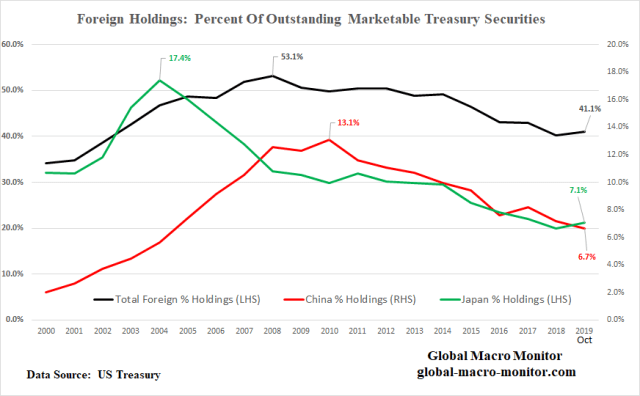
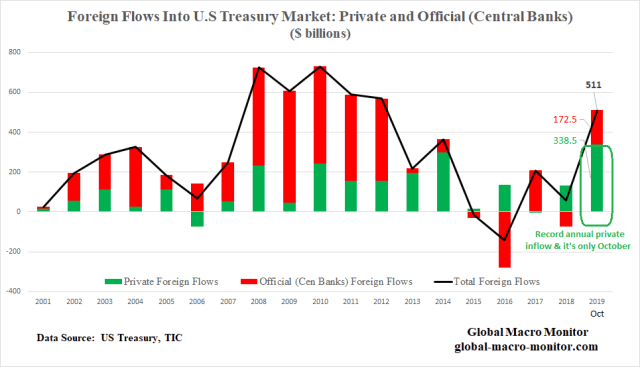
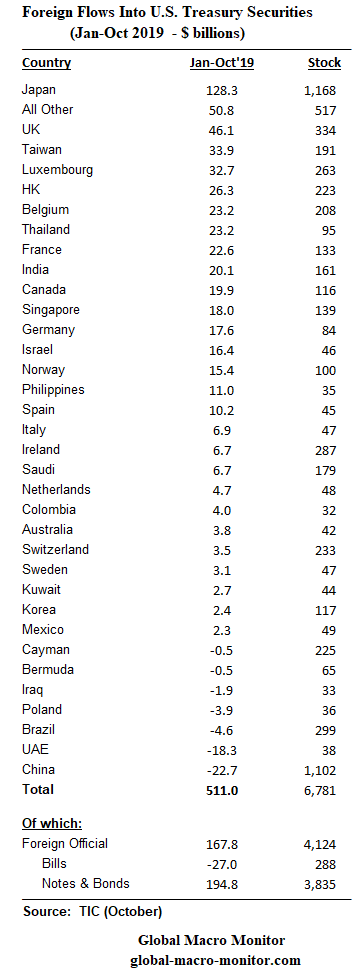
Private foreign flows into the Treasury market have already reached an all-time annual high at the end of October due to positive U.S. interest rate differentials and negative-yielding debt abroad.

Nonetheless, the foreign holdings as a proportion of the total stock of marketable Treasuries have fallen from a high of 53.1 percent to 41.1 percent in October.   The proportion of China and Japan’s holdings of the marketable Treasuries has also declined significantly as their inflows (China flows are negative this year) have been outpaced by the growth of the stock of market debt.
Treasury_Chart_1

Treasury_Chart_5

Central Bank Holdings Of T-Bills And Coupon Curve

The Fed and foreign central banks still hold almost 50 percent of the U.S. coupon curve though central bank proportional holdings of T-Bills have fallen off precipitously, which is probably why the Fed is engaged in a fast and furious exercise to provide liquidity to the money markets.   We’re not certain about this but it is our best-calculated guess.

It would be interesting to add the Fed’s current repo holdings to the last data point on the blue line.  It does include recent purchases of T-Bills by in its SOMA portfolio, however.
Treasury_Chart_2

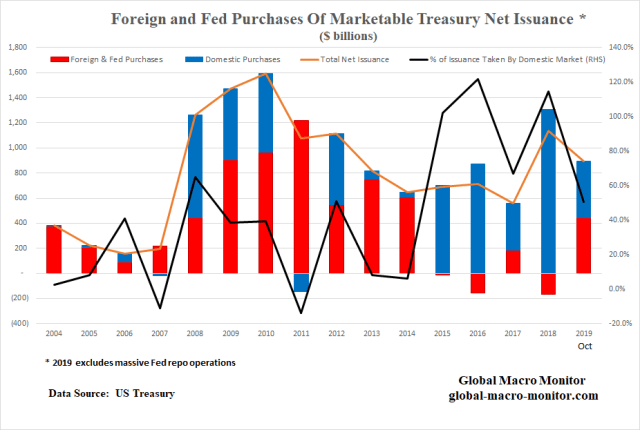
In the following chart, it is easy to see why the S&P crashed in Q4 2018 due to a crowding-out effect, not so much from interest rates but that liquidity was sucked up and hoovered into the Treasury market.   In 2018, marketable Treasury securities increased by $1.1 trillion and all of it, and then some were financed by non-central bank domestic sources.
Treasury_Chart_3

At the end of October 2019, the Treasury has issued $896 in marketable debt with around 50 percent financed domestically, which does not include the recent multiple rounds of repo operations by the Fed.

S&P Returns And Treasury Issuance

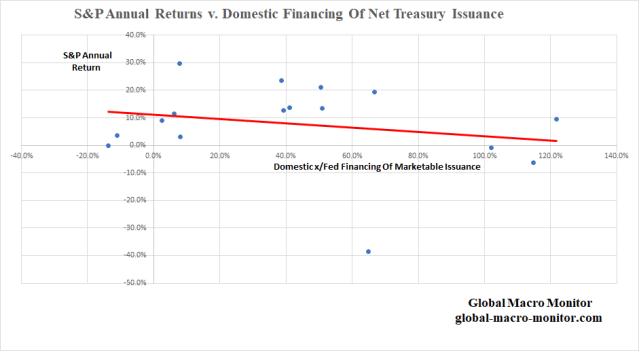
Finally, though the data is very noisy and there are many factors at play, we show in the graph below there is a negative correlation (ρ = -.22)  with returns on the S&P and domestic financing of the marketable Treasury issuance.  The data makes sense and we suspect digging deeper and adding more observations the actual correlation is much higher.
Treasury_Chart_4

Keep It On Your Radar

Though policymakers and market wonks have completely ignored the debt, deficit, and this type of analysis, we think you should keep it on your radar, folks.  We have zero doubt it will come back to bite the markets in the ass someday.

In fact, Alan Greenspan was out today warning,

Greenspan

See here for full Greenspan article.

Data Appendix
Treasury_Chart_7


Budget Deficit

Posted in Bonds, China, Interest Rates, Japan, Uncategorized | Tagged , , , , | 1 Comment

The Long-Term Damage Of The Trade War

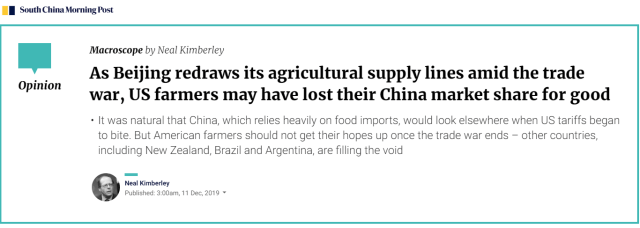
“US farmers might not regain their market share even if a trade settlement is concluded with China.”  – South China Morning Post

If you have been following the Global Macro Monitor over the past year, you know our thoughts on the trade war.  We have raised the concept of trade hysteresis in several posts, warning U.S. farmers may never get their foreign markets back in China, or even Japan and the other countries in the eleven-member Trans-Pacific Partnership (TPP) after the United States pulled out of the deal.

Hysteresis in the field of economics refers to an event in the economy that persists into the future, even after the factors that led to that event have been removed. – Investopedia

Go no further than a piece in yesterday’s South China Morning Post, which lays out in layman’s terms the concept of “hysteresis” and how it was set in motion by U.S. trade policy.  The term “policy” may be too generous a word as the negotiations have been nothing more than a long series of staccato ejaculation of Tweets in, large part,  to manipulate the stock market higher.

The Kommisars Are In Town

Yes, it’s possible a Soviet-style trade deal may be cut for mostly show, where quotas for say, Chinese imports of U.S. soybeans may be announced by the trade Kommissars but come on, man, U.S. export markets, and even more important the global trading system, have been irreparably damaged.

Moreover, we seriously doubt that the kind of deal, which has been imminent for the past 20 months, will remove the uncertainty repressing capital spending as companies will still have no clue about the future of their supply chains.

The only thing that seems to matter is that a deal gooses the stock market, which probably makes it a sell upon announcement.

Prepare for the “Greatest and Largest Deal Ever In the History Of The Universe.”  Not!

SCMP

Money Quotes

  • US farmers might not regain their market share even if a trade settlement is concluded with China.
  • US officials should have known that China would redraw its agricultural supply lines. After all, Chinese people still have to eat, trade war or no trade war, and China relies on food imports, a fact that has come into sharper focus as a consequence of the outbreak of African swine fever.
  • In the meantime, the impact of African swine fever has put pressure on pork prices in China. As a result, consumers have been seeking alternative, less-expensive sources of protein. Step forward, New Zealand, which has had a free-trade agreement with China since 2008.
  • US farmers might not regain their market share even if a trade settlement is concluded with China.
  • China has taken more than half of New Zealand’s beef exports in recent months.
  • US cattle farmers could have expected to benefit from this rise in Chinese demand for beef, but for the trade war.
  • Step forward Argentina and Brazil. Both countries have supplied China with soybeans that, before the US-China trade war, Beijing would probably have sourced from American farmers. Brazil alone exported a monthly record of 5.16 million tonnes of soybeans in November, with some 94 percent destined for China.
  • Trump has noticed:


  • Trump’s intervention seems more like an attempt to punish Argentina and Brazil for having the temerity to supply soybeans to China.
  • But a resolution of the US-China trade war doesn’t necessarily mean things would go back to the way they were. The trade war and the impact of African swine fever have forced China to rethink. Washington may find Beijing has redrawn China’s agricultural supply lines in indelible ink.   – SCMP
Posted in Trade War, Uncategorized | Tagged , , | 1 Comment

The Last Central Banker With Balls

[Balls as in courage and bravery.  Exemplified in the quote,  “Margaret Thatcher was Ronald Reagan with balls.”  Don’t get all PC on us now!]

As a graduate student, I interviewed at the Federal Reserve Board in the Eccles Building on Constitutional Avenue (entrance on 20th Street) as a junior economist.  This was way before the exceptionally tight security now ubiquitous in government buildings.  I had worked at other Federal government agencies but never experienced the tight security upon entering those buildings as I did at the Fed that day.

Upon arriving upstairs for my interviews, I asked one of the economists why such tight security?   He responded something to the effect,

When Paul Volcker raised interest rates to near 20 percent to wring inflation from the economy, farmers and other disgruntled citizens were caught wandering the halls of the Federal Reserve Board with guns looking for the Fed Chairman. 

Yikes!

Paul Volcker had some brass ones and realized, and it was central to his policy that short-term pain would result in long-term gains, such as a thirty-year plus bond bull market, for example.

Mr. Volcker’s legacy contrasts sharply with the central bankers of today, who panic when, say,  the S&P500 drops 2 percent, which will almost surely result in the opposite of the Volcker monetary policy precept, i.e., trading short-term gains for long-term pain. It is already evident with the accelerating and now acute wealth inequality.

He was an intellectual monetary giant, honest and spoke what was on his mind until his last days.

PV

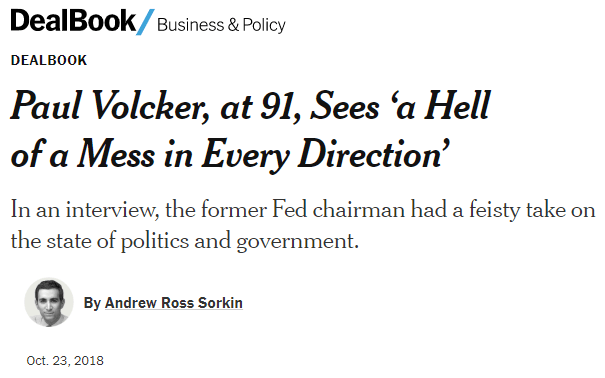
“I’m not good,” said Mr. Volcker, 91, the former Federal Reserve chairman, who came to prominence after he used shockingly high interest rates to help end the runaway inflation of the late 1970s and early ’80s. Long one of finance’s wise men, he has been sick for several months.

But he would rather not talk about himself. Instead, Mr. Volcker wants to talk about the country, the economy and the government. And if he had seemed lethargic when I arrived, he turned lively in his laments: “We’re in a hell of a mess in every direction,” he said.  – NY Times

RIP,  Paul Volcker.  Still wishing President Obama appointed you Treasury Secretary as we would be in a much better place.

But at root, Paul was a public servant — someone who truly believed in the honor of serving others. His scorn was reserved solely for those who corrupted institutions or put their own selfish interests above the good of society.  – Christine Harper, Bloomberg


Posted in Banking, Monetary Policy, Uncategorized | Tagged | Leave a comment

December 7, 1941: “We are all in the same boat now”

Those words spoken to President Franklin Roosevelt by British Prime Minister Winston Churchill on this day 78 years ago.

On December 7, 1941, at around 1:30 p.m., President Franklin Roosevelt is conferring with advisor Harry Hopkins in his study when Navy Secretary Frank Knox bursts in and announces that Japan had attacked Pearl Harbor. The attack killed more than 2,400 naval and military personnel.

For weeks, a war with Japan had appeared likely since negotiations had deteriorated over the subject of Japan’s military forays into China and elsewhere in the Pacific during World War II. FDR and his advisors knew that an attack on the U.S. fleet at the Philippines was possible, but few suspected the naval base at Pearl Harbor would be a target.- History.com

These words were spoken by the Japanese just a few days and hours earlier…

Niitakayama nobore 1208 –  a coded message: “Climb Mount Niitaka, December 8.”  The signal meant that war with the United States would commence on December 8, Japan time, or December 7 in Hawaii.

The message, which translated means “Climb Mount Niitaka 1208,” was uttered over the radio from the Japanese battleship Nagato and relayed to a transmission station in Tokyo. From there, it was relayed to another station before reaching the fleet and setting off the infamous surprise attack.  – Stars & Stripes

Tora, Tora, Tora” –  indicating that the surprise attack on Pearl Harbor had commenced and everything seemed to be going well for the Imperial Japanese Navy (IJN).   Well, at least until the slumbering Giant got woke.

Beware Of The Sleeping Giant

We are so grateful and thankful to everyone, from all of the Rosie the Riveters to General Douglas MacArthur, and, most of all, to the heroes that made theultimate sacrifice to help America win the war in the Pacific.


Posted in Uncategorized | Leave a comment

Why The Stock Bull Is A Big Meh For Most Americans

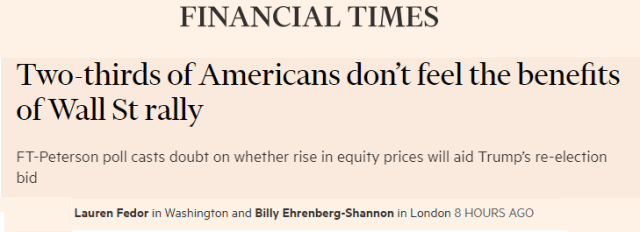
Interesting piece by the FT today that only one-third of Americans feel the benefits of the great bull market.   Only 40 percent of the population realizes stocks are up for the year.  These are tough numbers for a so-called “populist” president who claims the stock market bull as one of his greatest achievements and much of his base is not participating in the gains.

FT

Nearly two-thirds of Americans say this year’s record-setting Wall Street rally has had little or no impact on their personal finances, calling into question whether one of the strongest bull markets in a decade will boost Donald Trump’s re-election chances.

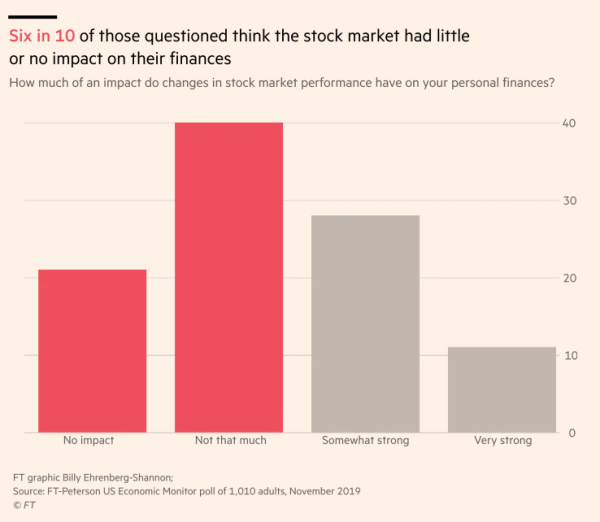
A poll of likely voters for the Financial Times and the Peter G Peterson Foundation found 61 percent of Americans said stock market movements had little or no effect on their financial wellbeing. Thirty-nine percent said stock market performance had a “very strong” or “somewhat strong” impact. 

The survey suggested most Americans are not aware of market movements, with just 40 percent of respondents correctly saying the stock market had increased in value in 2019. Forty-two percent of likely voters said the market was at “about the same” levels as at the start of the year, while 18 percent believed it had decreased.- FT

Say It Ain’t So, Joe.  How Can This Be So?

The above survey closely tracks the Fed’s data on the distribution of stock ownership by wealth percentiles.  Rarely does the economic data so closely confirm such a survey study.


Table_Dec10

The data show that 86.4 percent of all public equity wealth is held by the top 10 percent of households as of the end of June 2019.  Even with a very generous assumption that 60 percent of pension entitlements are allocated to equities, the numbers just don’t change much.

Most of the difference, when including our generous assumption on pension assets,  is allocated to the upper-middle class, who fall in the 50-90 percentile of households, where one-third of the assets of this cohort group are in the form of pension entitlements.

Note the bottom 50 percent of households have almost no exposure to the stock market, except, of course, indirectly as their income and job prospects are determined by an asset-driven economy, highly dependent on ever-increasing bubbles.

The New “Stock Market Conundrum”

Alan Greenspan used to talk a lot about the bond market conundrum and lays much of the blame of the credit and housing bubble on it.  Simply put, the Greenspan Fed raised the funds’ rate by over 400 basis points from 2004-2006 and the 10-year yield barely budged allowing the housing bubble to rage on.

In his February 17, 2005, testimony before the Committee on Banking, Housing, and Urban Affairs of the U.S. Senate, Federal Reserve Chairman Alan Greenspan observed that long-term rates had trended lower despite the 150-basis-point rise in the Federal Open Market Committee’s (FOMC’s) target for the federal funds rate. Rejecting a variety of possible explanations for the behavior as implausible he called it a “conundrum.”  – St. Louis Fed

We have posted several times that the conundrum was largely explained by foreign central banks recycling their FX reserves back into the U.S. Treasury market and the relative dearth of Treasury securities at the time.

We fear a new conundrum is developing in stocks or has already evolved. Though the equity market directly impacts only a small segment of the population, it has an outsized impact on the economy.   This, we believe, may result from the fact the market considers it the last financial sector with any semblance of an economic signal, though faint and often wrong as it may be, to divine future economic prospects, which determines confidence and thus consumer and capital spending decisions.

In 1966, four years before securing the Nobel Prize for economics, Paul Samuelson quipped that declines in U.S. stock prices had correctly predicted nine of the last five American recessions.  –  Bloomberg

Our suspicions are bolstered by the fact that QE has almost completely neutered and drowned out the economic signals of the bond market.  Great Ph.D. dissertation material.

Can somebody, for example,  please explain the fundamental economic signal of the Italian 10-year trading at 75 bps in September?

As the Brits head to the polls next week to choose a new government, we can paraphrase their great war-time PM with some confidence with respect to Mr. Market’s outsized impact,

Never in the field of political economy are so many so dependent on so much owned by so few


FT_2

Posted in Economics, Equities, Quotes, Uncategorized | Tagged | 31 Comments

QOTD: Churchill On Truth

QOTD:  Quote of the Day

The truth is incontrovertible. Panic may resent it, ignorance may deride it, malice may distort it, but there it is.  — Winston Churchill, HOUSE OF COMMONS, May 17th 1916

Posted in Quote of the Day, Uncategorized | Tagged , , | Leave a comment

Rollback Is The Word And Dealbreaker

Posted in Uncategorized | Leave a comment

The Trend Toward Hyperautomation & Autonomous Things

Where is the policy response to help the U.S. labor market prepare for this?  
Michael Kung, a senior partner at the US research and advisory firm Gartner Inc, told reporters at a press conference in Taiwan yesterday hyper-automation tops the list of 10 most important strategic technology trends for next year.

The ultimate goal of hyperautomation is to automate anything that can be automated, everything from single tasks to entire business operations… Among all trends that we have uncovered over the course of the year, I believe that hyperautomation and autonomous things are the two most crucial trends that businesses shouldn’t ignore… By taking hold of related technologies, businesses can transform and satisfy key performance indicators..It might be hard for us to visualize, but autonomous devices will be much more perceptive and will be able to interact with other devices.  — Michael Kung, Tapei Times

Gartner research director of personal technologies Lu Chun-kuan also predicted that AI-related research conducted by businesses would increase 10-fold over the next five years, from an average of three to 30.    See full articel at Tapei Times here

Posted in Uncategorized | Leave a comment

COTD: Apple’s Global Supply Chain

COTD:  Chart of the Day

Maybe a bit dated but you get the picture, no surprise, China dominates the supply chain, which also includes fabs.  Apple is very exposed to a protracted or forever trade war and deterioration of the global trading system, which of course makes the stock market much more vulnerable to the spectre of anti-globalization haunting the world.


Apple Global Supply Chain.png

Posted in Apple, Uncategorized | Tagged , | Leave a comment

Getting Narrow Up Here


Apple and Microsoft

We are not big fans of high and narrow.


Posted in Uncategorized | 1 Comment