IMF Analysis Of Nafta 2.0 = Potemkin Trade Deal

Summary

  • IMF published a working paper on NAFTA 2.0 or the USMCA on March 26th
  • The trade deal still needs Congressional approval
  • The impact on GDP is negligible and the effects are relatively small at the aggregate level
  • Trade is reduced between all three nations with trade deficits in the U.S. and Canda rising slightly
  • Real wages in Mexico decline slightly and are unaffected in Canada and the U.S.
  • Automobile and parts production will be incentivized to move out of North America
  • Consumers will pay higher vehicle prices and resulting in lower demand and production
  • In other words, the deal sucks and is, at best, Potemkin, which confirmed our suspicions when it was announced.

The IMF goes deep on NAFTA 2.0 and confirms our initial conclusions from October,

More Potemkin than real beef.  Or, as they say in Texas, “big hat, no cattle.”

At first glance, with our limited information,  our conclusions are the negotiations were a huge waste of time, energy, and diplomatic capital resulting in a nugacity of a new agreement.   High drama all for naught, in our opinion.  – GMM, October 1st

IMF Conclusions

IMF economists’ main conclusions on Nafta 2.0 (see the full report here ):

  1. At the aggregate level, effects of the agreement  are relatively small
  2. Reduces trade among the three North American partners by more than US$4 billion (0.4 percent) while offering members a combined welfare gain of US$538 million
  3. Trade deficits will widen slightly in Canada ($36 million) and the United States ($275 million) but that of Mexico improves modestly
  4. Effects on real GDP are negligible
  5. Most of the benefits will come from trade facilitation measures that modernize and integrate customs procedures to further reduce trade costs and border inefficiencies
  6. Changes in trade flows will lead to structural changes in the composition of production across North America
  7. Some sectors benefit from greater trade integration while others
    experience declines in output and job losses
  8. Changes in industrial structure that result from changing trade flows prompt employees to move from contracting to expanding sectors
  9. Real wages for skilled and unskilled workers in Mexico decline slightly but wages are unaffected in Canada and the United States
  10. Tighter rules of origin in the auto sector and the labor value content
    requirement will not achieve their desired outcomes and lead to a decline in the production of vehicles and parts in all three North-American countries, with shifts toward greater sourcing of both vehicles and parts from outside of the region
  11. Consumers will face higher vehicle prices and respond with lower demanded quantities

 True to form for the Art of the Deal – little gain, lots of pain. 

Potemkin Mexico Canada Deal


Posted in Mexico, Trade War, Uncategorized | Tagged , , | 10 Comments

Permabulls For The Long Run


Dow_Box_Digits

I once heard the late, great financial economist Stephen Ross speak at a Lehman Brothers bond conference in Sun Valley, Idaho.  He opened his presentation with a short story about how investors would approach him and ask, “if you’re so smart, why aren’t you rich?”  He said his reply was always, “if you’re so rich, why aren’t you smart?”  Touché!

The same Socratic logic can be applied to the permabulls, who have the probabilities on their side.  The U.S. stock market likes to go up.

For example, the Dow has generated positive returns 68 percent of the years since 1921, and the S&P more than 72 percent since 1951.

Moreover, it doesn’t take much intellectual gravitas to proclaim stocks are in a “structural bull market.”  Take a look at any long-term chart, as in more than 40 years, to see that any major stock index has moved from the lower left to upper right.  The stock market, by definition, is a perpetual structural bull market.  Innovation, growth and inflation have always, over the long-term, trumped fear.

Who in their right mind would consistently bet against a permabull, even if their message never changes — “the stock market will be up this year”  — if the empirical probability of being correct is 70 percent?  Someone headed for bankruptcy, that’s who.  Permabulls for the long run!

Shorter Time Horizons

The above argument weakens significantly in shorter timeframes as the binary stock market return converges toward a random bet on a daily basis.  The S&P Significant Digits table below illustrates this as the index generates positive daily returns only 53 percent of the time, 57 percent weekly, 60 percent monthly, and 66 percent on a quarterly basis.

S&P_Significant Digits

The data also show return distributions have more of a negative skew and a higher kurtosis — fatter or longer tails — the shorter the timeframe.   That is one major factor why short-term traders have a higher risk of ruin than long-term investors.

Stock Market Annual Streaks

We were extremely surprised by the results of how rare back-to-back down years is for the Dow Jones Industrials.  Only nine times since 1921 has the Dow had a down year after suffering a negative return the prior year, which includes two 3-year and one 4-year steak.  The worst of which was the four consecutive down years at the start of the Depression, where the Hoover administration experienced a negative stock market every year in office, as the Dow lost 62 percent of its value.

Keeping with our theme,  “the stock market likes socialism,”  or government (or the Fed) bailout/interventions,  the best year in the Dow was in 1933 after FDR took power and began to implement the New Deal.   The 36 percent 3-year moving average of annual returns in 1936 topped the second highest level of 1997 by almost 1000 bps. 

Of the 98 years of Dow returns we looked at since 1921, 46 percent generated back-to-back positive years, with the longest streak, the 9-year bull market ending in 1999,  which lifted the Dow by 337 percent.  The streak ended with the bursting of the dot.com bubble in Q1 2000, which then resulted in three straight down years in the Dow.   

Thus, given the above data, after a down year,  such as 2018, there is about a 90 percent empirical probability the Dow will generate a positive return in the next year, which implies annual returns are not independent.  Rather stunning odds, nonetheless. 


Dow_Box_Streaks


Upshot

So what about 2019?

We don’t know and can’t say with any certainty, but given how rare it is for back-to-back down years,  the higher probability bet would be for a Dow higher than where it started the year.   Moreover,  the average return for bounce years suggests the Dow, up 9.4 percent year-to-date, has around another 10 percent to go.

The big caveat, and the uncharted water Mr. Market currently finds itself is the shape of the yield curve.  Though there are four trading days left in the month, 2019 could be the first bounce year since 1960 (our start year) where the yield curve is negative at the end of March.

Dow_Box_Dow Bounce


Conclusion

Considering and internalizing the above data, it would then behoove investors to always keep timeframes long-term.  The financial media, including this blog, is rendered mostly noise and, at best, entertainment for long-term investors.

There are a few times in history, however, – we count five – where reducing risk was a smart move, which allowed investors to reinvest at a significantly lower price without the risk of being left behind in a V bottom bounce.  Those times to sell were in the 1910s, 1929, late 1960s, Q1 2000, and 2007, most of which were known at the time to be a period of historically high and extended valuations but justified by the mass and social media as a “this time is different” situation.

We are not even sure most even see what we perceive or they choose to ignore it, surrendering to the all the rage passive investing, which, ironically, is based on the very analysis in this post.

Given the current combination of historically high market valuations, the high levels of sovereign and corporate debt, record-high budget deficits, the shifting geopolitical tectonic plates, the end of the post-War era and Pax Americana,  and the extreme wealth and income disparities,  we sense today is one of those times.  That is why we are and will continue to take money off the table in this rally, which we suspect will be the blow off before another historic Big Dipper,  that is a 40 plus percent bear market.

The global monetary authorities will then likely kick into full monetization mode with new regimes, such as a “People’s QE”, which directly finance consumption and other schemes to finance infrastructure investment, for example.   Our brothers and sisters in the MMT crowd will finally have their day and the people will suffer the consequential inflation and stagflation as confidence in the currency plummets, and money demand collapses.   This may take some time to play out but we are fairly confident, play out it will.

The deflatiionistas will, for sure, win the next few battles but, we are almost certain, will lose the war.

We are also cognizant our scenario contradicts the historical data and, as always, we reserve the right to be wrong.  Like us,  investors should always have a Plan B, whatever their strategy,  in the event they are wrong.

Stay tuned.

Dow_Box_Times Series


Dow_Box_Plots

Dow_Box_Definitiions


Posted in Equities, Uncategorized | Tagged , | 15 Comments

Week In Review – March 22

Summary

  • Big move in 10-year yields fueled by dovish Fed and ugly German economic data
  • German 10-year Bund yields crossed into negative territory
  • Turkey and Brazil bond yields blow out on currency weakness and Brazil’s political risk we spoke about at the start of the year now biting
  • Major Latin FX getting spanked why Asia hangs in
  • S&P down less than 1 percent on the week though felt worse. Friday’s close fugly
  • Latin stocks spanked
  • Russell, the January, and February darling giving the most back of U.S. majors
  • Gold starting to catch a bid again

Commentary:  Our Power of  Zero (POZ) thesis, i.e., markets are driven by yield-chasers panicked that interest rates are going to zero,  had a big set back on Friday’s ugly German data and the feedback into the U.S. yield curve.  As we said, last week POZ would be a bullish driving force for markets until we see the white in the eyes a global recession.  The market thought they saw white on Friday.

Still, we believe the markets should settle down this week unless more super ugly economic data confirms.   The yield curve is freaking out traders and investors, and the Fed is now paying the consequences of its over-engineering in the interest rate complex.

It’s not just the Fed, but the major global central banks.   French Oats 230 bps through the U.S Treasury in a currency nobody can say with certainty will be around in ten years?  Come on, man!   Global monetary policy = reductio ad absurdum.

Staying close to home until we see if Friday’s volatility carries over into the new week and watching the data.  Note the Atlanta’s Fed GDP now forecast for Q1 2019 has moved up from around 0.5 percent at the beginning of the month to around 1.2 percent, which is a big move lost on the markets.

The markets are now pricing almost a 20 percent probability of a Fed rate cut by the June meeting, and a 67 probability by January 2020 with a 20 percent probability of an additional cut. We don’t see a recession this year in the U.S. and once the markets get through this squall should begin to move higher.

Unless this time is different.  The year’s record start, after a down year, implies a higher S&P not only in March but by the end of the year.  See the table below.

Back to back down years are very rare.  We are working on a big piece on this which should be posted early in the week.

Nevertheless, though we think stocks finish the year higher, we don’t like the market and have been selling out on the way up.  The longer-term valuations are way too high or close to record highs, the global geopolitical tectonic plates are shifting, and the post-War order is crumbling.

Longer-term investors should not be chasing markets here, in our opinion,  and using the strength to take risk off into this, what we believe, will be the speculative blow-off before the Big Dipper, providing investors with a chance  to buy cheaper.

Those depending on the year-end bone — all of the Street — and traders who depend on weekly cash flow to feed their children will end up chasing this market higher as TINA will seduce and force them in.  TINA as in (T)here (I)s (N)o (A)lternative.  Two percent 10-years in the U.S. and negative rates in Germany ain’t gonna pay the rent, folks.

Finally, global central banks have FUBARed the economic signals,  which have been traditionally extracted from interest rates and yield curves.  How in the hell is one supposed to divine info about anything after years of engineering yield curves and central bank bond purchases that now price Portugal’s 10-year sovereign risk (1.26 percent) at almost half that of the United States (2.46 percent)?   That is a double rainbow in our book, folks.  What does it mean?

Yada, yada, yada!.   The relative Euro/U.S. 10-year yields reflect interest rate parity, and the path of the spot dollar will follow the forward rate lower against the euro over the next ten years.   Yeah, right.  Good luck with that trade.

How ironic would it be if market fears based on distorted interest rates and yield curves are a major factor in taking down the global economy?

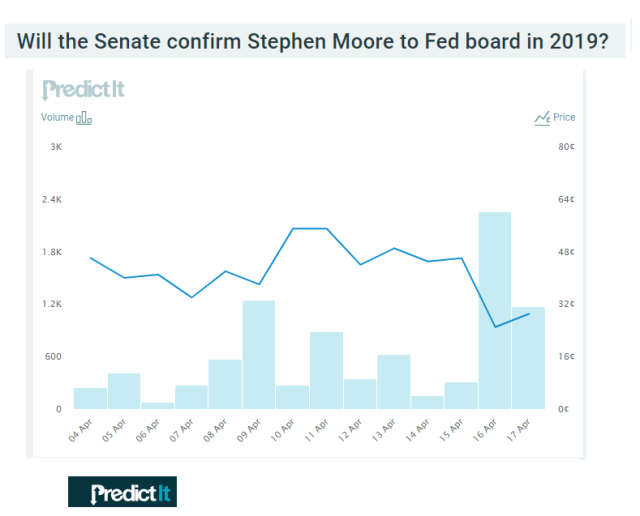
Imagine Jay Powell trying to explain that one or POTUS and S. Moore trying to understand it!

2019 Q1 GDP Forcast Has Almost Doubled Since March 1

GDP_Now

Is This Time Different Because Of The Yield Curve?


WIR_March22_Hot Months

Financials ETF Breaks All Four Major Moving Averages 

WIR_Mar22_Chart1

Brazil ETF Moves From Top Dog To Middle of Pack

Week_2019_ETFs

Bg Move Down In Global 10-year Yields

Week_Table

Posted in Uncategorized, Week in Review | Tagged , , , , , | 1 Comment

QOTD: More On Moore

QOTD = Quote of the Day

Memo to Senate: Just Say No

…today the president nominates Stephen Moore to be a Fed governor. Steve is a perfectly amiable guy, but he does not have the intellectual gravitas for this important job. If you doubt it, read his latest book Trumponomics (or my review of it). – Greg Mankiw, Harvard University 

Posted in Economics, Fed, Monetary Policy, Uncategorized | Tagged , | 2 Comments

Vol Spike…

https://twitter.com/alexus309/status/1109537029912711168?s=12


Posted in Uncategorized | Leave a comment

Sector ETF Performance – March 22

ETF_Day

ETF_Week

ETF_Month

ETF_YTD

Posted in Sector ETF Peformance, Uncategorized | Tagged , | Leave a comment

Global Risk Monitor – March 22

RM_1

RM_2

Posted in Daily Risk Monitor, Uncategorized | Tagged , , , , , | Leave a comment

Exactly As We Suspected…

Ugghhh….

Posted in Uncategorized | 2 Comments

This Should Concern And Worry Everyone

Adios to Fed independence.  This will hurt the reserve currency status of the dollar.

Did you read his clueless and ideology laced OpEd last week?  Now obvious nothing more than an audition cover letter.

Why are wheat and soybean prices falling and torching the farm belt?  Not because  the Fed is too tight but due to the administration’s inept trade policies.

Moore has no understanding of economics, in my opinion.  Beware of unprincipled hard money ideologues turned doves for political expediency.

Bad, bad news if true.


Posted in Uncategorized | 1 Comment

Is The Trade Deal Moving South? China Balks On 737 Max

We are revising and reposting and earlier piece from this week, which, in hindsight, was written with a tone a little too cute and too cavalier for such a serious topic. For that, we apologize to our readers and those who have been hurt by the trade wars.  

How Are Negotiations Going?

We can never know with this administration and can only infer from the tape bombs and tweets that hit us on a daily basis.  It does seem both sides are hardening their positions, so we assume trade talks are becoming more rancorous and drifting a bit South.

President Trump has now said he wants China to double or triple its purchase of U.S. goods. Sonny Purdue, the U.S. Secretary of Agriculture, says Chinese attitudes on striking a deal have hardened.

Moreover, the Trump-Xi March summit has been pushed way out, from March to now talk of June, and Bloomberg reported recently that China is walking back some concessions.

Some U.S. negotiators are concerned that China is pushing back against American demands in trade talks, according to people familiar with the negotiations, even as President Donald Trump sounded optimistic about reaching a deal that could boost his reelection chances.

Chinese officials have shifted their stance because after agreeing to changes to their intellectual-property policies, they haven’t received assurances from the Trump administration that tariffs imposed on their exports would be lifted, two of the people said on condition of anonymity. — Bloomberg, March 19th

Moreover, the South China Morning Post reported this week,

China is looking at excluding Boeing Co.’s troubled 737 MAX jet from a list of American exports it would buy as part of a trade deal with the US, people familiar with the matter said.

Boeing planes were featured on a draft list of American products China would buy to reduce its trade surplus with the US, the sources said, asking not to be identified discussing private deliberations. Now, safety concerns are pushing China to examine whether to cut the 737 MAX from the list altogether or replace it with other Boeing models after the crash of a plane operated by Ethiopian Airlines led to the aircraft being grounded worldwide, they said. – SCMP, March 20

Why is the Boeing tape bomb so important?

The chart below speaks for itself,  Heavy aircraft is one of China’s largest imports from the United States, though we are not sure of the actual impact the 737 Max has on total imports.  Chinese airlines took down 20 percent of 737 Max deliveries worldwide through January according to Boeing.

China Imports

More Than Trade

We have always believed that trade is just a small part of the increasingly complicated and complex U.S.-China relationship, and it won’t be easy to negotiate the deal that the Trump administration would like to achieve.  China appears to be playing 3-D chess, while the U.S. plays checkers.

Furthermore, after hundreds of years climbing back to global superpower status, why would President Xi now give away the keys to the Middle Kingdom?

Study your history, folks.

China has not had such a great experience with western powers trying to force their hand on international trade.  Don’t think this is lost on President Xi’s negotiators and does not go into their calculus.

In the 17th and 18th centuries, the demand for Chinese goods (particularly silk, porcelain, and tea) in Europe created a trade imbalance between Qing Imperial China and Great Britain. European silver flowed into China through the Canton System, which confined incoming foreign trade to the southern port city of Canton. To counter this imbalance, the British East India Company began to grow opium in India and smuggle them into China illegally. The influx of narcotics reversed the Chinese trade surplus, drained the economy of silver, and increased the numbers of opium addicts inside the country, outcomes that worried Chinese officials.

In 1839, the Daoguang Emperor, rejecting proposals to legalize and tax opium, appointed viceroyLin Zexu to go to Canton to halt the opium trade completely. Lin wrote to Queen Victoria an open letter in an appeal to her moral responsibility to stop the opium trade.[9] When he failed to get a response, he initially attempted to get foreign companies to forfeit their opium stores in exchange for tea, but this ultimately failed too. Then Lin resorted to using force in the western merchants’ enclave. He confiscated all supplies and ordered a blockade of foreign ships to get them to surrender their opium supply. Lin confiscated 20,283 chests of opium (approximately 1210 tons or 2.66 million pounds). 

The British government responded by dispatching a military force to China and in the ensuing conflict, the Royal Navy used its naval and gunnery power to inflict a series of decisive defeats on the Chinese Empire, a tactic later referred to as gunboat diplomacy.  – Wikepedia

We find it extremely ironic, but not inappropriate, that President Trump has raised Chinese exported fentanyl to the U.S. in the trade talks.  The new Opium Wars?

Who Is Winning?

But, hey, the stock market is up so the U.S. can take a harder line, no?   Not so fast.

The problem with that argument is China’s stock market is up almost double that of the U.S. year-to-date.

Stock Market.png


Does that mean, using POTUS logic,  China is winning?

Don’t get us wrong, we are rooting for a good deal, where China graduates to developed market status and adjusts its trade and investment policies accordingly.  This should have been done with the help of pressure from U.S. allies done in a multilateral framework, such as the World Trade Organization (WTO).

President Trump Doesn’t Understand Trade

It is clear, at least to us, the President does not understand free trade, that there will always be winners and losers when engaging in foreign trade, but mostly winners in the form of higher real incomes and purchasing power for the general population.  Does he even understand American importers and consumers and not the Chinese are paying for his tariffs?

The pain in the farm belt and the political pressure it puts on President Trump weakens the U.S. bargaining position with China, in our opinion.  The Chinese team realizes this and the longer they drag out negotiations and run out the clock the weaker Trump becomes.

We also feel bad for those in the rust belt, who are now paying higher prices for consumer goods but will never return to the golden age of employment that President Trump promised them during the campaign.  It’s time for more and to accelerate forward-thinking to prepare these workers for the 21st plus century economy.  A new Marshall Plan for the rust belt.

His trade war has torched the American farm belt and his comments today will not ease the anxiety in the corn and wheat fields of the heartland,

We’re not talking about removing [tariffs], we’re talking about leaving them for a substantial period of time, because we have to make sure that if we do the deal with China that China lives by the deal  – President Trump, CNBC, March 20th

The administration also has a lot of ‘splaining to do with American farmers as reports U.S. wheat farmers are losing market share in Japan to other countries that remained in the TPP,

US farm groups are ramping up pressure on Donald Trump to quickly launch trade talks with Tokyo, as they face mounting evidence of lost sales and market share in Japan following America’s withdrawal from the Trans-Pacific Partnership. In recent weeks, wheat, pork and beef producers in the US have complained that they are being rapidly outflanked and replaced in the lucrative Japanese market by rivals including Canada, Australia, and EU member states, whose trade deals with Japan entered into force in recent months.  – FT, March 18th

Hysteresis Due to TPP Pullout

At best, a bilateral trade deal with Japan, which even now looks distant, will not make American farmers better off than if the U.S. had stayed in TPP,  in our opinion.  And look at the freaking cost!

Moreover, there will be some hysteresis in terms of lost export markets.  Hysteresis implies that the lost export market share, may not necessarily be regained when a new bilateral trade deal is struck.  Competitors who entered the markets in order to exploit the U.S., temporary — we all can hope — protectionist backslide will not immediately be abandoned by these countries.

Art Of The Deal

Can you see the pattern developing and the results of the administration’s Art of Deal negotiating style and so-called trade and budget deals — that is little gain, lots of pain?

Conclusion

We leave you with two thoughts:

  1. The Thucydides Trap:  Trade is just a small part in managing now the world’s most dangerous geopolitical relationship. Keep that in mind. It’s more than just a few tons of soybeans.
  2. and, on a sadder note,  Farmers are really hurting as a result of the Trade Wars,

The worst agricultural downturn since the 1980s is taking its toll on the emotional well-being of American farmers.

In Kentucky, Montana, and Florida, operators at Farm Aid’s hotline have seen a doubling of contacts for everything from financial counseling to crisis assistance. In Wisconsin, Dale Meyer has started holding monthly forums in the basement of his Loganville church following the suicide of a fellow parishioner, a farmer who’d fallen on hard times. In Minnesota, rural counselor Ted Matthews says he’s getting more and more calls.” –  Duluth News Tribune, March 20th

P.S.  We are still working a strategy to protect the contributors to Global Macro Monitor while dealing with the free riders but not at the expense of our readers in the weak currency countries, some of which have capital controls.  It’s coming. 

Help keep the lights on by making a donation with any major credit card by clicking on the donate widget at the right side of the website.   


Posted in Agriculture, Trade War, Uncategorized | Tagged | 1 Comment