The Clash of Generations Cometh

The Times They Are a-Changin’,

Come mothers and fathers
Throughout the land
And don’t criticize
What you can’t understand
Your sons and your daughters
Are beyond your command
Your old road is rapidly agein’
Please get outta’ the new one if you can’t lend your hand
For the times they are a-changin’  –   Bob Dylan, 1964

It will be 6 years on March 1st since we wrote and posted,  Connecting the Dots: The Coming War Between Generations.   We wrote back then,

It doesn’t take a C.I.A. analyst with a Ph.D. to realize the potential for political blowback when one generation is rendered into servitude due to the excesses of another.   Or does it?  – Global Macro Monitor

We also cited Thomas Friedman a few months later in our piece, The Clash of Generations,

What we are witnessing in the Middle East where the young, who have little or no political voice and a not so bright future are throwing off their autocratic gerontocracies at an incredible pace.   Something similar will manifest here and the rest of the aging west, though probably in different way, when younger generations realize the consequences of being saddled with a massive debt and declining public services as the tax revenues are diverted to debt service and retirement benefits.   Not to mention the world full of carbon they have inherited.
Thomas Freidman,  NY Times,  July 16, 2011

It’s here, folks.

KD over at thinkinthemorning.com sent over this tweet,

A retweet of this:

richmond_feb8The chart is from a LA Times article from a few days ago titled,  Cutting jobs, street repairs, library books to keep up with pension costs,

The truth is that there are cities all over the state that just aren’t owning up to all their problems,” said San Bernardino City Manager Mark Scott.

Increasingly, pension costs consume 15% or more of big city budgets, crowding out basic services and leaving local governments more vulnerable than ever to the next economic downturn.

Stunning:  “Every dollar the city [Richmond, CA] collects over the next five years will go toward retirement costs.”

We just had a presidential election that resulted in the biggest political disruption in U.S. history bringing a “so-called” disrupter to the White House.  All because a certain segment of the population was hurt by international trade —  77,744  voters to be exact,  in Michigan, Wisconsin, and Pennsylvania, the marginal votes that led to President Trump’s electoral college victory.

Imagine when the younger generations have their epiphany that they have been screwed by the baby boomers?

Richmond is only the tip of the iceberg and this ugly story is being played out across the nation and the world.

Here is one example of a milquetoast approach to solve the problem,

The California Public Employees Retirement System, or CalPERS, voted in December to lower the pension fund’s discount rate—the projected annual investment returns for future years—from 7.35 percent to 7 percent, in two steps that will occur between now and 2020. It’s a modest adjustment and one that leaves the fund with a discount rate that still might be too high, but even that small change is going to add billions to the state’s annual pension tab.

Last week, the California State Teachers’ Retirement System, or CalSTRS, followed suit, announcing plans to lower the discount rate from 7.5 percent to 7 percent over the next two years.

…Taxpayers will be hit hard by the change. Bloomberg, citing data from the California Finance Department, says the share of pension costs paid by state taxpayers will triple in less than a decade and might increase further if investment returns under-perform the 7 percent threshold.   – Reason.com

Come on,  let’s stop dicking around about the discount rate, just as they do in climate change debates, and fix the problem.   Public sector pension payments are going to have to be restructured.  Punto!

We say this not because we want it to happen but because there is no other choice, it has to happen.

Some already have, by the way, as they are in the private sector.  We need to move quickly lest the millennials rise up and march the retiring baby boomers off the cliff as they see their taxes raised and public services being cut.

We suspect one big theme in the 2020 presidential election?   The “Clash of Generations” and we don’t think the younger voters will cast their ballot for a Caspar Milquetoast.  We just witnessed in November what happens when voters are angry at their government — anything can happen.

milk-toast_feb9

Stay tuned.  We have lots more to say on this.   Prepare for blowback.


Posted in Politics | Tagged , | 19 Comments

European bonds suffer from uncertainty – FT

Keep some powder dry to buy the French Dip.    That is,  the market panic over the  Euro elections,  if there is one.

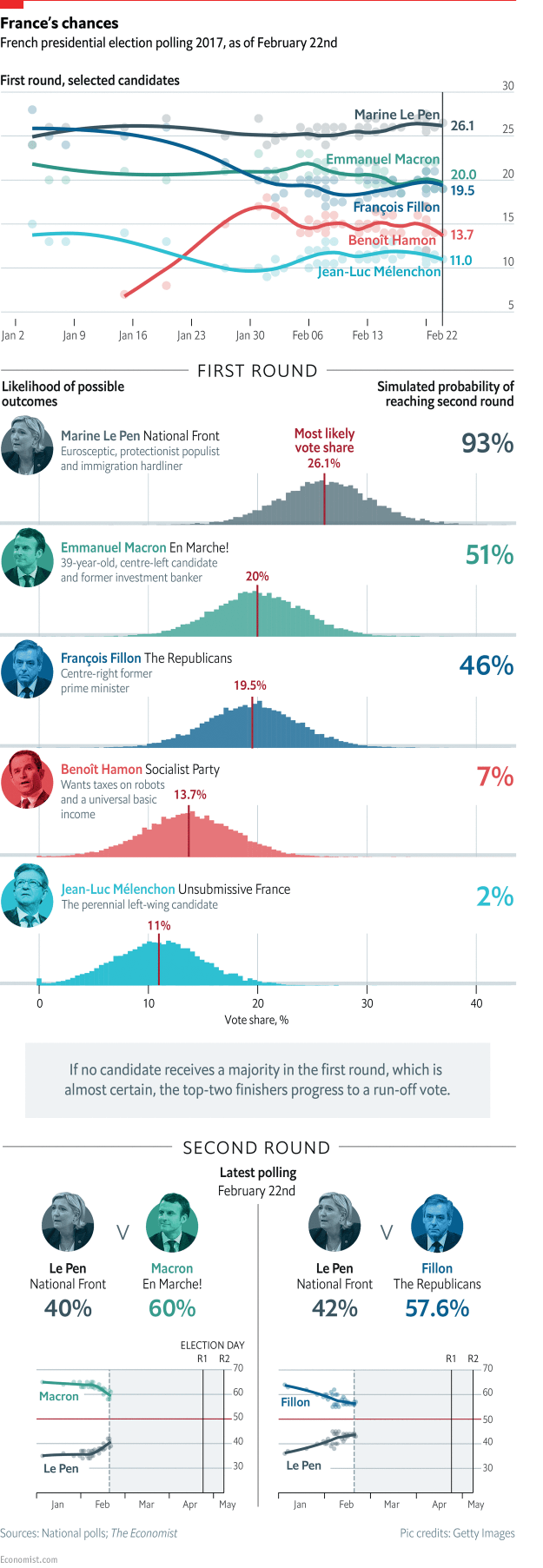
The French will hold the populist “Maginot Line” and Le Pen will lose in the second round, “bigly“.  Polls can be wrong for maybe 3-5 points, but 32 points?   We don’t think so.  Nevertheless, have to allow for a small probability of a political shock from now until May 7th and markets are pricing it in.

Geert Wilders, the “Dutch Trump,” and his Freedom Party (PVV)  will win the most seats in the Netherlands lower house next month, maybe 35, but still needs 75 to form a government.  “Most other parties have vowed not to team up with him.”  Sorry, Geert, no prime ministership.   March 15th Dutch elections?  Yawn!

German elections?   Let’s think this through.

If Martin Schultz and his SPD-Green-Left coalition manage to defeat Angela Merkel on September 24th,  the country swings to the left of Merkel,  not to the hard right.  Schultz has called the right-wing parties “rat-catchers.”  The new government will be even more pro-EU than the Merkel government.

The world will definitely miss the strong leadership of Ms. Merkel as a check on President Trump, but Wolfgang Schäuble, her hardline finance minister will be gone.  Then, maybe, just maybe, Greece will get some meaningful debt relief and pro-growth policies in Southern Europe.    No panic here, comrades.

Italy?   We need to do more homework and get back to you.   The same with Portugal and Spain.  But our sense is and what we are seeing in the European street is that these countries are repelled and more willing to run away from Trump rather than attracted to and running to him.    Stay tuned.

The FT’s Katie Martin on what to watch for in markets on Wednesday, including French bonds spread over German Bunds widening as the threat of an exit from the euro looms with Marine Le Pen’s candidacy, and concerns over Greek debt and on US policies steering markets back to havens.

► Subscribe to FT.com here: http://on.ft.com/2eZZoLI

.

Posted in Eurozone Sovereign Spreads, Politics, Sovereign Risk, Uncategorized | Tagged , , , | Leave a comment

Map of the Day: Export Markets

Notice any trend or clusters?  Who gets hurt as global trade declines?

imports_feb8Source:  Fascinating Maps

Posted in China, German Bund | Tagged , , | 2 Comments

Talking ’bout Mexico – JT

So King David at thinkinthemorning.com sends over an article showing U.S. stocks with revenue exposure to Mexico.   Starts us thinking about who is smarter,  equity traders or currency traders,  who follows who,  or who is fooled by randomness?

.

exposure-to-mexico

.

Definite comovement between Kansas City Southern (KSU) and the Peso.   Looks like KSU may lead the Peso by a day or two,  no?  Sometimes.  And there’s the rub.

.

peso_ksu_feb7

Johnson Controls (JCI) slightly correlated, not so much.   If you stare at the chart long enough you can convince yourself JCI leads.  Currency traders a little more short-term than equity traders, in our opinion,  are more reactive to and often trade more on noise.

.

peso_jciNevertheless,  as the old saying goes  “if you stare at the clouds long enough, you can see pink elephants.”     By the way,  check out the head and shoulders top in the lightening strike.

head-and-shoulders_feb8

On a more serious note, a shout out to our friends “down in Mexico“,  who are “so far from God and so close to the United States” and now caught up in the nasty realpolitik of the moment that seems to be “shaking [the world] like a live wire.”  We are with you.


Posted in Currency, Equities, Geopolitical, Uncategorized | Tagged , , , | Leave a comment

U.S. GDP: The Real Estate Economy

Interesting data that even surprised us.  The real estate sector is now the largest sector of U.S. economy.   Real estate is a sub-category of the BEA’s  industry group, Finance, insurance, real estate, rental, and leasing.   Could it be one of the many reasons why a real estate mogul now lives in the White House?  

Some inferences from the data:  1)  the U.S. economy is much more diversified than in 1950 and less dependent on manufacturing.   That can be interpreted as good or bad depending on where you sit;  2)  the U.S. is a FIRE economy.  That is,  Finance,  Insurance and Real Estate,  which now exceeds 20 percent of GDP;   3) Agriculture continues to decline as a share of GDP, which is now only 1 percent of the economy.  This may change as “reefer” legalization becomes more ubiquitous and is counted in the official data;  4)  the Federal government’s role in terms of value added to the GDP is shrinking;  5)  State and local governments have almost doubled their share of output since 1950;  and 6)  Professional and business services have almost tripled their output as percent of the economy since 1950.   There are many more.  You decide and analyze.

One last point.  Real estate is all about leverage and, traditionally, highly dependent on credit and lending.

us-economy-by-sector_tablemanufactuing_real-estate_time-seriesus-economy-by-sector_2015us-economy-by-sector_1950

Posted in Economics | Tagged , , | 1 Comment

The Proposed Border Tax’s Costs Outstrip Its Benefits – PIIE

Published on Feb 7, 2017
Adam S. Posen outlines the potential gains from a proposed corporate tax overhaul but says the costs, especially to lower income groups, outweigh the benefits.
.
Posted in Economics | Tagged , | Leave a comment

What Really Keeps Us Up At Night – Do The Math

Lots of these being drawn up by the new U.S. administration.

red-lines_feb6

The one that scares us most is this:

Mattis: US will defend Japanese islands claimed by China – CNN

And today we hear this:

China sails warships near islands Mattis vowed to defend for Japan – Fox

Plus the realpolitik of this:

…tough talk with China will likely lead Beijing to test the new administration’s resolve militarily. Whether the president is ready for such a confrontation is entirely unclear. For the moment, he seems not to have thought much about the future ramifications of his rhetoric and his actions.  – Foreign Policy

Xi Jinping will have to exude and appear strong either for domestic politics or to “wag the dog” to deflect attention from a potential flailing economy:

Every five years China holds a selection process that can do the same thing. Communist Party officials tout it as evidence of a well-ordered rhythm in their country’s politics. This year it may turn out as unpredictable as America’s election in 2016.

The people up for re-selection are the 350-odd members of the party’s Central Committee, the political elite, along with its decision-taking subsets: the Politburo, the Politburo’s Standing Committee (a sort of inner cabinet) and the army’s ruling council. The choice of new leaders will be made at a party congress—the 19th since the founding one in 1921—which is expected to be held in Beijing in October or November, and at a meeting of the newly selected Central Committee which will be held directly afterwards. – Economist

The U.S. and China could back themselves into war if both parties  adopt this as their new anthem:

.

And will equal this:

shiller-cape_feb6

And that is only the financial “fallout“,  which will largely be irrelevant.

Hope the President is drawing those red lines with a red pencil like this and with a very effective and efficient eraser.

red-pencil_feb6

But that would equal this:

paper-tiger_feb6

Therefore,  we render the equation unsolvable….

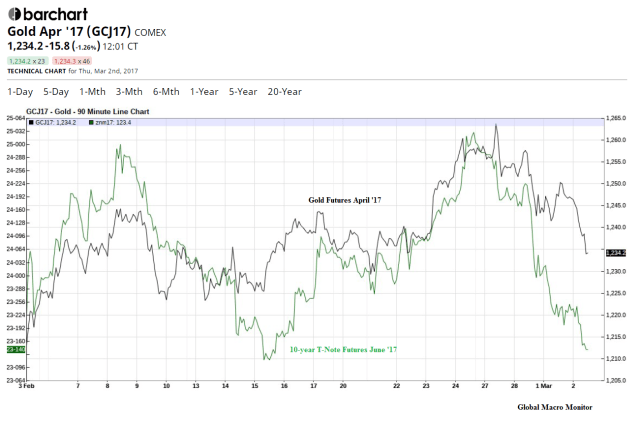
And may be why gold and bond prices are moving higher together.  Can they move higher together on inflationary expectations?   Not consistent and totally absurd.

Our bet, this relationship, albeit, and most likely, temporary is geopolitical worries.  Maybe not so much about an imminent  U.S.- China conflict, but,  something more general, such as increased uncertainty and the expectations shock about the continuity of the Pax Americana that has ruled the world since World War II.   Or, it could be just a simple unwind and short squeeze in both.  Stay tuned.

bond_gold

Posted in China, Geopolitical, Uncategorized | Tagged , | Leave a comment

Tremors in the Eurozone (Again)

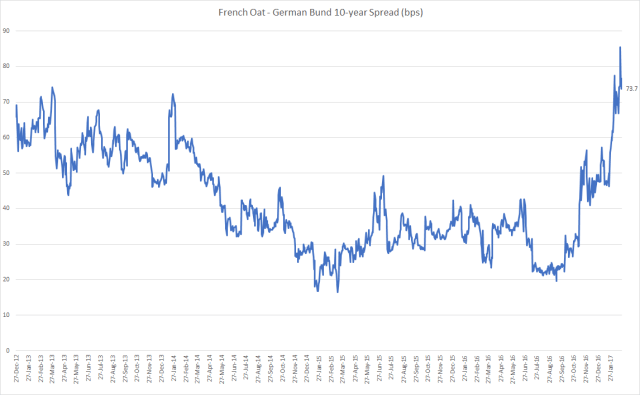
The France OAT-German Bund 10-year blew out another 12 bps today.  This is off our charts going back to December 2012.   The FT reports,

“Markets underpriced the political risks in 2016 and they are determined not to do the same again,” said James Athey, investment manager at Aberdeen Asset Management. “Investors want greater rewards for the risks they see in French, Dutch, German and possibly Italian elections this year to destabilise the region.”

Mr Fillon dug in his heels on Monday, apologising at a campaign headquarters news conference for putting his wife and two children on the government payroll, but vowing to salvage his damaged presidential bid.

…The widening of the spread between Italian and Spanish debt is also being watched closely. While the Spanish economy, the region’s fourth largest, has staged a recovery in recent years, growth in Italy remains weak, its banking sector besieged, and unemployment high and rising. 

…“This is not just about politics,” said Mr Athey. “It is a confluence of politics and the fact that economic data in the eurozone has been improving, which makes investors think the ECB might be questioning how much stimulus is still required.”  – FT

.

oat_bund_spread_feb6

Posted in Eurozone Sovereign Spreads, Geopolitical, Uncategorized | Tagged | Leave a comment

French Oat-German Bund 10-year Spread

Starting to get interesting.   The French 10-year Oat- German 10-year bund spread widened and closed at its highest level since January 2014 on Friday.  Francois Fillon has dropped like a stone in the past few weeks as the political scandal that he had his family on the public payroll unfolds.   Looks like Emmanual Macron — very pro EU — is the best bet now to advance to second round in a run off with Marine Le Penn, which he should win.   Volatility should pick up.

Game over for Eurozone if Le Pen wins the second round and becomes President.  Watch this space!

france_polls_feb3franace_election_predictitoat_bund_spread_feb3

Posted in Bonds, Eurozone Sovereign Spreads, France, Uncategorized | Tagged , | 1 Comment

US Sector ETF Performance – Feb 3

etf_dayetf_weeketf_monthetf_ytd

Posted in Sector ETF Peformance, Uncategorized | Tagged , | Leave a comment