The Transition Trade

Nice chart (hat tip King David over at thinkinthemoring.com) from Wall Street Journal on the return of the Dow Jones after election day to the inauguration of presidents all the way back to McKinley when the Dow index was created.

Note Herbert Hoover leads the pack.  Like we have said the return on the Dow during the transition is meaningless in terms of predicting future performance.   Hoover had the momentum of the 1920’s and the 262 percent return of Calvin Coolidge’s bull market behind him at the start of his administration.

The Dow continued to rise 19.44 percent from Hoover’s inauguration on March 4, 1929 to September 3, 1929, where it peaked at 381.17.   The Dow then fell 31.62 percent by October 28, 1929, the day before the Black Tuesday crash, when it fell 11.7 percent in one day.  Interestingly, the markets usually give a sign they are not healthy before a big puke happens.

In spite of the Dow’s good performance during the Hoover transition and first 100 days,  the Dow’s total return during Herbert’s Hoover’s reign was the worst of all presidents, down over 80 percent.   Conversely, the Dow’s performance during  FDR and President Obama’s transition were among the worst as the economy at the time were in throes of the two worst crises the nation has faced.   Yet, FDR and Obama’s bull markets ranked among the best of all presidents.

The Dow did not recover the September 3, 1929 high until November 23, 1954.   And, no, folks,  that is not a typo.   It took more than 24 years to recover the 1929 high.

transition-trade_jan23


Posted in Equities, Politics | Tagged , , , , , | Leave a comment

Reagan-Trump S&P500 Analog

We continue to track the meaningless (in terms of projecting trajectory)  Reagan-Trump S&P500 analog.  At their respective inaugurations, the Trump S&P is outperforming Reagan by 4.4 percent.  Note, Trump was inaugurated 51 trading days after the election whereas Reagan’s inauguration took place 53 trading days after the election.  In terms of the exact days after the election, 51 days,  Trump outperforms Reagan by 2 percent.

Our sense the markets will be spooked by Saturday’s global protests and may perceive that Trump has been weakened politically.  Thus, we expect a sell off next week.

But what do we know?   Absolutely nuttin’.

reagan-v-trump_analog

Posted in Equities, Uncategorized | Tagged | Leave a comment

French Oat-German Bund 10-year Spread

Stabilizing at around 50 bps.

predictit_france

oat_bund_spread_jan14

Posted in France, German Bund, Germany, Politics, Uncategorized | Tagged , , | Leave a comment

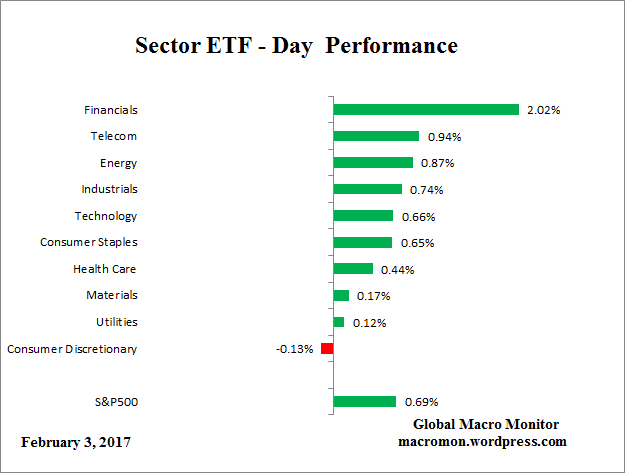
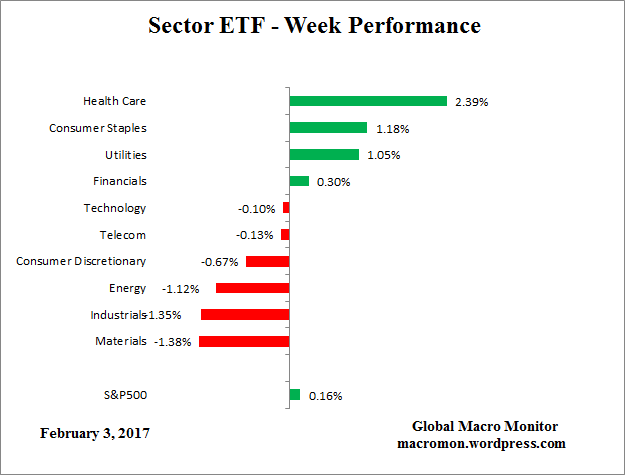
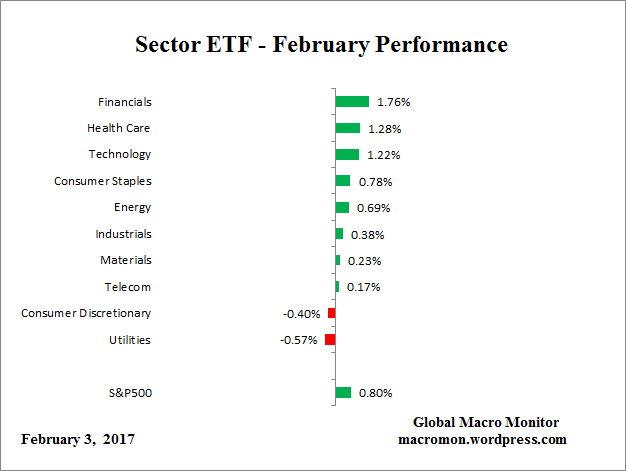
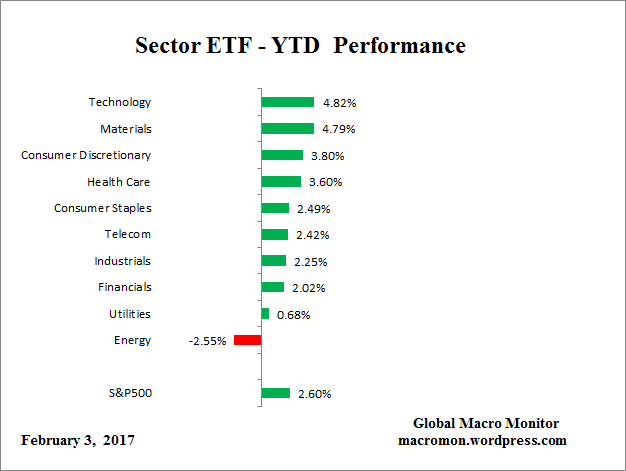
US Sector ETF Performance – Jan 13

etf_dayetf_monthetf_month

Posted in Daily Risk Monitor, Sector ETF Peformance, Uncategorized | Tagged , | Leave a comment

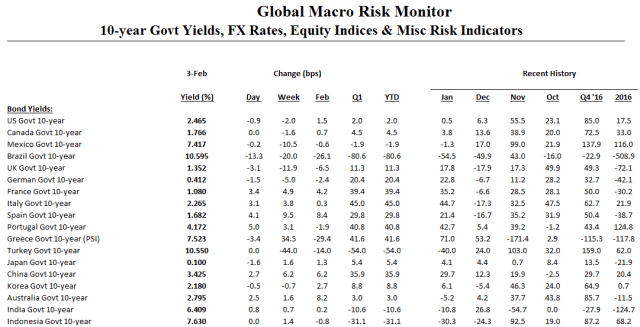
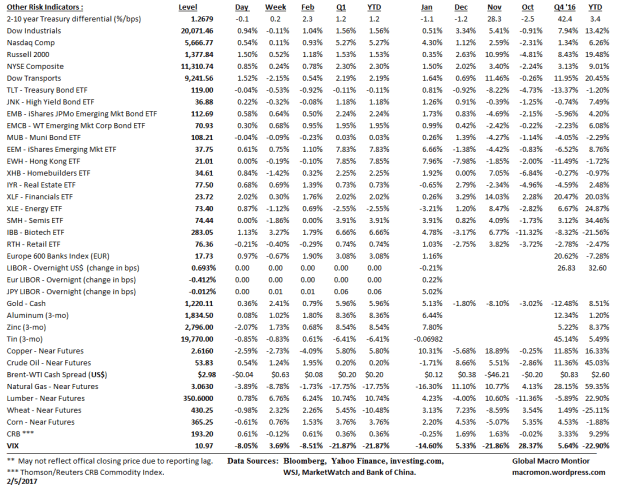
Global Risk Monitor – January 20

Click on table to enlarge and for better resolution

riskmon_1riskmon_2riskmon_3

Posted in Daily Risk Monitor, Uncategorized | Tagged , , , , , | Leave a comment

You’re Hired!

trump-cabinet

S0urce:  Economist


Posted in Politics, Uncategorized | Tagged , | 1 Comment

Obama’s Bull Market

president-dow_table_jan20president-dow_chart_jan20

Posted in Equities | Tagged , , , | Leave a comment

The Dow of the Inaugural and First 100 Days

We quickly put together a table of the return on the Dow Jones Industrials Average after the first 100 days of presidential administrations,  the return on their Inauguration Day, and the return the day before the inaugural going back to William Howard Taft.  We included only newly inaugurated president (first term) and left out those who assumed the office mid-term either through tragedy or scandal.

It is safe to say that no president has, and probably never will,  beat FDR’s performance unless the country experiences a bout of hyperinflation or another depression.   Roosevelt declared a bank holiday as soon as he assumed office and the stock market was closed for several days until Congress could act on legislation.

…The banking system was on the verge of collapse. On March 4, Delaware became the 48th and last state to close its banks. [1] Following his inauguration on March 4, 1933, President Franklin Roosevelt set out to rebuild confidence in the nation’s banking system. On March 6 he declared a four-day banking holiday that kept all banks shut until Congress could act.

…The EBA [Emergency Banking Act]  was one of President Roosevelt’s first projects in the first 100 days of his presidency.

…Within two weeks, Americans had redeposited more than half of the currency that they had squirreled away before the bank suspension. The stock market registered its approval as well. On March 15, 1933, the first day of stock trading after the extended closure of Wall Street, the New York Stock Exchange recorded the largest one-day percentage price increase ever with the Dow Jones Industrial Average gaining 8.26 points to close at 62.10; a gain of 15.34 percent. – Wikipedia

Interestingly, George H.W. Bush first 100 days (approximate trading days)  saw the Dow’s highest return of the modern day presidents.   Thoughts and prayers go out to the President and the former First Lady as they recuperate from their recent illness.  What great people,  full of grace, dignity, and class.

president-100-days

Posted in Uncategorized | Leave a comment

Why Money Keeps Flowing Out of China – Bloomberg

Published on Jan 18, 2017
The outflow of Chinese capital hasn’t abated in the last few years, as a weak Yuan and slew of other hindrances perpetuate losses. QuickTake Q&A explains how these pressures continue to take a toll on China’s economy.
.
Posted in China, Uncategorized | Tagged , | Leave a comment

TOTD: Who Owns The U.S. Equity Market?

holders-of-u-s-equities_jan18

(TOTD = Table of the Day)

Posted in Equities, Uncategorized | Tagged , , | Leave a comment