R.I.P. #24

Posted in Uncategorized | 1 Comment

Follow The Capital Flows

According to IMF data reported by Bloomberg News, despite global calls to diversify away from the dollar, the U.S. has attracted a significant share of international investment post-Covid. The U.S. share of global investment flows rose from 18% pre-pandemic to one-third recently, driven by high U.S. interest rates and incentives for renewable energy and semiconductor production under President Biden. In contrast, China’s share has significantly declined. However, potential changes in U.S. policy and interest rates could impact these trends.

Key Points:

  • U.S. investment share increased from 18% pre-Covid to about 33% recently.
  • High U.S. interest rates and Biden’s economic initiatives have attracted significant foreign direct investment.
  • China’s global investment share has halved since the pandemic.
  • Potential policy reversals in the U.S. and lower interest rates could change investment dynamics.
  • Emerging markets are struggling, receiving minimal capital inflows.
  • Significant investments in the U.S. include Samsung’s $6.4 billion grant for chip production in Texas.
  • Concerns about U.S. political stability and fiscal health could affect future investment attractiveness.

Source:  Bloomberg.

Posted in Uncategorized | Tagged , , , , | Leave a comment

Global Risk Monitor: Week In Review – June 14

This week’s Global Macro Risk Monitor shows significant declines in European markets following a hard-right swing in the Euro parliamentary election. The Euro weakened by 0.92 percent against the USD, and the German DAX and French CAC fell 2.99 percent and 6.23 percent on the week. Euro sovereign bond spreads reflected increased risk, most widening significantly for the week. These movements underscore market concerns over potential political instability and economic policy shifts. In contrast, the S&P 500 and tech sectors in the US continued to show robust performance, highlighting sector disparities and the narrow breadth of the market.  The equal-weighted S&P 500 was down ½ percent for the week.

  • Equity Performance:
    • The S&P 500 gained 1.58 percent weekly, driven by tech sector strength.
    • Apple (AAPL) and Nvidia (NVDA) saw weekly gains of 7.92 percent and 9.09 percent respectively.
    • The equal-weighted S&P500 was down 0.53 percent for the week, reflecting the very narrow breadth of this market
    • European markets were slammed by the results of the European Parliamentary elections’ big lurch to the hard right.  The French CAC led the declines, falling 6.23 percent for the week.
  • Sector and ETF Trends:
    • Financials (XLF) and Energy (XLE) ETFs fell over 2 percent.
    • AI and tech ETFs showed robust weekly performances, highlighting investor interest.
  • Sovereign Bonds:
    • The US 10-year yield dropped 20.6 bps for the week.
    • European sovereign spreads blew out.
    • France’s spread over the German bund is now 75, but surprisingly, only 3 bps tighter than Portugal.
  • Currencies:
    • The Dollar Index rose 0.55 percent last week and is now up 4.09 percent YTD.
    • The South African rand was close to 3 percent stronger after the ANC formed a coalition government.
  • Commodities:
    • Gold increased 1.71 percent for the week, now up 13.06 percent YTD.
    • Copper rose 0.39% on the week, adding to its YTD gain of 16.07 percent
  • Energy Commodities:
    • Crude Oil rose 4.13 percent.
    • Natural Gas fell 1.75 percent.
  • Market Volatility and Conditions:
    • VIX increased slightly by 0.44 points for the week.
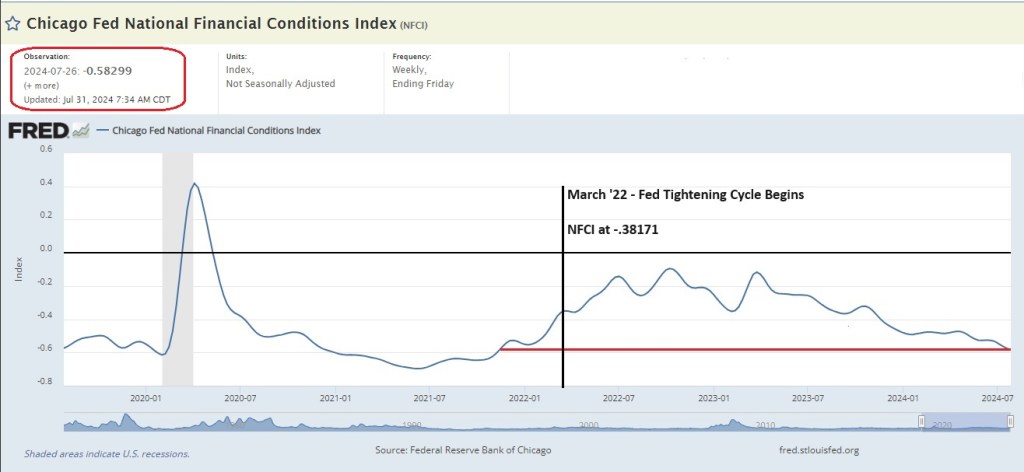
    • Chicago Fed NFCI indicates easing financial conditions with a reading of -0.5639

Posted in Uncategorized | Leave a comment

In Real Estate We Trust, But John Bull Not Feeling It

John Bull can stand many things but he can’t stand 2 percent. – Walter Bagehot

Key Insights from Gallup on American Investment Preferences

There is an intriguing disconnect between the general population’s sentiment and the seemingly robust economy. While the stock market reaches all-time highs, inflating the wealth of the top 10%—who own 87% of all corporate equities—many Americans, the majority of whom have limited to no stock holdings, do not feel wealthier due to relatively soft and sluggish housing prices.

Additionally, Republicans prefer gold over other investments by a 20% margin compared to Democrats, reflecting the dystopian outlook held by some within the MAGA movement.

Key Takeaways:

  • Stock Ownership Disparity: Stock holdings are heavily concentrated among the wealthiest Americans. The top 0.1% owns 23.4% of corporate equities, the top 1% controls nearly half of the stock market, while the bottom 90% hold only 13.12% of corporate equity wealth.
  • Real Estate Preference: Americans consider real estate the best long-term investment among six options, with 36% favoring it. Stocks or mutual funds are chosen by 22%, gold by 18%, and savings accounts or CDs by 13%.
  • Low Confidence in Bonds and Cryptocurrency: Bonds and cryptocurrency are viewed as the best long-term investments by relatively few Americans, at 4% and 3%, respectively.
  • Income Level Investment Perceptions: Across all income levels, Americans perceive real estate as a superior investment. However, opinions diverge on the value of other investments, particularly stocks and savings accounts.
  • Political Differences on Gold’s Value: There is a marked political divide in the perception of gold’s value. Currently, 27% of Republicans consider gold the best investment, compared with 7% of Democrats and 18% of independents.

Gallup has asked Americans to choose among real estate, stocks, gold, savings accounts and bonds as the best investment. Cryptocurrency was added as an option in 2022.

Real estate has topped the list each year since 2014, with between 30% and 45% (in 2022) selecting it. In 2013, real estate essentially tied for first with gold and stocks; it trailed gold in 2011 and 2012.

Americans’ historical tendency to choose real estate as the best long-term investment is consistent with their usual expectations of rising local home values.  – Gallup

Posted in Uncategorized | 1 Comment

COTD: Chips Ahoy!

COTD = Chart of the Day

…the largest [new semi fabs] of which are planned in Arizona, New York, Ohio, and Texas—are expected to create jobs and boost domestic production of semiconductors. However, the industry faces challenges in recruiting and retaining talent, particularly engineers and technicians. – McKinsey

We are not fans of industrial policy. Furthermore, we believe U.S. policymakers have a misguided notion of what truly matters in restoring manufacturing. Just ask Tim Cook.

China has moved into very advanced manufacturing, so you find in China the intersection of craftsman kind of skill, and sophisticated robotics and the computer science world. That intersection, which is very rare to find anywhere, that kind of skill, is very important to our business because of the precision and quality level that we like. The thing that most people focus on if they’re a foreigner coming to China is the size of the market, and obviously it’s the biggest market in the world in so many areas. But for us, the number one attraction is the quality of the people. – Tim Cook, Apple CEO

Posted in Uncategorized | Leave a comment

QOTD: Cold War 2.0 – This Time Is Way Different

QOTD = Quote of the Day

Never before have a rising power [China] and the established hegemon [U.S]. been so economically intertwined….China holds at least $860bn in US public debt, representing 12 per cent of the foreign owned debt. Trade volume between the US and China measured just about $690bn in 2022 . . .The United States also remains the largest destination for outbound Chinese investment in 2022. – Oriana Skylar Mastro, Upstart: How China BecameA Great Power

Why’d you have to go and make things so complicated? – Avril Lavigne 

Posted in Uncategorized | Leave a comment

Discretionary Spend: Experiences v. Things?

Doom Spending

Shoppers are stretched, but discretionary spending isn’t abating as quickly as some finance chiefs and economists expected—a phenomenon economists and finance chiefs have coined “revenge” and even “doom” spending. And it has CFOs across industries—from travel to clothing, restaurants and consumer packaged goods—working to figure out what the impact is on balance sheets.

…The pandemic changed what motivated people to spend. Shoppers emerging from the pandemic with money to burn were eager to splurge, and this so-called revenge spending drove people to Taylor Swift and other concerts and led them to take trips and buy designer handbags. This boosted some companies’ profits as living in the moment took priority over saving for a home or rainy day. – WSJ

Consumers are remixing their spending back into services and entertainment outside of their homes after curtailing those activities during the pandemic..This normalization, combined with the cumulative impact of higher prices on consumer budgets, is resulting in continued soft trends in discretionary categories, most notably in home and hardlines. – Brian Cornell,  Target CEO

Posted in Uncategorized | Leave a comment

Global Risk Monitor: Week In Review – June 7

Mexico Markets Thumped 

The Mexican governing party’s unexpectedly lopsided victory this week has investors concerned that it may use its mandate to sweep aside some of the checks on presidential power which have long been a source of comfort to the business community.

The possibility that current president Andres Manuel Lopez Obrador could push through some of those changes during his final month in office in September has some investors especially on edge. – Reuters

Posted in Uncategorized | Leave a comment

Freedom Is Not Free

Posted in Uncategorized | Leave a comment

What’s Bothering America…

We warned about the coming wave of inflation in February 2021, when year-on-year CPI inflation was still below 2 percent, at 1.67 percent. We then followed up with this:

Inflation is way too high given exremely easy financial and monetary conditions.  There will be blood…The Democrats should begin to worry. – GMM,  June 11, 2021

Inflation is one of the most insidious and pervasive of all economic indicators, as it affects all Americans, albeit some more than others. We don’t second-guess the economic policy response to the pandemic, but the monetary authorities erred by keeping the liquidity spigot open for too long.

Posted in Uncategorized | Leave a comment