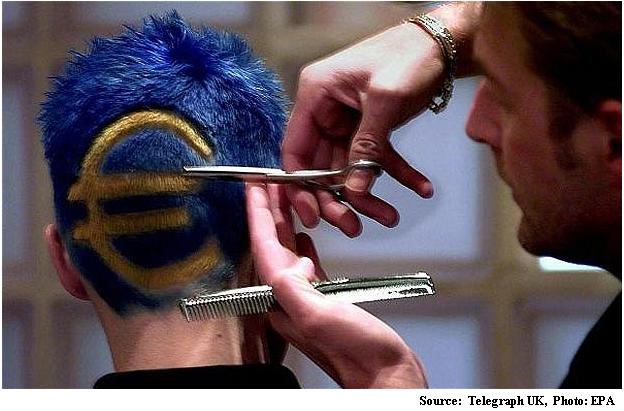
Picture of the Day: Greek Sovereign Haircut

(click here if chart is not observable)
Posted in Picture of the Day | Tagged , , | Leave a comment

Greece Debt Swap Surprises, Great Deal for the Country

The FT is reporting,

The largest debt restructuring in history was heading for a successful outcome last night as Greece looked set to see a participation rate of close to 95 per cent for its €206bn bond exchange.

One person involved in the deal said that more than 90 per cent and possibly more than 95 per cent of investors had taken part, assuming collective action clauses (CACs) were used to bind dissenting holders of some bonds.

We are not sure if the totals include/exclude bonds held by the ECB and EIB.

We do find it interesting, however, to hear some analysts state “Greece is still going to default.”   On what, may we ask?

Setting the official debt aside — EU,  IMF, etc — which doesn’t trade and not subject to market rates, let’s take a look at the new bond debt service burden.

The bond exchange allows Greece to effectively buyback and thus retire €141.11  billion or 68.5 percent of its €206 billion bond stock, at 22 cents on the euro.   The remaining 31.5 percent of bonds , or  €64.89 billion,  are exchanged for various bonds with 11-30 year maturities and an annual coupon of 2 percent through 2015 and gradually stepping up thereafter.

Thus, assuming full participation,  Greece will now have annual bond payments of only €1.3 billion through 2015 and €1.9 billion from 2016 to 2020.   That’s only 0.5 to 0.8 percent of 2011 GDP, which makes default on the new bonds very unlikely, in our opinion.  Unless, of course, an asteroid hits the country.

We’ve worked on many of the world’s largest sovereign restructurings and this is one helluva of deal for Greece,  in our opinion.   Now let’s hope the government can continue on the reform path and animal spirits can generate some investor confidence, which will allow the economy to bottom and start to recover.

At the very least,  assuming this deal closes,  the  “acute”  part of Greece’s sovereign debt crisis where large bond maturities could not be repaid and almost took down Europe and its banking system in the second half of 2011 is over.   The country still needs a big adjustment in relative prices,  but they have bought some time,  politics willing.

Hats off to those getting this deal done!

Godspeed, Greece.

(click here if video is not observable)

Posted in Black Swan Watch, Bonds | Tagged , , , | 1 Comment

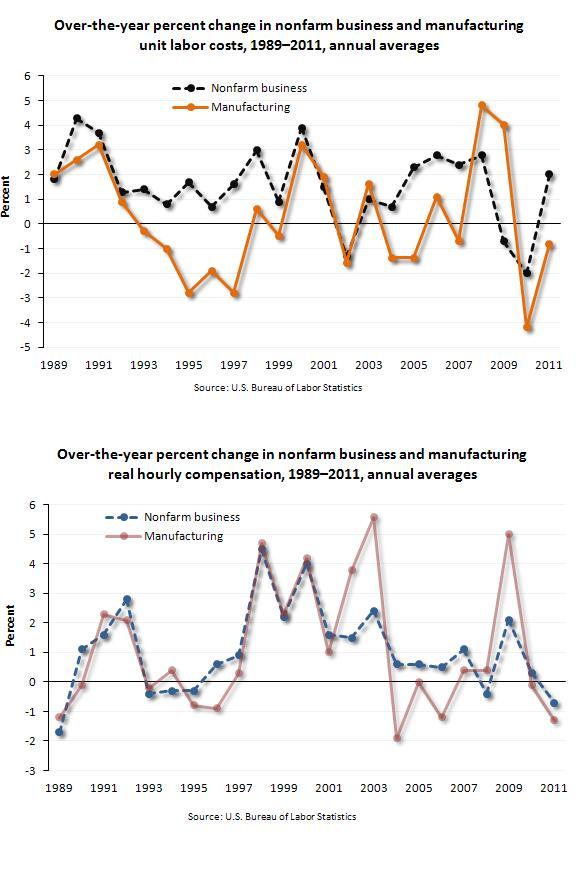
Unit Labor Costs and Real Hourly Wages, 2011

Good stuff from the BLS providing informative insight on trends in U.S. labor costs and compensation,

For 2011, in both the nonfarm business and manufacturing sectors, annual average growth in unit labor costs was revised upward; this was due to upward revisions to hourly compensation and downward revisions to productivity.

In the nonfarm business sector, unit labor costs rose 2.0 percent in 2011 and declined 0.8 percent in the manufacturing sector.

In 2011, real hourly compensation, which takes into account changes in consumer prices, decreased 0.7 percent in the nonfarm business sector. This is the largest annual decline in the measure since a 1.7-percent decline in 1989.

Real hourly compensation in the manufacturing sector decreased 1.3 percent in 2011, the largest decline in the measure since a 1.9-percent decline in 2004.

(click here if charts are not observable)

Posted in Employment | Tagged , , | Leave a comment

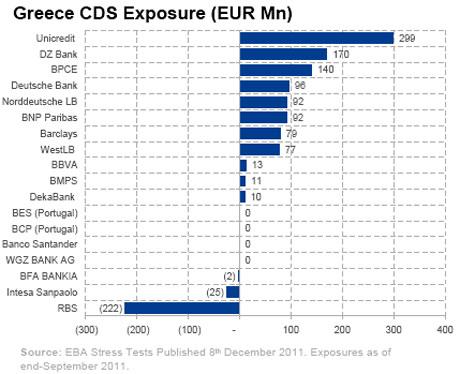
Greece CDS Exposure

Nice chart from Ambrose Evans-Pritchard’s Telegraph piece.   One would expect a relatively small first order effect if Greek CDS’ are triggered.   The second order effects,  such as contagion and the ding to market confidence are much more difficult to quantify and predict.

We have no idea what the take up on the bond swap participation will be.   But we’ll make the over/under at 64 percent of all outstanding bonds x/ official holdings of the ECB and EIB, for example.

Lots of optimism and complacency out there.   Guess zero interest rates and cen bank liquidity floats all boats.   But will it put out the the political fires?

It’s going to be an interesting day.

(click here if chart is not observable)
Posted in Black Swan Watch, Bonds, Euro, PIIGS | Tagged , | Leave a comment

Major Holders of Japanese Govt Bonds (JGBs)

Note the central bank holdings are increasing significantly .

(click here if chart is not observable)

Posted in Black Swan Watch, Bonds, Japan | Tagged , , | Leave a comment

Could Tiger Do This?

Here is the next Masters Champion taking a point from Anna Sharapova  at the BNP Paribas Showdown at MSG on Monday night.   Rory, the number one ranked golfer in the world, was there watching his girlfriend,  Caroline Wozniacki,  play in the exhibition.

(click here if video is not observable)

Posted in General Interest | Tagged , , | Leave a comment

Is Sunspot Theory Back?

Do you remember being flabbergasted as an economic graduate student when studying business cycles and learning that recessions and booms were once linked to sunspots and solar flares?  In case you haven’t heard, the sun emitted a massive solar flare yesterday and the blast is about to hit mother earth with a strong geomagnetic storm sometime in the next few days.

How’s this going to affect markets and the economy?  Given we’re really no longer an agrarian economy we have know idea and our suspicions are probably nothing unless it somehow whips up the animal spirits.

We did find this video piece linking geomagnetic storms to earthquake activity very interesting, however.   We take this stuff a little bit more serious as we move closer to the anniversary of Japan’s tragic earthquake on March 11th.

Not many people could have taken such a severe blow as the Japanese and the country’s heroic response and perseverance is a testament to their national character.   Godspeed,  Japan.

(click here if video is not observable)

Posted in Economics, General Interest | Tagged , , | 1 Comment

U.S. Posts First Petro Product Trade Surplus Since 1949

The times they are a-changin’.

According to the EIA the United States exported more petroleum products than it imported in 2011 for the first time since 1949.   Though declining, American refiners still imports large amounts of crude oil.

Strong global demand for distillate fuel, which includes diesel, some, of which, is likely the result of Japan’s energy problems from last year’s devastating earthquake helped fuel demand for U.S. products.   Refiners also had increased access to to supplies of crude oil imports from Canada, which exceeded 2 million bbl/d for the first time in 2011 and North Dakota’s Bakken formation.   The U.S. does remain a net importer of crude oil, however.

Petroleum products were ranked second in value of all U.S. exports during 2011 at $111.1 billion, up 60 percent from 2010.  Vehicles were the number one U.S. export last year at $132.5 billion.   Crude oil was the biggest U.S. import, totaling $331.6 billion, up 32 percent from 2010, mainly due to rising prices rather than volumes.

This appears to be a trend.  Still want to be short the dollar?

(click here if charts are not observable)

Posted in Commodities, Crude Oil | Tagged , , | 5 Comments

Our Pick for World Bank President: Arminio Fraga

Bloomberg’s Tom Keene reported this morning that Bill Gates is on the short list to replace  Robert Zoellick as President of the World Bank.   As former Bank employees we’re O.K. with that and kind of surprised Hillary isn’t on the list.  Maybe she is just burnt out.

Larry Summers?  Absolutely brilliant, but absolutely abrasive.

We think a Brazilian with:  1) a Ph.D. in economics from Princeton; 2)  former Brazilian Central Bank president;  3)  and hedge fund manager for George Soros;  would be the best choice, however.    Furthermore,  Arminio Fraga understands the dynamics of international capital flows, which can either make countries bloom or turn them into barren economic deserts.

The U.S. must accept the reality of the world’s changing geopolitical power structure and giving up the American post as President of the World Bank is a low risk gesture and good diplomacy, in our opinion.

President Obama must make the decision by March 23rd.

Click here for an interview with Arminio Fraga.

(click here if picture is not observable)

Posted in Economics, Policy | Tagged , , , | 2 Comments

Charlie Rose: Daniel Kahneman

This is a must view for all investors and traders.   Daniel Kahneman is the only non-economist to win the Nobel Prize in economics and his work provides key insights into market, investor, and trader biases.   There is  no doubt, at least to us, the markets “think fast” and “think slow.”  Listen to his observations on Soros and Paulson.

Click here for full interview.

(click here if pictures are not observable)

Posted in Economics | Tagged , , | 2 Comments