Creative Destruction 2.0

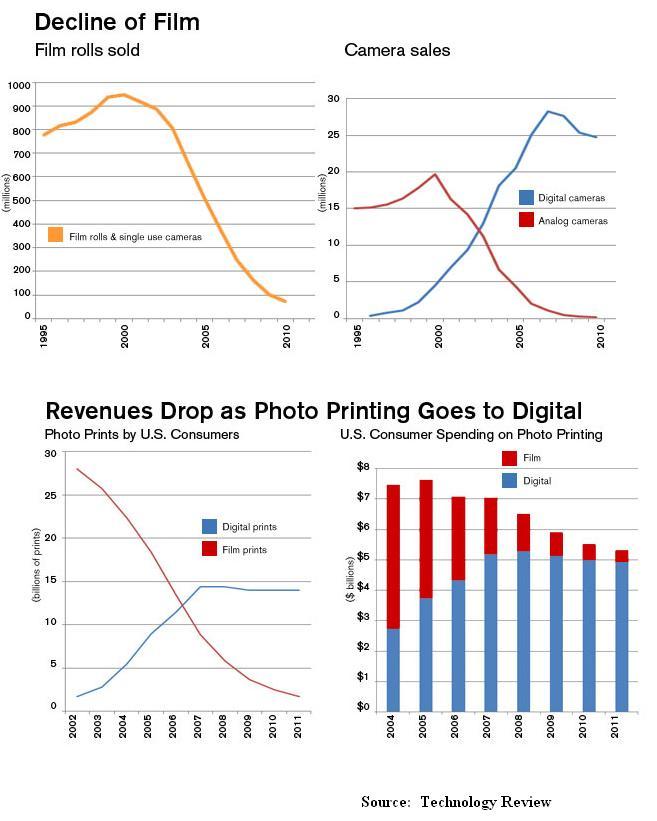
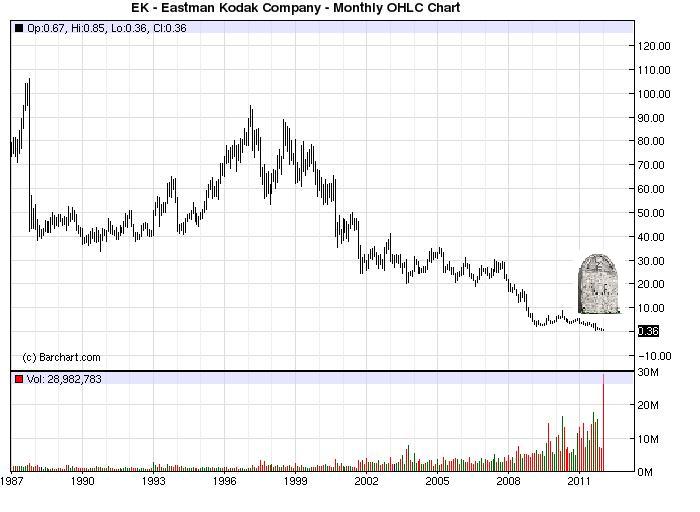
R.I.P, Eastman Kodak, may you rise like a Phoenix out of bankruptcy.   If only you were owned by the government,  Larry Wood, as pictured below, might still have his job doing the same work he was doing in 1968.

(click here if charts are not observable)

Posted in Economics, Employment, Energy, Policy, Politics | Tagged , , , | 4 Comments

Westport Innovations: A Nattie Play That Has Worked

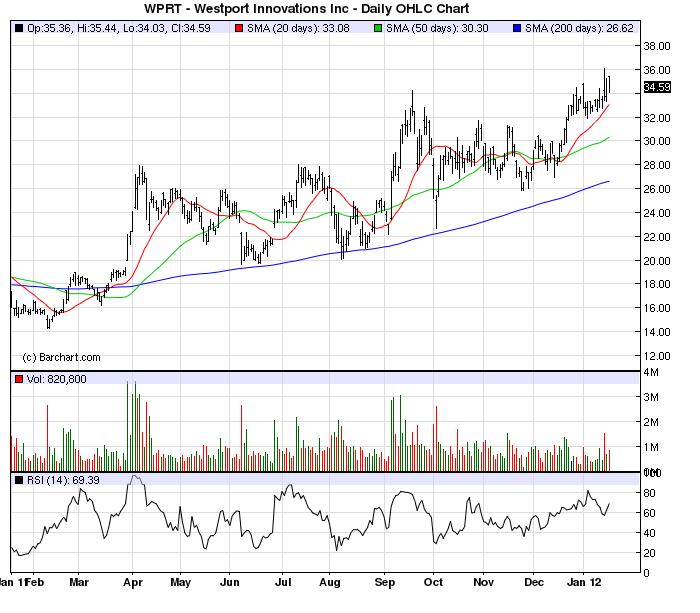
Westport is a nattie/crude oil arb play (see last week’s post here) we’ve  dabbled in and sold waaaaaaay too early.  No earnings yet, but strong revenue growth.  Buying it here?  Place your bets.

The collapse in natural gas prices, which is now trading at a $14 BTU equivalent barrel of crude oil,  could has sparked the “Next Big Thing.”  Clean Energy Fuels (CLNE) unveiled its plans for America’s Natural Gas Highway last week,

The route plan for the first phase of 150 new LNG fueling stations for America’s Natural Gas Highway (ANGH) was unveiled today by Clean Energy Fuels Corp. (Nasdaq: CLNE – News), the leading provider of natural gas fuel for transportation in North America. The company has identified 98 locations and anticipates having 70 stations open by the end of 2012 in 33 states.

Here’s a little intro video to Westport, which should give an idea where we’re going with all this.

(click here if video is not observable)

Posted in Clean Tech, Crude Oil, Energy | Tagged , , , , , | 1 Comment

IMF Having Trouble Raising New Funds

(click here if video is not observable)

Posted in Black Swan Watch, Sovereign Debt, Sovereign Risk | Tagged , | 2 Comments

What Eurozone Crisis?

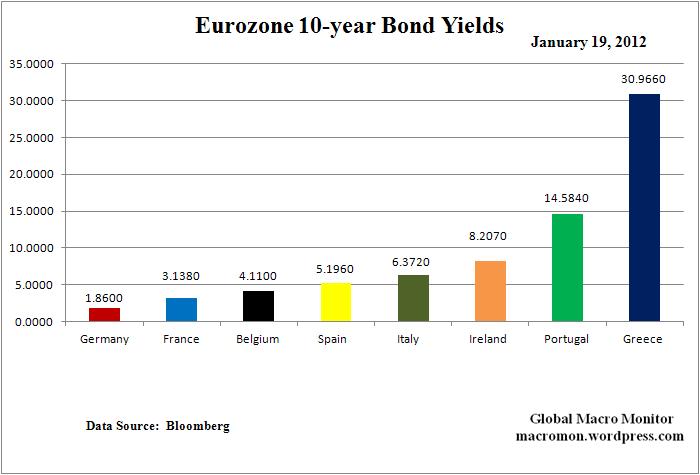
Wow!  Check the moves in the large Eurozone bank stocks today and for the week.  And, unlike the U.S. market, on heavy volume.   Euro sovereign spreads are a bit tighter on the week with the exception of Portugal, which Standard and Poor’s relegated to the junkyard last Friday.

After our post last week about confidence improving in Europe,  we now sense markets are starting to perceive the big two — Italy and Spain — have been ring fenced from Greece and Portugal.   Sovereign risk, within certain bounds,  is largely about confidence and is why some countries can fund themselves with debt loads three times greater than others that can’t.

The first big test of our hypothesis will come when Greece defaults.  Longer term,  reform fatigue and political risk will be the major drivers of European volatility, in our opinion.

Stay with Global Macro Monitor throughout the year as we closely monitor the situation in the ‘zone with our Weekly Eurozone Watch.

(click here if charts are not observable)

Posted in Black Swan Watch, Euro, PIIGS, Sovereign Debt, Sovereign Risk | Tagged , , , , , | 2 Comments

Does the Solar ETF Reflect the Chances of Obama 2.0?

Take a look at the Solar ETF’s performance over the past couple of years.   We, along with the President and most Democrats, were all lathered up about the “Green Economy” leading us into a new economy.    What a disaster!

Granted much of the losses are due to the European sovereign debt and fiscal crisis and China subsidies, but thank goodness we’re traders and cut our losses.    Will the electorate hold the White House accountable for its naïveté about a “green” economic expansion?

(click here if chart is not observable)

Posted in Clean Tech, Energy, Policy | Tagged , , , | 2 Comments

500-million Chinese Using the Internet

Stunning!

(click here if video is not observable)

Posted in Clean Tech | Tagged , | Leave a comment

World Bank Bearish on Global Economic Prospects

The World Bank’s latest Global Economic Prospects (GEP) 2012 published today warns of a coming year of “uncertainties and vulnerabilities.”    They note gross capital flows to developing countries plunged to $170 billion in the second half of 2011, which was only 55 percent of the $309 billion in the same period of 2010.  In addition,  they are forecating developing country growth for 2012 to be 5.4 percent, the second lowest over the past 10 years.

Here is the GEP lead author Andrew Burns warning EM economies to prepare for further shocks.   It’s well worth your three  minutes and we generally share the Bank’s macro view of the world in the coming year.  After all, we got our start at the World Bank working on the first two Structural Adjustment Loans (SALs) for Chile in the mid-1980’s.   How cool was it to help the country set up their copper stabilization fund, which later became the model for the Mexico and Venezuela Brady bond oil warrants or value recovery rights.

That said,  “sometimes an economist is just an economist” as nobody knows the future for certain and markets can behave au contraire to the real economy often longer than traders can remain solvent.

Furthermore markets can sometimes change fundamentals.  This is especially true with respect to sovereign risk, which is largely, within certain bounds, a function of confidence.  It’s certainly going to be an interesting year.  The Year of the Dragon!

(click here if video is not observable)

Posted in Black Swan Watch, Economics, Sovereign Debt, Sovereign Risk | Tagged , | Leave a comment

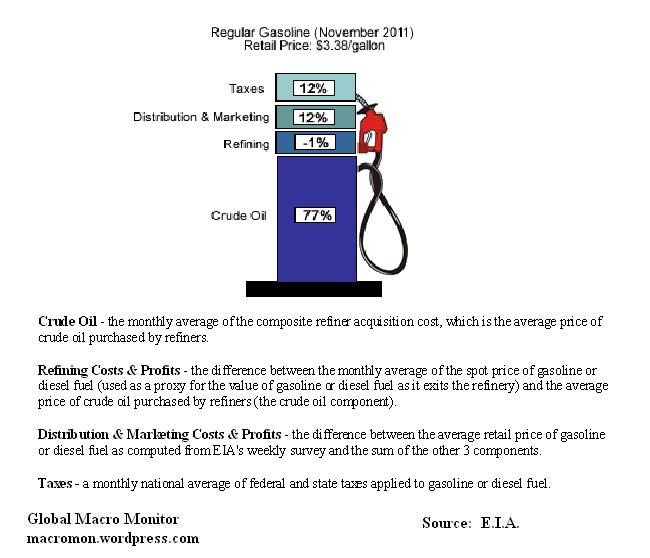
Here’s What You’re Paying for in a Gallon of Gas

Very informative graphic from the E.I.A. on what we’re paying for at the pump.   Note the loss in refining.   See our post,  U.S. Gasoline Consumption Tanks in 2011,  illustrating the collapse in gasoline consumption in 2011.

Click on chart to enlarge image and for better resolution.

(click here if chart is not observable)

Posted in Crude Oil, Energy | Tagged , | 4 Comments

Fareed Zakaria’s GPS: Krugman and Rogoff

Great exchange between Krugman and Rogoff on Fareed’s GPS yesterday.   Here’s the money rumble:

FAREED ZAKARIA:  Paul, you had a column and a really striking graph, where you point out that if you’d asked yourself what has the market told us over the last three years, you know, the market’s verdict has been that the United States, which engaged in a big stimulus program, and then the Fed did quantitative easing and quantitative easing to – has found that its borrowing costs have just fallen and fallen and fallen.

PAUL KRUGMAN:  That’s right. People are actually willing to basically pay the United States government to keep their money safe, which suggests that the market, at any rate, is not at all worried about U.S. solvency, which suggests that even leaving aside the whole question of multipliers and whether you can create lots of jobs, this would be a really good time to being doing a lot of public investment, because you can borrow the money for zero or actually negative cost.  So it’s a pretty spectacular contrast with the rhetoric in Washington….

KEN ROGOFF:  Well, for one thing, interest rates are not an incredibly great predictor of what’s going to happen in the future.  Iceland was borrowing at very low interest rates in 2006.  You can point to lots of other examples.  This has been studied a lot, and it’s hard to find evidence that they really can predict what’s going on.

And, of course, debt levels are surging, not just the United States, but across the advanced countries.  And I think that’s really important, not just to look at public debt, but to look at the total picture on debt, which just looks like nothing we’ve ever had before.

We’re already a general government debt above World War II, but if you throw in private debt, which often becomes public debt, we’re very familiar with that.  I mean, I don’t think it’s nuts to be worried about debt and to just point at the interest rates and say, well, this isn’t a concern.  I think it’s too easy.

And the there you have it, folks, TheTale of the Two Tails, and one of the major factors driving global volatility.   Check out the rest of the interview.   Two heavyweights going at it – in a civilized way.

(click here if video is not observable)

Posted in Black Swan Watch, Economics, Fiscal Policy, Monetary Policy, Whales | Tagged , , , | 3 Comments

China’s GDP beats forecasts, Q4 Growth at 8.9 percent

The Sydney Morning Herald reports,

China, the world’s second biggest economy, posted growth of 8.9 per cent in the last three months of 2011, beating economist forecasts even as export demand moderated.

China’s growth for the quarter, though, slowed for a fifth consecutive quarter as the government reversed some of its stimulus policies in a bid to keep inflation in check. The 8.9 per cent pace is also the slowest expansion since the June quarter of 2009 and compared with the 8.7 per cent pace tipped by analysts.

After the announcement the Shanghai Composite initially sold off on expectations that monetary easing would be less than originally expected before bouncing nicely.

All eyes  are now on how Chinese factories react after the holiday.  Will they or won’t they rehire workers returning from the New Year.  Stay tuned.

Posted in Black Swan Watch, Charts | Tagged , | Leave a comment