Italy’s Monti to Focus on Growth

(click here if video in not observable)

Posted in Black Swan Watch, Euro | Tagged , , | 2 Comments

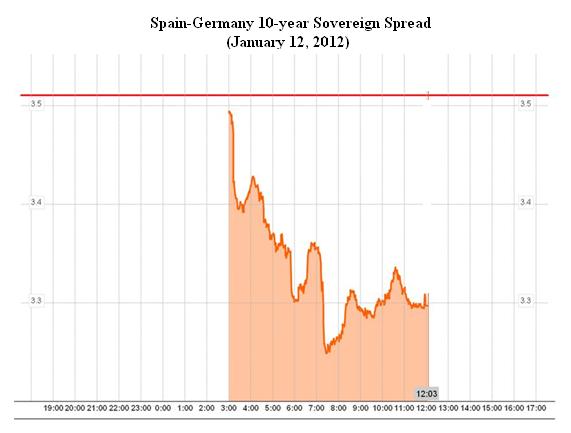
Eurozone Sovereign Spread Tightening

After the better than expected Spanish bond auction, eurozone sovereign spreads have come in significantly today.  The widely watched Italian 10-year bond yield fell to 6.63 percent.

The return of confidence, in our opinion, is the continuation of the markets’ realization that the ECB’s Long Term Refinancing Operation (LTRO) was the hidden bazooka in the last EU summit, which took a systemic banking crisis off the table in the short-term.   Though risk remains elevated, the LTRO directly addressed the funding problem and liquidity crisis in the European banking system.

This is reflected in the break of the correlation between the Euro and European equities in mid-December.  We have been closely monitoring this relationship to signal a potential confidence inflection point in the eurozone’s sovereign debt and banking crisis.

Note in the chart below the Euro and European equities, as reflected in the German DAX, traded almost tick for tick for most of 2011.  The divergence began as the markets realized LTRO greatly reduced the systemic risk and the potential collapse of Europe’s banking system.

Rather than hoarding gold and fretting over the collapse of the Euro, Germans are now openly discussing the hidden “blessing” of the European crisis.  Tuesday’s Der Spiegel’s piece, Europe’s Crisis Is Germany’s Blessing, wrote,

Its neighbors may be suffering, but the euro crisis has created conditions that actually benefit the German economy. Not only is the government enjoying the windfall of negative interest rates on bonds, but unemployment is down and exports are booming.

It’s every debtor’s dream. When asked for a loan, the bank not only agrees, but actually pays the borrower for their patronage. It sounds like a fairy tale, as though the laws of the market economy had been suspended. But on Monday it really happened.

The debtor in this case was the German government, which borrowed €3.9 billion ($5 billion) for the next six months at the unbelievable interest rate of -0.01 percent. Even the German Finance Agency was stunned. “This has never happened before,” a spokesperson said.

The Finance Ministry should be pleased. In the last four years, they’ve had to shell out around 1.8 percent in interest for such bonds. But recently even interest rates on German bonds with longer maturities have decreased significantly. The federal government is saving a bundle.

The European sovereign debt crisis is far from over and the LTRO directly addresses only one of the four issues driving the sovereign/banking crisis in the eurozone:

1)       Sovereign liquidity/funding – ability of sovereigns to rollover debt maturities at sustainable interest rates.  The markets are still looking to the ECB for a short-term liquidity backstop for Spain and Italy.

2)      Sovereign debt sustainability and solvency – This has been the primary focus of EU policymakers and can only be realized with long-term structural adjustment policies in the highly indebted countries.   Policies that promote growth must be an integral part of structural reform.  The key risk is reform fatigue and political populism.

3)      Bank funding/liquidity – The LTRO addresses this issue and takes the financial collapse scenario off the table and elevates  “muddling through” as the base case scenario.

4)      Bank capital and solvency – European banks still need to raise large amounts of capital and EU leadership has been weak, in our opinion.  Balance sheets need to be strengthened to allow for bad debt to written off/down.  This will take some time and depends much on market conditions.

We find interesting the policy juxtaposition of the EU, who appear more focused on longer-term structural adjustment, with the U.S., who are experts at short-term stabilization and fall short at addressing longer term structural issues.  The ultimate survival of a cardiac arrest patient needs both short-term and long-term care.   Until both approaches are incorporated into a fully consistent policy response, in both, the E.U. and U.S., global market and business confidence will remain depressed.

(click here charts are not observable)

Posted in Black Swan Watch, Euro, Eurozone Sovereign Spreads, PIIGS, Sovereign Debt, Sovereign Risk | Tagged , , , , , , | 2 Comments

Charlie Rose: Ian Bremmer on Volatility Drivers

Ian Bremmer of the Eurasia Group on their latest report and the top risks that will drive volatility in 2012.

Click here for full interview.

                       (click here if picture is not observable)

Posted in Geopolitical, Interviews, Uncategorized | Tagged , , , | 3 Comments

U.S. Employment and Wage Growth in Large Counties

Interesting data points on the U.S. employment situation from the BLS:

From June 2010 to June 2011, employment increased in 215 of the 322 largest U.S. counties, the U.S. Bureau of Labor Statistics reported today. Ottawa, Mich., posted the largest increase, with a gain of 4.7 percent over the year, compared with national job growth of 0.9 percent. Within Ottawa, the largest employment increase occurred in manufacturing, which gained 2,514 jobs over the year (9.0 percent). San Joaquin, Calif., experienced the largest over-the-year decrease in employment among the largest counties in the U.S. with a loss of 4.0 percent.

The U.S. average weekly wage increased over the year by 3.0 percent to $891 in the second quarter of 2011. Among the large counties in the U.S., Williamson, Texas, had the largest over-the-year increase in average weekly wages in the second quarter of 2011 with a gain of 18.0 percent. Within Williamson, a total wage increase of $195.2 million (39.2 percent) in the trade, transportation, and utilities industry had the largest impact on the county’s over-the-year increase in average weekly wages. Champaign, Ill., experienced the largest decline in average weekly wages with a loss of 3.6 percent over the year. County employment and wage data are compiled under the Quarterly Census of Employment and Wages (QCEW) program.

The stealth manufacturing renaissance continues.

(click here if charts and tables are not observable)

Posted in Demographics, Employment | Tagged , , | 1 Comment

The Shanghai Bounce

The Shanghai has put in its best two day performance since September ’09, rising 5.8 percent.   After its post crash peak in August 2009,  Chinese stocks have fallen almost 40 percent before hitting their lows last Friday.

Expectations of monetary easing before the Chinese New Year (January 23rd)  and news that the government might loosen regulations in the A-share market has bounced the  market.    The China Daily writes,

It was reported that the regulator has approved US bank Citigroup Inc to set up a joint-venture securities firm in China.

Analysts said that the acceleration in approving the launch of joint-venture securities firms is part of the regulator’s preparation for the long-awaited international board in Shanghai. The board will allow overseas companies to raise capital in the A-share market.

“The board failed to debut in 2011 due to global turbulence,” Banny Lam, economist with CCB International Securities Ltd, said. “I believe the board will be launched in the second half of this year when the global economy should improve.”

We doubt the monetary authorities will crank up money supply growth by 40 percent as they did in 2009,  but the depth the equity sell-off, coupled with the policy news could give a decent boost to the equity market.

Sustainable?  We have know idea, have our doubts, but will let the market decide.

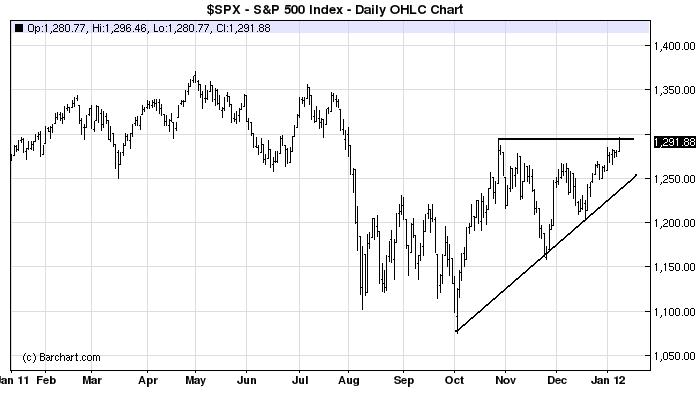
The S&P500 is also flirting with the 1292.66 October 27th high, but seems a little hesitant to cut loose.   If China worries and a euro meltdown are taken off the table in the short-term,  the market will only need decent and not great earnings as to move higher, in our humble opinion.

The European bond auctions, crude at $100 plus, and Iran need to be monitored closely, however.

P.S.  Long Jon Huntsman in the New Hamster primary.   More of a prediction than a political statement though we think he is one smart dude.  

(click here if charts are not observable)

Posted in Black Swan Watch, Equities, Global Stock Performance | Tagged , , , , | Leave a comment

Nonlinear Thinking: Smartphone Ultrasound Imaging

Stunning!  Guess it’s time for our annual physical with Dr. iPhone.

(click here if video is not observable)

Posted in Nonlinear Thinking | Tagged , , | Leave a comment

Macro Notes from the Alcoa Conference Call

4Q 2011 Highlights

  • Loss from continuing operations of $193 million, or $0.18 per share; excluding special items, loss from continuing operations of $34 million, or $0.03 per share
  • Revenue of $6 billion, down 7 percent sequentially, up 6 percent from 4Q 2010
  • Cash from operations of $1.14 billion, up $653 million from 3Q 2011
  • Record low days working capital
  • Free cash flow of $656 million
  • Cash on hand of $1.9 billion
  • 531,000 metric tons of capacity closed or curtailed to improve competitive position
  • Forecasting 7 percent growth in global aluminum demand and a global aluminum supply deficit in 2012

2011 Full-Year Highlights

  • Revenue of $25 billion, up 19 percent over 2010
  • Income from continuing operations of $614 million, or $0.55 per share, more than double 2010 results; excluding special items, income from continuing operations of $812 million, or $0.72 per share
  • Cash from operations of $2.2 billion
  • Free cash flow of $906 million
  • Debt-to-capital ratio 35 percent

Notes from the conference call:

Charles McLane – CFO

A 13% drop in the LME, combined with continued European weakness, contributed to the decrease in revenues on a sequential basis. On a year-over-year basis, sales increased 6% despite an 11% drop in LME as the aerospace, automotive, and commercial transportation markets all showed greater than 20% increases in revenue…

Now let’s move to the income statement. The loss for the quarter of $0.18 per share was primarily driven by restructuring and other charges which I will detail in the next slide. The COGS and SG&A percent of sales increases were essentially driven by a decline in revenue, which was a function of the falling metal prices…

The Global Rolled Products business faced challenges in the second half of 2011 due to demand destruction from market weakness in Europe and expected fourth quarter seasonal declines…

Klaus Kleinfeld- CEO

The aluminum demand continued to grow substantially. It started strong into the year and weakened in the second half. As you may remember, we projected originally 12% growth. We believe the market has finished with a growth rate of 10% in the last year so that’s where it leaves us…

So let’s go into the end markets that we cater to. So we actually see on the global scale growth to be positive in 2012 in those end markets that we serve, and at the same time, there are still some specific headwinds in certain regions that will prevail. So let’s go through it in the usual way.

Aerospace for 2012, we believe the positive momentum is going to continue. We expect 10% to 11% growth, driven strongly by large commercial aircraft. We now have an increased confidence in the delivery rates because 2011 net orders came out to be 2,183 of our large commercial aircraft. That’s obviously Boeing and Airbus together, which is the second highest in aviation history. The combined backlog of both firms now is 8.2 years. So I think there is good reason to be optimistic about that market.

Automotive, another pretty good story, with the exception of Western Europe. We expect on a global basis to have growth between 3% to 8%. So let’s look in some of the major regions. North America. It looked in the summer as though we would see a slowdown but then the fourth quarter came on strong with 13.4 million vehicles. We expect this momentum to continue into 2012 and driven very strongly by the average vehicle age. That’s currently at 10.6 years whereas the 10-year average is 9.4 years, so we anticipated a growth here between 5% to 10% in 2012…

In China, the Chinese commercial truck market has substantially come down from this enormous high of 1 million vehicles in 2010, 865,000 trucks in 2011. We’re looking forward to 2012 because we anticipated growth between 3% to 8% to 2011. Chinese government is expected to enforce some stricter engine requirements in the second half so this is going to cause onto some positive momentum here in this market.

(click here if charts are not observable)

Posted in Commodities, Earnings | Tagged , , | 1 Comment

What’s Up at the CES

(click here if video is not observable)

Posted in Technology | Tagged , | Leave a comment

France and Germany push financial transaction tax

(click here if video is not observable)

Posted in Economics, Equities, Fiscal Policy | Tagged , | Leave a comment

The Widow Maker

What energy crisis?  And why doesn’t our electricity bill come down with the price of natural gas?

The BTU equivalent price of a barrel of crude oil relative to natural gas is now around $16.60 versus the $100 where crude oil trades today.  That is one heck of an arb and will be the “Next Big Thing” if the discrepancy lasts.   Nattie has to be a buy in here.

(click here if chart is not observable)

Posted in Energy, Technology | Tagged , , | 8 Comments