Best Investment 2011: Default on Your Mortgage

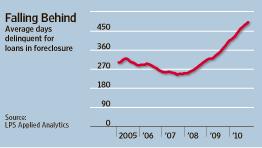
It’s an absurd world.  We have incentivized people to stop paying their mortgage and stay in the house as long as possible before eviction.  The Wall Street Journal reports the average number of days since the average borrower in foreclosure last made a mortgage payment is 492 days.    The Journal writes,

In recent months, the number of borrowers entering severe delinquency — meaning they missed their third monthly mortgage payment — has been on the decline, falling to about 700,000 in October, according to mortgage-data provider LPS Applied Analytics. But it’s still more than double the number of foreclosure processes started.

As a result, banks are taking progressively longer to foreclose. The average borrower in the foreclosure process hadn’t made a payment in 492 days as of the end of October, according to LPS. That compares to 382 days a year ago and a low of 244 days in August 2007.

In other words, people who default on their mortgages can reasonably expect, on average, to stay in their homes rent-free more than 16 months. In some states such as New York and Florida, the number is closer to 20 months.

That’s a meaningful incentive, and it’s likely to grow unless banks manage to boost their throughput. Speeding up the process won’t be easy, as demonstrated by the banks’ continuing legal troubles related to robo-signers, bank employees who signed foreclosure affidavits without properly checking the required loan documentation.

Millions of Americans still are paying their mortgages even though they owe more than their homes are worth. The more banks’ backlog grows, the more likely they are to join it, adding to the already giant pile of foreclosures weighing on the housing market.

492 days! And it’s an average. That’s 16 months of free rent. In a McMansion, were talking $75K net of taxes!  Is this the new “cottage” industry?  Those who continue to pay get hosed, those who default live rent-free or get mortgage modifications.  I guess we know the direction of defaults in the next few years.
Posted in Black Swan Watch, Bonds | Tagged , | 4 Comments

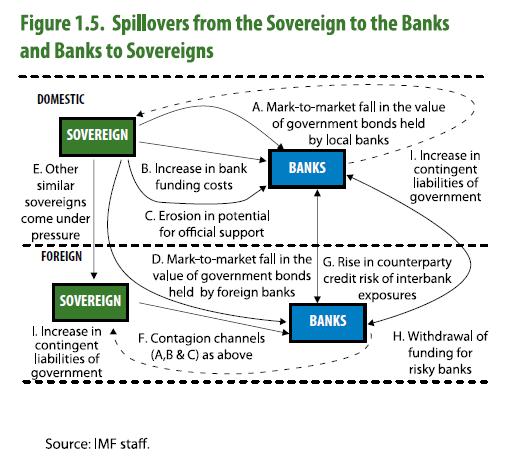
Chart of the Day: Banks to Sovereigns to Banks

Great chart from IMF showing feedback loop of Europe’s Sovereign Debt Crisis.  A little busy, but stick with it.

Posted in Black Swan Watch, Bonds, Budget Deficit, Credit, PIIGS, Sovereign Debt, Sovereign Risk | Tagged , | Leave a comment

Run on German Safe Deposit Boxes? WTH?

The implosion of the Eurozone appears to be accelerating. But Germany?  Come on!  Yet Ambrose Evans-Pritchard writes the crisis in the eurozone periphery is moving to the core as credit default swaps for German, French,and Dutch bonds have blown out in recent days.  In his Telegraph article, EU rescue costs start to threaten Germany itself, Evans-Pritchard writes,

“Germany cannot keep paying for bail-outs without going bankrupt itself,” said Professor Wilhelm Hankel, of Frankfurt University. “This is frightening people. You cannot find a bank safe deposit box in Germany because every single one has already been taken and stuffed with gold and silver. It is like an underground Switzerland within our borders. People have terrible memories of 1948 and 1923 when they lost their savings.”

The refrain was picked up this week by German finance minister Wolfgang Schäuble. “We’re not swimming in money, we’re drowning in debts,” he told the Bundestag.

While Germany’s public and private debt is not extreme, it is very high for a country on the cusp of an acute ageing crisis. Adjusted for demographics, Germany is already one of the most indebted nations in the world.

Reports that EU officials are hatching plans to double the size of EU’s €440bn (£373bn) rescue mechanism have inevitably caused outrage in Germany. Brussels has denied the claims, but the story has refused to die precisely because markets know the European Financial Stability Facility (EFSF) cannot cope with the all too possible event of a triple bail-out for Ireland, Portugal and Spain.

There is creeping doubt about Germany’s commitment if new funds are required,

Whether governments will, in fact, write a fresh cheque is open to question. Chancellor Angela Merkel would risk popular fury if she had to raise fresh funds for eurozone debtors at a time of welfare cuts in Germany. She faces a string of regional elections where her Christian Democrats are struggling…

The great question is at what point Germany concludes that it cannot bear the mounting burden any longer. “I am worried that Germany’s authorities are slowly losing sight of the European common good,” said Jean-Claude Juncker, chair of Eurogroup finance ministers.

Europe’s fate may be decided soon by the German constitutional court as it rules on a clutch of cases challenging the legality of the Greek bail-out, the EFSF machinery, and ECB bond purchases.

The article concludes with concern over German legal support for the bailouts,

“There has been a clear violation of the law and no judge can ignore that,” said Prof Hankel, a co-author of one of the complaints. “I am convinced the court will forbid future payments.”

If he is right – we may learn in February – the EU debt crisis will take a dramatic new turn.

Wow!  Even if the article is discounted for Ambrose-Pritchard’s perma-bearishness and sometimes borderline alarmism, the issues he raises must be considered in assessing market risk, and are certainly not priced,  in our opinion.  Meanwhile, Larry Fink, founder of Blackrock, says the Euro is going to $1.20.  Why would it stop at $1.20, we ask?   Buckle up!


Posted in Black Swan Watch, Bonds, Budget Deficit, Fiscal Policy, Geopolitical, PIIGS, Sovereign Debt, Sovereign Risk | Tagged , , , , | Leave a comment

“Will the next fiscal crisis start in Washington?”

Sheila Bair, chairman of the Federal Deposit Insurance Corp., writes in today’s Washington Post,

Even as work continues to repair our financial infrastructure and get the economy moving again, we need urgent action to forestall the next financial crisis. I fear that one will start in Washington. Total federal debt has doubled in the past seven years, to almost $14 trillion. That’s more than $100,000 for every American household. This explosive growth in federal borrowing is a result of not just the financial crisis but also government unwillingness over many years to make the hard choices necessary to rein in our long-term structural deficit.

Sheila Bair is bright enough to realize that Ireland’s blanket deposit guarantee of its banking system is a major cause of its current collapse and loss of confidence in its sovereign credit.   Furthermore, she, no doubt, understands, like Ireland,  the FDIC collapses if confidence deteriorates in “the full faith and credit of the U.S. government.”

The drumbeat is growing louder about a potential U.S. sovereign debt crisis.  What is happening in Europe must be scaring the Begeezus out of official Washington.  Let’s hope they get religion.

Posted in Black Swan Watch, Fiscal Policy, Policy, Politics, Sovereign Debt, Sovereign Risk | Tagged , , , | Leave a comment

Haircuts for Senior Bondholders in Irish Bank Package?

This Irish Times is reporting the that EU-IMF are “examining” burden sharing for senior bondholders.   Several proposals are being discussed, but the major focus is on two ideas: 1) bank debt-for-equity conversions; and 2) option of providing fresh capital injections or face a haircut on original principal.   The Irish Times writes,

Several proposals are on the table, said a source. At present attention centres on two similar schemes. In the first, bank debt would be converted into equity shares. In the second, bond investors would be given the choice of injecting fresh capital into banks or face a cut in their investment.

The source said there was a “common understanding” between delegations from the EU Commission, the European Central Bank and the IMF that senior and junior bondholders should each pay a share of the rescue costs.

The first step would be to seek to “persuade” senior bondholders to participate in the bailout, said the source. “If that doesn’t succeed, the question is how can you force them in a legally-sound way.”

Finally!  The recognition that the problem will only be solved by reducing debt, not increasing it.  This is a tricky and delicate issue, however, as it may induce further bank runs that could spread into Spain.  They need to be decisive and move quickly.  One reason the emerging markets are so strong today is that many countries reduced their debt burdens during the 1990’s when the restructurings of the 1990’s that finally started to focus on debt reduction.  Both Brazil and Russia were in default not much more than 10 years ago and are creditors to the U.S. government.

Posted in Black Swan Watch, Bonds, Fiscal Policy, PIIGS | Tagged , , | Leave a comment

Chart of the Day

Posted in Black Swan Watch, Bonds, Budget Deficit, Fiscal Policy, Japan, Sovereign Risk | Leave a comment

Ireland and Greece: “very different financial meltdowns”

Good piece on the Christian Science Monitor blog comparing the Irish and Greek crisis. The author defends four main differences:

1)      …while the Greek crisis involves long time fiscal mismanagement with systematically too large deficits even during the boom, the Irish crisis is instead a case of a bursted property bubble that has created big problems in the banking system. Indeed, Ireland actually had a surplus during the boom. However, that surplus was of course largely based on revenues from the property bubble.

2)      …related difference is that Ireland last year actually had a debt level below the euro area average (65.5% of GDP versus 79.2%). This year’s massive deficit will probably push it above the average, but it will still be significantly less than Greece and some other countries.

3)      A third related difference is that whereas the bulk of the Greek deficit is structural, the Irish deficit this year is mostly a result of the one time factor known as the bank bailouts. This means that even without either austerity or recovery, the Irish deficit will drop dramatically in the coming years once the recapitalization of the troubled banks are finished with.

4)      A fourth difference is that Ireland has more to lose from a IMF-EU rescue package. In Greece, there was no real disadvantage in taking that package because the austerity measures was needed anyway (though they arguably chose to rely too heavily on tax increases and too little on spending cuts) and because it lowered their cost of borrowing. While Ireland too needs more austerity measures (preferably spending cuts) and can lower its cost of borrowing, theere is a risk that the other EU countries might condition aid on an increase in the Irish corporate income tax rate.

Posted in Uncategorized | Leave a comment

Is Ireland’s Rescue Package a Veiled Bailout of the ECB?

Not that it needs a one, but some in Ireland are starting to ask the question.   The European Central Bank exposure in Ireland is above €130 BN, a quarter of its book, and now wants its money back.  In the article,  The ECB May Not Be The Friend It Seems, in Monday’s  Irish Times, John McMananus writes,

Suggestions that [the] bailout may in fact be to protect European interests may not be too wide of mark

WHEN THE history of Ireland’s banking and fiscal collapse comes to be written, the role of the European Central Bank may well turn out to be the most controversial..

…the role of the ECB in how we came to this sorry pass is worthy of some scrutiny. A more critical analysis might conclude that its policies over the last two years added greatly to our problems and ultimately its own. And it is the ECB’s problems as much as ours that brought things to a head last week.One of the main differences between how the two-year-old crisis has played out in Europe and America has been the refusal of the ECB to allow any significant bank fail.

It is worth noting in this regard that Jean Claude Trichet rang Brian Lenihan over that fateful weekend in September 2008 to impress on him the importance of not letting any Irish bank fail. The obvious inference was that the ECB would play its part.

Trichet was, of course, pushing at an open door given the other factors at play in Ireland: profound regulatory failure combined with the inability of the administration or the banks to comprehend the scope of the problem.

But the fact remains that the Government could not have gone down the road it did without the support of the ECB. Frankfurt has provided the liquidity needed to make the National Asset Management Agency function and was committed to a similar facility for the winding up of Anglo.

Above all it has provided liquidity to the Irish system to such an extent that Irish banks account for something like one in every four euro it makes available through its emergency measures. We kept our end of the bargain. No Irish bank has failed although two are to be closed, but crucially their secured creditors are to be paid…

Instead a situation arose whereby the problems in the Irish banks were not dealt with as they should have been – through letting them fail or some sort of debt for equity swap – and the ECB found its own balance sheet contaminated by the amount of support it had to extend to Ireland as a consequence. Meanwhile, the Irish exchequer is left with a bill it cannot afford.

Now, in order to extract itself from this mess, the ECB has in effect withdrawn its support and said that the Irish taxpayer must now borrow even more money and try – for a third time – to fix the knackered banks so the ECB can get its money back.

There you have it.  The beginnings of a debate that sounds vaguely familiar to the one ongoing in the U.S. for the past few years.  And with some Germans now declaring the Euro “equivalent to US’ Subprime Securities’” the financial crisis has officially entered the political stage of the second phase.   The success or failure of the rescue programs and, utimately,  the integrity of the Eurozone itself,  will be determined largely by how the politics plays out.  Stay tuned!

Posted in Black Swan Watch, Bonds, Fiscal Policy, PIIGS, Policy, Politics, Sovereign Risk | Tagged , , , | Leave a comment

‘The Euro Was Equivalent of US’ Subprime Securities’

This quote is from today’s Spiegel Online International, which has an excellent summation of what the German newspapers are saying about the Eurozone sovereign debt crisis.   The leftist Die Tageszeitung writes:

“Where earlier countries with small currencies like the Irish pound had to pay high interest, suddenly the unified interest rate of the European Central Bank applied. This magical interest rate also remained very low, because the central bankers geared themselves not towards delicate, small Ireland, but rather towards stable, large Germany.”

“For Europe, the euro was equivalent to the US’s subprime securities. Both inventions promised a totally new financial world in which credit risks disappeared magically. Suddenly, consumption also seemed possible in financially weak social classes and countries, who, until then, had been shut out of the glittery world of capitalism. With a little bit of financial technology, the social questions appeared to be solved. Now, though, they have returned. That’s the real news behind the euro crash in Greece and Ireland. The austerity measures being taken by the governments there are affecting the weakest, regardless whether it means lowering the minimum wage or making cuts to social spending.”

“The euro temporarily transformed ‘Europe’s poorhouses’ into flourishing economies, but now the era of low interest rates is over. Forever. And what will become of Ireland and Greece now?”

Posted in Black Swan Watch, PIIGS, Sovereign Risk | Tagged , , , | 1 Comment

Irish Sentiment

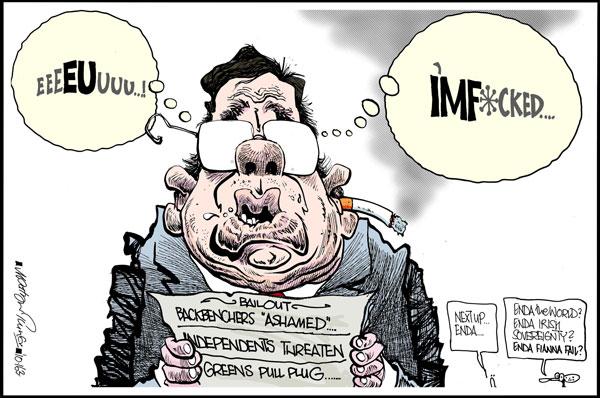
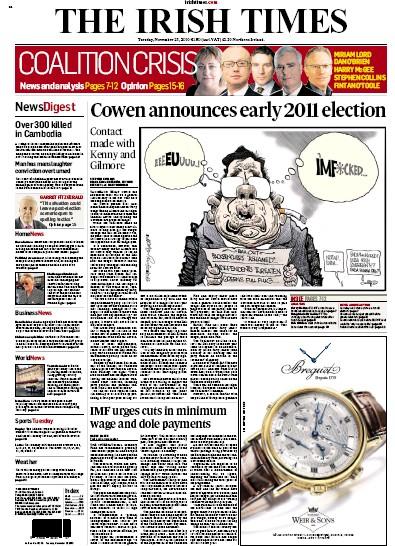
This cartoon of Prime Minister Brian Cowen is on the cover of today’s Irish Times.  Pretty much sums up how the Irish feel.  How long can the Euro last?


Posted in Black Swan Watch, Bonds, Policy, Sovereign Risk | Tagged , , , | Leave a comment