The Christmas Ramp

Here’s a look at the YTD performance of U.S. stocks.  December is shaping up for a year-end ramp as many dedicated funds are under allocated and under performing their benchmarks in a big way.  The S&P500 held its 50-day moving average in the recent market squall just as it does in textbooks and the incoming economic data is now a tailwind for stocks.  If Ireland fails to pass their budget next week, all bets are off!

The question is will they sell the losers and jump on the YTD winners?  Our flavors of the month are tech, energy, the aggies, and high-yielding commodity trusts in the U.S.; long the dollar;  short the 10-year bond with a close over 3 percent;  gold; and long Japan and Brazil equities.   Good luck!

Posted in Equities | Tagged , , , | 1 Comment

Economies of Scale: Eurozone vs American States

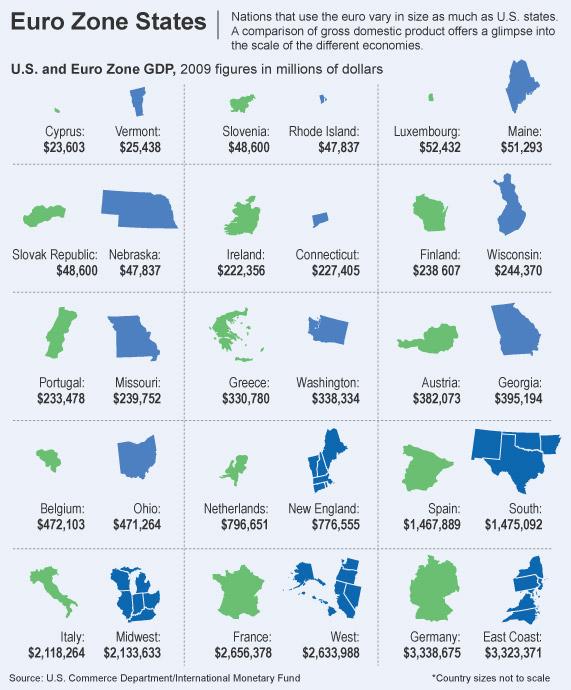
Great graphic from the Wall Street Journal’s Real Time Economics comparing the size of Eurozone economies to those of selected American states.  Here’s their intro,

To get a sense of scale, Real Time Economics compared the 2009 output of goods and services for members of the euro zone to the output of U.S. states. The economy of Spain, for instance, is about the same size as the combined economies of Texas, Oklahoma, New Mexico and Arkansas. Italy is nearly as big as Illinois, Indiana, Michigan, Ohio, Wisconsin and Kentucky combined.

Meanwhile, hopes for rescue rest on the shoulders of France, whose economy is bigger than that of the entire West Coast including Alaska, Hawaii and the U.S.’s largest state California, and on Germany, which is about the size of New York, New Jersey, Pennsylvania, Maryland, Virginia and North Carolina — plus the District of Columbia.


Posted in Economics, Euro, Policy | Tagged , | Leave a comment

Chart of the Day: Euro’s Dead Cat Bounce

Our Chart of the Day is the Dead Cat Bounce in the Euro.  The currency rallied on rumors of massive QE by the ECB to support the bonds of the PIIGS?  Come on!  QE of such size would drive the Euro lower.

The economic data in the U.S. is improving and much of Europe is slowing.  Unless a global facility is constructed to recapitalize European banks and provide support for European sovereign bonds, we remain bearish on the Euro.  The markets seem also to be ignoring the politics.  The highly respected economist, Barry Eichengreen, wrote today,

It pains me to say this. I’m probably the most pro-euro economist on my side of the Atlantic. Not because I think the euro area is the perfect monetary union, but because I have always thought that a Europe of scores of national currencies would be even less stable. I’m also a believer in the larger European project. But given this abject failure of European and German leadership, I am going to have to rethink my position.

The Irish “program” solves exactly nothing – it simply kicks the can down the road. A public debt that will now top out at around 130 per cent of GDP has not been reduced by a single cent. The interest payments that the Irish sovereign will have to make have not been reduced by a single cent, given the rate of 5.8 per cent on the international loan. After a couple of years, not just interest but also principal is supposed to begin to be repaid. Ireland will be transferring nearly 10 per cent of its national income as reparations to the bondholders, year after painful year.

This is not politically sustainable, as anyone who remembers Germany’s own experience with World War I reparations should know. A populist backlash is inevitable. The Commission, the ECB and the German Government have set the stage for a situation where Ireland’s new government, once formed early next year, rejects the budget negotiated by its predecessor. Do Mr. Trichet and Mrs. Merkel have a contingency plan for this?

There you have it.  And don’t forget the Irish package is contingent on their budget vote next week.   Stay Tuned!

Posted in Black Swan Watch, Bonds, PIIGS, Sovereign Debt, Sovereign Risk | Tagged , , , | Leave a comment

Curse of a Strong Currency: Australia’s Growth Stalls

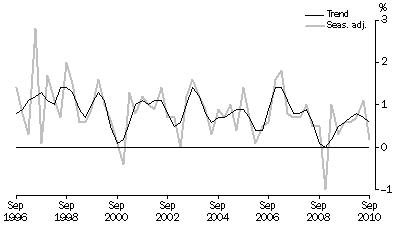
In a world of competitive devaluations, Australia is now the poster child of why countries are fighting to keep their currencies cheap.  The government announced Q3 GDP grew just 0.2 percent, bringing down the annual growth rate from 3.3 percent to 2.7 percent.  Growth in the quarter was the weakest in over two years.   Housing investment slowed due to the Reserve Bank of Australia’s interest rate hikes, which also led to a 25 percent appreciation of the Australian dollar from June to November.   Consequently, exports were hit relatively hard, falling 2.4 percent in quarter.

Posted in Currency, Monetary Policy | Tagged , , | Leave a comment

Will It Hold?

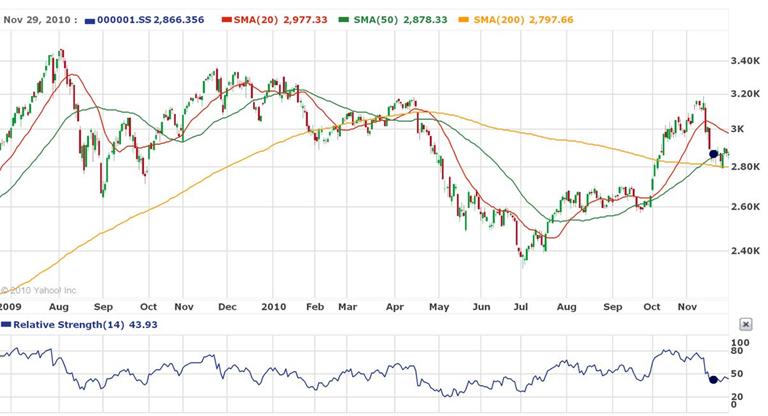
China ‘s PMI came in at 55.2 from 54.7 in October, better than expected.  The reports also showed input prices surging, however, reinforcing expectations that interest rate hikes are imminent.   The Shanghai Composite is right at its 200-day moving average of 2,800. Given that inflation is now the primary policy concern, we doubt the 200-day holds given the tightening cycle has only just begun.

Posted in China, Equities | Tagged , | 1 Comment

ECB About to PIIG Out on Bonds. Gold to the Moon.

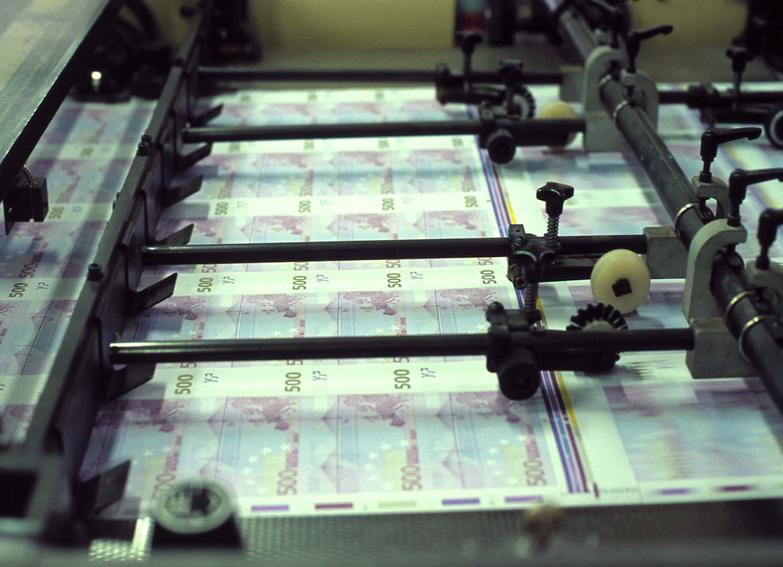
Just a few short weeks after German Finance Minister Wolfgang Schaeuble criticized U.S. monetary policy with his “with all due respect, U.S. policy is clueless” statement, the FT reports the ECB is contemplating expanding its sovereign bond purchase program.  That is, “printing money” to drive down European sovereign yields, which they believe are too high and do not reflect fundamentals.   The FT writes,

The hint that the ECB could recalibrate its response to the unfolding crisis came as the premiums that Italy and Spain pay over Germany benchmark interest rates hit fresh highs since the launch of the euro. The euro’s monetary guardian had already stepped up purchases of Portuguese bonds, traders reported…
Speaking in the European parliament on Tuesday, Mr Trichet would not comment “at this stage” on the bond programme “in the light of the current situation”. But the programme was “on-going” and decisions on its future would be taken by the 22-strong governing council, which next meets on Thursday. He also refused to rule out the possibility of eurozone governments issuing joint bonds, although the ECB was not endorsing such a step.

The ECB has bought €67bn of bonds since May and will have to significantly increase purchases to stem the panic now gripping the Eurozone.  We wrote earlier how the gold market may be sensing the ECB will be forced to monetize the rollover of Eurozone sovereign bonds in 2011.   More from the FT,

Willem Buiter, chief economist at Citi, said: “The involvement of the ECB is likely to rise, despite its statements – and probably wishes – to the contrary.” He argued recently that the ECB backed by governments could give the new European bail-out fund a €2,000bn loan.

Gary Jenkins, head of fixed income at Evolution Securities, argued the ECB could try “real quantitative easing” through purchases of €1,000bn-€2,000bn of bonds. “It might be politically unpalatable. But it would be an immediate way of creating a firebreak.”

Wow, €1,000bn-€2,000bn!  This would send gold up $1,000 in a nanosecond if markets sensed it had any credibility, even as the ECB contends they have and will sterilize any bond purchases.

Nevertheless, markets have reached the tipping point where they no longer have confidence in the ability of many Eurozone countries to pay back the debt they’ve accumulated and/or possess the political will do so.  The ECB thinks otherwise,

The ECB thinks financial markets are badly mis-pricing risk. Mr Trichet said that “pundits are under-estimating the determination of governments”.

What will the Germans say?  Stay tuned!


Posted in Black Swan Watch, Bonds, Currency, Euro, Fiscal Policy, Gold, PIIGS, Policy, Politics, Sovereign Debt, Sovereign Risk | Tagged , , , , | Leave a comment

Where is Gold Headed?

In 1996, we visited the Bulgarian central bank at a time when the country was experiencing economic turmoil and a loss of confidence that the government could rollover its maturing debt.  After a long discussion on the domestic economy and balance of payments, the chief policymaker looked us in the eyes and said, “we will not let the government default.”  That is, the central bank would buy and effectively rollover all maturing government debt if the auctions failed.   Within days the Lev began to reprice and we could buy nice Bulgarian wines for $.70 as domestic prices had not yet adjusted for the massive monetization.

The price action in gold today, after the sloppy trading of the past few weeks, may be the start of the market’s perception the ECB could be forced to monetize the PIIGS bond maturities coming due in 2011.   This is doable for the smaller countries, but Spain and Italy are much more problematic.  There are rumors in the market the ECB is buying Irish bonds today.

Gold held its 50-day and has been consolidating the sharp August-November rally.  Some see a head-and-shoulders forming, but we’re looking for a new high before year-end and a close above $1,390 would negate the right shoulder.  Take a look at the chart below and you can see several head-and-shoulders formations just in the past year, such as the trading pattern during March.

Nobody knows how this plays out. What will the Germans will do?  Will an international facility be put together with Chinese support?  Will we see a global TARP-like facility at the IMF?   This is why we live and trade by the 11th commandment:  “Those who remain flexible shall not be broken.”   Stay tuned!

Posted in Black Swan Watch, Commodities, Currency, Euro, Fiscal Policy, Gold, PIIGS, Policy, Politics, Sovereign Debt, Sovereign Risk | Tagged , , , , , , , | 1 Comment

Euro Trashed!

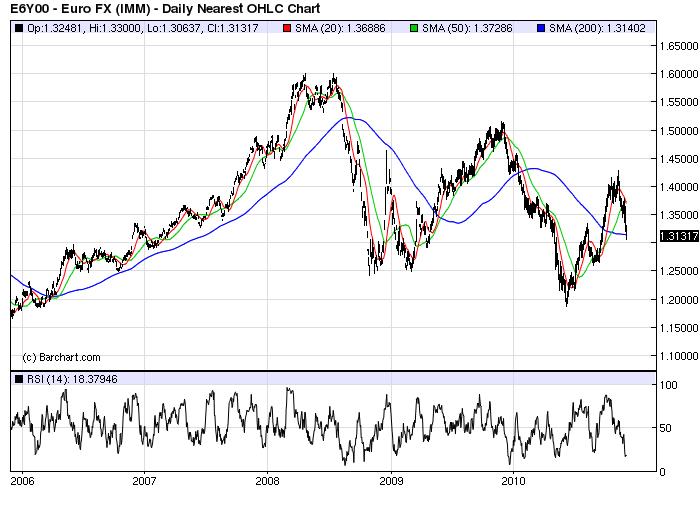
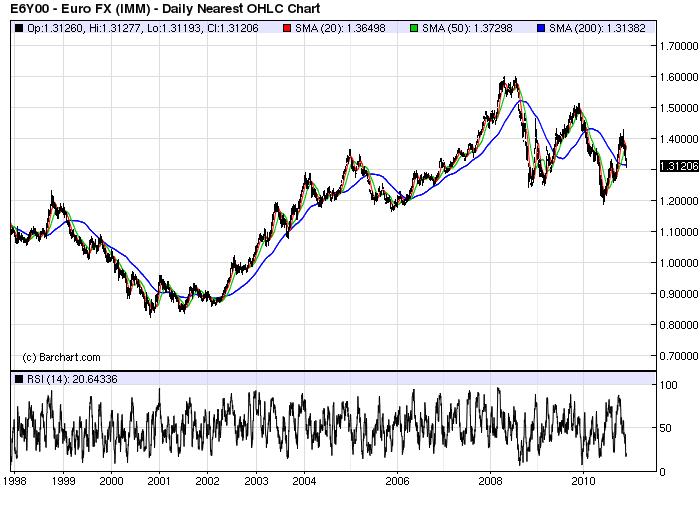
Dennis Gartman (click here for video) said today the Euro has “almost terminal problems”and eventually “breaks apart”  into a Northern Euro and Southern Euro.  The currency broke its 200-day moving average against the dollar and looks headed to a very important technical level of $1.20 (see long-term chart), which is close to its birth rate of $1.18.   We wouldn’t be surprised to see a bounce given the RSI is below 20 and would use the opportunity to buy more dollars.   Stay tuned!

Posted in Black Swan Watch, Bonds, Currency, Euro, Monetary Policy, Sovereign Risk | Tagged , , , | Leave a comment

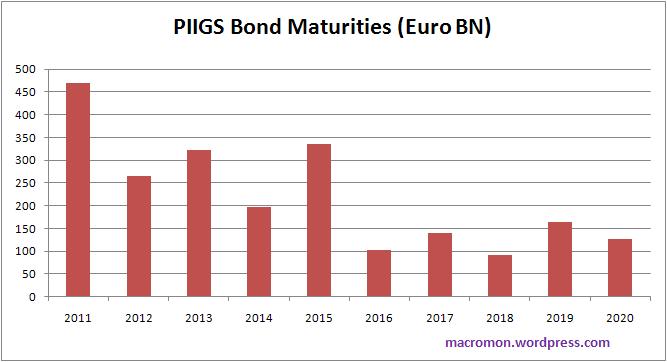
Chart of the Day: PIIGS Bond Maturities

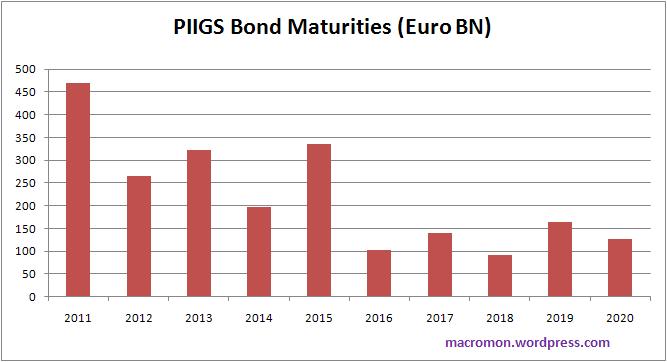
This is a major factor contributing to the Eurozone stress that just won’t go away.  SpiegelOnline charts show the PIIGS must redeem bonds totaling over Euro45o BN in 2011, of which, Euro 128.3BN are Spanish Bonds and Euro264.6 BN Italian Bonds.  Looks like 2011 is shaping up to be the year of “rollover risk.”

Posted in Black Swan Watch, Bonds, PIIGS, Sovereign Debt, Sovereign Risk | Tagged , | 1 Comment

Equity Bulls Battle on Two Fronts

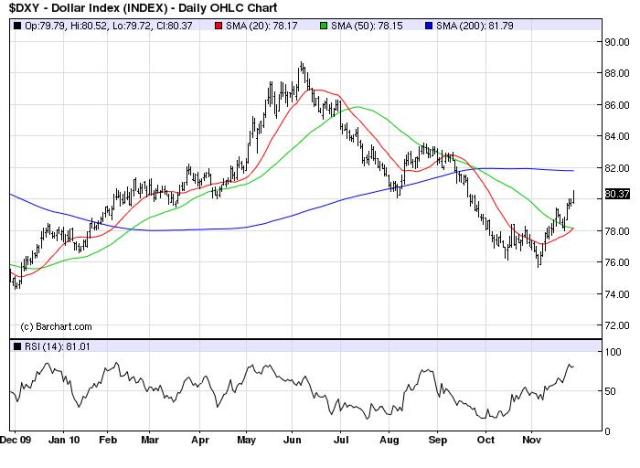
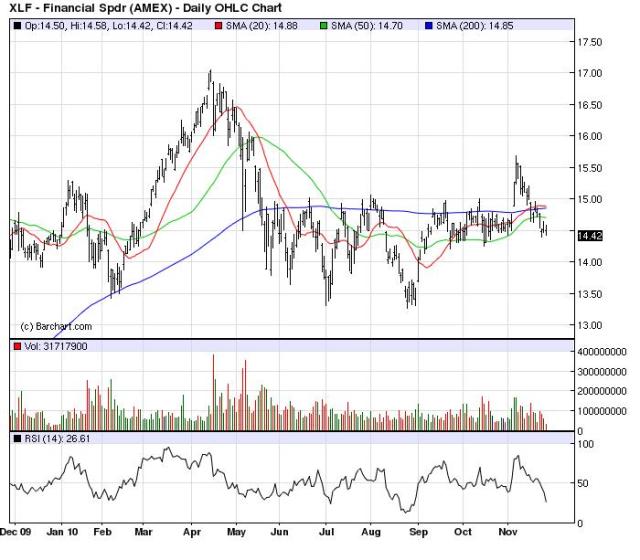
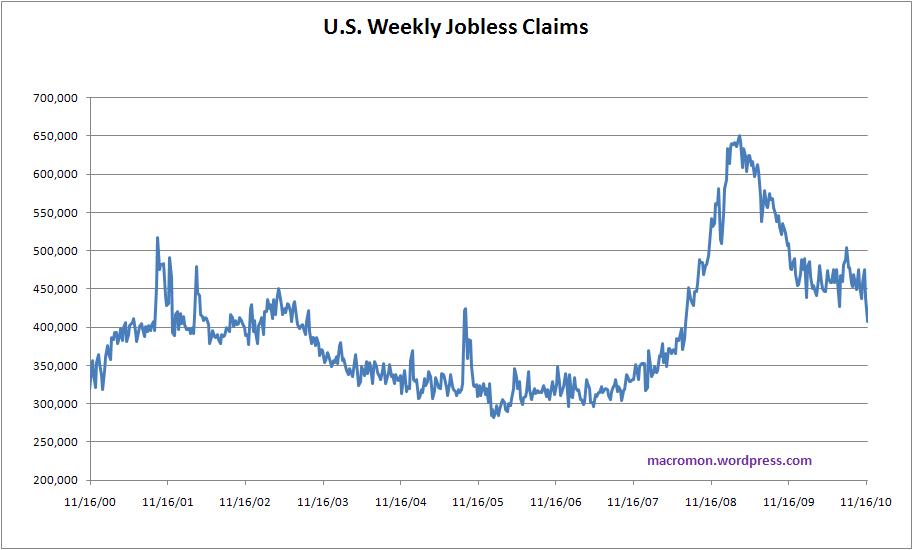
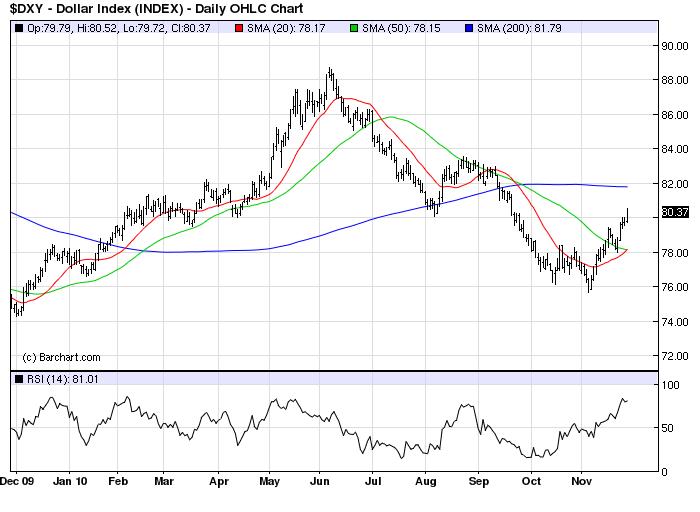
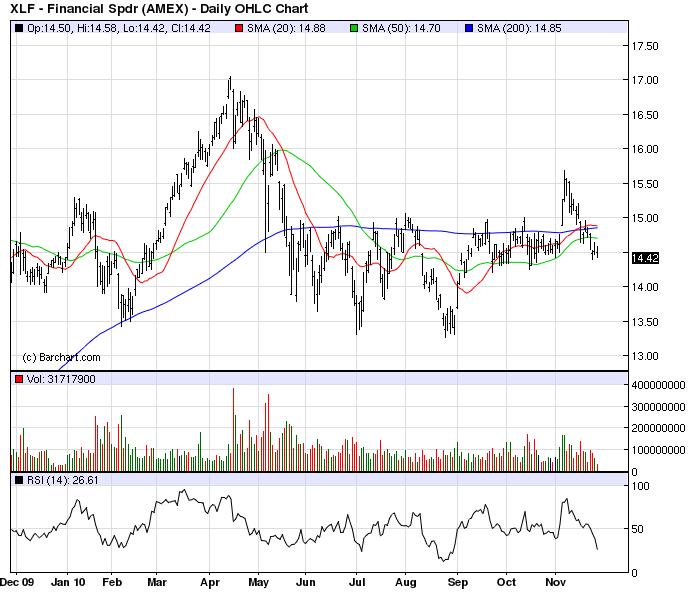
The slow improvement of the U.S. economy, reflected in weekly jobless claims, coupled with QE2 is providing an underlying bid to the equity market, which is surprising to many, given the increasingly ugly global macro picture.  On the Western Front, bulls are fighting the negative forces of the implosion of Europe, which has contributed to a sharp rally in the dollar and a sell-off in financials stocks (see charts.).   If the announcement of Ireland’s rescue package fails to stabilize Europe, we suspect the correction will gather speed causing the S&P500 to test, at minimum the 50-day moving average at 1176, with stronger support at 1132, the 200-day moving average.

The battle on the Eastern Front is much more uncertain, however.   First, who can predict the actions of North Korea?   And what and how will the Chinese react?  Will they try and use the situation to diminish the U.S. role in region, allowing the conflict to escalate in order to argue that the American presence actually increases instability?   China’s tough stance and export embargo of rare earth elements to Japan during the diplomatic row over the detainee of a fishing boat captain earlier in year was both shocking and enlightening.  It was, for many political analysts,  the “coming out” of  a new and more aggressive Chinese foreign policy.

Second, the direction of China’s monetary policy, which has been pushed off the radar with the North Korea and the European debt crisis, is a key driver for commodities and emerging markets.  China is perceived as the locomotive of global economic growth and the tightening monetary policy to tame inflation only adds more uncertain to the markets.

Nobody knows how the macro picture will play out.  We are surprised how well the U.S. equity market is trading and believe it is because: 1)  the perception the economy is improving; and 2) a surge of global capital flows back to the U.S. market.   We’re on the cautious side with a  small long equity position hedged with S&P puts and larger long dollar position.  We’re keeping a tight stop on gold as it has not been trading poorly, which is disturbing given the increase in geopolitical tensions and the Eurozone meltdown.

Finally, the bond is not behaving normally and has failed to rally during this period of global uncertainty.  This may be confirmation of the economic recovery story, or that sovereign debt concerns are starting to spread.  We will discuss in further posts.  Stay tuned.


Posted in China, Commodities, Currency, Equities, Geopolitical, Japan, PIIGS, Rare Earth Elements, Sovereign Debt, Sovereign Risk | Tagged , , | 1 Comment