IMF – U.S. monetary policy drives global stock prices

A recently published paper by the International Monetary Fund (IMF) found that U.S. monetary policy shocks drive global stock market prices. (click here for paper)

The International Business Times sums up the study,

When the Fed tightens (loosens) monetary policy, global equities tend to decline (rally), according to the study, which estimated that the unexpected component of U.S. interest movements has a negative coefficient of 0.04 with global stock prices.

For example, a 25-basis point increase of U.S. interest rates would reduce global stock prices by  1 percent. Interestingly, the impact of a 25-basis point rate hike on U.S. stock performance is similar.

The study also discovered that companies that depend on external financing and countries that are more “integrated with the global financial market” are more affected by U.S. monetary policy. The influence is also more pronounced during economic recessions.

“These findings suggest that financial frictions play an important role in the transmission of monetary policy, and that U.S. monetary policy influences global capital allocation,” said Laeven and Tong.

Interesting, but not surprising.

Posted in Equities, Monetary Policy | Tagged , , , | Leave a comment

Gold Spike Coming? Straw BRICs to Gold BRICs

There’s lots of chatter about China buying gold.  It was a big factor in Friday’s $30 move.  Jim Cramer was all over it, pounding the table the “secular trend” is not going away.

The Wall Street Journal reported Friday,

Data cited Thursday by China’s state-run Xinhua news agency showed that China imported 209.7 metric tons of gold in the first 10 months of the year, a fivefold increase compared with the same period last year…

China’s import growth is a reminder of the country’s huge but nascent purchasing power.

It comes as the government loosens its restrictions on gold purchases by financial institutions and individual investors. In August, the country began allowing more banks to import and export gold, opening up the gold market to the institutions and their clients.

Then this week, the Chinese securities regulator approved the country’s first gold fund designed to invest in overseas-listed gold ETFs, a move analysts interpreted as another bullish sign for gold.

As the market focuses on China’s private demand, we look at the potential massive official demand from global central banks, with particular focus in this analysis on the BRICs.  The Q4 2009 data from the IMF shows that 58 percent of official foreign exchange reserves from member countries are allocated to the U.S. dollar and 31 percent to the Euro.

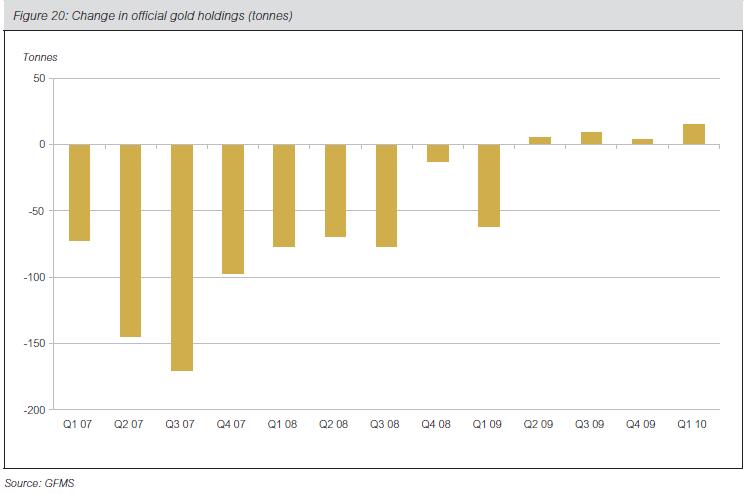
Given the choice of a reserve currency which is monetizing massive budget deficits and running large current account deficits or a reserve currency whose future existence is questionable, we believe emerging market central banks will be heavy buyers of gold over the next few years.  Many are significantly under allocated and some have been big sellers of over the past ten years.  Only recently have the central banks been net buyers as illustrated in this World Gold Council chart.

Of the BRICs, Russia’s central bank has been the most aggressive buyer of gold, increasing its official holdings by 244 tonnes over the past two years.  Note, purchases may not be reported until later dates, such as China’s announcement in April 2009 that it had bought 454 tonnes of gold over a six-year period from 2003-2009.

The table below shows Russia and India’s official gold holdings as a percent of reserves are a multiple of those of China and Brazil.  China’s reported gold holdings, for example, are only 1.70 percent of its reserves compared to India’s 8.10 percent.   To reach a gold target of 5 percent of reserves, for example, which is more than 2 percent below the average of Russia and India’s gold holdings, the People’s Bank of China would have to purchase 2,046 tonnes  and the Banco Central do Brasil 302 tonnes.   The sum of the two is almost double the total holdings of the popular gold ETF, GLD.

Similar to the under allocated portfolio and hedge fund managers who are forced to buy a rising market, most emerging market central banks are under allocated to gold.  We believe they are, and will be forced to chase gold up as it moves higher.

Gold is not about the destination, but about the journey.  As long as the major reserve currencies are monetizing fiscal deficits, running large external deficits, experiencing sovereign funding crises, and maintaining near zero interest rates, gold will continue to move higher.

Posted in BRICs, China, Gold | Tagged , , | 4 Comments

Bernanke’s 60 Minutes Interview

In case you missed it.

Posted in Monetary Policy, Video | Tagged , , , | 1 Comment

Merkel Warned EU Germany Could Leave the Euro

The slow motion fracturing of the Eurozone continues as revelations surfaced that German chancellor, Angela Merkel warned the EU her country could abandon the euro.  The Guradian reports the threat took place at the EU Summit in Brussels at the end of October.  Merkel became embroiled with Greek prime minister George Papandreou, who accused her of proposing “undemocratic” solutions to the crisis.

The Guardian writes,

Merkel’s central aim, which she achieved, was to win agreement on re-opening the Lisbon treaty so a permanent system of bailout funding and investor losses could be established to deal with debt crises that have laid Greece and Ireland low and are threatening Portugal and Spain. The Germans also called for bailed-out countries to lose voting rights in EU councils…

“If this is the sort of club the euro is becoming, perhaps Germany should leave,” Merkel replied, according to non-German government figures at the dinner. It was the first time in the 10 months since the euro was plunged into a fight for its survival that Germany, the EU’s economic powerhouse and the lynchpin of the euro’s viability, had suggested that quitting the currency is an option, however unlikely.

Merkel’s spokesman Steffen Seibert would not comment on her remarks today. But the threat, he said, was “not plausible. The chancellor sees the euro as the central European project, wants to secure and defend it and the government is not at all thinking of leaving it,” he said. “Germany is unconditionally and resolutely committed to the euro.”

Despite overwhelming opposition to her calls for depriving eurozone countries of their EU votes if they need to be bailed out, Merkel stuck to her guns on the issue at the summit, while conceding that the proposal would not feature at another summit in Brussels in two weeks’ time.

She argued that under the Lisbon treaty, which came into force a year ago, EU member states can have their voting rights suspended if deemed guilty of gross human rights violations. “If this is possible for human rights infringements, the same degree of seriousness needs to be awarded to the euro,” Merkel told the summit, according to the witnesses. She shelved the demand for suspension of voting, however, but won the argument on more limited change of the treaty to enable a “permanent crisis mechanism” to be established for the currency from mid-2013. This was rechristened the European stability Mechanism at last Sunday’s emergency meeting of EU finance ministers in Brussels which decided on an €85bn (£72bn) bailout for Ireland.

It is difficult to see the Euro surviving in its current form unless some miraculous burst of sustained economic growth takes place.  Merkel has insisted the primacy of politics over financial markets has to be restored.  She just might get her wish.  The clash of politics of “adjustment fatigue” in the troubled countries and the politics of resentment in Germany and other core countries just may terminally fracture the Eurozone.  Stay tuned!

Related Articles
How to quit the euro – Economist
Tight-fisted Germans resent paying for profligate Greeks, Irish and others – Economist
Governments not off hook, warns Trichet – FT
Sovereign debt: In a monstrous grasp  – FT
ECB’s Trichet Says There Is No Euro Crisis – WSJ

Posted in Black Swan Watch, Bonds, Budget Deficit, Euro, Fiscal Policy, PIIGS, Sovereign Debt, Sovereign Risk | Tagged , , , , , | 3 Comments

Global Central Bank Watch

This Week
Reserve Bank of Australia; Bank of Canada; Reserve Bank of New Zealand; Bank of England.

Past Week:
Rate Hikes – Pakistan +50bps; Hungary +25bps; Thailand +25bps;
Other – Brazil increased the reserve requirements on term deposits to 20% from 15%, and demand deposits to 12% from 8%; ECB announced it delay exist from extraordinary measures.  Vietnam and Indonesia criticized for not raising rates.

Source:  Daily Markets

Posted in Monetary Policy | Tagged , | Leave a comment

Share of U.S. Income and Federal Taxes, by Income Quintile

This is an interesting chart from the Congressional Budget Office (CBO) showing the share of income and federal tax liability by income quintile.  In 2007,  the average income of the bottom quintile was $18, 400;  the middle, $64, 500; and the highest quintile was $264, 700.   The top one fifth earn 55% of the county’s income and pay 70% of federal taxes.  Witness the push back on Obama’s plan not to extend the Bush Tax cuts to the $250K club.

Some argue the marginal utility/satisfaction/importance of an extra $10K for a family making over $250K is much lower than a family earning $65k, for example.  They argue and the most efficient — though maybe not fair — way to reduce the deficit is to tax the higher income groups.   This concept of diminishing marginal utility of income is the theoretical basis of a progressive income tax, but we believe may not apply to risk taking entrepreneurs, for example, who often exhibit increasing marginal utility of income.  Governments must be careful to consider such issues when formulating tax policy.

Posted in Budget Deficit, Fiscal Policy | Tagged , , , | Leave a comment

Heads Up: Bernanke on 60 Minutes

(CBS) In a rare and frank interview, Federal Reserve Chairman Ben Bernanke talks to “60 Minutes” correspondent Scott Pelley about the troubled economy and the measures the central bank has taken to improve it for a segment to be broadcast this Sunday, Dec. 5, at 7 p.m. ET/PT.

Bernanke’s interview took place in Columbus, Ohio, last Tuesday (Nov. 30) and addresses several pressing economic matters, including deepening unemployment, the prospects of a second recession and taxes. He also talks about the federal deficit and reforming the tax code.

He explains why the Fed announced its intention to buy $600 billion in Treasury securities, defending against charges the move will lead to inflation and not ruling out the purchase of more.

The Fed chair also addressed the federal deficit.

Posted in Monetary Policy, Policy, Politics | Tagged , | Leave a comment

Quote of the Day

“In a country well governed, poverty is something to be ashamed of. In a country badly governed, wealth is something to be ashamed of.” –  Confucius      circa 540 BC

Posted in Quotes | Tagged | Leave a comment

Rogoff on Euro Crisis: “Endgame…a wave of debt writedowns”

One of the best pieces we’ve seen on Europe’s debt crisis is Kenneth Rogoff’s, The Euro at Mid-Crisis, posted today over at Project Syndicate.  He doesn’t hold back in criticizing how policymakers, excluding Angela Merkel,  are deluding themselves and in denial. He believes  a “huge sustained burst of growth” could solve Europe’s problem, but is not likely and defaults and debt restructurings are inevitable.  He writes that Portugal is at the top of the list for the next bailout,

With an average growth rate of less than 1% over the past decade, and arguably the most sclerotic labor market in Europe, it is hard to see how Portugal can grow out of its massive debt burden…The Portuguese rightly argue that their situation is not as dire as that of Greece, which is already in the economic equivalent of intensive care. But Portugal’s debt levels are still highly problematic by historical benchmarks (based on my research with Carmen Reinhart). With a baseline scenario of recession or sluggish growth amid budget austerity for years ahead, Portugal will likely seek help sooner rather than later.

Spain, he says, is a “more difficult case.”  He writes,

The central government is arguably solvent, but a significant chunk of municipal and provincial bank debt seems underwater. The big question in Spain is whether, as in Ireland, the central government will allow itself to be gamed into taking on private (and also municipal) debt. Here again, history gives no cause for optimism. It is very difficult for a central government to sit on the sidelines when the economy’s key players are on the brink of collapse.

Rogoff believes the final phase of the crisis will be a significant restructuring of private and/or public debt across all the “debt-distresseda” eurozone countries,

After all, bailouts from the EU and the IMF are only a temporizing measure: even sweetheart loans, after all, eventually must be repaid.

He notes that Latin America’s rebirth only began after the debt write-downs of the Brady Plan,

Already facing sluggish growth before fiscal austerity set in, the so-called “PIGS” (Portugal, Ireland, Greece, and Spain) face the prospect of a “lost decade” much as Latin America experienced in the 1980’s. Latin America’s rebirth and modern growth dynamic really only began to unfold after the 1987 “Brady plan” orchestrated massive debt write-downs across the region. Surely, a similar restructuring is the most plausible scenario in Europe as well.

He thinks the Eurozone policymakers are in denial,

It sometimes seems that the only eurozone leader who is willing to face the likely prospect of future debt restructuring is German Chancellor Angela Merkel… Many pundits would have one believe that Ireland would have pulled through unscathed absent Germany’s blundering statements.

That is nonsense..Allowing European debt problems to fester and grow by sweeping them under the carpet through dubious theatrics can only make those problems worse.

He tears the Irish bailout apart,

Here is where the latest Irish bailout is particularly disconcerting. What Europe and the IMF have essentially done is to convert a private-debt problem into a sovereign-debt problem. Private bondholders, people and entities who lent money to banks, are being allowed to pull out their money en masse and have it replaced by public debt. Have the Europeans decided that sovereign default is easier, or are they just dreaming that it won’t happen?

By nationalizing private debts, Europe is following the path of the 1980’s debt crisis in Latin America. There, too, governments widely “guaranteed” private-sector debt, and then proceeded to default on it. Finally, under the 1987 Brady plan, debts were written down by roughly 30%, four years after the crisis hit full throttle.

Rogoff’s conclusion,

As European policymakers seek to move from one stage of denial to another, perhaps it is time to start looking ahead more realistically. As any recovering alcoholic could tell them, the first step is admitting, with Merkel, that Europe has a problem.

Good stuff.  The path to the “endgame” will be full of turbulence and volatility.  Stay tuned!

Posted in Black Swan Watch, Bonds, Budget Deficit, Euro, Fiscal Policy, PIIGS, Sovereign Debt, Sovereign Risk | Tagged , , , | 1 Comment

Video of the Day

Now for a little timeout from the markets.  If the weather’s got you down, of for our friends in Ireland and Greece,  or anyone else,  check this out.  Inspiring.

Posted in Video | Tagged , | Leave a comment