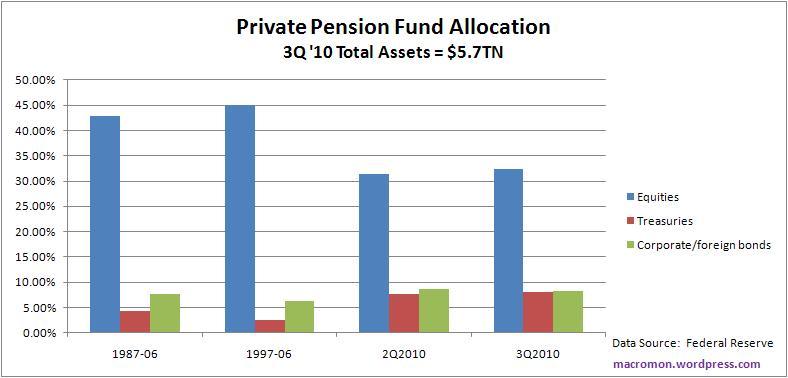
Chart of the Day: Private Pension Fund Asset Allocation

Today’s release of the Flow of Funds Accounts by the Federal Reserves shows the private pension fund sector asset allocation.  Though a slight uptick from 2Q2010, the data show private pensions remain significantly under allocated to equities compared to historical benchmarks.  We posted similar analysis in September.   Private pensions are also historically over allocated to Treasuries.   The potential reallocation from bonds to equities is fuel for a 2011 rally.

Posted in Uncategorized | Leave a comment

Apple in Santa’s Bag

The global frenzy for Apple products show no signs of letting up.  This is the best company in the world and not just a game changer, but defining the culture for younger generations.  The stock has been trading in $300-320 range for the past few months with a couple of failed attempts at breaking out.   It does feel like a coiled spring to us and we suspect that we’ll see $333 relatively soon.

Adjusting for the company’s  $51 BN in cash and investments, the stock trades at 14x this year and 11.5x next year’s earnings.   Stunningly cheap for the best growth story in the market!  Stay tuned.

Posted in Equities | Tagged , , | Leave a comment

Global Interest Rate Spike: Young Lady or Old Hag?

The epic interest rate spike and U.S. bond sell-off during the past few trading days is generating a fierce market debate.  The bears see it as the beginning of a new phase of the crisis, where sovereign debt woes spread from the European periphery to the other high deficit/high debt countries.   The bulls view it as the markets revising global growth upward and a mass reallocation out of bonds into risky assets.

The ”confirmation bias” of the bulls and bears is very much like the “Young Lady or Old Hag” illusion.  What you see depends on your predisposition, previous exposure, and what you really want to see.    The bears see the old hag and the bulls see the pretty young lady.

In the context of Keynes’ “speculation is a beauty contest” analogy, our job as traders, at least in the short term, is to render irrelevant what we see and to determine what the market sees.   And it appears, for now, the market is determined to see the young lady.

One thing we do know with almost certainty, however, is that  young ladies turn into old hags over time.  Our job as traders is to determine how fast this young lady ages.  Stay tuned!

Posted in Black Swan Watch, Bonds, Economics, Sovereign Debt, Sovereign Risk | Tagged , , , | Leave a comment

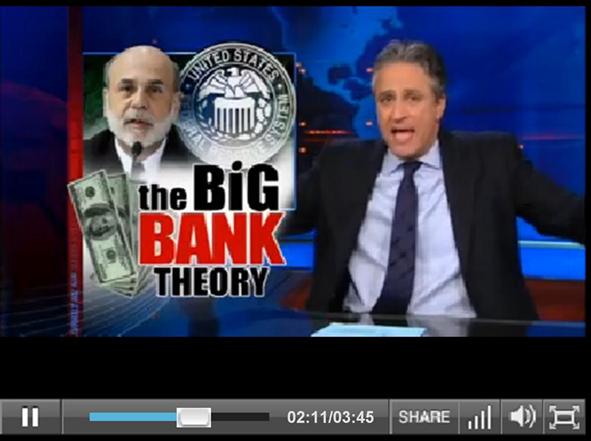
Jon Stewart Catches Bernanke “Printing Money”

Hillarious video of Jon Stewart’s take down of Ben Bernanke’s 6o Minutes interview this past Sunday.   Stewart referenced a 60 minutes interview in June 2009 where Chairman Bernanke said what the Fed was doing was “much more akin to printing money” when buying bank assets.   In Sunday’s interview, Bernanke complained that “one myth that is out there, is we’re printing money.  We’re not printing money.”   Short Fed Cred!

Click here for the interview.

Posted in Monetary Policy, Video | Tagged , , , | Leave a comment

GOP plan: “Push states to bankruptcy and smash unions”

In his Reuters blog,  James Pethokoukis states the biggest political battle in Washington next year will be the Congressional Republicans plan to:  a) avoid a federal bailout of financially troubled states; and b) cripple employee unions by pushing fiscally troubled states, including California and Illinois to declare bankruptcy.

He writes,

That’s why the most intriguing aspect of President Barack Obama’s tax deal with Republicans is what the compromise fails to include — a provision to continue the Build America Bonds program.  BABs now account for more than 20 percent of new debt sold by states and local governments thanks to a federal rebate equal to 35 percent of interest costs on the bonds. The subsidy program ends on Dec. 31.  And my Reuters colleagues report that a GOP congressional aide said Republicans “have a very firm line on BABS — we are not going to allow them to be included.”

In short, the lack of a BAB program would make it harder for states to borrow to cover a $140 billion budgetary shortfall next year, as estimated by the Center for Budget and Policy Priorities. The long-term numbers are even scarier. Estimates of states’ unfunded liabilities to pay for retiree benefits range from $750 billion to more than $3 trillion.

Though we agree public sector unions are a huge problem, its a risky strategy and borders on reckless. .  Once markets reach the tipping point,  the subsequent volatility and contagion is very unpredictable and extremely difficult to stabilize.  Have they not learned from the Lehman failure?

The muni market is getting hammered again.   No sh%t!


Posted in Black Swan Watch, Charts, Muni Market | Tagged , , , , | 1 Comment

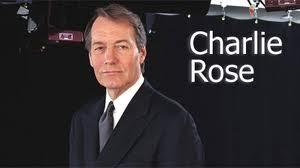
Einhorn: “Global Economy in a Period Between Two Crises”

A must view Charlie Rose interview with David Einhorn, President of Greenlight Capital.   He is a very smart guy with an excellent track record.

He speaks of the absurd way we calculate official inflation in the U.S. using the Apple iPhone battery example.   Because the iPhone now has twice the battery life than last year’s model, yet the price hasn’t changed,  economists at the Commerce Department account for the quality improvement through hedonic adjustments to the inflation data.   That is, the price of the iPhone shows a 15 percent decline in the CPI, not based on a realized price decline, but an adjustment for quality.   The Fed’s current monetary policy,  effectively,  tries to make up for the phantom deflation in iPhones by raising the price of clothing, for example. 

He is critical of policy and says,  “I noticed through the crisis… the Federal Reserve is more concerned about which way the next 50 points in the S&P go than your average hedge fund manager is.”    The interview is well worth your time.  Click here.

Posted in Black Swan Watch, Budget Deficit, Economics, Sovereign Risk, Video, Whales | Tagged , | Leave a comment

December 7th – A Rate Move Which Will Live In Infamy

CNBC puts an interesting spin on the stock market sell-off and reversal in almost all commodities today, blaming the SEC insider trading probe.  We have a different view, believing it was the historic rise in long-term rates.

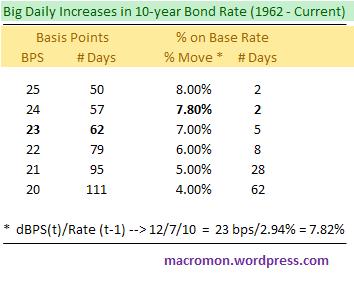
Today’s 23 bps (at the time of writing) increase in the 10-year Treasury rate was historic.  There have been only 62 days since 1962 where the 10-year rate has increased by 23 basis points.

On a percentage basis — today’s 23 bps change over yesterday’s base rate of 2.94% — the 10-year rate was up 7.82 percent.  There have only been 2 days since 1962 where the 10-year rate has moved 7.82 percent — January 2, 2009 and September 19, 2008.  Note, all three days, including today, were off historically low base rates with 2 percent handles.

What is the rate spike signaling?   Growth revision?  Change in inflation expectations?  Credit concerns over budget and tax deal?  Technicals?   Noise?   All of the above?  Hard to decipher.  Keep it on your radar!


Posted in Black Swan Watch, Bonds, Budget Deficit, Charts, Commodities, Credit, Crude Oil, Economics, Equities, Fiscal Policy, Gold, Politics, Sovereign Risk | Tagged , , | 3 Comments

China Rate Hike This Weekend?

The China Securities Journal, not citing a source,  says the timing is right for a rate hike this weekend.  It would be the second of the current tightening cycle.   Reuters reports,

“With reference to the central bank’s record of raising interest rates just ahead of the release of CPI, this weekend will provide a window for a possible policy change,” the newspaper said, without citing any source.

China’s CPI in November may have risen to a 27-month high of 4.7 percent from a year ago, according to a Reuters poll, up from a 4.4 percent pace in October.

The China Securities Journal has a fairly good track record in predicting policy moves. It reported on November 17 that the central bank would raise interest rates two days later. On the predicted date, it announced an increase in banks’ required reserves, not interest rates.

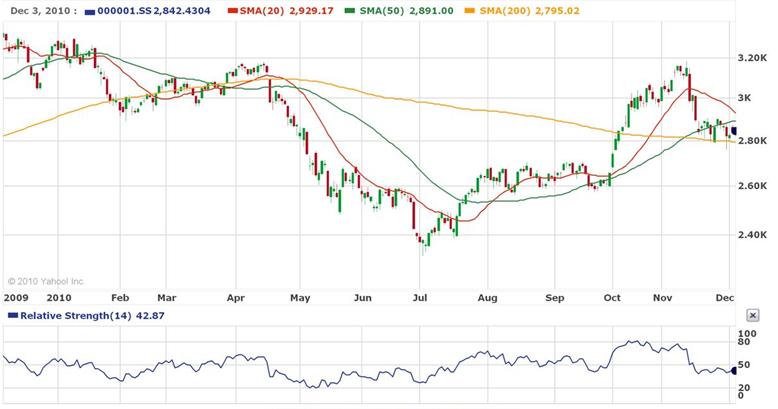
The Shanghai Composite is sitting around its 200-day moving average at 2,800, which, given the early stage of the tightening cycle,  will not hold, in our opinion.  Though most commodities will probably sell-off on a China rate hike,  crude and copper are the markets to watch. If crude holds, it would confirm the latest move is more secular than cyclical.

Posted in China, Commodities, Crude Oil, Equities, Gold, Monetary Policy | Tagged , , , , | Leave a comment

Reserve Bank of Australia Monetary Policy Decision

Statement by Glenn Stevens, Governor: Monetary Policy Decision

At its meeting today, the Board decided to leave the cash rate unchanged at 4.75 per cent.

Since the previous Board meeting, concerns about the creditworthiness of a number of European governments have again become the main focus of financial markets, with a marked rise in sovereign bond spreads for some euro-area countries and an increase in volatility. At the same time, recent data suggest that the Chinese and Indian economies have continued to grow strongly and price pressures, particularly for food, have picked up in China as well as a number of other economies in Asia. Modest growth is continuing in the United States.

For Australia, the terms of trade are at their highest level since the early 1950s, and national income is growing strongly as a result. Recent information indicates that, as had been expected, private investment is beginning to pick up in response to high levels of commodity prices. In the household sector thus far, there continues to be a degree of caution in spending and borrowing, which has led to a noticeable increase in the saving rate. Asset values have generally been little changed over recent months and overall credit growth remains quite subdued, notwithstanding evidence of some greater willingness to lend.

Employment growth has been very strong over the past year, though some leading indicators suggest a more moderate pace of expansion in the period ahead. After the significant decline last year, growth in wages has picked up somewhat, as had been expected. Some further increase is likely over the coming year.

The exchange rate has risen significantly this year, reflecting the high level of commodity prices and the respective outlooks for monetary policy in Australia and the major countries. This will assist, at the margin, in containing pressure on inflation over the period ahead. Over the next few quarters, inflation is expected to be little changed, though it is likely to increase somewhat over the medium term if the economy grows as expected.

Following the Board’s decision last month to lift the cash rate, and the subsequent increases by financial institutions, lending rates in the economy are now a little above average. The Board views this setting of monetary policy as appropriate for the economic outlook.

Posted in Monetary Policy | Tagged , | Leave a comment

Chart of the Day: ECB Bond Purchases

They’ve only just begun…

Posted in Black Swan Watch, Bonds, Budget Deficit, Charts, Credit, Currency, Economics, Euro, Fiscal Policy, Monetary Policy, PIIGS, Sovereign Debt, Sovereign Risk | Tagged , , | Leave a comment