Fed Ownership of the U.S Treasury Curve

Here’s an interesting chart we threw together showing the Fed’s ownership of Treasury securities maturing in each year on the curve.  There are no bonds maturing in 2032-35 due to the temporary discontinuance of the 30-year earlier in the millennium, which some believe contributed to the housing bubble.

The Fed owns a high of 35 percent of the $60 BN of bonds maturing in 2011,  and only 4.4 percent of $142 BN of 2040 bonds.  It doesn’t take a MOTU to recognize the potential for massive POMO generated short squeezes on the long-end of the curve, which we have seen and, will not doubt, continue see during this age of quantitative easing.

It will be also interesting to juxtapose the same chart in six months hence when QE2 is under full sail.   Stay tuned!

Posted in Black Swan Watch, Bonds, Budget Deficit, Credit, Economics, Fiscal Policy, Monetary Policy, Policy, Politics, Sovereign Debt, Sovereign Risk | Tagged , , , , | 9 Comments

Argentina – “Cookie Cutter” for the European Periphery?

“I would not say that Mexico is going to be a cookie cutter for others.”
– William Rhodes, Citibank 1989

These were the words of the chairman of Mexico’s Bank Advisory Committee in 1989, just after the country and its commercial banks creditors agreed to the first, and ultimately, prototype Brady Plan Debt Restructuring.  Twenty-one years later, the now EU struggles with how to deal with member countries that have borrowed too much and will, ultimately, be forced to restructure their sovereign debt.

The quicker EU leaders – and hopefully in private – recognize the inevitable, the better, as a disorderly default will be much more damaging to both Europe and the global economy.  The Economist’s, Free Exchange blog, makes a pretty good case that EU leaders are following the same path and inadvertently using Argentina as a “cookie-cutter” in dealing with their own debit crisis,

For now the European Central Bank has held the euro zone together by purchasing members’ bonds and providing liquidity to beleaguered banks. Although such stopgap solutions, like case-by-case bail-outs, are the path of least political resistance, the effort to avoid defaults at all costs could prove calamitous.

Argentina’s recent default is illustrative. As in Europe today, Argentine politicians ruled out restructuring debts that looked unmanageable. Domingo Cavallo, Argentina’s respected finance minister, even took to the pages of the Financial Times to call the idea “ludicrous” and promise that “Argentina will not be lured by the call of the sirens”. And so throughout 2001 the country attempted increasingly desperate manoeuvres—two IMF loans, a short-for-long securities “megaswap” and finally zero-deficit budgeting—to stave off default…

Of course, Argentina’s default was only inevitable in hindsight, and euro zone leaders cannot be so certain of their fate. Nonetheless, it’s important for the EU to seriously engage with the potential need for planned, systematic debt restructuring because the alternative—a slow motion train wreck ending in disorderly default—would be far more dangerous. When it comes to debt restructuring, MacBeth’s advice remains true: “if it were done when ‘tis done, then ‘twere well / it were done quickly.”

Unfortunately, the logic of politics incentivises default denial. Even if delays increase the risk of a disorderly default, European leaders will struggle to accept the known, certain harms of debt restructuring while there is still hope, however remote, of avoiding it. Necessary or not, the decision to default is likely to be career-ending, which shortens politicians’ time horizons and encourages risky “double or nothing” gambles (as with Britain’s Black Wednesday devaluation).

During a crisis and heightened market volatility, it’s extremely difficult, as EU leaders are now learning, to create a mechanism to address the debt overhang. The Economist writes,

In theory, creating a structural mechanism to wind down sovereign debts in an orderly way would help alleviate this problem. But it seems impossible to implement such a plan in the middle of a crisis—any hint of bondholder haircuts risks setting off market anxieties and triggering a disorderly default, as shown by the reaction to Angela Merkel’s suggestion for incorporating debt restructuring in future bail-outs.

Finally,

A euro zone default, disorderly or not, will reverberate around the world. The shattering of Europe’s illusion of fiscal responsibility would cause a re-evaluation of other developed countries’ debt burdens—no longer will rich world sovereign debts be treated as “risk-free”. In fact, such a re-assessment may already be underway: over the last month, 10-year Treasury yields have risen by about a quarter to 3.3%, British yields are above 3.5%, and even German yields hover around 3%.

One thing for certain is 2011 is going to be one interesting year.

Related Articles:
Europe’s Inevitable Haircut – Barry Eichengreen
Living to disorderly default another day – Economist
The eurozone is in bad need of an undertaker – Telegraph

Posted in Black Swan Watch, Bonds, Budget Deficit, Credit, Euro, Fiscal Policy, PIIGS, Sovereign Debt, Sovereign Risk | Tagged , | Leave a comment

Brazil Rising

Great 60 Minutes piece on Brazil tonight.   Lula looks great!  But who wouldn’t if they were leaving office with a 70 percent approval rating.   Check it out.

Posted in BRICs, Video | Tagged , , | Leave a comment

Day of the Week Effect: Can “MF Monday” Shake Its Slump?

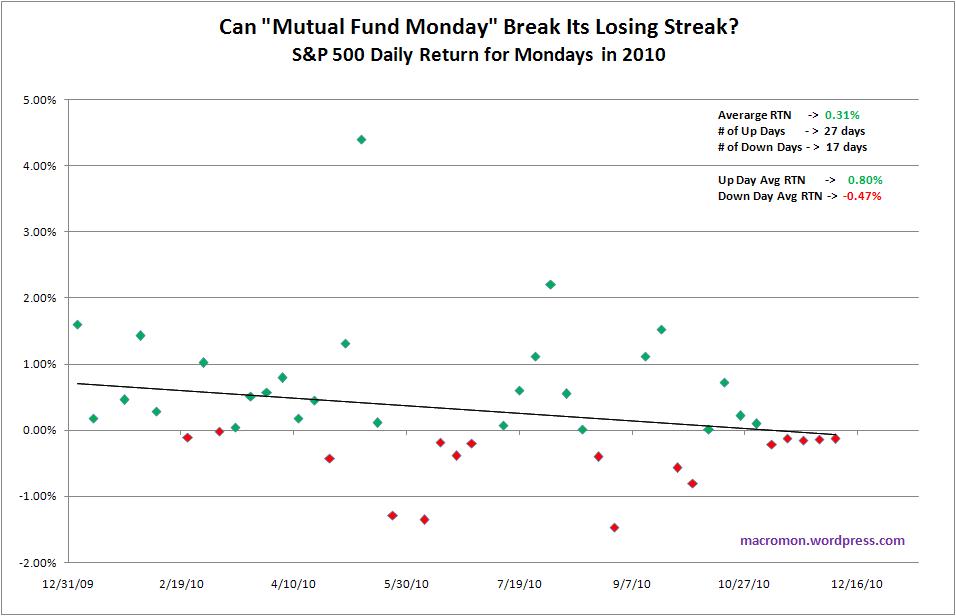
Not that MF Monday!  Traders like to muse over the “Day of the Week Effect”, particularly, “Mutual Fund Monday”, where convention posits that since the crisis, the S&P5oo performs better on Mondays than other days.   The thesis is that mutual funds tend to step-up purchases of stocks on Mondays, driving the day’s higher return.

We love to “torture the data until it confesses” as much as anyone else and have sliced and diced daily returns S&P 500, not only “just to entertain you, “ but to enhance your trading/investing acumen in order to impress others at the company Christmas party.   Making money?   Iffy.

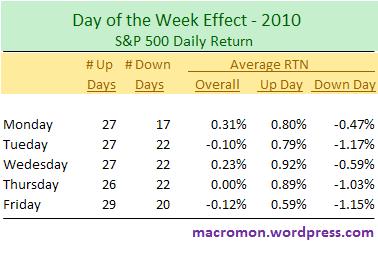
The average return on Mondays for the S&P5oo in 2010 is 0.31%, which is higher than other days of the week.  The index has been up 61% of all Mondays in 2010, rising 27 and declining 17, which is the highest percentage day of the week.   Generating only the third highest return on up days, trailing Wednesday and Thursday, Monday’s average loss on down days is significantly lower than others.

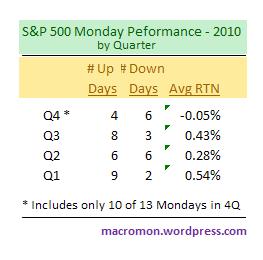
Slicing deeper, however, “ Mutual Fund Monday” appears to have lost its luster since the first quarter, when the S&P 500 traded up 9 of 11 Mondays .  After an excellent Q3, the Monday fade continues into Q4, where the S&P500 is currently down 5 straight Mondays.   On a positive note, after a similar 5-week losing streak in June, Monday generated a positive return for next 6 weeks.

Now, how’s that for making the data dance?   Can and will the S&P snap its “MF Monday” losing streak end tomorrow after China’s hot inflation number?  We’ll leave for the Monday morning quarterbacks.  Stay tuned!

Posted in Charts, Equities | Tagged , , , | 1 Comment

Who’s Funding the U.S. Budget Deficit?

Interesting data showing who is funding the U.S. budget deficit and how the profile has changed since the financial crisis.  We excluded 2008 as the aggregate data was distorted due to the Federal Reserve’s $265 BN sale (or exchange?) of Treasury securities, which appear to have gone directly to the broker/dealers.  *

Though foreign central banks continue to be the largest buyers of Treasury securities, on a proportional basis, their $974 BN net purchase during 2009-Q32010 declined dramatically.    Foreign central banks effectively funded 73 percent of the $421.2 BN cumulative deficit for 2006 and 2007,  and only 30 percent in 2009-Q32010.   There was massive swing in the household sector, who went from large net sellers in 2006-07 to funding 28.2 percent of federal borrowing in 2009-Q32010. The Fed became the third largest buyer of Treasuries during 2009-3Q10,  which will certainly increase with QE2.

We conclude from the data that unless  the foreign sector significantly steps up it Treasury purchases, which will largely depend on the direction of the current account deficit,  capital flows, and foreign exchange rate policies,  the bond market will remain under pressure.  Furthermore, we expect households to begin reallocating to equities, putting increased pressure on the Federal Reserve to maintain the stabilizing bid in the market.

Looking at the flows, — i.e, budget deficits and the profile of buyers — it is hard to make a case for lower interest rates.  Stay tuned!

* Data subject to statistical discrepancies;  Q32010 is annualized data.   

Posted in Bonds, Budget Deficit, Charts, Fiscal Policy, Monetary Policy, Sovereign Debt | Tagged , , | 1 Comment

U.S. Equities Gettin’ Jiggy…No Love for the Haters

The Christmas Ramp continues as stocks remain firmly bid even going into this weekend’s monetary event risk in China.   There’s a whiff of panic as under allocated investors watch the markets runaway and refuse to correct (see chart below).

The economic data has reversed from being a headwind and is now a tailwind.   The bond market safe haven is safe no more.  There is a growing  perception that the U.S. is the place to be in 2011 as emerging markets are at the early stages of a tightening cycle with the Eurozone engulfed in a sovereign debt and existential crisis.  No shortage of potential Black Swan events to keep traders and investors from getting crazy optimistic.  We worry about the growing euphoria on the Street, however,  and took advantage of the collapse in volatility, buying SPY puts to hedge long positions.

Most important, however, valuations are not stretched as illustrated in the heat map, which ranks the S&P500 by forward P/Es.  The darker the green the closer the P/E is to zero while the dark red reflect higher P/E stocks.

The S&P500 Relative Strength Index (RSI) is approaching overbought at 67,  which could generate some short-term profit taking that we think will be bought and expect the Christmas ramp to continue into year-end.  Giddy up, Rudolph!


S&P 5oo Forward P/E

Here’s something to fire you up for next week’s trading.


Posted in Bonds, BRICs, Charts, China, Equities, Video | Tagged , , | Leave a comment

filliBuster Sanders now on Senate Floor

Bored?  Click here to watch CSPAN’s live view of Senator Bernie Sanders “ tax cut filibuster” on the Senate floor.   CSPAN  writes,

He began his speech by saying, “I am simply here today to take as long as I can to explain to the American people the fact that we have got to do a lot better than this agreement provides.”

Long Buster Posey, short Buster Sanders.

Posted in Budget Deficit, Fiscal Policy, Politics | Tagged , | 2 Comments

The Illustrated History of the U.S. Credit Collapse

We constructed these charts with data from today’s release of the Federal Reserve’s Flow of Funds.  They are both stunning and frightening as they illustrate the cardiac arrest that took place in the credit markets.  The  collapse in credit issuance/borrowing began in 2008 and would have been net negative without the Federal government.  In 2009, for example, the Federal government was 141 percent of total net credit borrowings.

If, as the President says, ‘the flow of credit is the lifeblood of our economy”, the country would have died in 2009 had not the policymakers taken the extraordinary measures they did.    These charts illustrate how close we were to the abyss and should give a clearer perspective on what Bernanke & Co. were/are up against.  They are heroes, in our book, for stabilizing the situation and pulling us back from the abyss.  The jury is still out, however, on long-term structural adjustment and preventing a global sovereign debt crisis.

Posted in Black Swan Watch, Budget Deficit, Charts, Fiscal Policy, Sovereign Debt, Sovereign Risk | Tagged , , | 2 Comments

“A money-financed tax cut is…[a] ‘helicopter drop’ of money”

Wow!  Sounds a lot like what the President and Congress just negotiated, no?  Tax cuts financed by QE2 and a possible QE3?  Break out the Apaches!

Here is the excerpt from his famous  helicopter speech, given at the National Economist Club of Washington, D.C. on November 21, 2002.

Fiscal Policy
Each of the policy options I have discussed so far involves the Fed’s acting on its own. In practice, the effectiveness of anti-deflation policy could be significantly enhanced by cooperation between the monetary and fiscal authorities. A broad-based tax cut, for example, accommodated by a program of open-market purchases to alleviate any tendency for interest rates to increase, would almost certainly be an effective stimulant to consumption and hence to prices. Even if households decided not to increase consumption but instead re-balanced their portfolios by using their extra cash to acquire real and financial assets, the resulting increase in asset values would lower the cost of capital and improve the balance sheet positions of potential borrowers. A money-financed tax cut is essentially equivalent to Milton Friedman’s famous “helicopter drop” of money.

You think the Chinese and other central banks holding $6 TRN of dollar foreign exchange reserves  feel duped or “spammed?”  Hey, it’s not his job to worry about foreign central banks, but no wonder gold is at record highs and heading north!  Bubble, schmubble!

Another nugget from the speech,

What has this got to do with monetary policy? Like gold, U.S. dollars have value only to the extent that they are strictly limited in supply. But the U.S. government has a technology, called a printing press (or, today, its electronic equivalent), that allows it to produce as many U.S. dollars as it wishes at essentially no cost. By increasing the number of U.S. dollars in circulation, or even by credibly threatening to do so, the U.S. government can also reduce the value of a dollar in terms of goods and services, which is equivalent to raising the prices in dollars of those goods and services. We conclude that, under a paper-money system, a determined government can always generate higher spending and hence positive inflation.

There is a growing risk the Fed loses all credibility, which will be an unmitigated disaster.   


Related Articles
Helicopter Ben gets in a spin – Economist
Monetary and fiscal policy, working together – Economist

Posted in Budget Deficit, Commodities, Gold, Monetary Policy, Sovereign Debt, Sovereign Risk | Tagged , , , | 4 Comments

Shanghai Watch

We’re are watching to see if the Shanghai Composite can hold its 200-day moving average right around 2,800.  There is widespread speculation the People’s Bank of China will raise interest rates this weekend for the second time in the tightening cycle.  We are also watching commodities,  mainly crude and copper, to see how they hold up.  We suspect with global growth kicking in x/China, the negative impact of the rate hike may be muted.  A significant sell-off in Chinese equities is another story.    Keep it on your radar!


Posted in China, Commodities, Crude Oil, Equities, Monetary Policy | Tagged , , , | Leave a comment