Don’t Fight the Bank of Japan!

The Nikkei 225 has been flying, while the global markets are down to flat,  since the November 5th Bank of Japan announcement that it would be purchasing equity ETFs as part of its QE program (click here for our post).   That is, the Central Bank printing money to buy equities!

Many were skeptical the program was not enough to weaken the Yen.  The chart below shows their announcement coincided with the recent high for the Japanese currency.

The Nikkei has recaptured the 200-day and we wouldn’t be surprised to see the momentum boyz gun the market higher into year-end.  We’ll change our view if the index fails to hold its 200-day moving average  Stay tuned.


Posted in Equities, Monetary Policy, Policy | Tagged , , | 1 Comment

Washington Gets Serious on Deficit Reduction

There is a whiff in Washington that the pols may be getting religion on the deficit.  The implosion of Europe must be scaring the s%*t out of them.  The WaPost writes,

A debate is raging over the size and shape of those changes, particularly the wisdom of cutting Social Security benefits. But a surprisingly broad consensus is forming around the actions required to stabilize borrowing and ease fears of a European-style debt crisis in the United States. As a presidential commission struggles to build political momentum for such a package, even Republicans who initially opposed the commission’s creation are still at the negotiating table.

“I’m open to everything if it gets us where we need to go,” said Sen. Tom Coburn (Okla.), who is emerging as one of the GOP’s most influential voices on budget issues. “This is going to require compromise, even from someone as conservative as me.”….Meanwhile, a chorus of retired military officers and national security experts has backed the call to reduce spending at the Pentagon for the first time since the Sept. 11, 2001, attacks.

“It is simply not going to be viable, either economically or politically, to exempt defense from the cuts that are coming,” said Gordon Adams, who oversaw military budgets during the Clinton administration. “Events over the past two weeks have begun to snowball to put defense, as well as every other form of federal spending, on the table.”…

The strange bedfellows are a “testament to the moderate nature” of the ideas under discussion, Domenici said. For those who have taken the measure of the debt abyss, including the threat of $1 trillion annual interest payments by the end of the decade, “this is not extreme.”

After hours of talks by the presidential deficit commission, which includes some of most liberal and conservative lawmakers in Congress, Bowles said it is clear that “there is common ground there.”

“If this town decides it really wants to come together and solve this today,” he said, “it’s doable.”…

Here is a great graphic from the Washington Post juxtaposing the various deficit reduction plans. Click graphic to enlarge.

Posted in Black Swan Watch, Fiscal Policy, Politics, Sovereign Risk | Tagged , | 1 Comment

Ireland Bailout Equal to $8.8 trillion US Equivalent

The FT reports the Irish bailout package will total €80bn-€90bn, which is about 60 percent of the country’s $200 BN annual GDP.  Massive!   The FT writes,

The bail-out is expected to total €80bn-€90bn and will include contributions from the UK and Sweden, according to people briefed on the discussions. But the deal may not be concluded until the end of November because the parties are still negotiating the conditions attached to the aid.

To illustrate the Irish bailout, imagine this scenario: A shaky U.S. banking system with total assets well in excess of 200% of GDP, coupled with deteriorating sovereign credit fundamentals as the government was forced to backstop the entire banking system during the financial panic.  Depositors, concerned about the credibility of the sovereign to honor deposit insurance and other explicit or implicit financial guarantees — not mention Treasury securities held by banks — begin to flee.  As the run on deposits picks up, banks are forced to turn to the Fed for liquidity or face collapse.   The government is unable to stabilize the banking system with a TARP II, for example,  because the capital injections are also perceived to be impaired.   The U.S. is forced to turn to an outside entity, such as the IMF,  to secure funds to recapitalize the banking sector in an attempt to stabilize the deposit base.  Imagine the political outrage, especially if the IMF doesn’t allow an extension of the Bush tax cuts!

This is exactly the case with Ireland.  Some of the rescue package will be used to recapitalize the banks with the hope of stabilizing deposits and some for fiscal adjustment.   The reported amounts vary, but Irish banks have been drawing large sums of liquidity from the ECB, which has stated that it can no longer continue. The result is the Eurozone equivalent of TARP via the Irish government.  Relative to Ireland’s  GDP, this is a big package – the U.S. equivalent would be $8.8 trillion.

It will be interesting to see if just the announcement of the deal is enough to stabilize deposits and how much of the bailout will actually be drawn.

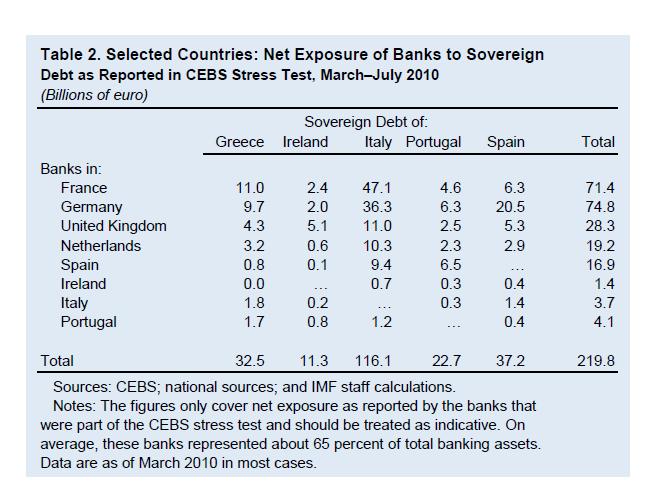
The IMF chart below shows that Ireland’s underlying economic fundamentals are superior to many European countries.   This is not about fiscal imbalances, lack of competitiveness, or fat pensions for 52-year old retirees.  Ireland’s problem, like much of Europe, is over banked,  and experienced a massive housing bubble.  The assets of just the Bank of Ireland and Allied Irish Banks, for example,  are around 200 percent of GDP.    If the country can somehow find a way to restructure and fix the banks, it will be on a much quicker road to recovery than the rest of the European periphery.   Godspeed Ireland!

Posted in Black Swan Watch, Currency, Equities, PIIGS, Politics, Sovereign Risk | Tagged , , , | Leave a comment

The Corruption of Academia

I saw Inside Job yesterday, which is a must view for anyone in the financial industry.  Clearly it has a lefty perspective and is very tough on the Street, but some scenes are illuminating and priceless.  The corruption of the economics academy is exposed in interviews with Fredrick Mishkin, former Federal Reserve governor, who resigned during the crisis,  and Glen Hubbard,  former head of the Council of Economic Advisors under Bush 43.   Larry Summers worth an estimated $15-30 MM?????  Laura Tyson paid $350K a year to sit on the Board of Morgan Stanley?

Hey, we’re all for making money, but just calling out a “no spin zone” when we someone. Here is  a clip from the film:

Posted in Black Swan Watch | Tagged , , , , | 2 Comments

China Rising: THE MARKET for Exports

We thought these charts of export markets from Barclays Capital to be very illustrious of the dynamic changes taking place in global trade.  China is becoming a larger export market than the U.S. for many countries, including Australia, Brazil, Korea, and Japan.   Given China’s voracious appetite for natural resources, it is not a surprise to see Brazil exporting more to China, even though it is not part Asia.

We thought it would be interesting to analyze the correlation between Brazil’s Bovespa stock index versus the S&P500 and the Shanghai Composite to see if this trend is internalized in the domestic financial markets.

Trading data of the past calendar year do not confirm this as the Bovespa remains more correlated with S&P500 than the Shanghai composite.  The Bovespa moved together 174 days with S&P500 versus 138 days with the Shanghai, for example.   The table also shows that there were 150 days where the Bovespa and S&P500 30-day correlation had readings greater than .8 against 72 days for the Bovespa and Shanghai Composite.

China’s relatively closed capital account keeps it somewhat immune from global stock market volatility.  The different time zones during the trading day may also play a role.  We expect the Shanghai to become more correlated with all markets as they liberalize their capital account, however.

As China becomes a more important market than the U.S. for many countries’ exports, the the relative influence of the U.S. in the international financial community diminishes. This was clearly evident at the G20.

Posted in BRICs, China, Equities, Geopolitical, Policy, Politics | Tagged , , , , , , , | 4 Comments

Post hoc ergo propter hoc

Correlation = 1)  causality; 2) spurious; or 3) reverse causality?   You decide…..

Source: Bond Vigilantes

Posted in Bonds, PIIGS, Sovereign Risk | Tagged , , | 1 Comment

Muni Market Rebounds, California Prices RANs

After widening 70 bps, long-term California munis rebounded today, tightening as much as 6-10 bps.  California priced $10 BN of Revenue Anticaption Notes (RANs)  paying higher than their initial target price.  Notes from the $2.25 billion Series A-1 mature in May 2011, yielding 1.50% with a 3% coupon. The $7.75 billion Ran Series A-2 matures in June 2011, yielding 1.75% with a 3% coupon.  Sacramento was hoping to sell the RANs with yields of of 1.50% or less.  The state is due to issue $2.75 BN of taxable Build America Bonds on Friday.   California’s structural deficit is becoming a key barometer for global credit issues and should be monitored closely.

Related Articles
Calif. Market Close: Long Tax-Exempts Rebound As Cal Prices $10B of Rans – Bond Buyer
California Pays More For New Notes As Muni Market Stabilizes – WSJ
California Shrinks Planned Tax-Exempt Sale, Expands Taxable – Bond Buyer
California Bond Woe Bodes Ill for States – WSJ

Posted in Bonds, Muni Market | Tagged , , | Leave a comment

Republicans Pound Fed, “Lasso” Gold Rally

On September 30th we wrote (click here)  of the “hard money inclinations” of the Republicans and how a electoral victory may put pressure on the Federal Reserve to reign in their money printing.  On election night, we also posted the “Fed to Face Short Squeeze in New Congress” (click here and here).

The squeeze is on.  After a storm of foreign criticism of QE2,  Congressman Mike Pence introduced a bill yesterday to limit the Fed’s mandate to just price stability.  Today,  the Republican leadership, including,  “Young Gun,”  Eric Cantor, published a letter to Fed Chairman Bernanke expressing their concerns over QE2.   It’s very unlikely legislation limiting the Fed will become law, but the recent uproar will embolden the dissenters on the FOMC, which may affect future monetary policy.

Meanwhile, gold has been hit by the trifecta of: 1)  international and domestic pressure on the Fed; 2) fears of China tightening; and 3)  European Sovereign Debt risk aversion.   The 50-day moving average is providing support, but we are patiently waiting to see if the October 22nd low of 1315.5 will hold.  If not, it significantly increases the probability of a deeper correction to $1220, the 200-day moving average.   Stay disciplined and stay tuned!

Related Articles
Dear Mr. Bernanke: No Pressure, but…… – NY Times
Bernanke Seeks To Reassure US Senators On Fed Policy – WSJ
Pence Introduces Bill to End the Federal Reserve’s Dual Mandate – GOP.gov
Fed under siege in new Washington landscape – Marketwatch

Posted in Gold, Monetary Policy | Tagged , , , | Leave a comment

Muni Meltdown: All Eyes on California

As the world focuses on Ireland, the hammering of the U.S. muni market continued today even as the treasury bond market rallied sharply.  As the case with any sell-off, it is difficult to discern fundamentally why the market is in complete meltdown.  A big supply of Build America Bonds has hit the market before the federal subsidy expires at the end of the year, swamping demand.   The Muni ETFs (see chart) now trade below their NAV as it appears, given the recent spike in volume, they have become hedging and trading vehicles.  These instruments are extremely oversold and rarely do we see an RSI of less than 10% on any traded security.  If they don’t experience even just a “dead cat bounce” here, we suspect the muni market is in serious trouble.

California is in the process of issuing $14 BN of new debt into this meltdown.  The state launched $10 BN of short-term revenue anticipation notes, RANs, on Monday, with two series maturing on May 25, 2010 and June 28, 2011. California Treasurer, Bill Lockyear, said 44% of the issue was circled on the first day, which is weaker than the September 2009 RAN sale, which sold 61% of the $8.8 BN offering on its first day.   The state is hoping to issue the RANs at a yield of 1-1 ½%.  The final yields will be set on Wednesday.

After the completion of the RANs, the state will sell $2 BN of Build America Bonds on Thursday followed by $1.75 BN of conventional tax-free bonds.   The sale of these issues should be monitored closely to determine whether the sovereign debt concerns of Europe are spreading into the U.S. muni market or the recent volatility is just a case of serious indigestion.

Debt service payments now account for 7.13% of California’s General Fund receipts , up from 4.14% in fiscal 2006-7.  The state has $76 BN of long-term bonds outstanding and a projected shortfall of over $100 BN for the next five years, not counting its structural underfunding of pension obligations.   California’s failure to deal with its structural fiscal problems may be finally “coming home to roost.”  Stay tuned!

Related Articles
Bad timing: California seeks bond buyers amid rout in muni market – LA Times
Tax-Exempt Muni Bonds Tumble – WSJ
Miller Tabak’s Pietronico Says Muni Supply Surge Means Bargains – Bloomberg
John Hussman: The Muni Market Has Fallen Off “The Cliff” And Equities Are Next – BI
Calif. Market Close: Tax-Exempts Finish Weaker – Bond Buyer
ETFs Disagree With Municipal Indexes – Bond Buyer


Posted in Black Swan Watch, Bonds, Politics | Tagged , , , | Leave a comment

“This could break backs…economies toward bankruptcy”

These were the words of Greek prime minister George Papandreou, speaking about Germany’s tough stance on burden sharing during his visit to Paris.   The fracturing of the eurozone appears to be accelerating, or, at best, the fault lines are beginning to surface.

The debt burdens in some countries  are just too large and the fiscal adjustments too onerous for the populations to bear, in our opinion.  The Irish Times writes,

Germany’s tough stance on banks and bond markets sharing the pain of any euro zone sovereign debt default could force some economies toward bankruptcy, Greek prime minister George Papandreou said today.

“It created a spiral of higher interest rates for countries that seemed to be in a difficult position, such as Ireland or Portugal,” Mr Papandreou said during a visit to Paris.

“This could create a self-fulfilling prophecy … This could break backs. This could force economies towards bankruptcy.”

On other side, Germans are “incensed” at having to bail-out the highly indebted periphery and German Chancellor Angel Merkel fears their wrath in the 2013 general election.  Der Spiegel reports today,

…Merkel defended her demands for tough new bailout rules on Monday by telling her party she was determined to create a new “culture of stability” in Europe. But other EU leaders are warning that her plan is scaring investors and could reignite the euro crisis.

German Chancellor Angela Merkel defended her tough stance on reforming EU budget rules on Monday as criticism of her policy mounted in Europe.

“Everything is at stake — if the euro fails, then Europe will fail,” Merkel told delegates at the party congress of her conservative Christian Democratic Union (CDU) in Karlsruhe, southwestern Germany. Market “excesses” caused the crisis and “markets have to bear the consequences of their actions,” she said. “It’s up to us. It’s our task to create a new anchor for a culture of stability in Europe.”…

With a permanent, legally binding mechanism in place, she won’t have to negotiate the inevitable extension of the safety net, a deeply unpopular measure in Germany where voters are incensed at having had to bail out high-debt nations this year. She faces a general election in 2013.

One thing is for certain, 2011 will not be dull.  Stay tuned!

Posted in Black Swan Watch, Bonds, PIIGS, Sovereign Risk | Tagged , , | Leave a comment