Stat of the Day: Average Daily Return on Up Days…..

We thought this is an interesting statistic.   Of the major equity markets we track, the Brazilian Bovespa ranks número um in terms of the average daily return on up days.  We need to do further work on this,  controlling for the number of observations, for example.   The Bovespa data range is from early 1993, whereas the S&P500 data series begins in 1950.  Nevertheless,  just looking at the the volatility of the up days and down exemplifies the definition of an  “emerging market.”   We will be posting further analysis of these data.  Stay tuned!

Posted in BRICs, China, Equities | Tagged , , , | Leave a comment

10-year Treasury Bond Rate At Key Resistance

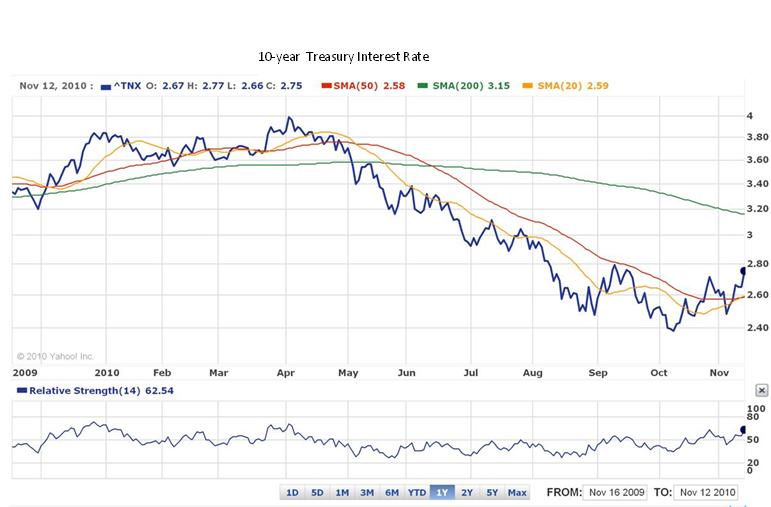
We’ve posted several pieces on the Treasury market about the bond’s positive technicals versus poor fundamentals.   The 10-year rate is now close to  piercing through key resistance at 2.83 percent.   It is difficult to fundamentally determine why rates are moving higher: 1) a change in economic fundamentals — stronger growth,  increase in inflationary expectations;  2)  sovereign credit concerns spilling into U.S. markets;  3)  reduced foreign capital flows into Treasuries;  4) Fed’s QE2  decision to focus on shorter maturities.

Probably all of the above, in our opinion.  The bullish case, stronger economic growth, should be confirmed by stronger equities and a sharp rally in the dollar.  That is,  a reversal of the weak dollar/strong equity relationship of the past year.

Nevertheless, a close above 2.85 percent would put the focus on next move to the 200-day at 3.15 percent.   Stay tuned!

Posted in Black Swan Watch, Bonds, Credit, Equities, Fiscal Policy, Monetary Policy, Sovereign Risk | Tagged , , | 2 Comments

The Golden Technicals

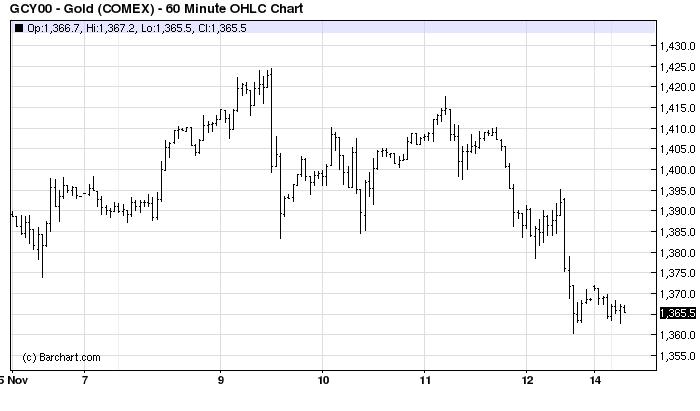
We closed out our gold position after last week’s failed bounced and ugly action. The trade is crowded and nervous about China tightening and European debt worries.  The levels we’re watching  to reopen the position is $1395 on the upside and buying down at the 50% retracement of the 13-week high at $1317, which is also the 4-week low.   Barchart.com does some great technical analysis.

Posted in Gold | Tagged , , | 2 Comments

Greenspan: High US Deficits Could Spark Bond Crisis

We are becoming more concerned that 2011 may be shaping up to be the year of the public debt crisis.  Greenspan seems to share those concerns.  The Hill writes,

“Look, I think something equivalent to what Erskine Bowles and Alan Simpson put out is going to be passed by the Congress,” he said. “The only question is, is it before or after a bond market crisis?”

Greenspan said he is “hoping that we have enough sense to realize that we’ve got to resolve this issue before it gets forced upon us.” His fear is that the long-term deficit could “spook” the bond market “to a point where long-term interest and mortgage rates move up very sharply.”

“If that happens, that will cause the double dip,” he said.

Is Greenspan moving to the European position on fiscal deficits,  believing in Ricardian Equivalence? Listen to this,

Even though there are some signals the economy is improving, Greenspan said, businesses are failing to make key investments because they are uncertain about the future. He said this is true to an extent that he has never seen before.

“The business sector is concerned is that business is highly uncertain about the future in a way which I’ve never seen it before and a way in which the data suggests has never, in fact, been so depressed,” he said.

Businesses showing an unwillingness to invest in long-term assets, according to Greenspan.

“Unlike previous recoveries when, for example, we would be getting very significant pick ups in building, residential, nonresidential, in a sense, longer-term assets, we’re not getting that today,” he said. “It’s a big hole in the economy.”

He pointed out that constructing a building, for instance, is a 20 or 30-year investment. Businesses are unlikely to begin making longer-term investments until some of the question marks disappear, according to Greenspan.

“Unless and until we can begin to lift that pall of uncertainty, it is very difficult to see people reaching out into the longer term,” he said.

One thing we think Mr. Greenspan is missing is that the “U.S. too large to bail.”  During the sovereign crises of the past thirty years, the U.S., alone, could step-up and bail-out any of the countries in trouble.

This year’s  U.S. budget deficit is larger than Canada’s GDP and would be the 9th largest economy in the world.  Stabilizing a crisis of that magnitude would be almost impossible if the market were to lose confidence.   Do you really think the Chinese, Germans, Russians, and Brazilians would put together a $500 BN rescue package for the U.S.?   

We continue to monitor the 10 and 30-year Treasury rates for market confidence.  The 10-year rate is right at an importance resistance of 2.83 percent.   This next Congressional session may be the most critical in many years.  Stay tuned!

Posted in Black Swan Watch, Bonds, Credit, Fiscal Policy, Sovereign Risk | Tagged , , , | Leave a comment

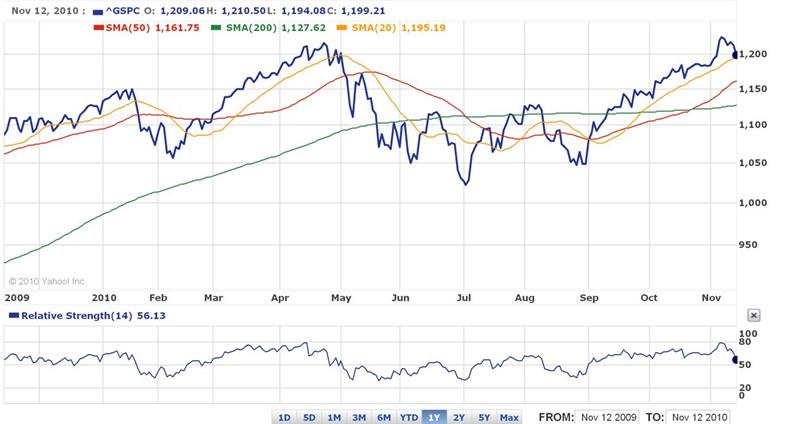
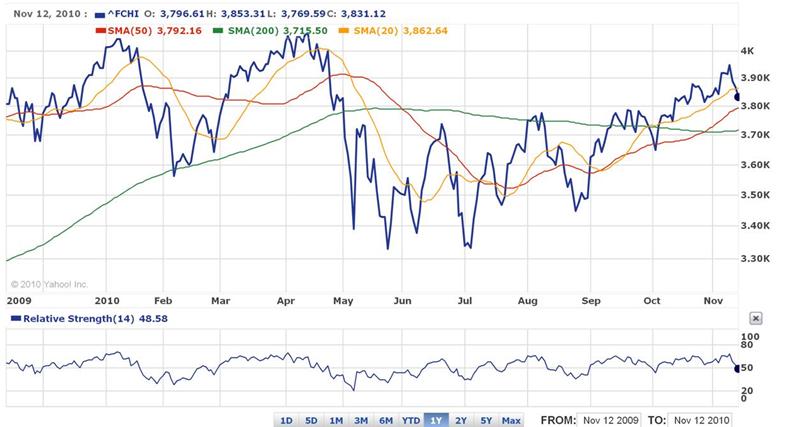
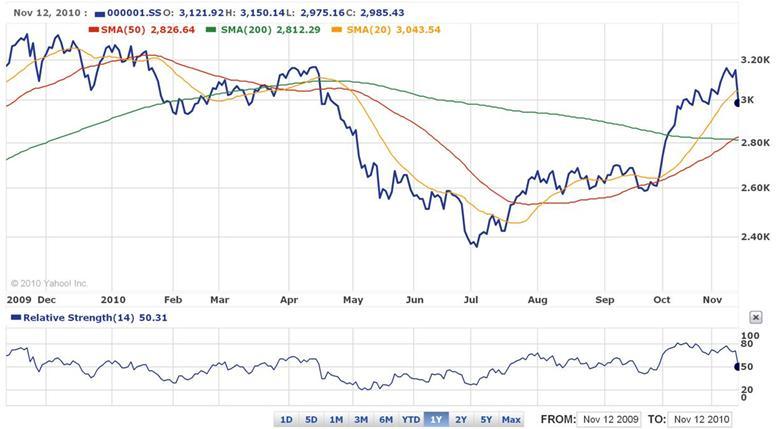
Global Equity Markets Straddle Their 20-day Moving Averages

The S&P500 bounced off 1195, its 20-day moving average on Friday to close at 1199.21, while the Shanghai composite, after rallying 23 percent since September 20, failed to hold its 20-day, closing down over 5 percent on the day.

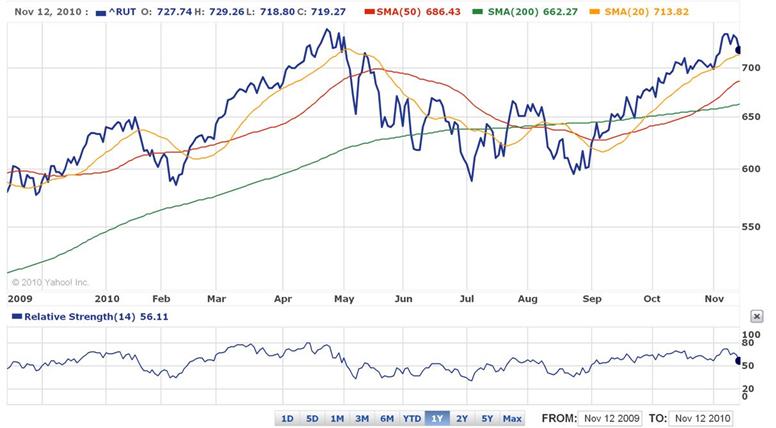
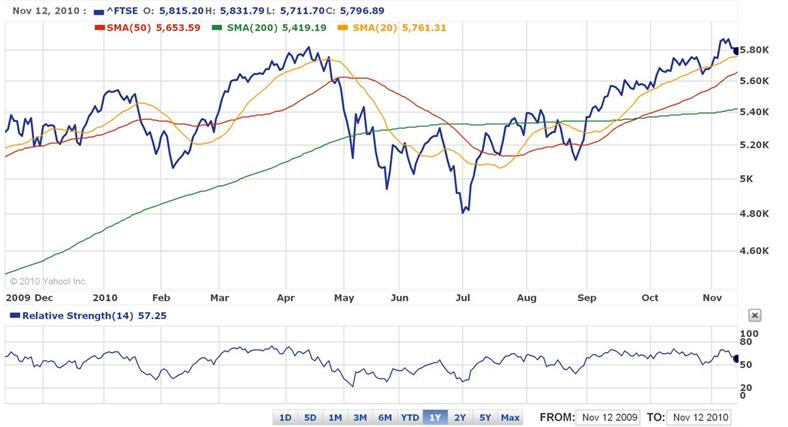
Given the strong 4Q rally in global equity markets and Friday’s sell-off, we have looked at where the major markets stand with respect to their moving averages.  The 20-day moving average is the first level of support in an uptrend, which is illustrated in several of the charts below.

The uncertainties of China tightening and European sovereign debt,  coupled with the recent rally,  makes us doubtful the 20-days will hold and will be looking to be buyers at, or around, the 50-day moving averages.   Note, Brazil, China, and France are the only markets below their 20-day.    The charts are sequenced by their rank in the table. The sixth chart, the S&P500, for example, corresponds to the sixth line in the table.

Posted in Equities | Tagged , | Leave a comment

California Creamin’ (the muni market)

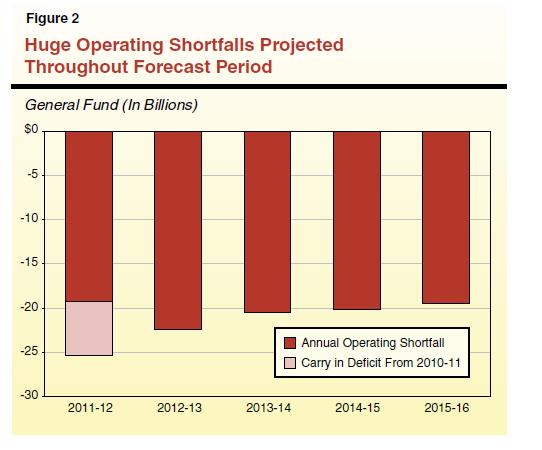
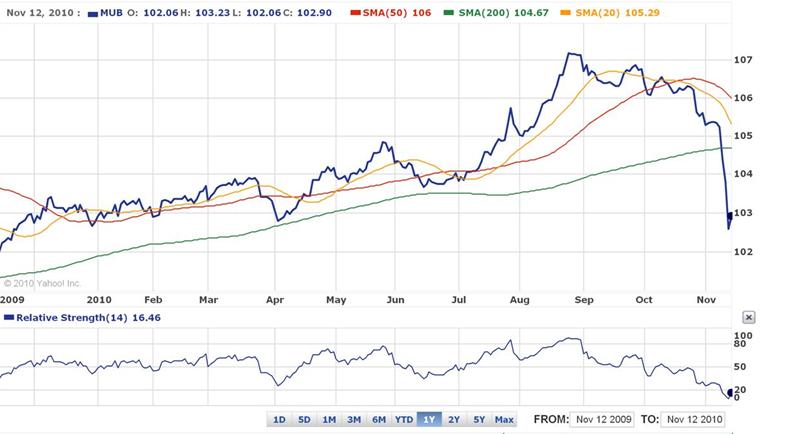
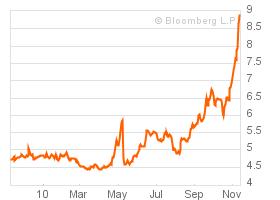
You think today was ugly in the equity market take a look at what is happening with, MUB,  the Municipal Bond EFT (see chart below).   The California Legislative Analyst’s Office released their state fiscal outlook on November 10th and projects a $100 BN cumulative shortfall for the next five years (see chart).  Governor-elect Jerry “all the leaves are ” Brown certainly has his work cut out.   The Analyst’s Office has this caveat on the projected shortfalls,

Projections Likely Understate the State’s Fiscal Woes. We believe that our projections probably understate the magnitude of the state’s fiscal problems during the forecast period. First, our forecast generally assumes no cost–of–living adjustments or inflationary increases in departmental budgets. Second, by including only current–law expenditures, our forecast does not include funding to address a number of large liabilities that pose a risk to future state finances, as discussed below.

Massive Liabilities Growing. Unfunded actuarial accrued liabilities in pension and retiree health funds for state employees, teachers, and university employees now total $136 billion. (Possible upcoming actions by the state’s two largest pension systems to lower their assumed annual rates of investment return would expand this number.) The California State Teachers’ Retirement System (CalSTRS) estimates that it needs billions of dollars more per year in contributions—not included in our forecast—to retire its unfunded liabilities within about 30 years and continue operations past the 2040s. Similarly, there are no funds assumed in our forecast to begin retiring the University of California Retirement Plan’s (UCRP) growing unfunded liabilities. State retiree health liabilities continue to grow, driving upward the associated General Fund expenditures. The Legislature took action earlier this year to modify state pension programs, providing some budget relief now and greater relief in the future. The unfunded liabilities of state retirement systems, however, loom over the state’s budget prospects. Left unaddressed in the near term, costs to service CalSTRS, UCRP, and retiree health liabilities will only grow, burdening future Californians more and more and requiring even harder decisions about taxes and services. The state should look for ways to address these problems soon, to avoid passing these huge obligations to future Californians.

California is not an isolated case as many other states are experiencing similar fiscal difficulties.   We were surprised and concerned the long-bond did not rally during today’s massive commodity sell-off and weak equity market.   Coupled, with what is happening in munis and PIIGs, it looks like “the chickens may be coming home to roost”  and 2011 could be shaping up to be a year of public debt crises. Stay tuned!

Related Articles
Super-sized pensions, and a doomsday scenario – MSNBC
Teachers’ $500 Billion (and Growing) Pension Problem – Time
Municipal Bond Market Shudders – NY Times
Calif. Market Close: Tax-Exempts Finish Weaker – Bond Buyer
Municipal Bonds Get Crushed – Bespoke

And saving the best for last……………

Posted in Bonds, News, PIIGS | Tagged , , | 1 Comment

Merkel Blinks, Irish Bonds Rally

The panic in the European periphery eased a but as Irish bonds rallied sharply after finance ministers issued a statement that current debt would not be included in burden sharing in the event of a sovereign restructuring.    The FT writes,

“We are clear that this does not apply to any outstanding debt and any programme under current instruments,” the British, French, German, Italian and Spanish finance ministers said in the statement released at the G20 summit in Seoul. Brian Lenihan, Irish finance minister, said the statement clarified “earlier ambiguities and doubts that were sown” by European leaders when they decided two weeks ago to reopen the European Union’s treaties to create a new bail-out system for future Greek-style implosions.

Angela Merkel, the German chancellor, has insisted the new system put more of a burden on private investors to pay for a future bail-out. The system would not be in place until 2013, but the markets had interpreted Ms Merkel’s hardline stance as a shift in sentiment that would force even current bondholders to take “haircuts” if Ireland or other “peripheral” EU economies needed to be rescued.

According to a European official familiar with deliberations in Seoul, the statement was put together after market turbulence led to “nervousness on the German side” that their tough stance was making Ireland’s position increasingly desperate.

Below is French Finance Minister Christine Lagarde’s interview, in which she discusses “bailing in” debt holders as opposed to bailing them out.  The interview was done on November 10th and contributed to the recent market turbulence.

Posted in Black Swan Watch, PIIGS, Sovereign Risk | Tagged , , , , , | Leave a comment

China, Commodities Slammed on Tightening Fears

Bloomberg sums it best,

The Shanghai Composite dropped 4.6 percent this week, halting a six-week rally, following government reports showing inflation is accelerating and that the government may further increase rates after boosting borrowing costs last month.

Consumer prices jumped 4.4 percent in October, the fastest pace in two years, and more than the 4 percent median forecast in a Bloomberg News survey of 28 economists, according to the statistics bureau yesterday. September prices rose 3.6 percent. The government’s full-year inflation target is 3 percent.

Rate Talk

The People’s Bank of China on Nov. 10 ordered an increase in bank reserve requirements by 50 basis points from Nov. 16, the first nationwide boost since May. Some lenders, including Bank of Communications Co., have to lift their reserve ratios by an additional 50 basis points from Nov. 15, a person with direct knowledge of the matter said yesterday.

“There’s talk of an interest-rate hike over the weekend,” said Wu Kan, a Shanghai-based fund manager at Dazhong Insurance Co., which oversees $285 million. “It’s quite possible given how inflation has accelerated.”


Posted in China, Commodities, Equities, Monetary Policy | Tagged , , , | Leave a comment

No Luck Be A Lady and The (Bad) Luck of the Irish

The Irish are caught in the middle of panicky capital flows and the loose rhetoric of European leaders.   PM Brian Cowen tried to calm markets after comments from German Chancellor Angela Merkel suggested that not all national debt should be covered under an EU bailout.  The panic increased after French Finance Minister Christine Lagarde seemed to back Merkel. The FT writes,

She acknowledged her stance had scared financial markets, which have punished Irish, Greek and Portuguese debt for two weeks. It was unfair for European taxpayers to finance rescues of debt-laden countries on their own, she said at the Group of 20 summit in Seoul,

“Let me put it quite simply: in this regard there may be a contradiction between the interests of the financial world and the interests of the political world,” Ms Merkel said. “We cannot keep constantly explaining to our voters and our citizens why the taxpayer should bear the ^Tof certain risks and not those people who have earned a lot of money from taking those risks.”

The Irish Prime Minister responded in Friday’s Irish Independent,

The Taoiseach believes that the German and French stance on the restructuring of debt caused unintended market reaction.

“It hasn’t been helpful,” he said, referring to Ms Merkel’s intervention.

“What has been said there has had, I think, an unforeseen consequence, perhaps.

“I’m not suggesting that anything was said for the purposes of causing further difficulty” he said.

However, “the consequence that the market has taken from it is to question the commitment to the repayment of debt.”

Mr Cowen said the bond markets were “behaving irrationally” and that Irish interest rates had jumped by 1pc on Wednesday for no reason.

Finance Minister Brian Lenihan also said that the bond spreads were influenced by recent “unintended” comments by “senior German figures”, which raised the possibility of sovereign defaults as part of future EU bailouts.

It’s amateur hour in Europe as Merkel & Co. don’t seem to understand the self fulfilling prophetic nature of markets.  Financial assets all about confidence in the future and the cost of restoring that confidence, as we learned in 2007-08 can be be quite expensive.  Merkel’s political concerns are understandable and we even share some of her views, but to express them in public in such a tone gives a blank check to speculators.   Maybe its personal as the Irish PM’s salary is a multiple of hers.  Nevertheless, we strongly urge that the EU consult with OECD Secretary-General, Angel Gurria, who is is the most knowledgeable person in the world on sovereign debt issues and has had years of hands on experience leading Mexico out of its debt crisis.  Buckle Up!

Posted in Black Swan Watch, News, PIIGS, Sovereign Risk | Tagged , , , | Leave a comment

The Historic 17%/50-day Rally. What’s Next for S&P500?

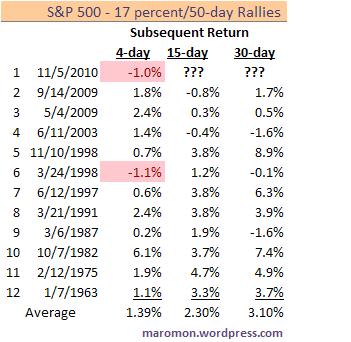
Only twelve times in the past fifty years has the S&P500 experienced a 17 percent rally in just fifty trading days with the most recent peaking on November 5th.   This surprised us as it sure didn’t feel like we were in the midst of a historic rally.   If past is prologue, the table below illustrates what to expect into year-end.

Only once, in March ’98, did the rally stop at 17 percent and was down four days later, similar to the current market.  The S&P500 subsequently traded flat for the next thirty days.  The current rally has stalled and the news from Europe makes us a bit more cautious.  The levels to watch are 1204 and 1227.   The best case is for the S&P to correct 4-5 percent from here, which will set up for a nice year-end rally.  Stay tuned!

Posted in Equities | Tagged , | Leave a comment