The Texas university system is unlike other colleges because of its oil-rich land that’s driving record revenue this year.
I have always (since my 20s) had a special spot in my heart for the University of Texas (UT) and its Longhorns. I came oh-so-close to pulling the trigger on attending graduate school in Austin, but GWU offered more money and a venue for more grandiose politics, which you know I fancy.
I am a full-on Georgia Bulldog now, as the late great CK was a very convincing evangelist, among many other good things. Go Dawgs!
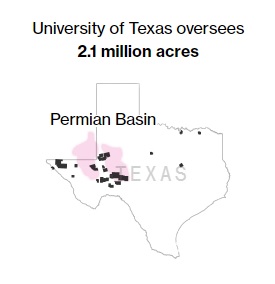
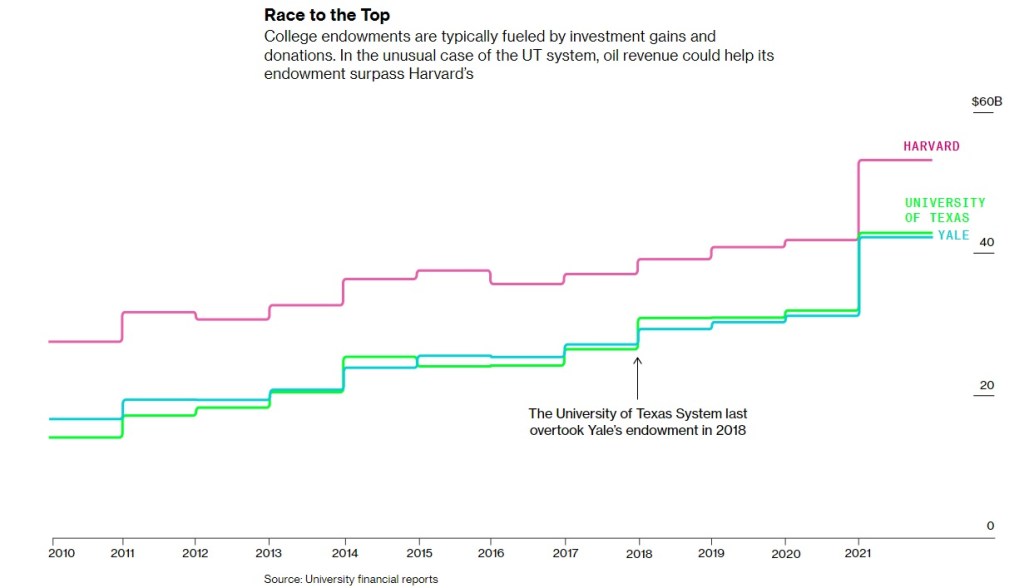
Every day, the University of Texas System makes about $6 million off a mineral-rich swath of land it manages in the US’s largest oil field. Crude and natural gas, not fundraising or investing prowess, have positioned the school’s endowment to overtake Harvard University’s as the richest in US higher education.
The University of Texas oversees 2.1 million acres—almost the size of Delaware and Rhode Island combined—in the Permian Basin. While other universities are shedding their fossil fuel holdings in the name of eco-consciousness, the Texas college system is leasing its land to drillers including ConocoPhillips, Continental Resources, Inc. and nearly 250 other operators. — Bloomberg
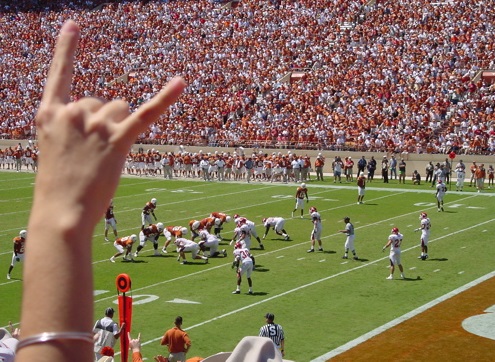
We are reposting the following more than decade-old piece as the football season is about to get underway in a few weeks. We had no idea the Rams would move back to Los Angeles five years later, soon followed by the Chargers from San Diego.
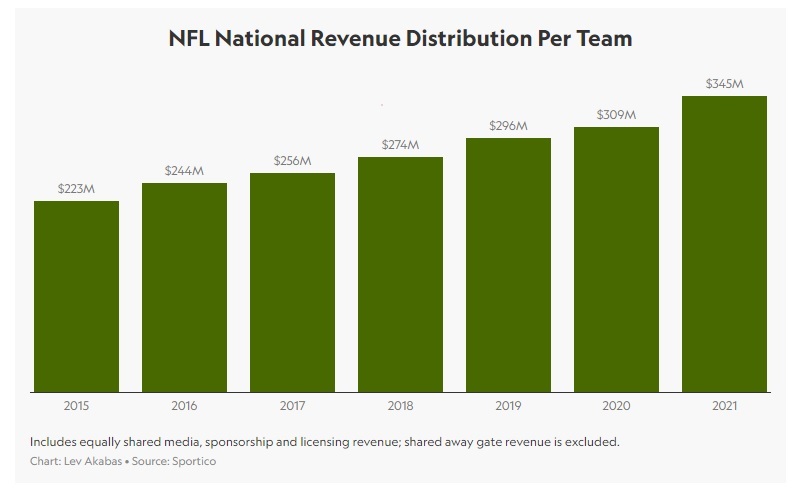
NFL teams pool their media share and divide them equally among 32 teams, which allows small market teams to compete on a more level playing field with the large market teams. Think Green Bay Packers.
That is socialism, folks. Not Soviet socialism but the same type of “socialism” the ignorant people and pols throw around so loosely like a pigskin to trigger and mislead the public and slander their opponents. Bernie Sanders would be proud of the NFL; DJT, and Ted Cruz would call it Satanic if they had a clue – about anything.
Major League Baseball (MLB)
In contrast to the NFL, the MLB is little less socialist but socialist, indeed:
Along with the TV deals, MLB teams also receive extra money through revenue sharing. Each team pools 48% of the revenue they earn, and the total amount is then split evenly (3.3% of the total) and given to each team. Teams receive more than $110 million through revenue sharing. – DodgerBlue
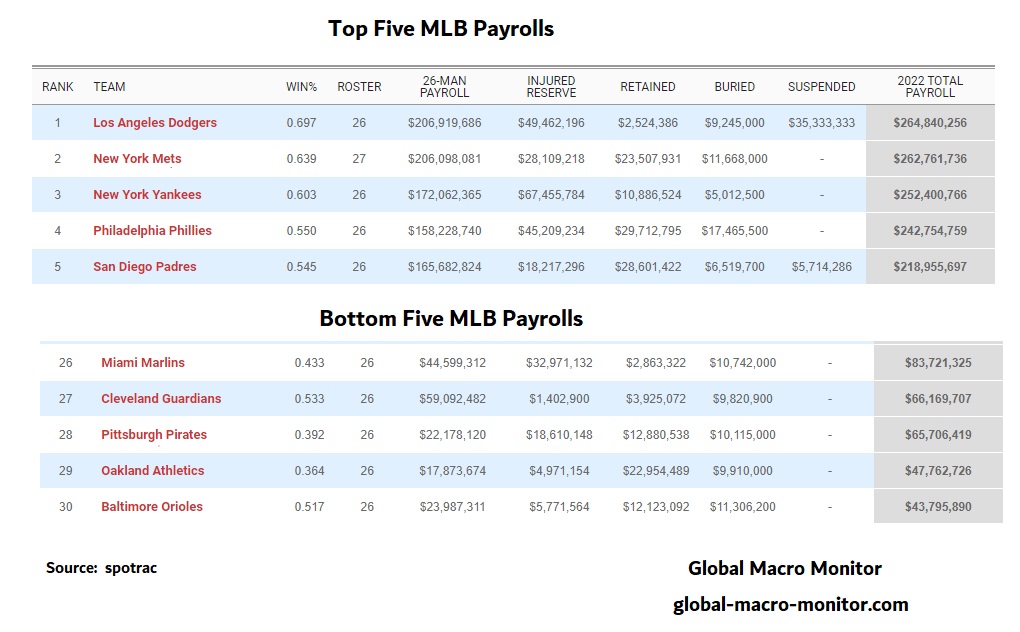
The percentage system still allows the large market teams to dominate the post-season almost, but not every year. Think New York Yankees and Los Angeles Dodgers with their massive payrolls. How ’bout a progressive percentage allocation for the bigger market teams?
Three cheers for Cleveland, who currently leads the AL Central by one game. The other four are in the celler or a step above. Money, the Guardians don’t make the World Series, however.
Golf And “Food Stamps”
Another ironic and seemingly contradictory twist in sports is the USGA golf handicap system.
Handicaps are also used as a measure of how ‘good’ a player is. Players with a ‘high’ handicap will be allowed a higher number of extra strokes over the course par. Players with a ‘low’ handicap are expected to take fewer additional strokes to get around the course. – FairwayApproach
In a sport traditionally dominated by “country club” conservative Republicans, “trying to level the playing field” among golfers would seem an abomination.
I never liked country clubs and thought of them as legalized segregation, but I did join one because of their quick play and pristine pool table-like greens. However, I do curse myself for violating my principles whenever I shank a shot. Yes, folks, I am a hypocrite.
I love this story about the late Senator Barry Goldwater, the 1964 Republican Presidential Candidate,
Arizona native Barry Goldwater once visited a golf club on the East Coast that would not allow Jewish people on its links. When he was informed that he couldn’t play the 18 holes he came for, he famously responded, “Well, my father was Jewish but my mother was Episcopalian, so can I play nine holes?” – FEE Stories
It pisses me off playing a golf match with some of my more conservative friends, who are constantly complaining how their taxes are being wasted helping the poor “who have made bad choices.” I have to give some of these bozos two strokes or “welfare” on every hole to even the playing field so they will have a better chance of winning (on a net basis).
When we approach every tee box, I ask them,
“How many food stamps do I have to give you on this hole?”
That’s the most excellent troll, especially to those “welfare queens ” who pad (cheat) their handicaps.
So, folks, next time you hear people spouting off, accusing somebody of being socialist, especially on the links, politely in a quiet and genteel voice, tell them to,
“STFU, you have no idea what you’re talking about.”
We grew up in Los Angeles watching our beloved Rams, who fled for St. Louis in 1994. The city was also a temporary home for the Oakland Raiders from 1982-94 as the Rams played their home games in Anaheim for almost 15 years. It has always been a mystery to us why Los Angeles, the second largest city in the U.S., has been without an NFL team since 1994.
In his excellent piece posted on the Globe and Mail blog, Frances Wooley, a professor at Carleton University, states it all about economics. He points out something we did not know,
The NFL, however, is egalitarian. All national revenues, such as sales of television rights, are divided 32 ways. Each NFL franchise receives an equal share. It is impossible to say how important national revenues are relative to other revenues for the league as a whole, as only one NFL team — the publicly owned, small-market Green Bay Packers — makes its financial information publicly available. In 2010, three-fifths of the Packer’s income – $157- out of $258-million – came from its 1/32 share of national revenues.
The revenue sharing system means there is little incentive for a team to move from a small to a large market. Yes, if the Vikings moved to LA, the NFL could potentially gain millions of additional Southern California viewers – and millions more in revenue. Yet the Vikings would only receive 1/32, or about 3 per cent, of that revenue. That’s not enough to offset higher stadium or property tax costs…
Interesting and helps explain why two relatively small market teams are headed to the Super Bowl and why the NFL, unlike Major League Baseball, has fewer major market Yankee-like dynasties. The piece is short, concise, and worth the read.
Not a bad primer video from CNBC on the Fed’s policy mistakes, which we all are now, literally, paying for.
I would add that monetary policy is a black box, mainly because we can’t define the money supply, much less measure it. Using your brokerage account to write checks to pay for gas and groceries, for example, shouldn’t it be counted as part of the money supply? Ditto for crypto, among others
Exogenous vs. Endogenous Money Supply
No distinction either between exogenous money (created by the Fed) and endogenous money created by the private sector. The Fed tries, and we stress, tries to control the endogenous money supply by interest rates and the exogenous money supply by its balance sheet.
Endogenous money is primarily created by leverage and is most likely easier to bring inflation down as assets deflate and credit slows.
The current inflation we are experiencing was mainly driven by exogenous money – Fed printing- and is much harder to break until quantitative tightening really begins to bite. Think middle of 2023.
So, realize, folks, if asset prices are increasing, such as stocks, with a 10 percent inflation rate, it is inflationary.
The Fed has a tiger by the tail, mainly of its own doing, by allowing monetary policy to be, in the words of my good friend, Professor Constantin Gurdgiev, “hijacked by Goldman Sachs and Black Rock.” Let’s throw in Jim Cramer just for fun.
The body politic gets it is unfair, and we see the political angst played out in today’s society.
Even a monkey will revolt against unfairness and inequality.
Money Quotes:
The two following money quotes from the vid could have been lifted straight from the Global Macro Monitor.
“If we were actually measuring inflation in a consistent manner, the peaks in the seventies and eighties are actually much more similar to the peak today than we would have initially thought.”
See our post, Today’s Inflation Rate And Nolan Ryan’s Fastball
“So I think at this point the Fed has to stick to its guns, even if that means taking speculators down. And that really is what has scared the Fed in the past. The Federal Reserve is supposed to make monetary policy in the whole of the public interest, not just that of investors. And this going to be a test of which they have not really had to take since 1981.”
We have written many posts on this issue, but see this one, in particarlur, The New “Supply-Side Economics” Fueling Asset Bubbles
We are reposting a piece from June 1, 2020 as we are very concerned about the stability of the American Street and how much of our country is slouching toward a bizarre and unprecedented form of a dangerous fascism.
[A]t least the Civil War…was about something. Compared with the bizarre ideas and half-baked wackiness that now infest American political life, the arguments between the North and the South look like a deep treatise on government.The United States now faces a different kind of violence, from people who believe in nothing—or at least, in nothing real.…all of us face random threats and unpredictable dangers from people among us who spend too much time watching television and plunging down internet rabbit holes. These people, acting individually or in small groups, will be led not by rebel generals but by narcissistic wannabe heroes, and they will be egged on by cowards and instigators who will inflame them from the safety of a television or radio studio—or from behind the shield of elected office. Occasionally, they will congeal into a mob, as they did on January 6, 2021. …I spoke with one of the original Never Trumpers over the weekend, a man who has lost friends and family because of his opposition to Trump, and he told me that one of the most unsettling things to him is that these same pro-Trump family and friends now say that they believe that Trump broke the law—but that they don’t care. They see Trump and his crusade—their crusade against evil, the drama that gives their lives meaning—as more important than the law.- The Atlantic
Originally Posted onJune 1, 2020The Conversation: When I Knew America Was In Deep Shit
In early February, I drove to San Diego to attend a trade show. I stayed overnight in the beautiful beach town of San Clemente, the home of President Richard Nixon’s Western White House.
I awoke on Super Bowl Sunday and headed down to the ocean to grab some breakfast before driving down to San Diego to pick up my good friend and colleague at the airport and to prepare to watch my 49ers give an ass-kicking to the Chiefs. Wrong!
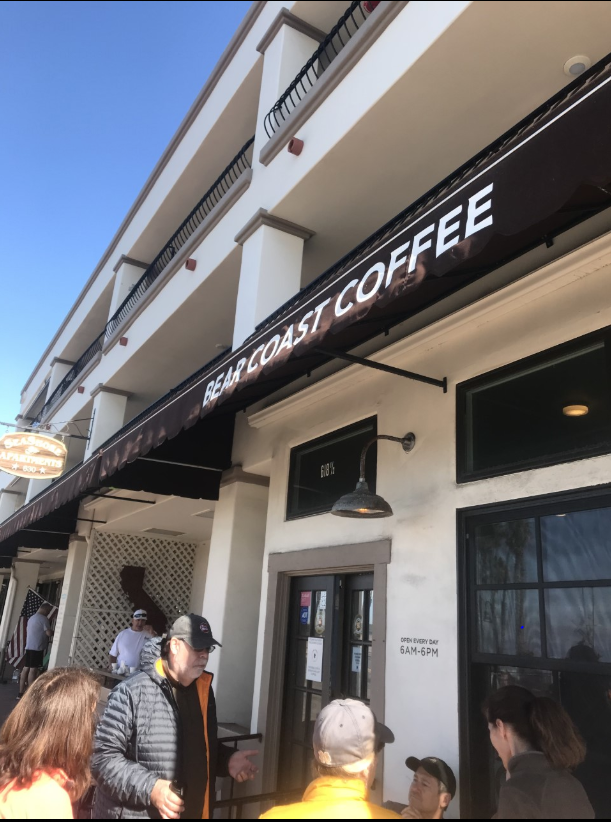
Bear Coast Coffee
I had been pretty bearish on the market at the time and thought how appropriate it was to eat at the Bear Coast Coffee. I do believe in omens, by the way. This was about two weeks before the market peaked on February 19th [and experienced it’s sharpest and quickest bear market in history, falling 35.4 percent over the next 24 trading days before a multi-trillion-dollar bailout, which was genesis of the inflation we now suffer.]
I snapped this picture and even thought about posting it while I was eating breakfast.
San Clemente, February 2, 2020
Clean & Pristine San Clemente
San Clemente wreaks of wealth (ranked 11th wealthiest city in the country), multi-million dollar ocean view homes, and I was very impressed by the clean and pristine character of the city. I thought what a great summer vacation spot for my daughter and me. Sat next to and had a great convo with a nice couple, who said their son commuted on the Amtrak to high school into Santa Ana. Great morning.
San Clemente, February 2, 2020
San Diego Convention Center
After nursing the wounds of the 49ers fourth-quarter collapse, we were about two days into the trade show when an elderly gentleman stopped in our booth and began to chat with my colleague.
Let’s call him Joe and my colleague Jim. After exchanging niceties, the conversation went something like this.
Joe:Can you believe what is happening to the world? The homeless are overrunning the country. Shitting in public. You can’t even walk in San Francisco now without stepping in human feces! Those god damn liberals can’t run anything. The homeless have even overrun my town of San Clemente. God damn it! Jim (from back east): No, haven’t really thought about or noticed it.
I found out later Joe’s net worth puts him in the Top 1 percent and couldn’t really confirm if he was a college graduate. I almost jumped in and told Joe he was full of shit and had been sniffing too much Faux News. I was primed for such a debate as I’ve had many similar Twitter debates with people making the same argument about San Francisco but have, you guessed it, never set foot in the town. Their perception was all painted by hard alt-right pundits.
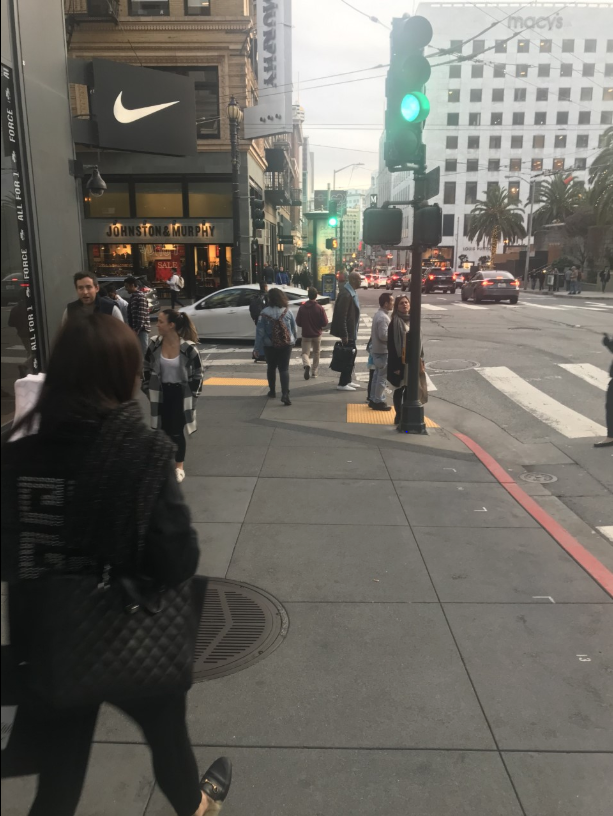
In fact, I was in San Francisco just the prior week and snapped the following picture to use in my Twitter debates. If anyone can find a human turd in the photo, I will send you $1000. The same goes for the pictures of San Clemente. No photoshopping.
San Francisco, January 2020
Of course, every city has a homeless problem and San Francisco’s is more acute than most. But the problem is not as ubiquitous as Faux News portrays.
I also wanted to wrap Joe on the knuckles with the fact that the People’s Republic of SF sports the most billionaires per capita by a factor 8x to the second-highest, NYC, and the city has the highest rents in the nation, which might help explain, in part, its homeless problem. See our post here. I bit my tongue and kept quiet.
The Bombshell
Then the convo turned very ugly.
Joe:My wife told me the other day she wanted to buy a gun. I said, “honey, why do you need a gun? I have several and we have a very good and expensive alarm system for the house. What’s up.” She told me, “I don’t want a gun for protection, I want one to shoot the liberals!”WTF?
O.M.G!
I thought WTF is wrong with this guy? I am almost certain he was 100 percent serious. The dude is not a poor uneducated cracker from some “‘Podunk’ Town In The Middle Of Nowhere” He’s a one-percenter and lives in the 11th wealthiest city in the nation.
How could this be? Didn’t he realize he could just have been easily born a crack baby in Harlem if not for being born into the Lucky Sperm Club?
Whatever happened to the noblesse obligepracticed by the likes of the Kennedy clan and George H.W. Bush, the unwritten obligation of people of means to act honorably and generously to others of lesser means?
Right then and there, I realized the country was near a very ominous tipping point.What Next?If you think the instability in the American Street is going away anytime soon, think again.
There may be an ebb and flow of calm and violence but unless the underlying issues discussed above are addressed and mitigated the country has crossed the Rubicon into failed state territory.
Trump can continue to talk tough and even send the M1 tanks into the streets but it won’t make a damn bit of difference but to make matters worse.
It’s time to get to work and begin to really address the issues at their very core, America.
All of us united, even if the goal is to save what’s left of our own personal and selfish interests. The alternative is peril.
CPI inflation hit 9.1 percent in June. The FinMedia is quick to point out it was “the highest level in more than forty years,” We doubt you will hear (at least from them) any context or the rest of the story. So here you go:
History Not On Inflation’s Side
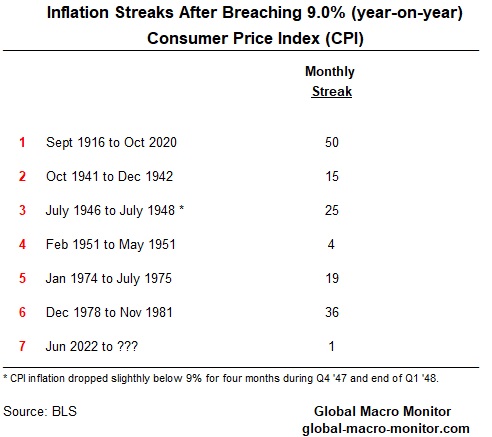
We looked at the inflation data going back to 1914, and our analysis surprised even us. Monthly annual CPI inflation has initially breached 9.0 percent only six times over the past hundred years – seven counting June 2022 (see chart above).
Once busting through the 9 percent (y/y) mark, inflation has never peaked or retreated from that level but only accelerated or stayed elevated for several consecutive months. The four-month streak during the Korean War was the shortest and is referenced by the following:
Worth Reiterating: Inflation Streaks When It Surpasses 9 Percent
Let’s repeat that. Once inflation initially breaches 9 percent, there has never been a case in the history of the data that it peaked or stopped there. This is so au contraire to the conventional wisdom of the markets that inflation has peaked, and the Fed is ready to “pivot.” Maybe “this time is different,” but we loathe those words and always make it a point to run away and fast when we hear them.
Behavior Changes As Inflation Increases
Economic agents change their behavior when inflation increases, especially as it approaches double digits. The willingness to hold cash balances diminishes, and money velocity, the inverse of money demand, increases when inflation starts to creep higher, causing more inflation. Central banks have found this feedback loop very difficult to break.
The problem is there is no clear or realistic definition of “money” and how to measure it. There is both exogenous money created by the central banks and endogenous money created by the private sector.
Inflation Is A Macro Concept
Quantity Theory Of Money
MV = PY
where, M = Money V = Velocity P = Price Level Y = Real GDP or production
Moreover, inflation, similar to the trade deficit, is a macro concept. Supply shocks don’t cause inflation unless they are monetized. Supply shocks cause relative price shifts, either temporary or permanent, and consumers and producers adjust their behavior and budgets accordingly.
Similarly, the overall trade or current account deficit is not the result of tariffs or trade policies but a macro concept:
In our recent observations, we suspect few genuinely understand the difference between changes in relative prices and inflation, even among some “so-called” economists.
Exogenous vs. Endogenous Money
We have a pretty good idea of how much “exogenous money” has increased, more than $10 trillion, or around 50%, by the major central banks, over the past few years. It is nearly impossible to quantify or measure the money, as loosely defined, that the private sector has created, which the Fed is fighting hard to control and slow by raising interest rates.
Bathtub Overfloweth
If I had to use one simple example today to explain what is going on with inflation, it would be the following picture of a bathtub overflowing:
Assume the water in the tub above is the global economy’s liquidity, which drives aggregate demand for goods and assets. It consists of the exogenous or base money created by the central banks and endogenous money created by the private markets.
My 19-year daughter, for example, recently received an offer for an $18k line of credit and was able to take out a car loan with no cosigner at a rate less than 3.0 percent.
The overflow is also the inflation now wreaking havoc in the goods & services market.
Interest Rate Hikes To Slow Endogenous Money
The Fed is trying to slow or reduce the flow of endogenous money through interest hikes. July’s massive stock and credit rally are indicators that financial conditions in the U.S. are easier than last month, even as the Fed tightens. That’s not inflation (as in going down) positive, folks.
Quantitative Tightening
The Fed plans to extract $2 trillion of exogenous money from the liquidity tub throughout 2023, which should make life interesting.
Money will get tight (the water level in the bathtub will recede) if the Fed follows through with its tough talk, but given the action of the markets over the past few months, the markets don’t believe the Fed and/or the “neutral rate” is nowhere even close.
Come on, man, a neutral funds rate at a negative 7 percent real rate? Seriously?
High inflation is a positive for nominal corporate revenues, which are showing up in the recent earning releases adding vigor and rationalizing the market rally. Monetary policy has yet to really bite.
Yeah, yeah, the yield curve inversion in a distorted bond market. Someday we will have a recession, and eventually, someday, I am going to die — the yield curve inversion is telling me so. Timing is everything.
Where is a law that states inflation can’t coexist with lower economic growth or recession? Not a bad “useful delusion” for the markets to grasp onto, however.
Old Monetary Aggregates
We view the old monetary aggregates – M1, M2, etc. – about as useless as the price of horseshoes as a leading indicator for the economy. Why isn’t my Schwab margin account counted as a deposit in the monetary aggregates? I can write checks from it.
Nevertheless, we can still glean a slight sense of what the economy is doing by looking at the old aggregates. Still, when, say, an asset class such as crypto can be created out of nothing, produce nothing, be leveraged and monetized to buy, say, Teslas, we consider that money in the true sense as it creates purchasing power. It is inflationary, by the way. In contrast, the crypto crash has been deflationary on the margin.
The recent massive rally in stocks, spread product, credit, and the growth and creation of alternative spec assets, such as crypto and NFTs, are money to us and becoming more authentic. As FinTech advances, assets become more liquid, complicated, and easier to use as collateral and leverage, understanding and making monetary policy becomes much more difficult.
Inflation “Hitting Streaks” Throughout History
The table below illustrates how and for how long inflation streaks when it blows through 9 percent. Notice all periods occurred during or near wars and/or significant supply shocks – WWI, Spanish Flu, WWII, OPEC I & II, COVID & Ukraine. This renders the deflationitas’ arguments that current inflation is a special case due to supply shocks almost laughable.
Comparable Months
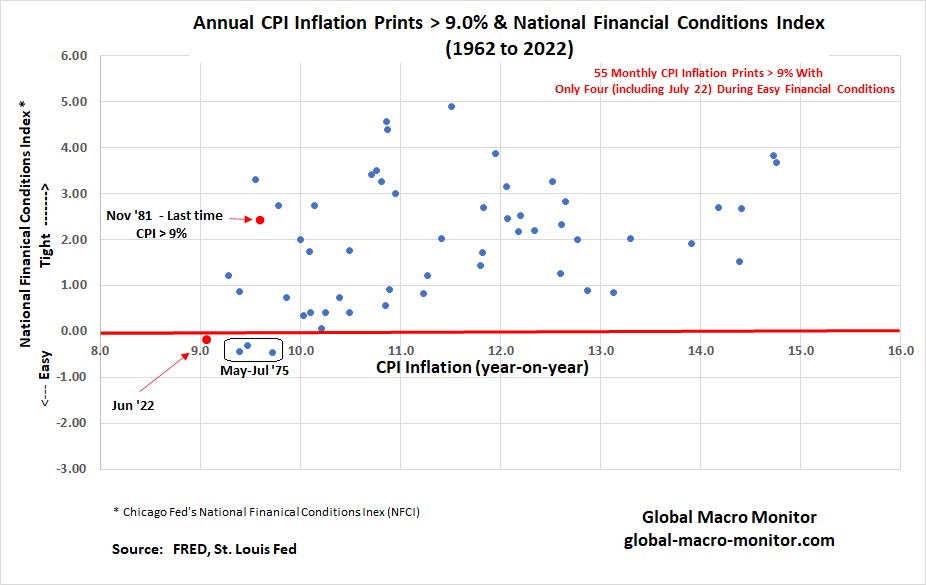
The “in the past forty years” 9 plus percent inflation print the financial media uses to compare the June 9.1 percent print occurred in November 1981, when inflation was dropping -like a stone and financial conditions in the U.S. were very tight. A more correct comparison should be the 9 percent inflation prints of 1975 when inflation exceeded 9 percent, and financial conditions were as easy as they are today.
The NFCI provides a comprehensive update on U.S. financial conditions in money markets, debt and equity markets, and the traditional and “shadow” banking systems.
Positive values of the NFCI are associated with tighter-than-average financial conditions, while negative values with looser-than-average financial conditions. The NFCI is a weighted average of a large number of variables, 105 financial indicators that can be found here,
Current Financial Conditions
Even with the Fed’s mega rate hikes since March, financial conditions are still loose in the U.S., as reflected by the red dot in the lower left corner of the scatter diagram.
Upshot
A 9 percent monthly year-on-year inflation rate with still loose financial conditions doesn’t take a genius to project the most likely trajectory for inflation over the near term. Yes, gas prices are falling but only make up less than 4 percent of the CPI basket.
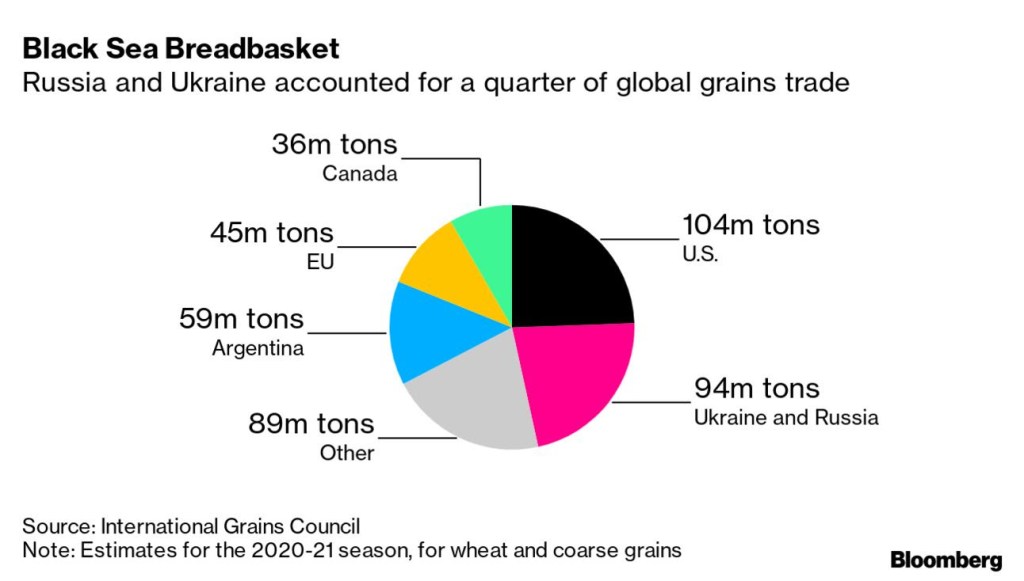
There was some rare good news out of Ukraine today when a vessel loaded with 26,000 tons of corn left the port of Odesa — the first legal shipment of grain since Russia’s invasion began in late February.
It’s a small step but potentially significant for some of the world’s poorest countries as they wrestle with soaring food prices caused in part by uncertainty over supplies of millions of tons of Ukrainian grain blocked by Russia’s assault. – Bloomberg
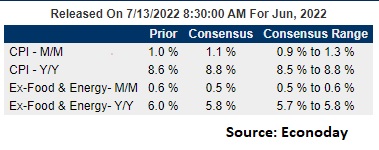
The BLS reports CPI inflation tomorrow with the expectations of the print in the above table.
We are taking the under on the overall consensus expectation of 1.1 percent and the over on the core of 0.5 percent. All based on anecdotal evidence as we see gas and avocado prices plummeting over the past few weeks and rents skyrocketing.
Housing
Nevertheless, the BLS has really painted itself in a corner with how they measure housing inflation.
We have been beating this dead horse for years, and now it has risen from the dead and will bite the BLS and the inflation figures in the arse. For the first time since its inception, the new measure of housing (OER – Owners Equivalent Rent) will be tested in a high inflation environment.
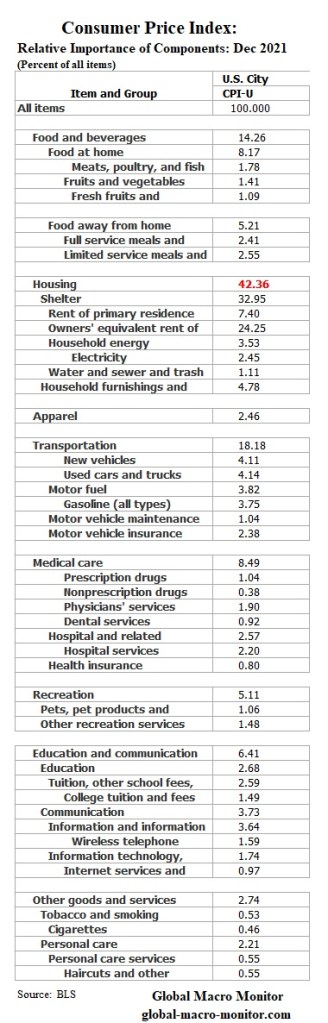
How odd is it that housing prices are softening, but a fixed-rate mortgage is up almost 100 percent in the last twelve months? Moreover, what if homeowners get the Airbnb bug and believe they can rent their homes at the Airbnb rate? That’s trouble with a capital T for the inflation figures, folks, as OER is 25 percent of the CPI basket.
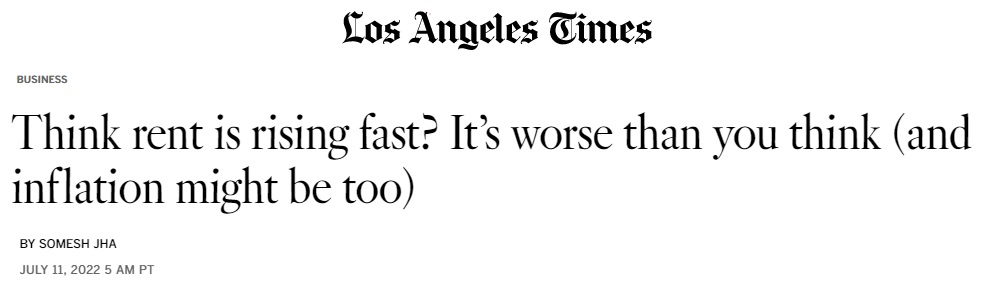
The Los Angeles Times printed a good piece yesterday, which sounded like the Global Macro Monitor.
Money Quotes:
Annual rental costs for new tenants jumped from 4.3% in July 2021 to 11.1% in March 2022. For existing tenants, inflation was lower and grew at a slower pace over that period, climbing from 1.5% to 2.7%. For residents of owner-occupied units, the trend was similar. (BLS is expected to release inflation data for June on Wednesday.)
With the spread between the new-renter and continuing-tenant rates at an all-time high, according to BLS data, that bias is even more pronounced than usual. That gives new ammunition to critics who have argued the data published by the BLS fail to reflect the severity of housing inflation, especially in states such as California, where the cost of housing is higher.
Beyond masking the extent of inflation faced by new tenants, Sohn said, the agency also distorts the market’s reality with the way it calculates the cost of housing ownership. Almost two-thirds of Americans live in homes they own.
Since 1983, BLS has approximated the rental value of owner-occupied homes by measuring the rent paid by tenants in the same vicinity. This is then translated into a rent equivalent.
“To me, the owner-occupied rent is somewhat a wild guess in the official data,” Sohn said. “If I were to rent my own house to myself right now when the price rise is really high, I would be paying much more than what an apartment rent would charge but the BLS wouldn’t reflect that necessarily.
”This data is evidence that rents are going up very fast, faster than they have been, for new tenants after a long period of slower price growth,” said David Wessel, director of the Brookings Institution’s Hutchins Center on Fiscal and Monetary Policy.
Past trends suggest it’s only a matter of time before the higher inflation rate spills over into renewals as well, he said. – LA Times
The Heavy Weight Of Housing In The CPI
Housing is 42 percent of the CPI basket and overshadows all else. Nothing comes close in terms of its importance. See our early May post, CPI Inflation’s Big Problem: Housing.
This will be a big headache breaking the feedback loop for the policymakers. We wouldn’t be surprised if they start tinkering with the basket again.
The Fed made their inflationary bed, and now they have to sleep in it. And we all suffer…well most of us.
Watch Jay Pow stumble over this question of why they are buying $40 billion a month in mortgages when there is a dearth of supply in housing.



 Clean & Pristine San Clemente
San Clemente wreaks of wealth (
Clean & Pristine San Clemente
San Clemente wreaks of wealth (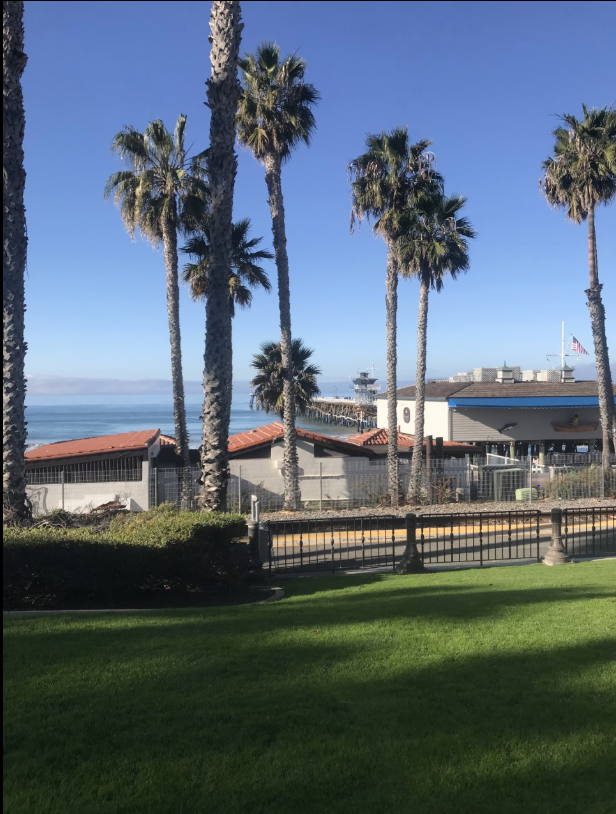
 San Diego Convention Center
After nursing the wounds of the 49ers fourth-quarter collapse, we were about two days into the trade show when an elderly gentleman stopped in our booth and began to chat with my colleague.
Let’s call him Joe and my colleague Jim. After exchanging niceties, the conversation went something like this.
Joe: Can you believe what is happening to the world? The homeless are overrunning the country. Shitting in public. You can’t even walk in San Francisco now without stepping in human feces! Those god damn liberals can’t run anything. The homeless have even overrun my town of San Clemente. God damn it!
Jim (from back east): No, haven’t really thought about or noticed it.
I found out later Joe’s net worth puts him in the Top 1 percent and couldn’t really confirm if he was a college graduate. I almost jumped in and told Joe he was full of shit and had been sniffing too much Faux News. I was primed for such a debate as I’ve had many similar Twitter debates with people making the same argument about San Francisco but have, you guessed it, never set foot in the town. Their perception was all painted by hard alt-right pundits.
In fact, I was in San Francisco just the prior week and snapped the following picture to use in my Twitter debates. If anyone can find a human turd in the photo, I will send you $1000. The same goes for the pictures of San Clemente. No photoshopping.
San Diego Convention Center
After nursing the wounds of the 49ers fourth-quarter collapse, we were about two days into the trade show when an elderly gentleman stopped in our booth and began to chat with my colleague.
Let’s call him Joe and my colleague Jim. After exchanging niceties, the conversation went something like this.
Joe: Can you believe what is happening to the world? The homeless are overrunning the country. Shitting in public. You can’t even walk in San Francisco now without stepping in human feces! Those god damn liberals can’t run anything. The homeless have even overrun my town of San Clemente. God damn it!
Jim (from back east): No, haven’t really thought about or noticed it.
I found out later Joe’s net worth puts him in the Top 1 percent and couldn’t really confirm if he was a college graduate. I almost jumped in and told Joe he was full of shit and had been sniffing too much Faux News. I was primed for such a debate as I’ve had many similar Twitter debates with people making the same argument about San Francisco but have, you guessed it, never set foot in the town. Their perception was all painted by hard alt-right pundits.
In fact, I was in San Francisco just the prior week and snapped the following picture to use in my Twitter debates. If anyone can find a human turd in the photo, I will send you $1000. The same goes for the pictures of San Clemente. No photoshopping.
 Of course, every city has a homeless problem and San Francisco’s is more acute than most. But the problem is not as ubiquitous as Faux News portrays.
I also wanted to wrap Joe on the knuckles with the fact that the People’s Republic of SF sports the most billionaires per capita by a factor 8x to the second-highest, NYC, and the city has the highest rents in the nation, which might help explain, in part, its homeless problem. See our post
Of course, every city has a homeless problem and San Francisco’s is more acute than most. But the problem is not as ubiquitous as Faux News portrays.
I also wanted to wrap Joe on the knuckles with the fact that the People’s Republic of SF sports the most billionaires per capita by a factor 8x to the second-highest, NYC, and the city has the highest rents in the nation, which might help explain, in part, its homeless problem. See our post 




 Global Macro Monitor
