No bottom in stocks or the economy until the test kits are ubiquitous. We believe markets want an aggressive plan and action to treat the disease rather than focusing on the symptoms. Then markets will take care of themselves and find their appropriate levels.
WTF? Where Are The Test Kits?
True story. A family member receives a text on the way to work this morning that her boss has a fever of 102 degrees with a diagnosis that she “ticked all the boxes for COVID-19.” They couldn’t test her because they didn’t have the test kits and she was put in quarantine for two weeks.
The Fed Steps Up
By the way, this is from our Sunday night post, What Every Market Player Should Now Be Contemplating,
Can the U.S. government finance its $1.2 trillion plus annual deficits with an entire yield curve at less than 1 percent?
We seriously doubt it and the Fed is going to have to step-up big time with QE, non-QE, or let’s just call it for what it is, monetization.
These yields are distorted and not true market rates, and now have become Airbnb rentals driven by haven flows, the MoMo crowd and ‘bots, and a proxy for stock shorts.
Long-term investors? Think rent control distortions. We will be closely monitoring the monthly auctions for real demand. – GMM, March 8th

No Trillion Dollar Issuance At “Fake Yields”
After two shitty bond auctions this week showing tepid demand, bid/offer spreads blowing out in Treasury securities, and the 10-year yield spiking from 0.39 percent to 0.85 percent, the Fed steps up big time today.

The Federal Reserve Bank of New York will start adding fresh capital to money markets on Thursday to pad against coronavirus risks and ease stresses on the Treasury-bill market.
The extraordinary funding measure first involves a $500 billion injection at 1:30 p.m. ET on Thursday, the bank said. The cash will be added to money markets through a three-month market repurchase agreement, or repo operation.
One-month and three-month repos for $500 billion each will be conducted on Friday and continue to be offered weekly through the calendar month, the bank added. – Market Insider
The term “capital” is a bit misleading, in our opinion.
Upshot
Marginal buyers, such as haven flows, momentum algos, and stock shorts using bonds as a proxy, who determine the price or bond yield on your screens, can set rates at zero or below. But that is not a price or yield where $1 trillion-plus of new securities can be issued or where the market can liquidate an enormous position.
Just think of the S&P500 level at the peak of 3393-ish. Marginal buyers drove the price there — irrationally in our view — and we all marked our positions and investments at that level but, in reality, it was not a level where all could liquidate.
Stay tuned as we are working on a more in-depth piece on this very important subject. We suspect all the distortions created by monetary policy and government intervention to prop up markets are coming home to roost at the worst time possible.
Marginal buyers set prices. Make sure you know who are the marginal buyers.
Washinton state lays out the next potential steps ” as its public-health officials are “at the ready” to order involuntary isolation and quarantines and are considering cancellation of major public events.

Patty Hayes, director of Public Health — Seattle & King County, outlined potential next steps in the area’s effort to slow the spread of the virus at a Seattle City Council meeting and said officials are talking about what to do.
Hayes shared a Washington State Department of Health chart that listed five levels of actions that officials could take. Gov. Jay Inslee hinted at the ongoing discussions Sunday on the CBS show “Face the Nation,” saying the state’s response could involve “reducing the number of social activities that are going on.”
Although King County’s first confirmed COVID-19 case was announced less than two weeks ago, the area’s response already has ratcheted through Level 1 and Level 2. — Seatlle Times
Nobody knows the exact path of the current crisis or how and when it ends but it will end. This too shall pass.
The S&P futures contract has turned up after President Trump’s press conference, which he laid out an economic relief plan, including payroll tax cuts.
The contract has moved in almost a 100 point range or 3.5 percent in the 90 minutes it has been trading.
The market is very oversold and a bounce is natural. We believe the S&P500 moves lower over the next few months, however, until we get a better handle on the coronavirus crisis.

Big moves on PredictIt in the past week and starting to price a Blue Wave in the November election.
The Democratic House & Senate contract is up almost 70 percent since March 1 after Montana Gov. Steve Bullock (D) put the state’s Senate seat in play
These contracts are volatile and fairly illiquid. We look at trends as a signal and not spot prices.
These markets really nailed the resurrection of Joe Biden last Super Tuesday. See our piece, Biden Rocks, Bernie Flops In Prediction Markets, which we posted last Monday.

Democratic VEEP
In your case your wondering, here are what the markets are predicting who gets the nod for the V.P. on the Democratic ticket.

Can the U.S. government finance its $1.2 trillion plus annual deficits with an entire yield curve at less than 1 percent?
We seriously doubt it and the Fed is going to have to step-up big time with QE, non-QE, or let’s just call it for what it is, monetization.
These yields are distorted and not true market rates, and now have become Airbnb rentals driven by haven flows, the MoMo crowd and ‘bots, and a proxy for stock shorts.
Long-term investors? Think rent control distortions. We will be closely monitoring the monthly auctions for real demand.
The dollar? Yikes!
One branch of the federal government tells us to buy the dip as the coronavirus is contained and is a hoax hyped by the Democrats while another branch is considering measures to protect itself, including shutting down. Not exactly a positive to turn market sentiment.
We have crossed the tipping point from denial to panic, folks.
By the way, in case you missed it, Senator Ted Cruz is in self-quarantine after interacting with a coronavirus patient at CPAC.
Everybody panic! It’s just like the Titanic but its full of bears! – Jackie Moon
The global markets are having their first real Jackie Moon moment of this downturn. We suspect many more to come.
What happens when they realize that the monetary policy transmission mechanism to stocks has mainly been a placebo effect? Monetary policy is much more of a black box than the market geniuses realize, in our opinion.

Will the Fed follow the Bank of Japan and start making outright purchases of stocks to prop up the market?

Analysts and investors in Tokyo have begun to question whether the programme, started in 2010 as a way to prop up the market in the wake of the financial crisis, still serves much purpose. The central bank now owns 80 percent of the domestic exchange-traded fund market, fanning fears that its grip over prices has become too strong. – FT, Nov ’19
Here are a few clues and a potential roadmap,
“We should allow the central bank to purchase a broader range of securities or assets,” Rosengren [FRB Boston president] said in a speech Friday in New York. “Such a policy, however, would require a change in the Federal Reserve Act.”
U.S. law currently limits Fed purchases to “any obligation which is a direct obligation of, or fully guaranteed as to principal and interest by, any agency of the United States.” That translates to buying U.S. government and agency debt and mortgages issued by federal housing agencies.
The Fed has traditionally maintained a strong internal resistance to expanding its purchases beyond Treasury securities because such activities are essentially credit allocation and leave the central bank vulnerable to criticism of favoritism if it’s investing in the bonds or stocks of specific companies.
“New deal progressives are not going to tolerate this unless the unemployment rate has risen sharply,” said Mark Spindel, a co-author of a book about Congress and the Fed. — Bloomberg, March 6th
Top 10 percent Own 88 percent of Corporate Equities
Good luck changing the Federal Reserve Act in the current populist moment that we find ourselves. Remember, folks, 88.1 percent of all corporate equities and mutual funds are held by just the Top 10 percent of households.
Nikkei’s Gruesome 30-year Bear Market
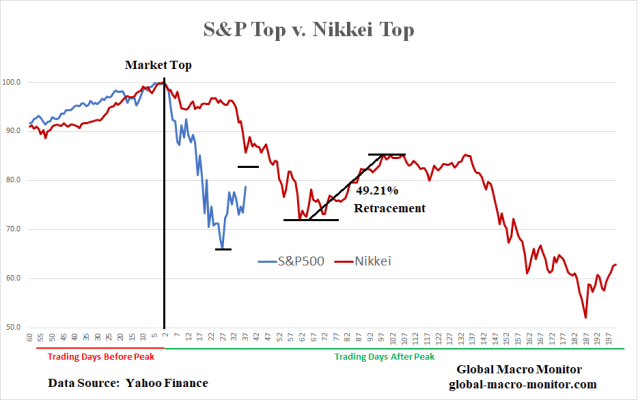
By the way, even with the Bank of Japan’s direct intervention in the stock market, 20 years of zero interest rates, massive fiscal stimulus, and quantitative easing, the Nikkei is still 50 percent below its December 29, 1989 high.
President Reagan On The ’87 Stock Market Crash
We are reposting this piece. History rhymes. The U.S. was in the midst of conflict with Iran during the 1987 crash as we are today.
The Fed tried to stem the selling today and who knows what would have happened if they didn’t step up.
Originally Posted on April 21, 2018
President Reagan certainly understood the nature of markets.
That is they do whatever they are going to do, sometimes without a fundamental rhyme or reason. Very different from the current occupant of the White House who seems to think every uptick in the S&P is all about him, and he is not afraid to take credit for the upside and tweet about it.
Before going to President Reagan’s comments about the October 19, 1987 stock market crash, we first review some data, which lends light on the 1987 crash.
The S&P500 had just completed a massive run from September 1985 before peaking on August 25, 1987, moving up almost 87 percent in less than two years. That qualifies as a bubble in our view.
Yuuuge Decline In Interest Rates
Much of the move was attributed to a sharp drop in interest rates.
The 10-year Treasury yield fell almost 350 bps in less than a year before making a local bottom in September 1986. Interest rates then began to move sharply higher, utterly roundtripping almost the entire move by the day of the crash.
The 10-year yield had risen 300 bps year-to-date on October 16th, closing back above 10 percent, increasing almost 150 bps just since the S&P peaked on August 25th.
The S&P500 was already down 16.33 percent from its high before crashing on October 19th. Markets rarely fall out of the sky and usually signal something big is coming by a sharp rise in volatility. Think of a Richter scale before a volcano blows.
This is why we take the early February volatility shock seriously and a signal of regime change, and give a much higher probability for a potential major price reversal than most in the market are anticipating.
Finally, the S&P500 fell 23.43 percent from the October 16th Friday close to the intraday low on Tuesday before a mysterious buyer stepped into to the Major Market Index futures contract at 12:38 p.m, setting the stage for one of the most powerful rallies in history.
We believe the 1987 stock market crash was an accident waiting to happen due mainly to a toxic cocktail of a severely overbought market and rising interest rates. All that was needed was a buyers strike coupled with some catalysts or reasons to bail and take profits. The same reasons may or may not have mattered if not for such a toxic cocktail.
Given the nature of the New Economy, we seriously doubt the government will allow such a similar short-term crash, say, 15-25 percent, to occur again. We now have no doubt the Fed will step up and announce they will do whatever it takes and become the buyer of last resort to keep the market from melting down in one or two days.
Why? Because it would be the end of the world and they surely know it.
The thought of the Fed directly purchasing stocks as the Bank of Japan now does contradicts everything Larry Kudlow’s dictum, “free market capitalism is the best path to prosperity” stands for.
Privatizing profits and socializing major Wall Street losses are now forever institutionalized especially given the structure of our asset driven global economy. The “Powell put” may now have a little lower strike price than many traders would like but it is absolutely still in place. No doubt about it.
Oy veh! Sorry deflationistas.
Iran Again
By the way, the U.S. was also in the midst of a conflict with Iran in October 1987.
President Reagan’s Comments
Now to President Reagan.
Asked after the close if the stock market crash was his fault, the President delivers the ultimate money quote, in our book:
Profound. We can learn from the Gipper to refrain from trying to explain or attribute daily stock market moves to certain factors. Any one of the catalysts we deem moved the market in a certain direction on a given day could have moved it 180 degrees the other way with a different set of technical conditions.
Reagan truly understood market noise.
Full Transcript Of October 19, 1987 Informal Exchange With The Press
Here is the full transcript with reporters that day, October 19, 1987.